Key takeaways
- For solo writers, bloggers, and freelancers, a $20/month plan on Claude or ChatGPT covers almost everything. Jasper rarely pays for itself at that scale.
- Claude is the pick when prose quality and long documents matter most. ChatGPT is the pick when writing is one task among research, images, and analysis.
- Jasper earns its premium when several writers need to sound like one brand, and when your work is the same marketing formats repeated at volume.
- Most Jasper-style tools run on the same OpenAI and Anthropic models you can access directly, so you are paying for the layer on top: brand voice, templates, workflows, and team controls.
- Verify prices on the vendor pages before buying. Jasper's and ChatGPT's dollar figures vary by source and change often.
The real question: model or wrapper?
Most comparisons of these three tools treat them as three rivals. They are not. ChatGPT and Claude are the models and the apps. Jasper is a marketing platform that sits on top of models like them.
One review (LumiChats, April 2026) makes the point bluntly: nearly every dedicated writing tool calls OpenAI or Anthropic APIs underneath. What you buy from Jasper is the layer: brand voice memory, templates, agents, team features. That layer is valuable in some situations and a waste of money in others.
So the useful question is not "which writes best?" It is "does the wrapper do something I can't get with a good prompt and a saved project in the base model?"
For one person, usually no. For a team of five trying to keep tone consistent, often yes.
Quick comparison
| Claude | ChatGPT | Jasper | |
|---|---|---|---|
| Type | General assistant | General assistant | Marketing-specific platform |
| Entry price | Free; Pro $20/mo monthly or $17/mo annual | Free, Go, and Plus tiers (confirm dollar prices on the pricing page) | Third-party sources cite roughly $59 to $69 per seat/month; confirm on Jasper's page |
| Strongest at | Natural long-form prose, large documents | All-round drafting, research, images, voice | Brand voice and repeatable campaign work at scale |
| Brand consistency | Projects with reference documents | Projects, custom GPTs | Brand Voice, Style Guide, Knowledge base built in |
| Best for | Writers, bloggers, editors | Mixed workloads | Marketing teams of 3+ writers |
Claude: the writer's default
Claude keeps coming up in 2026 roundups as the model with the most natural prose. The SaaS Library's August 2026 comparison names it the best writing tool tested at $20/month, and a long Quora thread says roughly the same thing: if ChatGPT sounds robotic to you, try Claude. That is anecdote plus a few reviewers, not a controlled test, but the pattern is consistent enough to take seriously.
Claude pricing, per Anthropic's own page:
- Free: limited usage that resets every 5 hours and weekly, with web search, file creation, Artifacts, and up to 5 Projects.
- Pro: $20 billed monthly or $17/month on the annual plan. More usage, unlimited Projects, Research, and Claude in Chrome.
- Max at $100/month and Ultra at $200/month for heavy use.
- Team: $20/seat/month annually or $25 monthly, with SSO and central billing.
The feature that matters most for writers is Projects. You load style guides, past articles, and reference material once and write against them repeatedly. That gets you a surprising share of what Jasper's Brand Voice does, minus the enforcement. Context windows go up to 1M tokens depending on the model, which helps when you are editing a whole ebook or synthesizing a stack of source documents.
Where it falls short: no built-in workflow for publishing, no SEO scoring, and no guardrail that stops a junior writer from drifting off-brand. Individual plans also default to opt-out for model training, which matters if you paste client material into it. Team and Enterprise plans do not train on your content by default.
ChatGPT: the broadest toolset
ChatGPT is the one you pick when writing is a slice of your day. One afternoon it is a blog draft, then a spreadsheet analysis, then a quick image, then a research summary. The Coursiv comparison puts it well: it handles everything from email drafts to code debugging to research reports.
OpenAI's pricing page now lists Free, Go, Plus, Pro, and Business/Enterprise. Plus adds advanced reasoning, Projects, scheduled tasks, custom GPTs, expanded deep research, and Codex. Pro adds heavier usage tiers, unlimited image creation, and maximum memory. The Go tier may include ads. I could not confirm current dollar amounts for these tiers from the page, so check before you budget. The commonly cited Plus price is $20/month.
What I like: deep research is genuinely useful for the pre-writing phase, and custom GPTs let you package a repeatable writing workflow. What bugs me: nothing is built to keep brand voice consistent across people, and results swing a lot depending on how well you prompt. Coursiv's own review lists exactly those two gaps.
Jasper: the specialist
Jasper calls itself the AI purpose-built for marketing. Its pricing page lists Pro and Business plans and a 7-day free trial, though the dollar amounts did not render when I checked. Third-party reviews cite $59/seat/month on annual billing (LumiChats, The Day Current) and $69/month for a single seat (Coursiv). Treat those as approximate and confirm on the live page.
What the extra money buys:
- Brand IQ, Brand Voice, Style Guide, and Visual Guidelines, so output follows your rules instead of whatever the prompt says that day.
- A Knowledge base and Product IQ that feed company facts into drafts.
- 100+ purpose-built agents, per Coursiv, for campaign formats and workflows.
- Newer additions: agents for GEO, research, and translation, and a GEO and AI Optimization product that monitors AI citation rates.
There is a history here worth knowing. LumiChats claims Jasper's revenue fell from $120 million in 2023 to $55 million in 2024, and reads that as customers doing the math against $20 chatbots. I'd treat that figure as one reviewer's claim, not an audited fact. The direction of the argument still holds: for individuals, the premium is hard to justify.
Side by side: where each one wins
| You are... | Best fit | Why |
|---|---|---|
| A solo blogger or freelance writer | Claude Pro | Best prose per dollar, Projects for your own voice |
| A founder writing a bit of everything | ChatGPT Plus | Research, images, and drafting in one place |
| An editor working with long documents | Claude | Large context window, strong at reading and rewriting |
| A marketing team of 3 to 5 writers | Jasper, or Claude Team with shared Projects | Brand voice enforcement vs. a cheaper DIY version |
| An agency producing the same formats daily | Jasper | Templates, agents, and guardrails pay off at volume |
| A fiction writer | Neither; look at Sudowrite or similar | Built for narrative |
The SaaS Library's rule of thumb is that Jasper only pays for itself once three or more writers need brand-voice consistency. That matches my sense of it. Below that, you can write a good style document and save it in a Project.
A cheaper way to fake a specialist
Before you spend $59 or more per seat, try building the wrapper yourself. It takes an afternoon.
- Collect 5 to 10 pieces of your best published work and a one-page style guide: tone, banned phrases, formatting habits, how you handle claims.
- Load them into a Claude Project or a ChatGPT Project (or a custom GPT).
- Write a standing instruction: audience, reading level, structure, and what a good first draft looks like.
- Run the same brief five times and compare. If the output is consistent enough that an editor can fix it in 15 minutes, you don't need a wrapper.
- If three different people get three different results from the same setup, that is when Jasper's enforced Brand Voice starts to make sense.
Teams that want automation on top can chain a model into a workflow tool such as Zapier or n8n, which gets you scheduled briefs, review steps, and CMS handoffs without buying a marketing suite.

What none of them solve: SEO and AI search
All three can produce a clean draft. None of them tells you whether the draft will rank or get cited. That is a separate job.
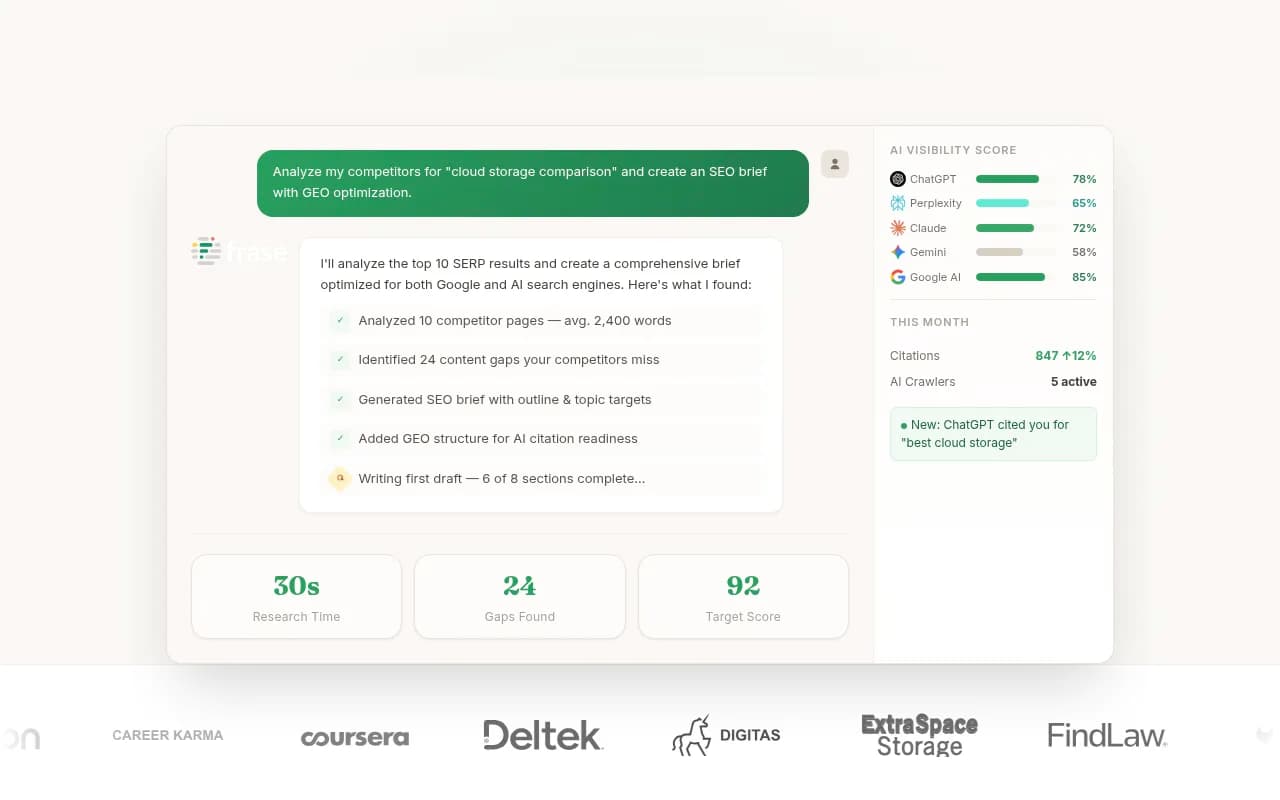
For classic search, optimization tools like Surfer SEO, Clearscope, and Frase score drafts against what already ranks. Writers often draft in Claude or ChatGPT and then run the result through one of these.
For AI search, the question is different: which prompts is your brand missing from, and which pages get cited? Promptwatch's data gives some useful context for what to write. In its report on content types, product pages were the most cited content type in ChatGPT at 22.4% of citations (Sep 28 to Oct 4, 2026), followed by landing pages and listicles. And landing pages and docs stayed cited longest, while news lost half its pages within 36 days in the July 2026 cohort Promptwatch tracked. If you are choosing what to ask your chatbot to draft, that argues for durable pages over news-style posts.
Tools like Promptwatch can show you the prompt gaps and then help produce and publish content against them, which is a job a general chatbot can't do because it has no view of what AI engines actually cite.

If you want to compare more options in that category, the GEO software directory at bestgeosoftware.com is a good place to start.
Pitfalls nobody mentions enough
I did not find independent, controlled writing-quality tests while researching this, so most of the "Claude writes better" consensus rests on reviewer preference. Run your own blind test: same brief, three outputs, have an editor rank them without knowing which is which.
A few other things to watch:
- Prices move. Both Positive Surfer and Writesonic restructured pricing in 2026, according to The SaaS Library, and Jasper's plan names have changed before. Check the live page.
- Model names change constantly. ChatGPT's page currently lists a long run of GPT-5.6 and GPT-6 variants, and Claude has its own tiers. Don't pick a tool based on a model name you read in a three-month-old review.
- Free tiers are real. Claude Free and ChatGPT Free are enough to run the test above before you commit to anything.
- Factual claims still need checking. Neither chatbot nor wrapper removes the need to verify numbers and quotes.
Verdict
Pick Claude if prose quality is what you are paid for. Pick ChatGPT if writing sits inside a messier workload of research, images, and analysis. Pick Jasper only if you manage several writers who must sound identical and your output is the same handful of marketing formats, week after week.
If you are unsure, spend a month on Claude Pro or ChatGPT Plus with a well-built Project. If the editing burden stays high because people keep going off-brand, that is your signal to trial Jasper on its 7-day free trial and measure editing time before and after. The tool that cuts review time is the one worth paying for.
For broader browsing, the software directory at surferstack.com lists more writing and content tools to compare.