Key takeaways
- Peec.ai is a capable AI visibility monitor, but teams consistently hit its ceiling on model coverage, pricing at scale, and actionability -- it shows you data but doesn't help you fix anything
- The best alternatives in 2026 go beyond monitoring: they track 8-10+ AI models, surface content gaps, and some even generate optimized content for you
- Promptwatch is the only platform in this space rated as a "Leader" across all GEO categories -- it's the one tool that completes the full loop from gap analysis to content creation to traffic attribution
- Pricing across alternatives ranges from ~$89/mo to $295/mo+, so there's a real option for every budget and team size
- If you're only monitoring, you're already behind -- the teams winning in AI search are the ones actively creating content engineered to get cited
Peec.ai had a good run as an early mover. When AI search visibility tracking was still a niche concern for a handful of forward-thinking SEOs, Peec.ai was already letting teams monitor brand presence across ChatGPT, Perplexity, and Google AI Overviews. That matters.
But it's 2026, and the market has moved. AI search is now a mainstream concern for marketing teams at companies of every size. ChatGPT Search, Google AI Mode, Claude, Grok, DeepSeek, Copilot -- the list of models your brand needs to show up in keeps growing. And the teams reporting the most frustration with Peec.ai aren't complaining about the core product. They're hitting three specific walls:
- Cost scales badly for large prompt sets
- Coverage gaps when they need data from newer or less common models
- No path from "here's what you're missing" to "here's how to fix it"
That last one is the real issue. Monitoring tells you where you stand. Optimization is what actually moves the needle.
This guide covers 10 alternatives worth considering in 2026, with honest takes on what each one does well and where it falls short.
What to look for in a Peec.ai alternative
Before jumping into the list, it's worth being clear about what separates a genuinely useful tool from one that just adds another dashboard to your stack.
The basics are table stakes: multi-engine coverage (ChatGPT, Perplexity, Gemini, Claude, Google AI Overviews at minimum), prompt-level tracking, and citation data. If a tool doesn't have those, it's not really in the same category.
What separates the good from the great in 2026:
- Prompt intelligence -- volume estimates, difficulty scores, and query fan-outs that show how one prompt branches into sub-queries
- Content gap analysis -- not just "you're not ranking here" but "here's the specific content you're missing"
- Content generation -- built-in tools to actually create the content that fills those gaps
- Traffic attribution -- connecting AI visibility to real clicks and revenue, not just impressions
- AI crawler logs -- seeing which pages AI bots are actually reading on your site
Most tools in this space do step one (monitoring). A few do step two (gap analysis). Almost none do all five.
The 10 best Peec.ai alternatives in 2026
1. Promptwatch -- best overall for teams that want to actually optimize
Promptwatch is the most complete platform in this space, and it's not particularly close. Where Peec.ai and most competitors stop at monitoring, Promptwatch is built around a three-step loop: find the gaps, create content that fills them, track the results.

The Answer Gap Analysis is the standout feature. It shows you exactly which prompts your competitors are visible for that you're not -- with the specific content your site is missing spelled out clearly. That's not a report you file away. It's a to-do list.
From there, the built-in AI writing agent generates articles, listicles, and comparisons grounded in real citation data (880M+ citations analyzed). This isn't generic content -- it's engineered around what AI models actually cite. Then page-level tracking closes the loop, showing which pages are getting cited, by which models, and how often.
The extras are genuinely useful too: AI crawler logs show which pages ChatGPT and Perplexity bots are reading on your site, Reddit and YouTube tracking surfaces discussions that influence AI recommendations, and ChatGPT Shopping tracking monitors product recommendation carousels.
Coverage spans 10 models: ChatGPT, Perplexity, Google AI Overviews, Google AI Mode, Claude, Gemini, Meta/Llama, DeepSeek, Grok, Mistral, and Copilot.
Pricing starts at $99/mo (Essential: 1 site, 50 prompts, 5 articles), $249/mo for Professional (2 sites, 150 prompts, 15 articles, crawler logs), and $579/mo for Business (5 sites, 350 prompts, 30 articles). A free trial is available.
The honest caveat: if you only need basic monitoring and have no interest in content optimization, Promptwatch has more capability than you'll use. But for any team that wants to actually improve their AI visibility rather than just measure it, it's the right tool.
2. AthenaHQ -- best for multi-engine brand monitoring
AthenaHQ covers Google AI Overviews, Perplexity, ChatGPT, and Claude with solid depth. It's built for teams that need reliable multi-engine data and competitive intelligence without a lot of setup friction.

The competitive heatmaps are genuinely useful -- you can see at a glance who's winning for which prompts across which models. Where AthenaHQ falls short is on the optimization side. It's primarily a monitoring platform, so you get good data but limited guidance on what to do with it. Pricing starts around $295/mo.
3. Profound -- best for entity-driven SEO teams
Profound has carved out a specific niche: precise AI Overview tracking with strong entity extraction and attribution mapping. If your SEO strategy is built around entity optimization and you need to understand exactly how AI models are representing your brand's topical authority, Profound is worth a look.

It's particularly strong for teams that are already thinking in terms of knowledge graphs and entity relationships. The attribution mapping helps connect specific content to specific AI citations. Starting price is around $99/mo, which makes it accessible for smaller teams.
The limitation is breadth -- Profound is deep on a specific use case but doesn't offer the full-stack optimization capabilities that more comprehensive platforms provide.
4. Scrunch AI -- best for enterprise brand narrative monitoring
Scrunch AI focuses on how AI models describe and position your brand -- not just whether you appear, but what they say about you. For enterprise teams managing brand reputation across multiple AI engines, that distinction matters.
The brand narrative analysis goes beyond citation counting to look at sentiment, descriptors, and how your brand is framed relative to competitors. It's genuinely differentiated from most monitoring tools that only track presence. The trade-off is that it's enterprise-priced and less focused on content optimization workflows.
5. Otterly.AI -- best for teams on a tight budget
Otterly.AI is the most accessible entry point in this space. It covers the core AI engines, tracks prompts and citations, and gives you a clean dashboard without a lot of complexity. For small teams or solo marketers who just need to know where they stand, it does the job.

The honest limitation: Otterly.AI is a monitoring tool. There's no content gap analysis, no content generation, no crawler logs. You'll see the data, but you'll need to figure out what to do with it yourself. That's fine for some teams. For others, it just means paying for a dashboard that tells you things are bad without helping you fix them.
6. SE Visible -- best for agencies managing multiple clients
SE Visible (from SE Ranking) sits in an interesting position: it's an AI visibility tracker built into a broader SEO platform, which means agencies can manage traditional SEO and AI visibility in one place. The competitor benchmarking and sentiment analysis are solid, and the reporting is clean enough for client-facing work.
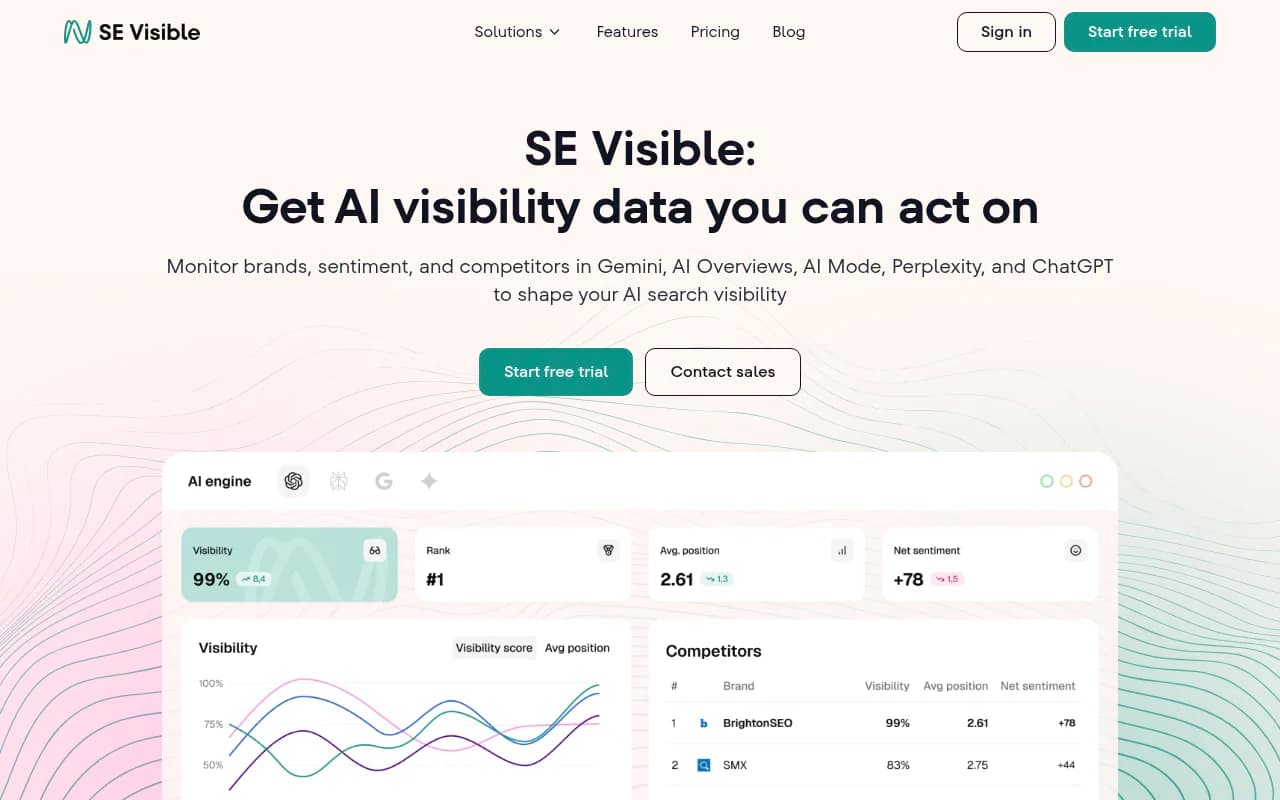
Starting at $189/mo, it's mid-range on price. The AI visibility features aren't as deep as dedicated platforms, but if you're already using SE Ranking for traditional SEO, the integration value is real.
7. Rankscale -- best for competitive AI visibility benchmarking
Rankscale is built specifically for tracking how brands rank across AI search engines relative to competitors. The competitive benchmarking is its strongest feature -- you can see share of voice trends over time and identify which competitors are gaining ground in specific AI models.
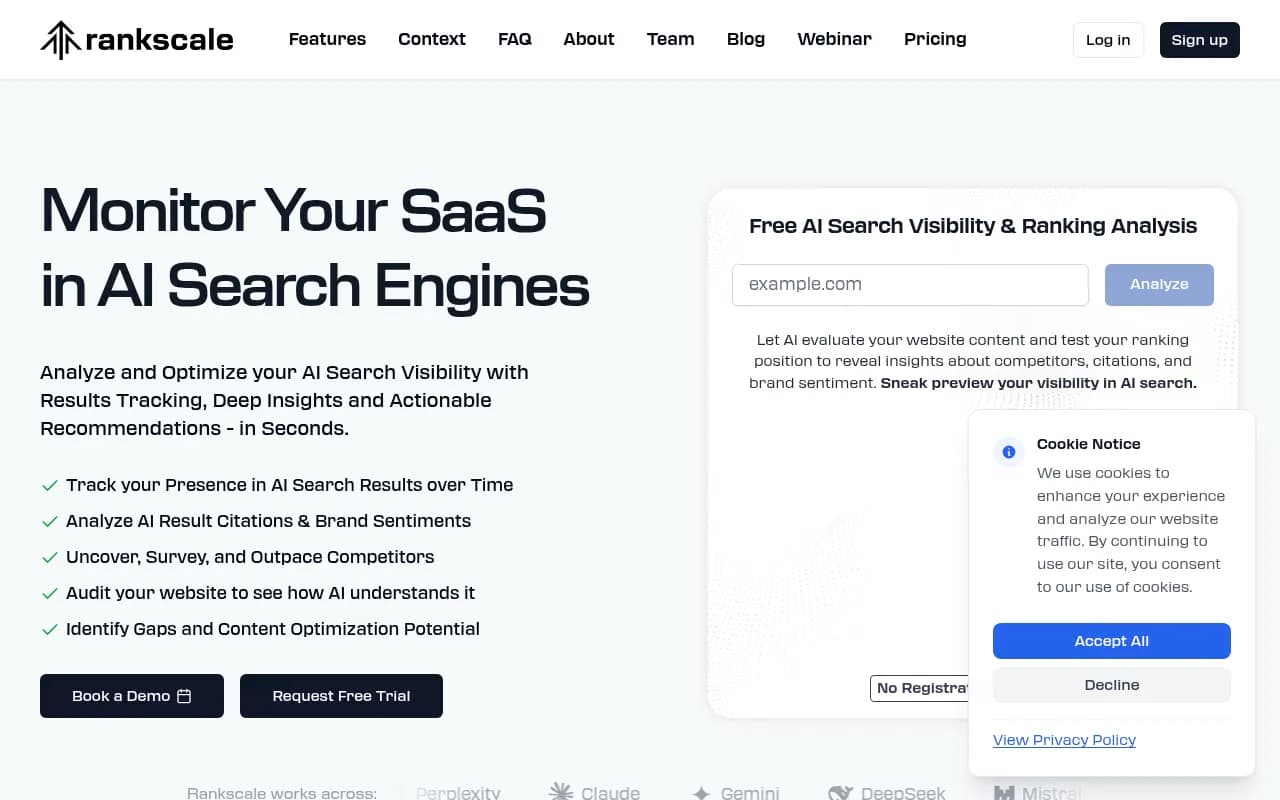
It's a focused tool that does its core job well. Like most tools in this space, it's primarily monitoring-oriented, so teams that need to move from data to action will need to supplement it with other tools or workflows.
8. LLMrefs -- best for citation and source tracking
LLMrefs takes a specific angle: tracking which sources AI models cite and how often your content (or your competitors' content) appears in those citations. If you want to understand the citation ecosystem -- which domains AI models trust, which content formats get cited, which topics you're being left out of -- LLMrefs gives you that data.
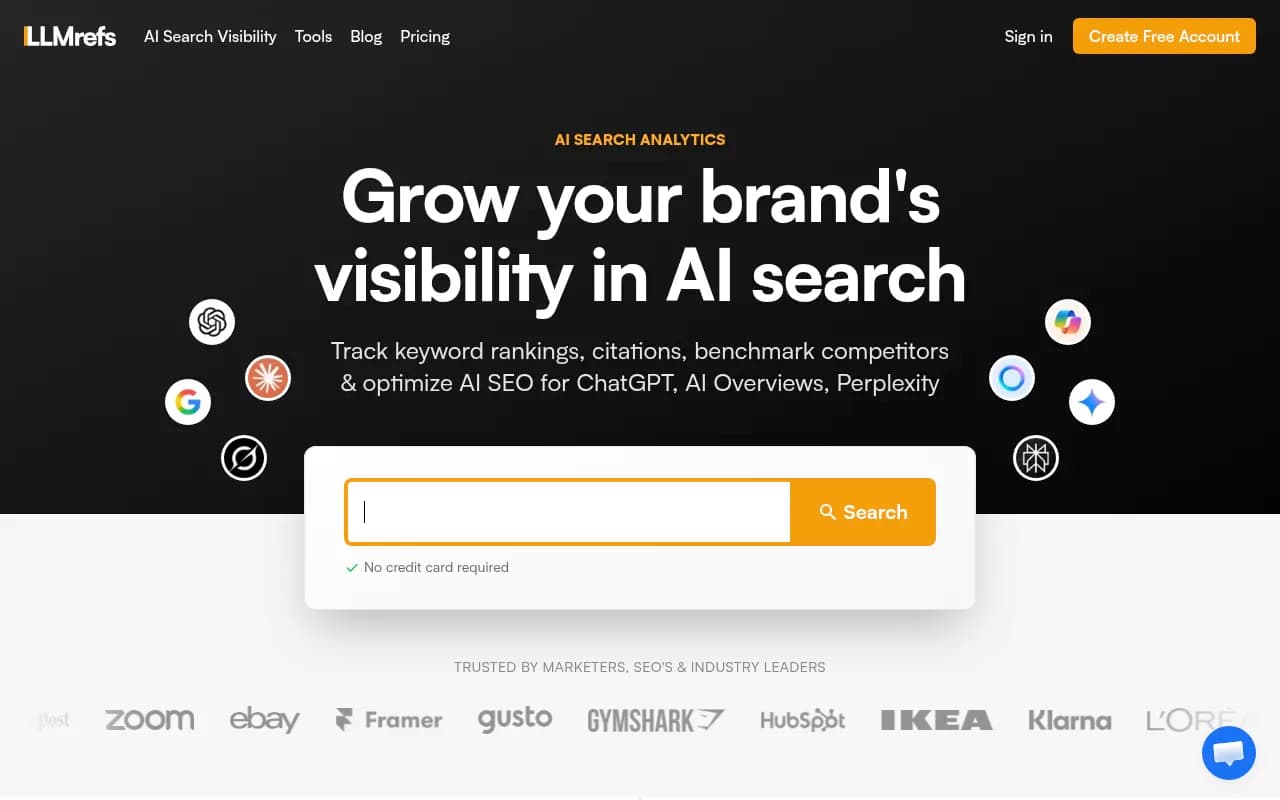
It's a more specialized tool than most on this list, but for content teams trying to understand why their content isn't getting cited, it's genuinely useful. The data can inform content strategy in ways that standard visibility tracking doesn't.
9. Rankshift -- best for GEO-focused content teams
Rankshift is built around the connection between content and AI visibility. It tracks LLM citations and brand mentions, but the workflow is oriented toward helping content teams understand what to write and how to write it to improve AI search presence.
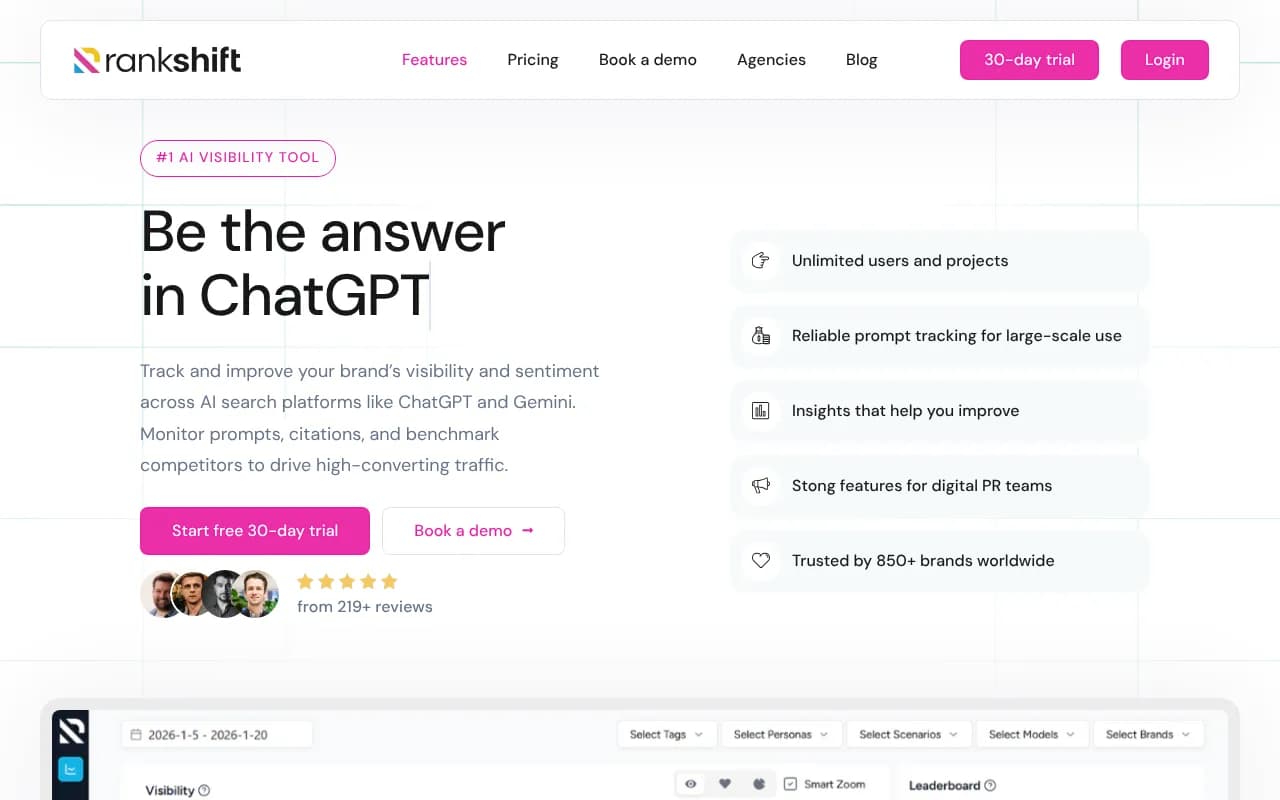
It's not as comprehensive as Promptwatch's end-to-end approach, but for content teams that already have a monitoring tool and just need better content direction, it fills a specific gap. The GEO-focused framing makes it easier to connect AI visibility work to content calendars and editorial workflows.
10. ZipTie -- best for solo SEOs and small sites
ZipTie is a diagnostic tool that gives you a clear picture of your AI search visibility without a lot of overhead. For solo SEOs or small sites that need to understand their AI visibility baseline before investing in a more comprehensive platform, it's a practical starting point.
It won't replace a full-featured platform for teams with serious AI search ambitions, but it's honest about what it is: a focused diagnostic tool at an accessible price point.
Side-by-side comparison
| Tool | AI models covered | Content gap analysis | Content generation | Crawler logs | Starting price |
|---|---|---|---|---|---|
| Promptwatch | 10+ (ChatGPT, Claude, Perplexity, Gemini, Grok, DeepSeek, Copilot, Meta AI, Google AIO, Google AI Mode) | Yes | Yes (AI writing agent) | Yes | $99/mo |
| AthenaHQ | 8+ | Limited | No | No | $295/mo |
| Profound | 4-5 | Partial | No | No | $99/mo |
| Scrunch AI | 5+ | No | No | No | Enterprise |
| Otterly.AI | 4-5 | No | No | No | ~$49/mo |
| SE Visible | 4-5 | Partial | No | No | $189/mo |
| Rankscale | 5+ | No | No | No | Custom |
| LLMrefs | 4-5 | Partial | No | No | Freemium |
| Rankshift | 4-5 | Partial | No | No | Custom |
| ZipTie | 3-4 | No | No | No | Low/free tier |
| Peec.ai (original) | 4-5 | No | No | No | ~€89/mo |
How to choose the right tool for your situation
The right tool depends on what you're actually trying to do.
If you're in a "we need to understand where we stand" phase, almost any tool on this list will work. Otterly.AI or ZipTie can get you oriented quickly without a big commitment. Peec.ai itself is fine for this.
If you're in a "we need to improve our AI visibility" phase -- which is where most serious marketing teams are in 2026 -- the monitoring-only tools will frustrate you. You'll have dashboards full of data and no clear path to acting on it. That's when the gap between Promptwatch and the rest of the field becomes obvious.
If you're an agency managing multiple clients, SE Visible's integration with SE Ranking's broader platform is worth considering, and Promptwatch's agency pricing covers multi-site workflows.
If you're an enterprise with brand narrative concerns (not just citation tracking), Scrunch AI's descriptor analysis is genuinely differentiated.
The honest reality is that most teams start with a monitoring tool, hit its ceiling within a few months, and then look for something that actually helps them move the needle. Skipping straight to a platform with optimization capabilities saves that cycle.
The monitoring trap
One thing worth naming directly: there's a whole category of AI visibility tools that are essentially dashboards. They show you data. They send you reports. They tell you your visibility score went up or down. And then they leave you to figure out what to do about it.
That's not a criticism of any specific tool -- monitoring is a real and necessary function. But in 2026, with AI search eating into traditional organic traffic for a growing number of categories, "we know we're invisible" is not a strategy.
The teams that are actually winning in AI search are doing three things: identifying the specific content gaps that explain why AI models don't cite them, creating content that addresses those gaps in a format AI models actually cite, and tracking whether it's working at the page level.
Most tools in this space help with the third thing (tracking) and partially with the first (gap identification). Very few help with the second. That's the gap Promptwatch is built to fill -- and why it's the recommendation for teams that are serious about AI search as a channel, not just a metric to monitor.
Final take
Peec.ai isn't a bad tool. It was an early mover in a space that needed early movers, and for teams that just need basic AI visibility monitoring across a handful of prompts, it still works fine.
But the bar has moved. AI search is now a serious channel, and the tools that matter are the ones that help you do something about your visibility, not just measure it. If you're hitting the walls that most Peec.ai users report -- cost at scale, limited model coverage, no clear path to optimization -- the alternatives above are worth a serious look.
Start with what you actually need to accomplish. If it's monitoring, Otterly.AI or Profound will serve you well. If it's optimization, Promptwatch is the only platform in this space that completes the full loop.