Key takeaways
- Otterly.AI is a solid monitoring tool, but it stops at showing you data -- it doesn't help you create content to improve your AI visibility.
- The most common complaint from Otterly users: "It tracks the source, but gives zero actionable strategy on how to restructure content to get cited."
- The best alternatives in 2026 combine monitoring with content generation, gap analysis, and crawler insights -- not just dashboards.
- For content teams specifically, the gap between "knowing you're invisible" and "doing something about it" is where most tools fail.
- Promptwatch is the only platform in 2026 rated as a leader across all GEO categories, with built-in content generation tied directly to real prompt and citation data.
The real problem with Otterly.AI
Otterly.AI does what it says on the tin: it monitors your brand's visibility across AI search engines like ChatGPT, Perplexity, and Google AI Overviews. For a lot of teams, that's genuinely useful. Knowing you appeared in 3 out of 10 ChatGPT responses for a target query is better than not knowing at all.
But here's where it breaks down. You see the number. Then what?
A Reddit user put it bluntly: "It tracks the source, but gives zero actionable strategy on how to restructure content to get cited." That's the implementation gap -- the space between knowing you're missing from AI responses and actually doing something to fix it.
For content teams, this gap is especially painful. You're not just trying to understand AI visibility -- you're responsible for producing content that improves it. A monitoring-only tool gives you a report to stare at. What you actually need is a workflow: find the gaps, create the content, track whether it worked.
The good news is that several platforms have built exactly that. Some are pure monitoring tools that do it better than Otterly. Others go further and help you generate content, analyze competitors, and track results at the page level. This guide focuses on the latter -- because if you're a content team, a prettier dashboard isn't the upgrade you need.
What to look for in an Otterly.AI alternative
Before jumping into specific tools, it's worth being clear about what separates a genuinely useful platform from one that just looks different.
For content teams, the key questions are:
- Does it show you which specific prompts and topics you're missing from AI responses?
- Does it help you create content to close those gaps, or just show you they exist?
- Does it track results at the page level -- which articles are being cited, by which models, how often?
- Does it monitor real user-facing AI responses (not just API outputs, which can differ significantly)?
- Does it give you data on why competitors are being cited -- so you can reverse-engineer what's working?
Most tools answer "yes" to the first question and "no" to the rest. Keep that in mind as you evaluate.
The best Otterly.AI alternatives in 2026
1. Promptwatch -- best for content teams that want to close gaps, not just find them
Promptwatch is the most complete platform in this space right now. It's used by 1,480+ brands and agencies including Booking.com and Center Parcs, and it's the only GEO platform rated as a "Leader" across all categories in a 2026 comparison of 12 platforms.
The core difference from Otterly is what happens after you see the data. Promptwatch's Answer Gap Analysis shows you the exact prompts your competitors are visible for that you're not -- not as a vague observation, but as a specific list of topics, questions, and angles that AI models want to answer but can't find on your site. From there, Content Agents generate articles, listicles, comparisons, and briefs grounded in that real prompt data. And then page-level tracking shows you when those new articles start getting cited, which models are citing them, and how that visibility connects to actual traffic.
That's a full loop: find gaps, create content, track results. Most competitors stop at step one.
A few other things worth knowing: Promptwatch tracks real user-facing AI responses, not just API outputs. It also has AI Crawler Logs that show you in real time which pages ChatGPT, Claude, and Perplexity are crawling on your site -- and which ones they're ignoring. That's genuinely rare. Most monitoring tools have no visibility into the crawl layer at all.
Pricing starts at $99/month for the Essential plan (1 site, 50 prompts, 5 articles). Professional is $249/month (2 sites, 150 prompts, 15 articles, crawler logs). Business is $579/month for 5 sites and 30 articles per month.

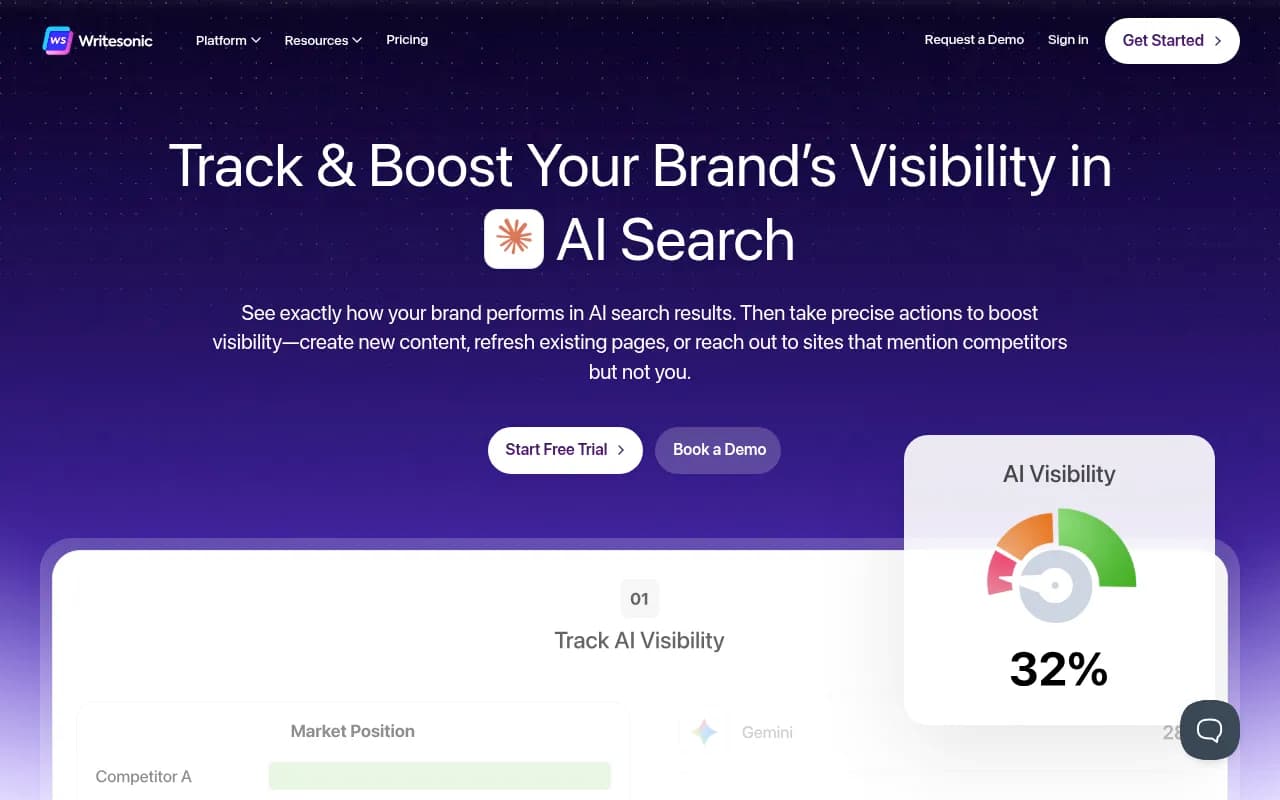
2. Writesonic -- best for content-first teams that want AI writing built in
Writesonic started as an AI writing tool and has since built out AI search visibility features. That history shows -- the content generation side is genuinely strong, and for teams that are primarily focused on producing articles rather than deep GEO analytics, it's a reasonable option.
The trade-off is that the monitoring side is thinner than dedicated GEO platforms. You get visibility tracking across major AI models, but the prompt intelligence and gap analysis features aren't as deep as what you'd get from a purpose-built GEO tool. If your workflow is "write a lot of content and hope it gets cited," Writesonic fits. If you want to know exactly which gaps to close and why, you'll hit its limits.
3. Profound -- best for enterprise teams with budget to match
Profound is a serious platform with strong monitoring capabilities across multiple AI engines. It tracks brand mentions, sentiment, and citation patterns at a level of depth that smaller tools can't match.
The catch is price. Profound is positioned at the enterprise end of the market -- the kind of budget that makes sense for a Fortune 500 brand but not for a mid-sized marketing team. It also lacks some of the content generation features that content teams specifically need. You get excellent data; you still have to figure out what to do with it yourself.

4. AthenaHQ -- best for teams that want clean monitoring across 8+ AI engines
AthenaHQ tracks brand visibility across eight or more AI search engines with a clean interface and solid reporting. It's a step up from Otterly in terms of breadth and depth of monitoring.
Like most monitoring tools, though, it stops there. There's no content generation, no gap analysis that tells you what to write, and no crawler log visibility. For a content team that just wants better monitoring data to inform their own editorial process, AthenaHQ is a reasonable choice. For a team that wants the platform to help them create content, it's not the right fit.

5. Scrunch AI -- best for teams that want monitoring without the enterprise price tag
Scrunch AI is a solid mid-market monitoring tool. It shows you where you appear in AI responses, tracks competitors, and gives you reasonable reporting. The interface is clean and the pricing is more accessible than Profound.
The limitation is the same one that affects most monitoring-only tools: it shows you where you appear, but doesn't tell you what to do about it. As Otterly's own comparison page puts it, "ScrunchAI shows where you appear. OtterlyAI tells you what to do about it." That's fair -- though neither tool actually helps you create the content to fix the problem.
6. Peec AI -- best for multi-language monitoring
Peec AI has built out strong multi-language and multi-region tracking, which makes it genuinely useful for brands operating across markets. If your content team is managing visibility in multiple languages, Peec's coverage is worth considering.
The platform is monitoring-focused, so the same content-generation gap applies. But for international teams that need to understand AI visibility across regions and languages, Peec does that job well.

7. SE Ranking -- best for teams already using an SEO suite
SE Ranking is primarily an SEO platform that has added AI visibility tracking. If your team is already using SE Ranking for keyword research, rank tracking, and site audits, adding the AI visibility module is a natural extension rather than a separate tool to manage.
The AI visibility features are solid but not the deepest in the market. You won't get the same level of prompt intelligence or gap analysis as a dedicated GEO platform. But if consolidating your toolstack matters and you're already in the SE Ranking ecosystem, it's a sensible choice.
8. Rankscale -- best for teams that want prompt-based pricing
Rankscale tracks AI search visibility with a prompt-based pricing model that's more transparent than credit systems used by some competitors. The platform has Looker Studio integration, which is useful for teams that need to pull data into custom dashboards or client reports.
Like most tools in this space, Rankscale is primarily a monitoring and analytics platform. The actionable recommendations are present but limited compared to platforms with full content generation built in.
9. ZipTie -- best for deep diagnostic analysis
ZipTie is positioned as a deep-analysis tool for AI search visibility. It goes further than basic monitoring in terms of explaining why you're appearing or not appearing in AI responses -- the diagnostic layer is more developed than most tools at this price point.
It's worth noting that ZipTie is more of an analytical tool than a content production platform. If you want to understand the mechanics of your AI visibility in detail, it's strong. If you want to generate content directly from that analysis, you'll need to pair it with something else.
How these tools compare
Here's a direct comparison across the dimensions that matter most for content teams:
| Tool | AI monitoring | Content generation | Gap analysis | Crawler logs | Pricing (from) |
|---|---|---|---|---|---|
| Promptwatch | 10 models | Yes (Content Agents) | Yes (Answer Gap Analysis) | Yes | $99/mo |
| Writesonic | Major models | Yes (writing-first) | Basic | No | ~$49/mo |
| Profound | Major models | No | Limited | No | Enterprise |
| AthenaHQ | 8+ models | No | No | No | Custom |
| Scrunch AI | Major models | No | No | No | ~$79/mo |
| Peec AI | Major models | No | No | No | ~$49/mo |
| SE Ranking | Major models | Limited | No | No | ~$65/mo |
| Rankscale | Major models | No | Limited | No | Custom |
| ZipTie | Major models | No | Diagnostic | No | Custom |
| Otterly.AI | Major models | No | Basic audit | No | From $29/mo |
The pattern is clear. Most tools in this space are monitoring platforms. A few add some form of content support. Only Promptwatch closes the full loop from gap identification to content generation to result tracking.
Which tool is right for your team?
The answer depends on what your content team actually needs to do.
If you just want better monitoring than Otterly, AthenaHQ or Scrunch AI are clean upgrades. If you're operating across multiple languages, Peec AI is worth a look. If you're already in the SE Ranking ecosystem, their AI visibility module is the path of least resistance.
But if your goal is to actually improve your AI visibility -- not just measure it -- the gap between monitoring tools and action-oriented platforms is significant. Knowing you're missing from 7 out of 10 ChatGPT responses is useful. Knowing exactly what content to create to fix that, having a tool generate that content, and then watching your citation rate improve over the following weeks is a different category of value entirely.
One Reddit user summarized the broader frustration well: "Unless a tool gives clear recommendations or ties to revenue, it's hard to justify $100-$400/month just to know if ChatGPT mentioned your brand today." That's the right question to ask of any tool you're evaluating. What does it actually change about your output?
For most content teams, the answer to that question points toward platforms that generate content, not just reports.
A note on Otterly.AI itself
Otterly is a legitimate tool and not a bad starting point. It's affordable, GEO-native from day one, and does monitoring well for the price. If you're just getting started with AI visibility tracking and want something simple, it's not a wrong choice.
The issue is where it leaves you. Monitoring is the beginning of a GEO workflow, not the end. As the category matures in 2026, the tools that are pulling ahead are the ones that help teams take action on what they find -- and Otterly hasn't built that layer yet.

Bottom line
The GEO tool market in 2026 is full of dashboards. What content teams actually need is a workflow. Find the gaps in your AI visibility, create content that closes them, and track whether it worked. That's the loop that moves the needle.
Most tools in this space handle step one. A few handle step one and a half. Promptwatch is built around all three steps, which is why it's the recommendation for content teams that want to do more than monitor.
If you're evaluating alternatives to Otterly, start by asking what you want to be able to do differently six months from now. Then pick the tool that actually gets you there.