
Key takeaways
- An API is for code (scheduled jobs, warehouses, BI tools). An MCP server is for assistants (Claude, ChatGPT, Cursor asking questions in plain language). Most serious platforms now ship at least one.
- Access varies a lot by plan. Some tools include it under $100 a month, others lock it behind Enterprise, and read-only versus read-write access changes what agents can actually do.
- Check whether the platform tracks real AI interfaces or only APIs. Surfer's own testing reported that about 75% of brands named via APIs didn't match what the real AI interfaces showed.
- Write access matters more than most buyers expect. An MCP server that can only read data gives you a chat interface over a dashboard. One that can create prompts, queue content, and move tasks lets an agent do work.
- Verify every price and plan limit on the vendor's own page before buying. The comparison posts we drew from are mostly vendor-authored.
Why API and MCP access decides the shortlist
AI visibility data tends to get trapped. The people who need it work in BigQuery, Looker Studio, client decks, or an assistant like Claude Code or Cursor. The dashboard is where the vendor wants you. Your warehouse is where you actually work.
Two years ago, a CSV export was good enough. In 2027 workflows, it is not. Teams schedule weekly briefings, push share-of-voice into BI tools, and ask an assistant "which competitor gained the most citations this month?" without opening a browser tab. That requires a real API, an MCP server, or both.
I think the MCP side is the more interesting shift. A REST API still needs someone to write the glue code. An MCP server lets a marketer connect Claude or ChatGPT with an OAuth click and start asking questions. The catch is that quality varies wildly: tool counts, permissions, and rate limits are not the same from vendor to vendor.
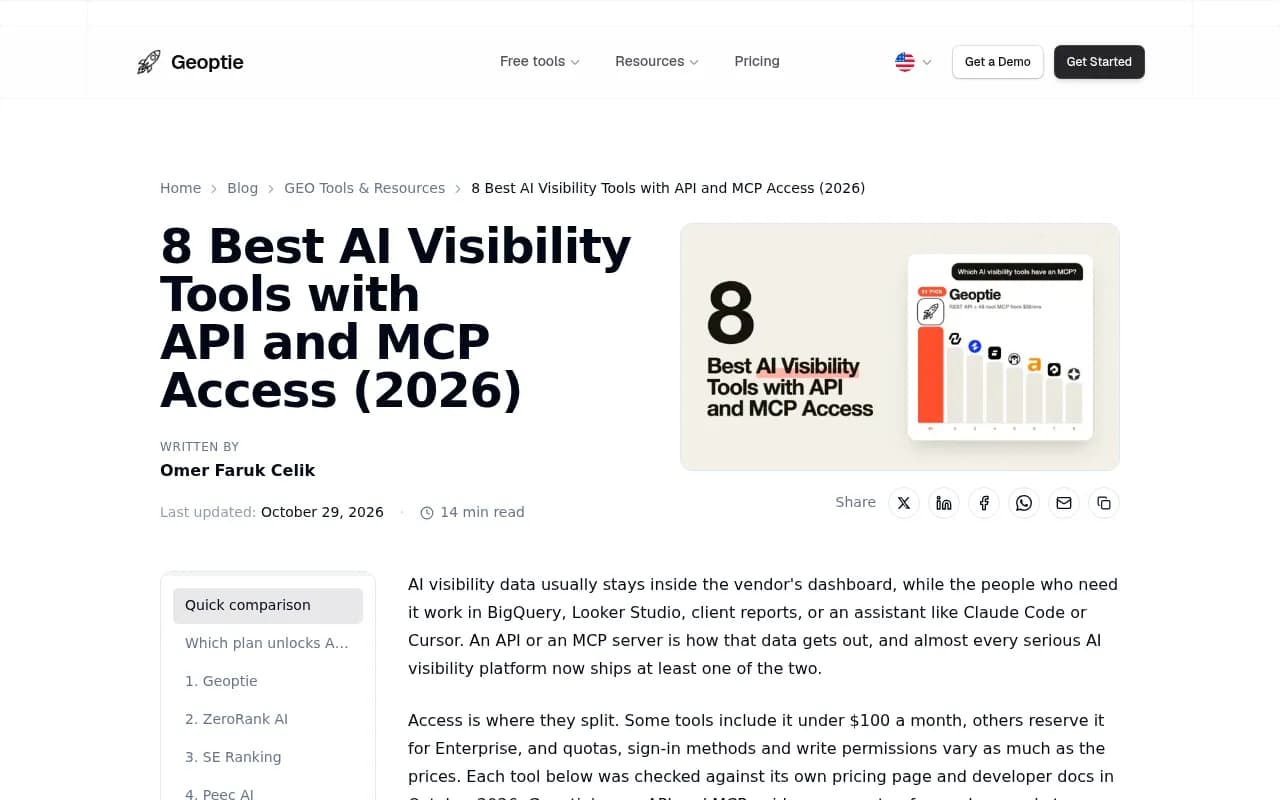
That comparison is vendor-authored (Geoptie ranks itself first), so treat the ordering with caution. The structure is still useful: it separates the tool, the engines covered, the plan where MCP starts, and the plan where the API starts.
API vs MCP: what each one is for
The short version:
- REST API: scheduled, repeatable, code-driven. Pull visibility, citations, sentiment and raw answers into a warehouse, a BI dashboard, or a client report template.
- MCP server: conversational and agentic. An assistant discovers the tools, calls them, and reasons over the results. Good for ad-hoc analysis, briefings, and workflows where the question changes every time.
Some platforms run both on one account, so the choice comes down to workflow. Others give you one and reserve the other for a higher tier. Peec AI, for example, offers an MCP server on every plan but reserves its API for higher tiers, according to Geoptie's comparison.
Read-only vs read-write MCP
This is the question I would ask first. AirOps says its MCP (35+ tools) reads and writes, bringing Brand Kit context, Insights data and platform actions into Claude and ChatGPT. It describes Rankshift's MCP as read-only: agents can retrieve visibility data but cannot take action through it. Otterly's MCP adds write tools for prompts, tags, reports and audits. Profound's reads analytics and writes to prompts, knowledge-base documents, projects and its content agents.
Read-only is fine for reporting. If you want an agent to add prompts, kick off a content brief, or reprioritize a task list, you need write tools.
Comparison: platforms with API and MCP access
The table below pulls from the vendor comparison posts in our research. Prices and plan thresholds come from third-party roundups (checked in October 2026 by their authors), so confirm them on each vendor's pricing page.
| Platform | MCP from | API from | Notable detail |
|---|---|---|---|
| Promptwatch | Paid plans (confirm on pricing page) | Paid plans (confirm on pricing page) | 110+ read and write tools, REST API v2, plus a content and action layer |
| Geoptie | $99/mo | $99/mo | 48-tool MCP, no monthly request cap, per its own claim |
| ZeroRank AI | $39/mo | $39/mo | Cheapest entry in the roundup, 17 AI platforms |
| Peec AI | $95/mo (all plans) | Enterprise per one roundup; Pro per another | Sources disagree on API tier |
| Otterly AI | $189/mo | $189/mo | Documented API, fixed quotas, write tools in MCP |
| SE Ranking | $129/mo | $129/mo | AI and classic search data behind one connector |
| Ahrefs Brand Radar | $129/mo | $129/mo | AI mentions next to backlink and keyword data |
| Profound | Enterprise | Enterprise | SDKs, SSO, read-write MCP, v2 reports API |
| Scrunch | $500/mo | $500/mo | Agency-oriented |
| Omnia | Every plan | Every plan | Covers AI Overviews, AI Mode, Gemini, ChatGPT, Perplexity |
| AirOps | Included, check tier | Included, check tier | 35+ tool read-write MCP, content workflow focus |
| Rankshift | OAuth MCP | Read-only API | Read-only access |
Note the Peec AI discrepancy. Surfer's table says API from Pro; Geoptie's says Enterprise. When two vendor-authored sources disagree, go to the primary docs.
The platforms, one at a time
Promptwatch
Promptwatch is the one in this list that treats the MCP server as part of a larger loop rather than a data pipe. Its hosted MCP server exposes 110+ read and write tools for Claude, Claude Code, ChatGPT, Cursor, Lovable, Codex and any MCP client, with one-click OAuth or an API key. The REST API v2 covers visibility, prompts, responses, citations, sentiment, crawler and visitor analytics, shopping, Ads Radar, site audit, content and publishing, with date ranges up to 92 days so a full quarter fits in one request. Docs live at promptwatch.com/docs.

What makes this useful for agent workflows is what sits behind the tools. An agent can query visibility and citation data, but also read IP-verified AI crawler logs, check AI-referred visitor analytics, queue content through the Content Agent, and publish to WordPress, Webflow or Framer. Responses include citation snippets and the widgets an AI answer showed next to its text. Agencies can create pitch projects through the API and MCP.
Two practical notes. Every plan, including the free Explore plan, includes MCP and API access, but request limits scale with the plan: 100 per hour on Explore, 500 on Essential, 2,000 on Professional, 10,000 on Business. Enterprise gets 24,000. Pricing runs from $95/mo (Essential) to $245 (Professional) and $579 (Business); confirm at promptwatch.com/pricing, since third-party sites list different numbers. The 7-day free trial is the way to test the full product, because Explore is a one-model evaluation plan.
The tracking itself runs on the real interfaces of ChatGPT, Google AI Overviews, Google AI Mode, Gemini, Perplexity, Copilot, Alexa and Meta AI, not just API calls. That matters for the reason Surfer's research flagged: user-facing answers can differ from API outputs. For a head-to-head view, see Promptwatch vs Profound and Promptwatch vs Peec.
Profound
Profound is the enterprise pick. Per Geoptie's roundup, the v2 reports API returns visibility, citations, sentiment, query fan-outs and raw prompt answers, and the MCP server reads analytics and writes to prompts, knowledge-base documents, projects and content agents. SDKs and SSO are part of the package, and it covers the widest engine set, including Claude, DeepSeek and Exa Search. The tradeoff is access: API and MCP sit on Enterprise.

Peec AI
Peec is the budget-friendly pick for teams that mostly talk to their data through an assistant. The MCP server is on every plan from roughly $95 (EUR 85 in Surfer's table), and daily tracking is the draw. The API is the part to verify.

Otterly.AI
Otterly has a documented REST API returning brand reports, citations, prompts, AI responses and recommendations, with fixed quotas. The MCP server adds write tools for prompts, tags, reports and audits. It is a sensible fit for small teams that want predictable limits.

Geoptie and ZeroRank
Both are low-priced entrants that lead with API and MCP access. Geoptie advertises a 48-tool MCP server and REST API on its $99 Professional plan across seven engines. ZeroRank advertises MCP and REST from a $39 Starter plan across 17 AI platforms. Both comparison sources are the vendors' own blogs, so I would run a trial and check tool lists in the docs before committing.
Omnia
Omnia includes the API and an MCP server on every plan, covering Google AI Overviews, AI Mode, Gemini, ChatGPT and Perplexity. It returns visibility, share of voice, citations, sentiment and full answers.
SE Ranking, Ahrefs Brand Radar and Semrush
These are for teams already living inside an SEO suite. SE Ranking offers AI and classic search data behind one connector you can add to ChatGPT or Claude. Ahrefs Brand Radar puts AI mentions next to backlink and keyword data. Semrush's AI Visibility Toolkit was marked "not listed" for API or MCP in Surfer's table, so verify before assuming.
AirOps and Rankshift
AirOps leans toward content teams running optimization workflows, and its read-write MCP is the main reason to consider it for agent use. Rankshift is monitoring-focused with a read-only API and OAuth MCP.
How to choose: a workflow-first checklist
Before comparing prices, write down what you want the integration to do. Then match.
If you report to clients or leadership
You want a stable API, scheduled PDF or Looker Studio output, and white-label options. Agencies should look at plans with unlimited projects. Promptwatch's Kick-off, Growth and Scale agency plans ($199, $399 and $799 per month) include MCP and API access, and its agency solution page explains the AI Visibility Reports used for pitches.
If an agent will act on the data
You need write tools. Ask each vendor: can the MCP create prompts, update monitors, queue content, and move tasks? Check which of those actions are logged. Promptwatch's organization audit log (Business, Agency Scale and Enterprise) records whether a change came from the dashboard, the API, an MCP client or Agent Chat, which is a detail you will want once more than one agent touches your account.
If you need to diagnose, not just count
Visibility numbers alone do not tell you why you are missing. Crawler logs separate an access problem from a content problem. Promptwatch's AI crawler logs are one example, and Promptwatch Data's AI crawler traffic report shows the benchmark: OpenAI accounted for 79.8% of verified AI crawler requests in Aug 31 to Sept 6, 2026, down from 94.8% in June 8 to 14. If a provider is a big share there but near zero in your logs, you are probably blocked in robots.txt, the CDN or the WAF.
If you are cost-constrained
ZeroRank, Geoptie, Omnia and Peec put access at the low end. The tradeoff is usually depth: fewer data types, thinner content tooling, or request caps. Our directories at bestgeosoftware.com list more budget GEO tools if you want to widen the shortlist.
Questions to ask any vendor before you sign
- Which plan unlocks the API, and which unlocks MCP? They are often different.
- What are the rate limits per hour or per month? A quota that works for a weekly report may fail for an agent that loops.
- Is the MCP read-only or read-write, and how many tools does it expose?
- Does the data come from real AI interfaces or API calls? The two can disagree.
- How are citations returned? Snippets, positions and URLs make downstream analysis much easier than counts.
- What authentication is supported: OAuth, API keys, scoped read-only keys?
- Is there an audit trail for changes made by agents?
Metrics worth pulling through the API
The numbers you pipe out matter as much as the pipe. A few that hold up in a time series:
- Citations per response. Promptwatch Data's average sources per response report shows ChatGPT citing about 5 sources per web-search answer, Google AI Overviews about 10, and Perplexity almost exactly 10 each day. ChatGPT's figure drifts with model updates, so track it over time instead of treating it as fixed. Perplexity's stability makes it a useful baseline for testing content changes.
- Share of voice and position per topic, so a drop is attributable.
- Citation share by domain rank and content type. Promptwatch's domain rank distribution report found the median cited domain was DR 57 in ChatGPT and Perplexity and DR 56 in AI Overviews and AI Mode (Nov 3 to Nov 16, 2026), but DR 100 sites earned 13.7% of AI Overviews citations versus 0.3% for ChatGPT. Benchmarks like that vary by engine, so do not blend them.
- AI-referred visits and conversions, which close the loop. Note that ChatGPT stopped sending a referrer on October 8, 2026, so tagged links (utm_source=chatgpt.com) help.
For how to attribute that traffic properly, the Promptwatch Academy guide on attributing AI traffic is a good starting point.
A note on MCP gateways and security
If your company routes agent traffic through an MCP gateway, the choice of platform interacts with it. Nightfall's roundup of MCP gateways for enterprise AI security covers local and remote protection and sensitive data detection. It is a separate category from visibility tools, but worth a look if your security team wants to inspect or restrict what agents can call.
Visibility data is mostly brand-level and low-sensitivity, but write tools that publish content or change monitors are worth governing.
Which one I would pick
For an end-to-end loop where the agent can find a gap, draft the page, publish it, and check whether AI cited it, I would start with Promptwatch and its free trial. For enterprise procurement with SDK needs, Profound. For the cheapest way to get an assistant talking to your data, ZeroRank, Peec or Omnia. For SEO suite users who want one connector, SE Ranking or Ahrefs.
Whatever you choose, run the same five prompts through the MCP and the API during the trial and compare them against what you see in the real ChatGPT interface. That ten-minute test will tell you more than any comparison table, including this one. For wider options, browse the AI rank tracking directory.
FAQ
What is the difference between an AI visibility API and an MCP server?
An API is for code: scheduled jobs that pull data into a warehouse or report. An MCP server lets an AI assistant query the same data in conversation and, on some platforms, take actions.
Do I need both?
Not always. Reporting teams usually need the API. Analysts and marketers working in Claude or ChatGPT usually want MCP. Platforms that include both on one account give you flexibility.
Are read-only MCP servers useless?
No. They are fine for briefings and ad-hoc questions. They just cannot change anything, so they will not run content or prompt workflows for you.
Why do prices differ between sources?
Vendors change plans often, and many comparison posts are written by competitors. Confirm on the vendor's pricing page. For Promptwatch, use promptwatch.com/pricing.
Is tracking via API the same as tracking the real interface?
No. User-facing answers, citations and shopping results can differ from API outputs, so platforms that capture real interfaces give a more accurate view of what your customers see.