
Key takeaways
- Bloomreach announced on November 16, 2026 that it had acquired AthenaHQ. Nothing public yet says pricing, contracts or the product will change, so there is no reason to panic-cancel.
- Treat the deal as a trigger to review your setup, not as proof you should leave. Ecommerce teams may gain from the Bloomreach tie-in. Non-ecommerce teams should watch the roadmap.
- Export your prompts, responses and sources now, whatever you decide. It costs an hour and removes the risk of being locked out later.
- Never judge a replacement on a few days of data. AI visibility metrics swing a lot, and engines change their behavior independently of any tool.
- The safest path for most teams is a parallel run of two to four weeks with identical prompts, then a decision.
What actually happened
Bloomreach, a Mountain View digital commerce personalization company, announced on November 16, 2026 that it had acquired AthenaHQ. CMSWire covered the deal on November 17, and the BusinessWire press release is the place to look for deal terms.
AthenaHQ is a Y Combinator-backed company founded by Andrew Yan (ex-Google) and Alan Yao (ex-ServiceNow). CMSWire lists Coinbase, Cozy Earth, Nuvadermis and Datmos as customers. The product includes ACE, the Athena Citation Engine, a model that forecasts how likely AI engines are to cite a piece of content. It also covers AI-driven content creation, product content optimization, and integrations with Shopify, GA4, and Claude and ChatGPT through MCP.
The strategic direction is explicit. The deal adds answer engine optimization to Bloomreach's Loomi AI stack, and Bloomreach frames it as tying AI visibility to revenue for ecommerce.
What I could not find: pricing changes, contract assignment terms, data handling changes, or any product sunset. Those gaps matter more than the headline. Until you hear from AthenaHQ or Bloomreach in writing, you are deciding on incomplete information, and that shapes how aggressive you should be.
One inference, clearly labeled as mine and not a sourced fact: a vendor that now belongs to an ecommerce personalization company may weight its roadmap toward ecommerce. If you sell software, run a publisher, or work in finance, keep an eye on that.
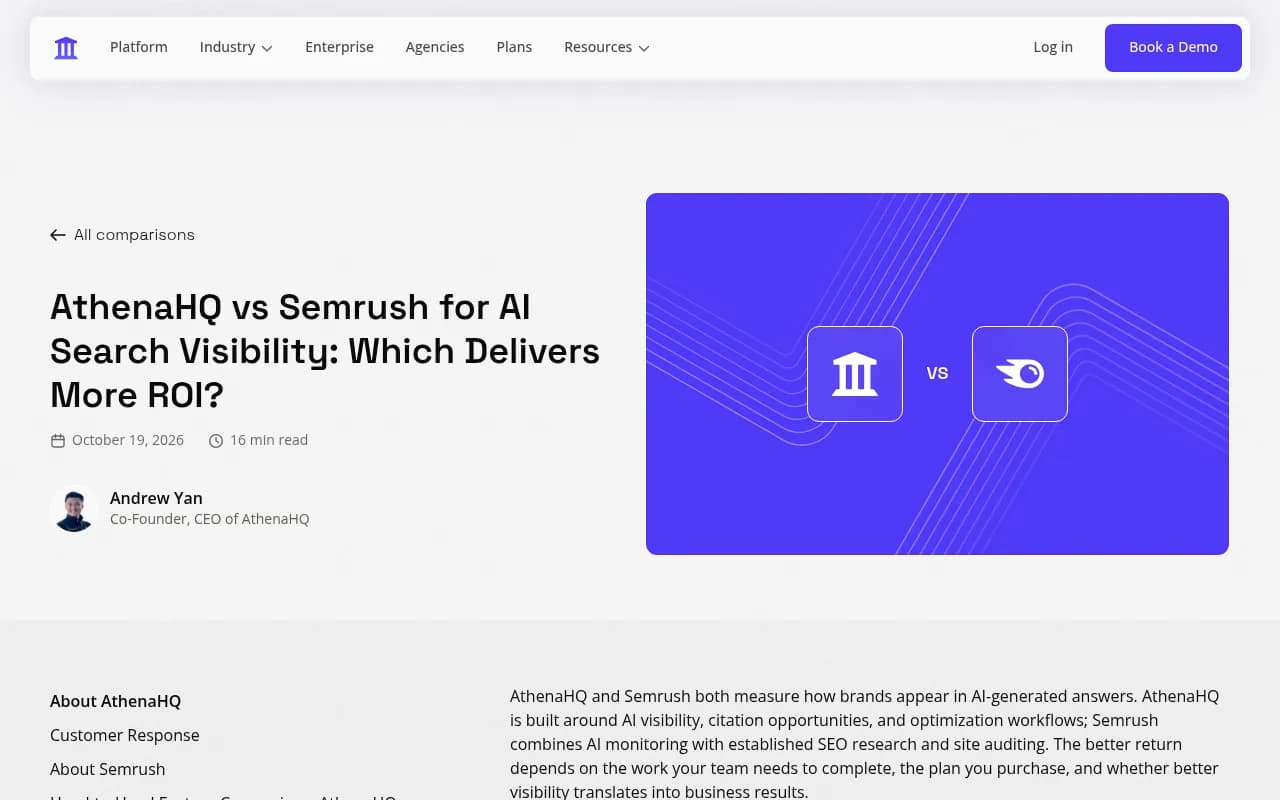
The screenshot above is AthenaHQ's own comparison page, dated October 19, 2026. It is vendor-written, but it is a useful snapshot of how the product was positioned before the sale: dedicated AI visibility and action workflows, with GA and Shopify integrations. It also admits neither AthenaHQ nor Semrush can prove incremental revenue from citations alone. That is a fair caveat for any tool you evaluate.
The 12-point checklist
Work through these in order. Points 1 to 4 are about facts you need to gather. Points 5 to 8 are about whether the product still fits you. Points 9 to 12 are about executing a move without losing history.
1. Find your renewal date and notice period
Open your contract or billing page. Write down the renewal date, the cancellation notice window, and whether you are on monthly or annual billing. Annual customers have the most to lose from a rushed decision and the most leverage to wait. Monthly customers can afford a parallel trial with almost no risk.
2. Check whether the contract can be assigned
In an acquisition, contracts usually move to the new owner. Read the assignment and change-of-control clauses if you have an enterprise agreement. Ask your account manager directly: does anything change on pricing, terms or data processing, and when? Get the answer in writing.
3. Review data handling and your DPA
A new parent company can mean new subprocessors and new data flows. If your legal or security team signed off on AthenaHQ alone, they may need to re-review. Ask whether your data processing agreement carries over unchanged. This is the point where regulated industries should be most careful.
4. Record what you actually pay and what you use
Note your current plan, your prompt count, the engines you track and the integrations you rely on. If you pay for features you never opened, that is a finding in itself. Research notes I gathered did not include current AthenaHQ or competitor pricing, so confirm numbers on each vendor's pricing page rather than trusting a roundup.
5. Decide whether the ecommerce pivot helps you
Bloomreach's pitch is AI visibility tied to revenue for commerce brands. If you run a Shopify store, the Shopify integration and the Bloomreach commerce stack may be a real upgrade. If you are B2B SaaS, a publisher or a services firm, ask what the roadmap looks like for you. Staying is reasonable if your needs are stable and the tool keeps working. Waiting for a roadmap announcement is also reasonable.
6. Check how much you depend on AthenaHQ-specific features
ACE citation forecasting, the action queue and the MCP connections are the parts hardest to replicate elsewhere. If your team built workflows around them, switching costs go up. If you mostly use AthenaHQ as a dashboard for mentions and citations, you have many substitutes.
7. Ask whether you need monitoring only or monitoring plus execution
Some teams just want to know where they appear. Others want the tool to help write and publish the fix. Decide which you are, because the replacement category is different. Pure trackers are cheaper. Platforms that also create content and measure the result cost more but save labor.
8. Confirm you can measure outcomes, not just visibility
Can your current setup show AI-referred traffic and conversions, or crawler access to your pages? If the answer is no, the sale is a good excuse to close that gap. Visibility scores alone do not tell you whether anything is working.
9. Export everything now
A competitor's migration guide from Nurdd (vendor-biased, but practical) says to export from three separate AthenaHQ pages: Prompts, Responses and Sources. Each has its own CSV, and each holds data the others do not. Add a screenshot or export of your baseline metrics. Do this before any decision, because it is free insurance.
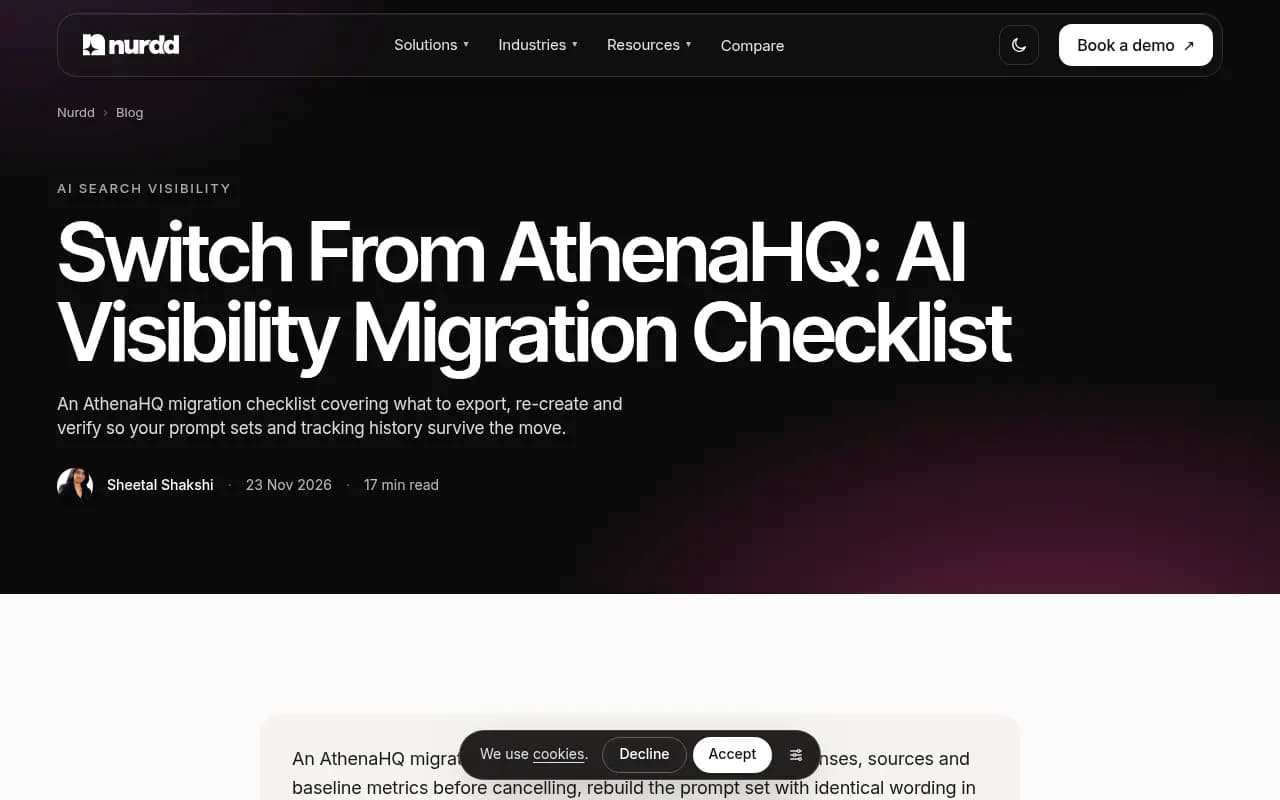
The same guide offers a useful triage table for your prompt list. Keep and rebuild first any commercial prompt tied to a product you sell now, where competitors are named in the answer. Retire or rewrite prompts that never named any brand. Archive prompts for discontinued products.
10. Rebuild the prompt set with identical wording
If you test a replacement, load the same prompts word for word. Change nothing on day one. Otherwise you cannot tell whether a shift in results comes from the tool or from your edits. Get3rd's buyer's checklist suggests loading the same 20 to 40 buyer questions into each tool you compare, and I think that is about right for a fair test.
11. Run both tools in parallel long enough to mean something
Here is the part people get wrong. AI metrics are noisy. Get3rd cites a median monthly swing of 12.5 points in visibility metrics (I did not verify that independently), so a few days of data can point either way.
Promptwatch Data's report on sources per response shows why. ChatGPT cites about 5 sources per web-search answer, Google AI Overviews about 10, and Perplexity almost exactly 10 every day. Copilot's average swung from under 2 to nearly 17 sources within a few weeks before settling at the low end. The report predates this month, so treat the numbers as a pattern, not a current benchmark. The takeaway for you: a trend line can move because an engine changed, not because the tool did. Compare tools on the same engine over several weeks, and judge volatile engines on monthly trends.
12. Make the call and note the series break
At the end of the overlap, choose one of three: stay, extend the parallel run, or cut over. If you cut over, cancel inside your notice period and add a note to your next report saying where the data series changes tools. Your history will not import cleanly into a new product, so set a fresh baseline and say so to stakeholders.
Stay, wait or switch: a quick decision guide
| Your situation | Likely best move |
|---|---|
| Shopify or ecommerce brand using the integrations | Stay, and read the Bloomreach roadmap |
| B2B or non-commerce team, annual contract with months left | Export now, run a trial of an alternative, decide near renewal |
| Monthly plan, light usage | Trial an alternative this month, low risk |
| Strict security or legal review requirements | Get written answers on data handling before anything else |
| You want tracking plus content execution plus traffic measurement | Evaluate platforms that cover the whole loop |
Alternatives worth testing
If the checklist points toward a trial, shortlist two or three tools, not ten. The catalog is crowded, and the GEO software directory at bestgeosoftware.com is a good place to scan the wider field.
For teams that want more than a dashboard, Promptwatch is the option I would put first on the list. It tracks ChatGPT, Gemini, Claude, Perplexity, Google AI Overviews, AI Mode, Copilot and others from the real interfaces, then goes further than monitoring: a Content Agent writes and publishes pages to WordPress, Webflow or Framer, IP-verified crawler logs show whether AI bots read them, and visitor analytics show whether they send traffic. That closed loop is what makes it relevant if checklist point 8 exposed a measurement gap. Pricing starts at $95 a month for Essential, with a 7-day free trial on monthly billing, and you should confirm current numbers at promptwatch.com/pricing. There is a head-to-head page against AthenaHQ if you want the detailed comparison.

Other tools in the catalog worth a look, depending on your priorities:
| Tool | Angle | Consider if |
|---|---|---|
| Profound | Enterprise monitoring | You need a large, established monitoring vendor |
| Peec AI | Multi-language tracking | You track many markets and want a simpler tracker |
| Otterly.AI | Affordable monitoring | Budget matters more than execution features |
| Semrush One | SEO plus AI visibility | You already live in Semrush |
| Scrunch | AI visibility monitoring | You want another monitoring-focused option |



Be a little skeptical of vendor-written comparisons, including the Profound review of AthenaHQ and the Nurdd migration guide. Both are written by competitors. They are useful for checklists and feature questions, less so for verdicts.
A suggested timeline
Here is a sensible schedule if you land on "export and test."
- Days 1 to 2: items 1 to 4, gather contract and usage facts, and email your account manager.
- Day 3: export prompts, responses, sources and baseline metrics.
- Days 4 to 7: sign up for one or two trials and load identical prompts.
- Weeks 2 to 4: run in parallel, compare mention rate by topic across repeated runs, never single answers.
- End of week 4: decide. Cancel inside the notice window if switching.
If you want a second pair of hands on the evaluation, an agency can run the comparison for you. 1001 SEO Media handles AI search and GEO work and uses Promptwatch as its platform, so it can set up a test without bias toward any single vendor's dashboard.
What I would do
If I were an AthenaHQ customer today, I would not cancel this week. I also would not ignore the news. I would export the data, ask the three contract questions in writing, and start a parallel trial of one alternative. Acquisitions rarely break a product overnight. They change priorities slowly, and you notice a year later when the features you wanted stop shipping. A calm four-week test costs little and leaves you with a real answer instead of a guess.
FAQ
Will AthenaHQ shut down after the Bloomreach acquisition?
No source I found says so. CMSWire's coverage describes AthenaHQ's capabilities being added to Bloomreach's Loomi AI stack, not retired. Ask your account manager for written confirmation.
Can I import my AthenaHQ history into another tool?
Do not count on it. Plan to archive your exports and start a fresh baseline in the new tool.
How long should I run two tools side by side?
Two to four weeks is a practical minimum, because AI answers vary from run to run and engines change behavior on their own.
What should I export first?
Prompts, responses and sources, each from its own page, plus a record of your baseline metrics.
Is switching worth it for ecommerce brands?
Maybe not. The Shopify integration and Bloomreach's commerce focus may favor staying. Compare after the roadmap becomes clear.