
Key takeaways
- ChatGPT has no "position 4." You are named in the answer, cited as a source, or absent. A good tracker measures mentions, citations, order within the answer, and sentiment.
- Real-interface monitoring captures what a user actually sees in ChatGPT Search. API polling captures what a model returns programmatically, which can differ in citations, shopping cards and search behavior.
- One prompt tells you little. Almost half of ChatGPT responses cite 10 or more unique domains, so you share every answer with many other sites.
- Citation behavior shifts overnight after model or product changes, so daily sampling and annotated trend lines matter more than any single snapshot.
- Most "best ChatGPT tracker" lists are written by vendors. Treat their rankings as marketing and test any tool on your own prompts.
Why ChatGPT rankings are not rankings
In Google, position 4 still earns clicks. In ChatGPT there is no position 4. The answer is a synthesized paragraph, and your brand is either in it or it isn't. Hit regenerate and you may get a different set of names.
That is why people searching for a "ChatGPT rank tracker" are really asking for four things:
- how often your brand is mentioned across a set of prompts
- how often your pages are cited as sources
- where you land in the order of brands inside the answer
- what ChatGPT says about you, and whether it is accurate
The first tools that appeared on this problem were thin wrappers: run a prompt, check for your name, show a green or red dot. Fine for a demo. Not fine for a decision.
There is also a sampling issue. ChatGPT is non-deterministic, and a prompt you test by hand from your office can return a different citation set tomorrow. Checking manually in a fresh session and logging results in a spreadsheet costs nothing, but the data is noisy because answers vary by session, login state and model update. Useful as a gut check, useless as a trend line.
Real interface data vs API polling
This is the decision that matters most, and vendors rarely explain it plainly.
API polling sends prompts to a model through an official API and reads the response. It is cheap, fast and reproducible within a model version. The catch is that the API is not the product your customers use. The ChatGPT interface runs web search, shows citations in a specific way, renders shopping carousels and ads, and may apply behavior that a raw API call doesn't. An API result tells you what the model believes from training data, which is a legitimate thing to measure, but it is a different question from "what does a buyer see when they ask ChatGPT?"
Real interface monitoring runs the prompt in the actual consumer product, in a chosen country and language, and records the answer, the sources and the extras around it. It is more expensive to run and harder to build, which is why many cheap trackers don't do it.
The practical differences:
| Factor | API polling | Real interface monitoring |
|---|---|---|
| What it measures | Model output, often training-data knowledge | What a user sees in ChatGPT Search |
| Citations | Often missing or different from the UI | Matches the sources shown to users |
| Shopping cards and ads | Not captured | Can be captured |
| Location and language | Limited | Country and language specific |
| Cost to the vendor | Low | Higher |
| Run-to-run consistency | High | Lower, needs repeated sampling |
| Best for | Baseline model knowledge | Real-world visibility and citations |
One more thing to ask any vendor: does a tool mix web-search-enabled answers with base-model answers? If it does, your citation trend line combines two different systems and the chart means nothing. Also ask whether results come from logged-in or logged-out sessions, how many samples per prompt are averaged, and how often prompts refresh.
A reasonable setup uses both. Interface data for the visibility number you report to leadership, API-based tracking for how models answer without live search (Claude, DeepSeek, Mistral and similar).
What to expect from the data
Before picking a tool, it helps to know what ChatGPT answers look like at scale, because it changes which metrics matter.
In Promptwatch Data's report on unique domains per response (Sep 28 to Oct 4, 2026), 47.6% of ChatGPT responses with citations cited 10 or more unique domains, and 66.1% cited at least 8. Only 6% cited three or fewer. Brand-specific prompts look different: 5 domains was the most common count, and only 21.3% cited 10 or more.
Translate that: for organic, non-branded prompts you are one of a crowd. Whether you are cited at all is a weak signal. Where you appear and how ChatGPT describes you carry more information.
Query fan-outs add another wrinkle. ChatGPT runs its own background searches for each prompt, often phrased differently from what the user typed. Promptwatch's query fan-out report measured an average of 2.15 queries per response in early December 2025, falling to about 1.84 by early March, and it noted that a single prompt can trigger 3 to 8 or more searches. A tool that shows those fan-out queries tells you what ChatGPT is actually searching for, which is far more useful than the prompt alone.
And the platform keeps moving. ChatGPT started using the site: operator at scale on August 8, 2026, jumping from about 0.4% to about 17% of fan-out queries overnight. Reddit's share of ChatGPT citations fell from roughly 4% to 0.5% on August 14, 2026. And average citations per response dropped around the GPT-5.3 rollout on March 4, 2026. None of those changes were caused by anything you did. If your tool only gives you a weekly snapshot, you won't be able to tell a content problem from a platform change.
What to look for in a ChatGPT tracker
Boil it down to a checklist:
- Data source. Real ChatGPT interface, API, or both, and clearly labeled.
- Search mode. Web-search answers separated from base-model answers.
- Sampling. Daily at minimum, with disclosure of how many samples are averaged per prompt.
- Metrics. Mentions and citations kept separate, plus position, share of voice and sentiment.
- Fan-out visibility. Can you see the sub-queries ChatGPT ran?
- Citation detail. Which of your URLs get cited, and which third-party pages do the citing instead.
- Beyond monitoring. Does it tell you what to fix, and does it measure whether the fix worked?
- Surfaces. ChatGPT Search, shopping, and ads, if they matter in your category.
- Export and API. CSV, API or MCP access so your data isn't trapped.
A note on sources. Most comparison articles in this space, including several that ranked highly while I was researching this, are published by tools that rank themselves first. TrueRanker, Searchable, OGTool, Rank Monster and SE Ranking all have lists like that. Pricing in them also goes stale quickly. Use them to build a shortlist, then verify on the vendor's own pricing page.
The tools worth shortlisting
Promptwatch
Promptwatch monitors the real ChatGPT interface (plus Google AI Overviews, AI Mode, Gemini, Perplexity, Copilot, Meta AI and Alexa) per country and language, and tracks API models such as Claude, DeepSeek, Mistral and Grok alongside to show what models believe from training data. That is the interface-plus-API split described above, in one product.
What separates it from a pure tracker is the rest of the loop. It shows query fan-outs per prompt, citation trends by content and source type, IP-verified AI crawler logs so you can tell whether ChatGPT's bots even read your pages, and visitor analytics for AI-referred traffic. Then the Action Board and Content Agent turn gaps into drafts that publish to WordPress, Webflow or Framer, and page tracking shows whether those pages get cited. Brand Narrative pulls out the individual claims ChatGPT makes about you, and Fact Check tests them against your site and the pages AI cites.
Pricing starts at $95/mo (Essential, 50 prompts, daily tracking) and scales to $245 (Professional) and $579 (Business, which adds the Content Agent, hourly tracking and Shopping insights). There is a 7-day free trial on monthly billing and a free Explore plan limited to ChatGPT with 10 prompts. Confirm current numbers at promptwatch.com/pricing. For ChatGPT specifically, see the ChatGPT visibility page.

Profound
A strong enterprise-oriented monitor covering many models. Good depth in monitoring, though it sits at a higher price point and, in my read, stops short of publishing content for you. Reasonable if procurement wants a name they recognize. Head-to-head: Promptwatch vs Profound.

Peec AI
Clean interface, multi-language support, popular with agencies who want something tidy to show clients. It is a prompt tracker at heart: no crawler logs, no visitor analytics, no content generation.

Otterly.AI
The budget entry point. A vendor-published comparison lists the Lite tier at $29/mo with 15 prompts shared across four engines, which gets thin fast. Good for a first look, less so for statistically meaningful sampling.

Searchable
Positions itself around covering every ChatGPT surface (model-only answers, Search, Shopping and fan-outs) with content and technical tools attached. Its own research claims an average of 1.74 underlying searches per ChatGPT response across 6.9 million responses. Worth a trial, keeping in mind that its own listicle crowns it the top pick.
Rankscale
High-frequency sampling at a low entry price, which suits teams who care about variance between runs. Lighter on action and content tooling.
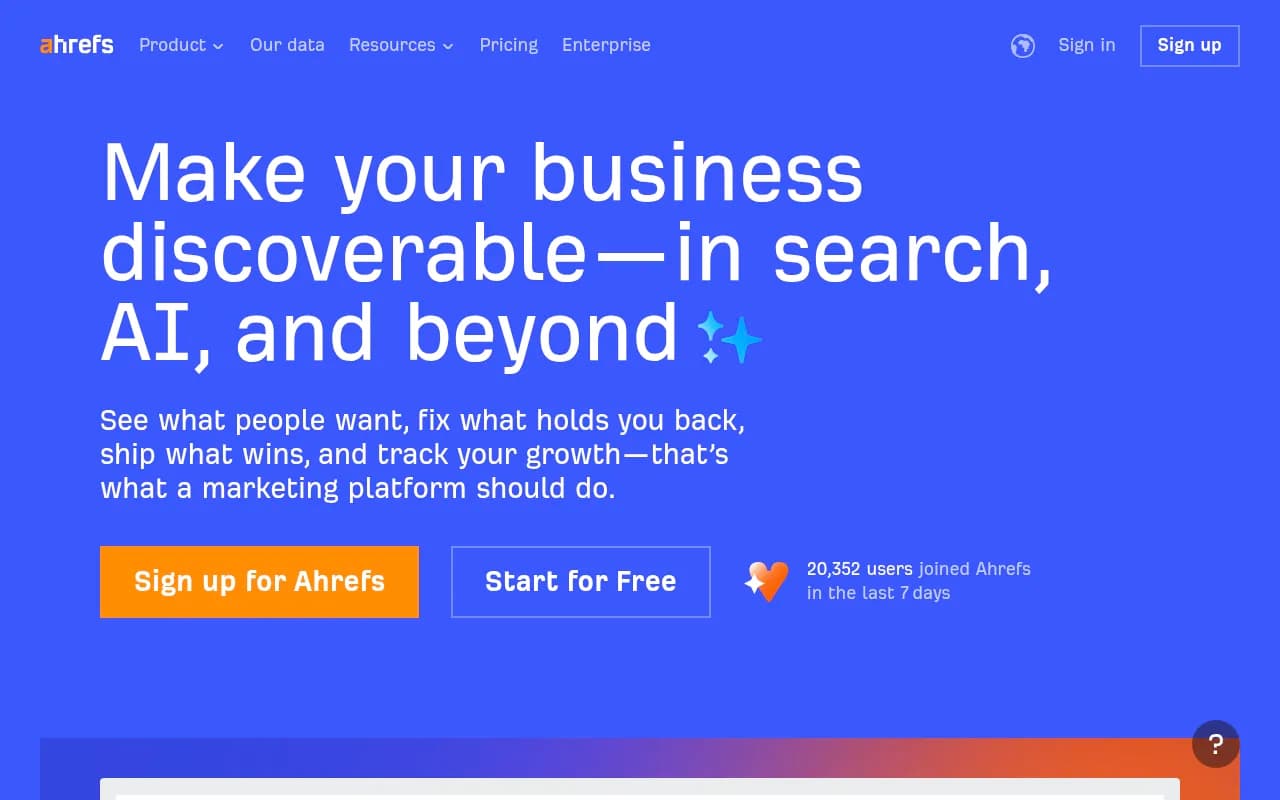
SE Ranking, Semrush and Ahrefs Brand Radar
If you already pay for one of these, the AI add-ons are the lowest-friction way to get started. The trade-off is fixed prompt sets and shallower AI-specific data, and no crawler logs or AI traffic attribution.
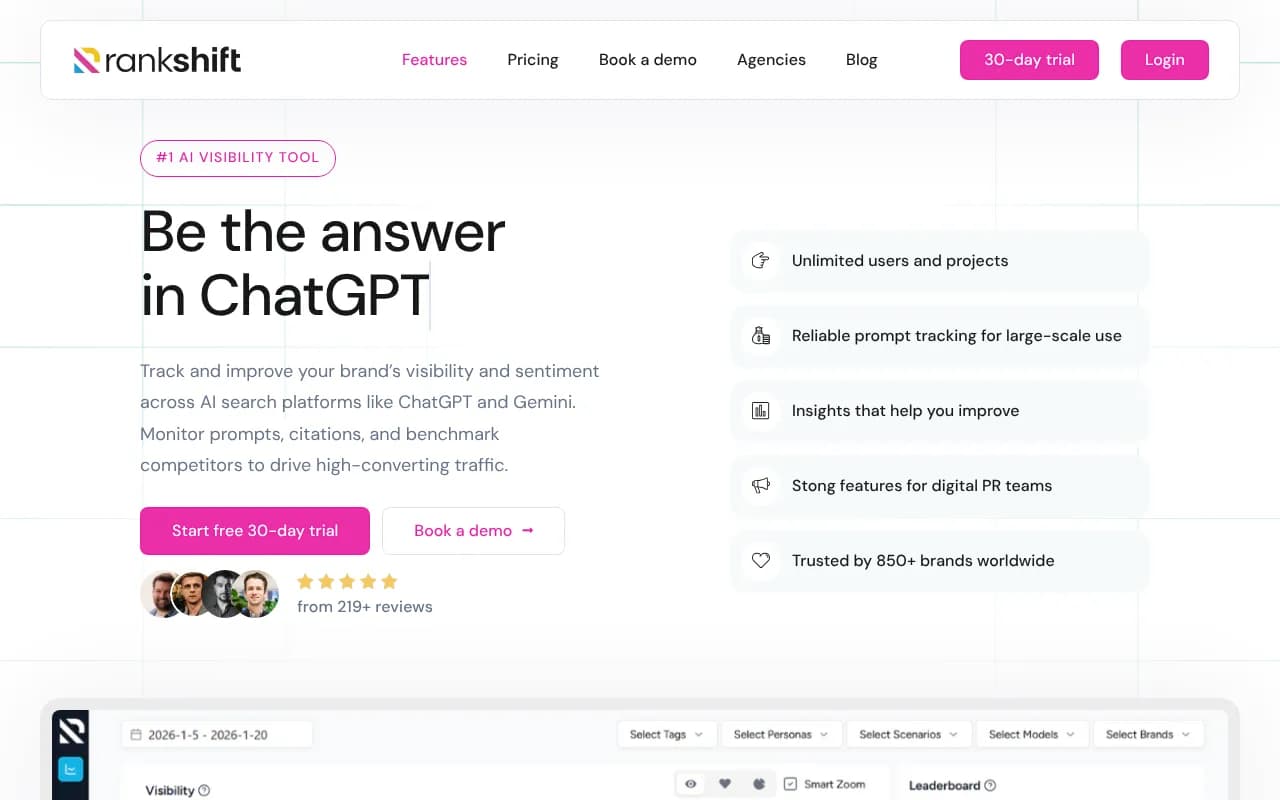
Rankshift
Useful for agencies that want AI citation data in the same view as organic positions rather than running a separate platform.
Comparison table
| Tool | Data approach | Starting price (verify) | Beyond monitoring | Best for |
|---|---|---|---|---|
| Promptwatch | Real interfaces plus API models | $95/mo, free Explore plan | Crawler logs, traffic, Content Agent, publishing | Teams that want to fix, not just watch |
| Profound | Monitoring focus | Higher tier pricing | Limited execution | Enterprise monitoring |
| Peec AI | Prompt tracking | From about 89 EUR/mo | Light | Agencies wanting a clean UI |
| Otterly.AI | Prompt tracking | From about $29/mo | Light | Cheap first look |
| Searchable | Multi-surface | See vendor | Content and technical tools | ChatGPT surface coverage |
| Rankscale | High-frequency sampling | From about $20/mo | Light | Variance checks |
| SE Ranking, Semrush, Ahrefs | Add-on to SEO suite | Bundled | SEO suite data | Existing customers |
Prices for non-Promptwatch tools come from vendor-authored roundups and may be out of date.
Build your own, if you must
Some teams script their own monitor. One published approach submits a batch of chatgpt.com query URLs to a scraping API, parses the results, and checks whether your brand name or domain appears:
text = json.dumps(content.get("json_content", "")).lower()
print(item["custom_id"], "mention:", BRAND.lower() in text, "citation:", DOMAIN in text)
That is a legitimate starting point, and it hits the real interface rather than the model API. But you own everything after that: proxies per country, retries, parsing changes when the UI shifts, repeated sampling, deduplicating citations, and storing history. A substring match on "Acme" also can't tell a mention from a negative one. Fine for a weekend experiment. If you need a number you will defend in a board meeting, buy.
A setup that holds up
- Pick 30 to 100 prompts, not 5. Mix organic category questions, brand-specific prompts and competitor comparisons. They behave differently, as the citation-count data above shows.
- Use personas and locations. A buyer in Amsterdam and one in New York can get different answers.
- Sample daily. Averages across days smooth out the randomness of individual responses.
- Annotate platform events. Mark model launches and known changes, such as the March 4 citation drop, so you don't chase phantom problems.
- Read the metrics together. Low share of voice is a coverage problem. Late position is a prominence problem. Mentions without citations to your domain point to a content or crawlability problem. Weak sentiment is a reputation problem.
- Check crawler access. If GPTBot or OAI-SearchBot can't read your pages, no amount of content work helps. Crawler logs settle this quickly, and the free Agentic Readiness Check is a fast first test.
- Close the loop. Ship content against the gaps, then check whether the pages got crawled, cited and clicked. Product pages are the most cited type at 22.4% of ChatGPT citations in Promptwatch's content type report, while news loses half its cited pages within 36 days, so refresh cadence depends on page type.
Which approach fits you
- Solo or tiny budget: a low-cost tracker like Otterly or Rankscale, or Promptwatch's free Explore plan, plus a monthly manual spot check.
- Already in Semrush, Ahrefs or SE Ranking: start with the add-on, and graduate when you need crawler data or citation-level detail.
- In-house SEO or content team that has to move numbers: an interface-based platform with action and content tooling. The free AI visibility report is a no-login way to see where you stand first.
- Agency: look at plans with pitch reports and unlimited projects, such as Promptwatch's agency plans.
For a wider shortlist across categories, the directories at ai-rank-tools.com and bestgeosoftware.com are worth a browse.
FAQ
Can I track ChatGPT rankings for free?
Partly. Run a consistent prompt set in fresh sessions and log results in a spreadsheet, or use a free report or entry plan. Expect noisy data, since answers vary by session and model version.
Is API data wrong?
No, it measures something different. It shows what a model says from its own knowledge and is reproducible. It can miss the citations, shopping results and web-search behavior real users get in ChatGPT.
How many prompts do I need?
One prompt is an anecdote. Start with a few dozen across prompt types and grow from there.
How often should data refresh?
Daily at minimum. Faster during launches or campaigns, and whenever ChatGPT changes behavior.
Does ranking well in Google mean ChatGPT will mention me?
Not reliably. A brand can sit high in Google and be missing from ChatGPT answers entirely, which is exactly why separate tracking exists.