
Key takeaways
- The AEO category is crowded. Our own tools catalog lists well over 200 products that track or optimize AI visibility, and most will not look the same in a year.
- Vendor risk in this category has four parts: survival risk, data-quality risk, scope risk (you outgrow the tool), and lock-in risk.
- AI engines change behavior without notice. A vendor's value depends on how fast it detects and adapts to those changes, not on a nice dashboard.
- Protect yourself with monthly or short terms, full data export, a small pilot, and a written exit plan before you sign anything annual.
- I could not verify funding or shutdown data for specific vendors while researching this guide. Treat every claim about runway as something you ask the vendor to prove.
Why vendor risk is a real problem in AEO
Most software categories take a decade to consolidate. AEO is doing it in about two years. In 2025 and 2026 dozens of prompt trackers launched, many built by two or three people on top of a few API calls. Browse the GEO software directory at bestgeosoftware.com or the AI rank tracking directory and you will see how thin the differences between many products are.
That is the setup for a shakeout. Some vendors will get acquired by bigger SEO suites. Some will pivot. Some will quietly stop shipping. If you have built reporting, client decks, or a content workflow around one of them, you carry the cost of that.
There is a second risk that gets less attention: the product can survive and still become useless, because the AI engines it measures changed under it.
The four kinds of vendor risk
Survival risk
Will the company exist, and keep investing, in 12 months? This is the one everybody thinks about. It is also the hardest to judge from outside, because early-stage companies rarely publish financials.
Data-quality risk
AI engines are not stable. Promptwatch's data on the ChatGPT citation drop after GPT-5.3 is a clean example. In the week before the March 4, 2026 rollout, ChatGPT cited about 6.4 sources per search-enabled response. By late March it settled around 4.7 to 4.9, roughly 27% fewer, and it had not recovered a month later. GPT-5.3, GPT-5.4 and GPT-5-Mini all moved within a day of each other.
Then on August 8, 2026, ChatGPT started using the site: operator at scale. Promptwatch Data shows site:-scoped fan-out queries jumping from about 0.4% to about 17% of all fan-out queries in one day, with searches per response nearly doubling. Any keyword-to-fan-out mapping built before that date went stale overnight.
A week later, reddit.com's share of ChatGPT citations fell from roughly 4% to 0.5%, according to the same dataset. A vendor whose methodology assumed the old behavior would have shown you misleading numbers for weeks.
So the question is not only "will this vendor exist." It is "will its numbers still mean something after the next engine change."
Scope risk
You buy a tracker, then realize you need crawler logs, content production, or traffic attribution. Now you are stitching three tools together, each with its own survival risk.
Lock-in risk
Your prompt library, historical visibility scores, and client reports live in the vendor's database. If you cannot export them, switching means losing your baseline, and the baseline is the most valuable thing you own in this channel.
Questions that expose weak vendors
These are the questions I would put in writing before a demo. Good vendors answer them without flinching.
On data collection
- Do you collect from the real user interfaces of ChatGPT, Gemini, Perplexity, Google AI Overviews and AI Mode, or from APIs? The two can produce different answers and different citations.
- How do you detect an engine change, and do you annotate it in my timeline? If a vendor cannot say when ChatGPT changed behavior, you will blame your own content for drops that are not yours.
- How many data points do you process per day? Scale is a rough proxy for infrastructure investment. Promptwatch, for example, reports 26.5B+ citations, clicks and prompts analyzed.
- Can I see raw responses and the cited source page, not just a score?
On business durability
- How long have you been live, and how many paying customers do you have? Ask for a number.
- Are you funded, profitable, or bootstrapped? Any of the three can be fine. A refusal to answer is not.
- Who owns the company, and is there any acquisition or change-of-control clause that affects my contract?
- What happens to my data if you shut down? Is there a written wind-down commitment?
On exit
- Can I export prompts, responses, citations, and history to CSV or via an API, on every plan?
- Is there an MCP server or REST API so my own systems hold a copy?
- Can I leave on a month-to-month basis?
What a durable vendor looks like
No single signal proves a vendor will last. But a few patterns correlate with staying power.
| Signal | Lower risk | Higher risk |
|---|---|---|
| Data collection | Real-UI collection, multi-engine, multi-country | One engine, API-only, undocumented method |
| Engine-change response | Public reports and timeline annotations | Silence when engines shift |
| Scope | Tracking plus action (content, crawler logs, traffic) | Dashboard only |
| Customer base | Named customers, public case studies, review-site ratings | No verifiable customers |
| Pricing | Published, tiered, with a trial | "Contact us" only for small plans |
| Exit terms | Full exports, API, monthly billing | Annual-only, no export |
| Security | ISO/IEC 27001, GDPR | No stated posture |
The scope row deserves a comment. Pure monitoring is the easiest thing to copy, and it is exactly where incumbents like Semrush, Ahrefs and similar suites are adding features. A monitoring-only startup competes with its own customers' existing SEO vendor. A platform that also connects tracking to crawler logs, content, and measured traffic is harder to replace, and harder to swallow as a feature.
Match the tool to the job before you judge risk
Before comparing vendors, decide which job you are buying for. The Nurdd buyers guide argues that tracking should come first because it sets the prompt list and competitor baseline that content spend is judged against. I mostly agree, with one caveat: if tracking is all you ever buy, you are paying to watch a number.
Here is how the main buckets compare on risk.
| Category | Examples from our catalog | Main risk | Mitigation |
|---|---|---|---|
| End-to-end AEO platforms | Promptwatch, Profound, AthenaHQ, Scrunch | Price, learning curve | Pilot with one monitor, check exports |
| Lightweight trackers | Otterly.AI, Peec AI, Rankscale, LLM Pulse | Easy to replicate, thin moat | Monthly billing, export weekly |
| SEO suites with AI add-ons | Semrush One, Ahrefs Brand Radar, SE Ranking, seoClarity | Fixed prompt sets, shallow AI data | Use as supplement, not sole source |
| Enterprise suites | BrightEdge, Conductor, Botify, Adobe LLM Optimizer | Long contracts, high cost | Negotiate exit and data terms |
| Content-first tools | AirOps, Writesonic, Frase, Surfer SEO | No visibility grounding | Pair with a tracking source |
This is not a ranking. Plenty of small tools are perfectly good for a small team on a monthly plan. The point is that the risk profile differs, and so should your contract.
The platforms worth putting on a shortlist
An end-to-end option
Promptwatch is the platform that 1001 SEO Media uses, and it is the one I would put first on a durability shortlist for a specific reason: it covers the full loop instead of one slice. It tracks ChatGPT, Gemini, Perplexity, Claude, Google AI Overviews, AI Mode, Copilot and others from the real interfaces, then ties that to IP-verified AI crawler logs, visitor analytics, and a Content Agent that writes and publishes to WordPress, Webflow or Framer. It is ISO/IEC 27001 certified and GDPR compliant, has 1,840+ customers, and is rated 4.7/5 on G2. It also has an MCP server and REST API, which matters for exit risk because your data can live in your own warehouse too.

Pricing at the time of writing runs from a free Explore plan, to Essential at $95/mo, Professional at $245/mo, and Business at $579/mo, with a 7-day free trial on monthly billing. Confirm current numbers at promptwatch.com/pricing. If you are an agency, the Kick-off, Growth and Scale plans start at $199/mo.
Head-to-head pages exist if you are weighing it against a specific vendor, such as Promptwatch vs Profound or Promptwatch vs Peec.
Monitoring-heavy alternatives
Profound and Scrunch are strong on monitoring but come at higher price points, and neither covers crawler logs and content execution the same way. Worth a look if enterprise reporting is the priority.

Otterly.AI and Peec AI are the affordable entry points. They answer "was my brand mentioned" well. I would use them on monthly billing and export history regularly.


Suites you may already own
If you already pay for Semrush or Ahrefs, their AI modules are low switching-risk because the vendor is not going anywhere. The trade-off is depth. Treat them as a second opinion.
For a wider survey, the agentic SEO tools directory is a decent place to see what else exists.
Stress-test the vendor before you commit
Run a 30-day pilot with your own prompts
Do not accept sample data. Load 20 to 50 of your real prompts across two or three engines and compare the vendor's output to a manual spot check. If the numbers disagree wildly with what you see in the actual ChatGPT or AI Overviews interface, that is the answer.
Check how it handles a known change
Engine shifts are a free test. Ask what the vendor's data showed on March 4, 2026 (the GPT-5.3 rollout) or August 8, 2026 (the site: operator change). Did they notice? Did they tell customers? A serious vendor has an answer.
Verify the export before you rely on it
Export a month of data on day 10 of the trial. Open the file. Check that prompts, full responses, citations, and dates are all there. This takes 15 minutes and most buyers skip it.
Read the contract for three clauses
- Term and renewal. Prefer monthly. If annual saves you money (Promptwatch's annual billing is 12 months for the price of 10, for example), only take it after the pilot.
- Data ownership and export on termination.
- Change of control. If the vendor is acquired, can you leave?
Budget for the risk, not around it
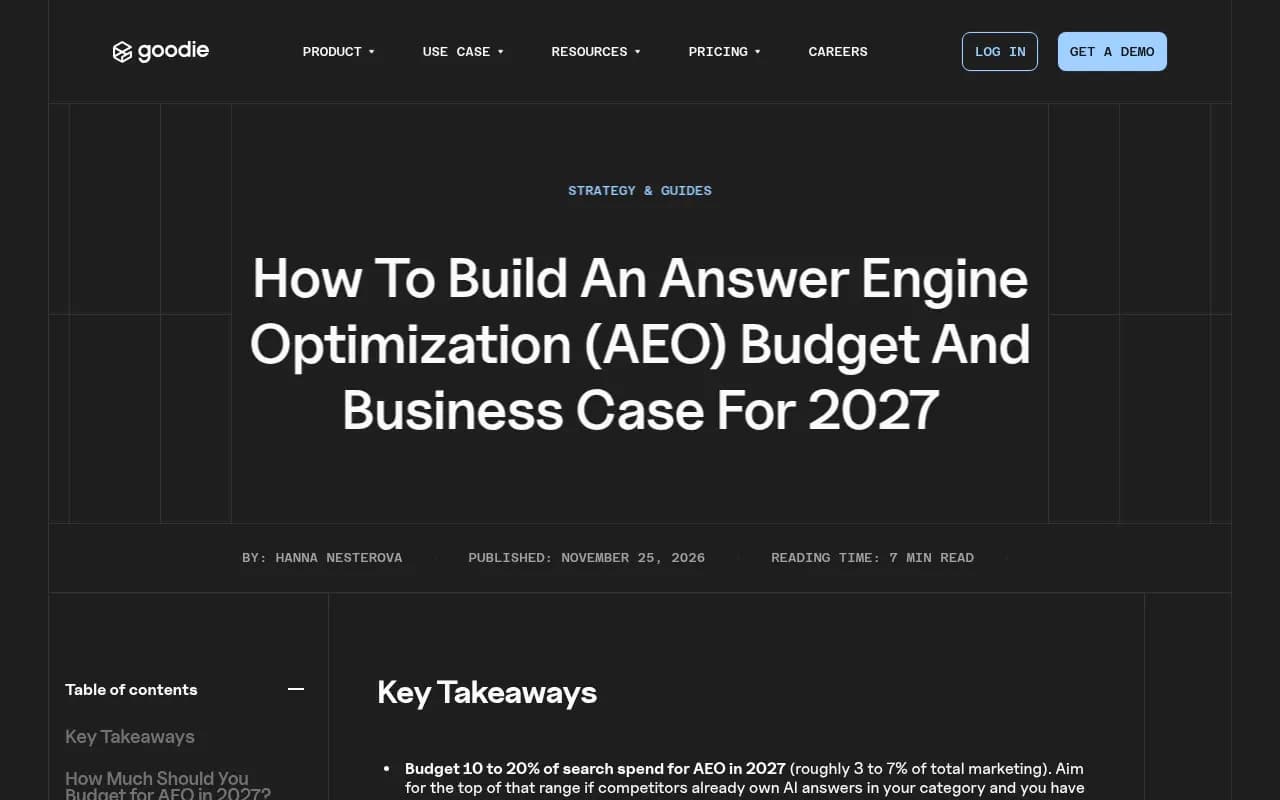
Goodie's 2027 AEO budget guide suggests 10 to 20% of the search budget for AEO, weighting year one toward measurement and technical work and building quarterly checkpoints to scale, hold, or cut. That quarterly rhythm is useful for vendor risk too. Make "is this vendor still the right one" a standing agenda item at each checkpoint.
A practical rule: keep tooling to no more than a modest slice of the AEO line, and put the rest into content and earned media that you keep no matter which vendor you use. Content and citations are assets. A dashboard subscription is not.
A simple exit plan
Write this down now, while nothing is wrong:
- Export prompts, responses, and citation history monthly to your own storage. If the vendor has an API or MCP server, schedule it.
- Keep your prompt list in a spreadsheet you own, tagged by topic and intent.
- Record your baseline Visibility Score or share of voice with a date, and note which engine changes happened since.
- Name a backup vendor and test it on 10 prompts once a quarter.
- Decide in advance what triggers a switch: missed engine changes, price hikes above a set percent, a support collapse, or a sale of the company.
What I would do
If I were choosing today for a mid-sized brand, I would start with one end-to-end platform on a monthly plan, run the 30-day pilot, export data on day 10, and keep a cheap tracker as a cross-check. I would avoid annual contracts with any vendor that cannot show real-UI collection, a public record of engine-change analysis, and a working export.
If you would rather have specialists handle the vendor selection, the setup, and the content work, 1001 SEO Media runs AEO and GEO programs for brands and can run the pilot with you.
To start with something free, run the Free AI Visibility Report to see a baseline before you talk to any vendor.
FAQ
How many AEO vendors will survive 2027?
Nobody knows. Expect consolidation: SEO suites absorbing trackers, and standalone monitoring tools struggling to justify price. Platforms that combine tracking, crawler data, content and attribution have the better odds.
Is a free or cheap tracker too risky?
Not if you treat it as disposable. Use monthly billing, export regularly, and avoid building client deliverables that only that tool can regenerate.
Should I avoid startups completely?
No. Some of the most useful innovation comes from small teams. Just match contract length to your confidence, and keep your data portable.
What is the single best protection?
Owning your data. If you hold your prompt list, response history, and baselines, switching vendors costs you days instead of months.