
Key takeaways
- Anything an AI can write from public information earns no credit. Proprietary numbers are the one asset a model has to attribute to someone.
- A model quotes a sentence, not a page. Put the fact early, make it stand on its own, and make your brand the subject.
- Original data rarely gets cited as "a study." In Promptwatch Data, ChatGPT cites mostly product pages, landing pages, listicles and comparisons, so the numbers should live on those page types.
- Being the primary source does not guarantee the citation. Third-party coverage of your data often gets cited instead, so plan for press and outreach.
- Track the result. Without citation and crawler data, you are guessing whether the numbers worked.
Why original data matters for ChatGPT
I'll start with the uncomfortable part. Most content published for AI search is a remix of what already exists. A model can write that remix itself, so it has no reason to cite you for it.
Proprietary data is different. Your turnaround times, your order minimums, your customer survey, what your own Search Console shows. Nobody else can state those facts. As Roman Sadowski of Rank Dough puts it, proprietary data is the one thing an AI answer cannot write without you, and it only earns a citation when it is phrased for lifting.
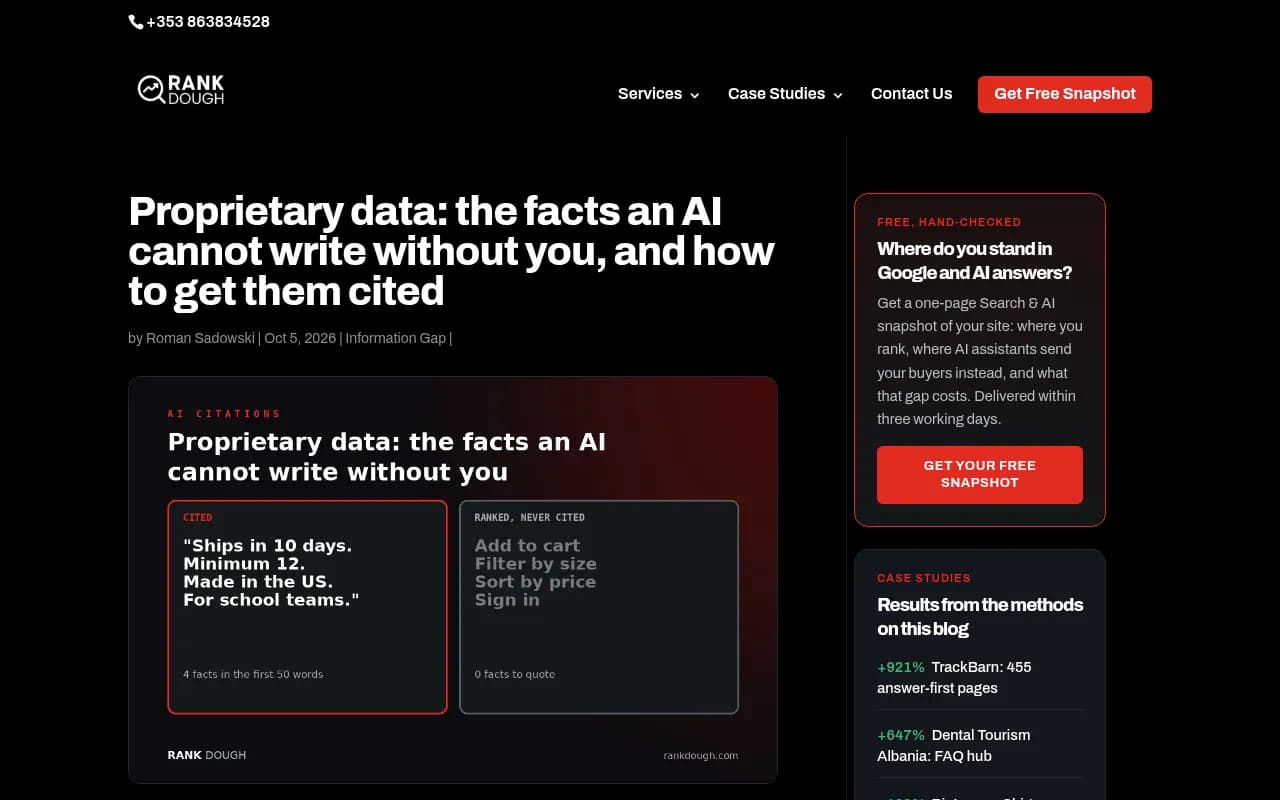
In Rank Dough's September 2026 test, the pages ChatGPT cited had turnaround, minimum order, origin and audience as plain facts in their first 50 words. The pages that only ranked in Google were product grids whose extracted text read "add to cart." That is a small test (6 buying prompts, 23 pages), so treat it as a strong hint rather than a law. But it matches what other practitioners report. Justin McKelvey says every ChatGPT citation his business holds is a "how much does X cost" page with real numbers on it.
There is also a pattern in the entities. Growth Memo's analysis found that the entity types predicting ChatGPT citations most are dates and numbers. High-cited pages are dense with a specific methodology, a precise statistic, a named comparison. Original data produces exactly that kind of content as a side effect.
What counts as original data
You don't need a research department. Four sources cover most companies:
- Your own operational data: orders, turnaround times, pricing, usage, support volumes, return rates.
- Customer surveys, even small ones, with the sample size and dates stated.
- Aggregated product or platform data, such as benchmarks across your customer base (anonymized).
- Your own tests: you ran 23 pages through 22 attributes, you timed 50 checkouts, you compared prices across 40 competitors.
The test is simple. If a competitor could reproduce the sentence from a Google search, it is not original. If only you can say it, it is.
Examples of liftable facts
| Weak (public, generic) | Strong (proprietary, specific) |
|---|---|
| Custom orders usually take a few weeks | Our median turnaround on 1,200 orders in Q3 2026 was 9 working days |
| Prices vary by size | A 50-seat plan costs $X per month; the median customer pays $Y |
| Many marketers use AI tools | 62% of 410 marketers we surveyed in October 2026 used AI weekly |
| Our product is fast | Pages load in 1.1 seconds at the 75th percentile across 300 customer sites |
The strong column has a number, a population and a date. That trio is what a model can quote safely.
Phrase it so a model can lift it
A model cites a sentence, not a page. Rank Dough's rule of thumb is to put the fact in the first 80 words, standing on its own, with the brand as the subject. NP Digital makes a similar recommendation: place significant original data within the first third of educational and commercial pages so both crawlers and models reach it before the page gets cut off.
Here is a practical template for the opening of a data page:
[Brand] analyzed [N things] between [date] and [date].
The median [metric] was [number]. [Segment A] was [number];
[Segment B] was [number].
Method: [one sentence on how the data was collected].
A few habits that make the difference:
- Write full sentences with the brand as the subject. "Acme's 2026 survey of 410 marketers found..." can be quoted as is. "Our survey found..." loses its owner when extracted.
- State the method and sample in plain text, not in an image. Charts are invisible to most crawlers.
- Put the key number in a heading or the first paragraph, and repeat it in a short table.
- Add a balanced explanation of what the data means. Growth Memo notes that balanced sentiment and entity-rich analysis help, and a flat "we're the best" claim does not.
- Cite your own primary sources with live links. It signals the claim is checkable.
Put the numbers on the right page types
Here is where I'd push back on the usual advice to publish a big research report and wait. Promptwatch Data on which content types ChatGPT cites (Sep 28 to Oct 4, 2026) has no separate "original research" category. Product pages get 22.4% of classified citations and landing pages 16.8%, so about 39% go to pages that describe what a company sells. Listicles get 13.6%, how-tos 8.7%, comparisons 5.9% and news 5.7%.
The report doesn't say where original studies land, and I haven't verified it. My read is that data gets cited when it is embedded in these formats, or when third parties cover it. That suggests a practical split:
| Page type | Share of ChatGPT citations (Sep 28 to Oct 4, 2026) | How to use your data there |
|---|---|---|
| Product pages | 22.4% | Real prices, specs, turnaround, minimums in the opening lines |
| Landing pages | 16.8% | Customer outcome numbers, with sample size and date |
| Listicles | 13.6% | Add your benchmark data as the evidence behind each pick |
| How-tos | 8.7% | Step timings and success rates from your own tests |
| Comparisons | 5.9% | Measured differences, not adjectives |
| Docs | 7.5% | Limits, quotas and performance figures |
The split matters by intent too. For commercial prompts, product pages get 26.0%, landing pages 20.6% and listicles 15.0%, and those types plus comparisons make up almost 70% of commercial citations. Branded prompts lean on product and landing pages (23.3% and 22.8%), with reviews rising to 5.6%.
So the playbook is less "publish a study" and more "put a real number on the page that already answers the buying question." Pricing and cost pages are the easiest first move. Pick your highest-intent "how much does X cost" question and put an actual figure on an actual page.
Plan for the citation you might not get
Here is the catch. Growth Memo is blunt about it: original data wins citations, but being the primary source might not. Another page that reports your findings can be the one the model cites.
That is not a loss if you handle it well. Even when your findings are picked up by another source that gets cited, the third-party authority signals tend to build back to you. But you can help it along:
- Pitch the data to industry publications, roundups and expert articles. Press matters here; McKelvey's tracking found outlets like Business Insider and Axios dominate his ChatGPT source mix.
- Give journalists a quotable sentence, the method, and a downloadable table. Make attribution easy.
- Name your brand next to every number. Unlinked mentions still help, and some tools can find them.
- Mind the half-life. In Promptwatch's content half-life data (pages cited on July 6, 2026, tracked to Oct 4), news loses half its pages within 36 days, with about a quarter never cited again after day zero. Landing pages and docs held 78% and 76% after 30 days. Press coverage is a burst. Your own landing, docs and pricing pages are the long-term asset.
Social channels are a smaller lever. In the November 2026 social citation data (Oct 11 to Nov 9), ChatGPT got only 0.64% of its citations from social platforms, though YouTube reached 6.71% of Google AI Overviews citations. If you distribute your data in video or on Reddit, you are mostly aiming at Google's surfaces and Perplexity, not ChatGPT.
A step-by-step workflow
- Pick five buying questions. Use the ones customers actually ask: price, time, size, comparison, fit.
- Find the number only you have for each. Pull it from orders, surveys, support tickets or a quick test.
- Write the lifting sentence. Brand as subject, number, population, date.
- Place it in the first third of the right page. Product, landing, pricing or comparison page, not a buried PDF.
- Add method and a plain-text table. Keep it crawlable and quotable.
- Make sure crawlers can reach it. Check robots.txt and that the page renders without scripts.
- Pitch the data. Send the headline number and method to the publications your buyers read.
- Refresh on a schedule. Prices and specs go stale, and models notice. Update dates and numbers quarterly.
- Track citations and crawls, then iterate on what moved.
For step 6, free checks like the Agentic Readiness Check show which AI crawlers can read your site.
Measuring whether it worked
This is where most teams go blind. You publish the numbers, then wonder. You need three views: which prompts mention you, which of your pages get cited, and whether AI bots even fetch the page.
Tools like Promptwatch cover that loop end to end. You can watch the prompts and pages that cite you with Page Tracker and prompt tracking, see whether AI bots read the page through IP-verified crawler logs, and tie it to AI-referred visits. It also has a content gap view and a Content Agent for drafting pages from the gaps, though your proprietary numbers still have to come from you.

There are plenty of lighter options if you only need monitoring. Profound is a well-known monitoring platform, while Otterly.AI and Peec AI are simpler prompt trackers.



| Need | Option | Notes |
|---|---|---|
| Track, trace, fix and measure in one place | Promptwatch | Crawler logs, citations, content agent, visitor analytics |
| Enterprise monitoring | Profound | Strong monitoring, no agentic execution |
| Cheap prompt tracking | Otterly.AI, Peec AI | Mention tracking, no crawler logs |
| Find unlinked brand mentions | Brand24, Mention | General brand monitoring |
For wider browsing, the GEO software directory lists more options by category.
What to watch
- Citation rate on the specific pages you edited, before and after.
- Whether ChatGPT quotes your number with your brand name attached.
- Whether third-party pages that repeat your data are the ones getting cited.
- Crawl errors on data pages. If bots can't read it, no phrasing will help.
Common mistakes
- Putting the number in an infographic or image only.
- Writing "we" or "our" and losing the brand name on extraction.
- Hiding the data on page four of a gated PDF.
- Publishing a one-time study and never refreshing it.
- Skipping outreach and assuming the model will find you.
- Leaving out the method, which makes the number unverifiable.
FAQ
Do I need a large dataset?
No. A modest, clearly described sample beats a vague big claim. State the sample size and date so the number can be checked.
Is original data enough to rank in ChatGPT?
No. It helps, but the page also has to be crawlable, answer a real buying question, and sit in a format models cite. Authority from third-party coverage adds to it.
How fast will citations appear?
It varies. Rank Dough's client TrackBarn went from 10 to 145 AI Overview keywords over four months on pages built from its own figures. That is one case in Google's surface, not ChatGPT, so expect weeks to months and measure.
Which page should I fix first?
Your highest-intent cost or pricing page. Put a real, dated number in the first paragraph and check it again next quarter.
The short version
Stop writing what a model already knows. Find the five numbers only your business has, state them in sentences that carry your name, put them at the top of product, landing and pricing pages, pitch them to the publications your buyers read, and measure what gets cited.