Key takeaways
- MarketMuse is built for content strategy: topic research, content scoring, and brief creation. Writing and publishing stay manual.
- AirOps is built for content operations: it connects opportunity identification, content creation, refresh workflows, and CMS publishing in one system.
- If your bottleneck is "we don't know what to write," MarketMuse helps. If your bottleneck is "we can't produce and publish fast enough," AirOps is the better fit.
- Neither tool offers strong AI search visibility tracking (GEO/AEO). If showing up in ChatGPT, Perplexity, or Google AI Overviews is a priority, you'll need a dedicated platform alongside either tool.
Most content teams don't lack ideas. They lack the operational capacity to turn ideas into published, optimized pages fast enough to matter. That's the real tension behind the AirOps vs MarketMuse question -- and understanding it saves you from picking the wrong tool.
These two platforms are often compared because they both use AI to help content teams work better. But they're solving different problems at different stages of the content lifecycle. MarketMuse sits at the planning end. AirOps sits at the execution end. Knowing which end of the pipeline is actually broken for your team makes this decision pretty straightforward.
What each tool actually does
MarketMuse: research and planning
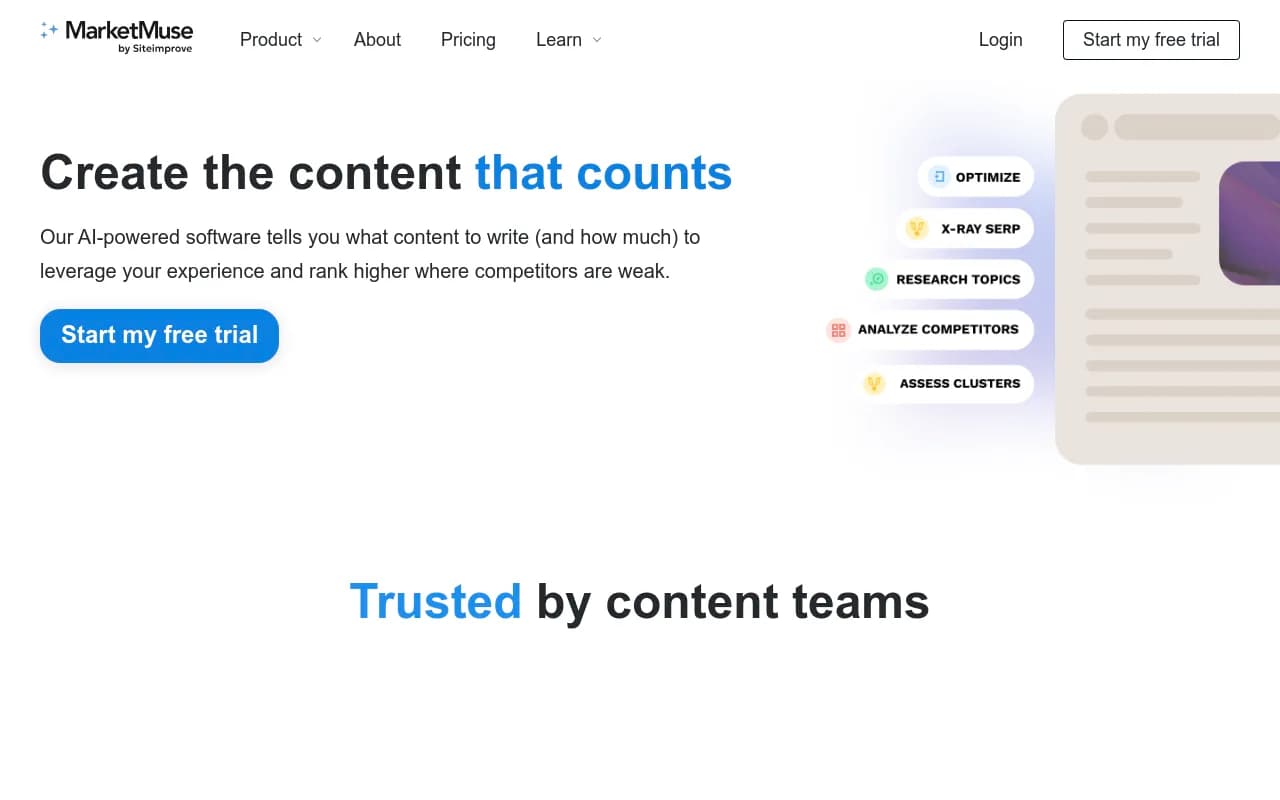
MarketMuse is fundamentally a content intelligence platform. Its core value is helping you understand the topical landscape around any subject -- what questions exist, how well your existing content covers them, and where the gaps are relative to competitors.
The main features most teams use:
- Topic modeling that maps related concepts and questions around a subject
- Content scoring that grades existing pages on topical depth and coverage
- Personalized difficulty metrics that factor in your site's existing authority (not just generic domain metrics)
- Brief generation that outlines what a well-optimized piece should cover
- Competitive content analysis showing what top-ranking pages include
What MarketMuse doesn't do: write the content, publish it, or track what happens after. Once you have a brief, you're back to your normal workflow. The tool hands off at the planning stage.
AirOps: execution and operations
AirOps is more of a content operations platform. It's built around the idea that content teams need to produce and maintain large volumes of pages -- not just plan them. The workflow connects opportunity identification, AI-assisted writing, content refresh programs, and direct CMS publishing.
Key capabilities:
- Performance-based opportunity identification (surfacing pages that need refreshing based on traffic signals)
- AI content generation with customizable templates and brand guidelines
- Bulk content creation for programmatic use cases (location pages, product descriptions, data-driven articles)
- CMS integrations that let teams publish without leaving the platform
- Content refresh workflows for maintaining existing pages at scale
AirOps is less focused on the strategic "what should we write about" question and more focused on "how do we actually produce and ship this content."
Head-to-head comparison
| Feature | AirOps | MarketMuse |
|---|---|---|
| Topic research | Basic | Strong |
| Content scoring | Limited | Core feature |
| Brief generation | Template-based | AI-driven, detailed |
| AI content writing | Yes, at scale | No |
| CMS publishing | Yes | No |
| Content refresh workflows | Yes | No |
| Programmatic SEO | Strong | Not designed for it |
| Personalized difficulty metrics | No | Yes |
| AI search visibility (GEO) | Limited | No |
| Best for | Large content libraries, execution-focused teams | SEO strategists, editorial planning |
| Pricing (approx.) | Starts ~$499/mo | Starts ~$149/mo (Standard) |
Where MarketMuse wins
MarketMuse's strongest argument is the quality of its research layer. The personalized difficulty scoring is genuinely useful -- it doesn't just tell you a topic is "hard," it factors in what your specific site already covers and how that affects your realistic chance of ranking. That's a meaningful difference from generic keyword difficulty scores.
The topic modeling is also more sophisticated than most alternatives. When you're trying to build topical authority in a competitive space, MarketMuse helps you see the full map of related concepts, not just the obvious head terms. That kind of structured planning reduces the risk of publishing content that technically covers a topic but misses the surrounding context that AI and search engines now expect.
For SEO strategists and content leads who own the "what to publish" decision, MarketMuse gives them a defensible, data-backed answer. That matters in organizations where editorial decisions need justification.
The limitation is real, though. Once the brief is done, you're on your own. Writing, review, CMS upload, internal linking -- all manual. For teams with strong writers and established publishing workflows, that's fine. For teams trying to scale output, it becomes a bottleneck.
Where AirOps wins
AirOps shines when the problem is operational rather than strategic. If you have a site with hundreds or thousands of pages that need refreshing, or you need to produce large volumes of programmatic content consistently, AirOps is built for that.
The CMS publishing integration is a genuine time-saver. Removing the copy-paste step between content generation and publication sounds minor, but across hundreds of pages it adds up. The refresh workflow is similarly practical -- instead of manually auditing which pages are declining, AirOps surfaces them based on performance signals and queues them for updates.
For agencies managing multiple client sites, or e-commerce teams maintaining product and category pages at scale, this operational layer is hard to replicate with a more research-focused tool.
The tradeoff: AirOps' template-based approach works well when your content fits the templates. Custom editorial workflows, nuanced brand voice, multi-stage review processes -- these can be harder to accommodate. Teams with complex governance requirements sometimes find the tool fighting them rather than helping.
The AI search visibility gap
Here's something worth flagging that neither tool handles well: AI search visibility.
In 2026, a growing portion of search traffic is going through AI interfaces -- ChatGPT, Perplexity, Google AI Overviews, Gemini. Neither AirOps nor MarketMuse was built to track or optimize for these channels. MarketMuse has no explicit AI visibility tracking. AirOps has some signals but it's not the core focus.
If your leadership is asking why you're not showing up when customers ask ChatGPT for recommendations in your category, neither of these tools will answer that question. That's a separate problem requiring a dedicated GEO (Generative Engine Optimization) platform.
Promptwatch is one option worth looking at here -- it tracks how your brand appears across ChatGPT, Perplexity, Google AI Overviews, Claude, Gemini, and others, and includes content gap analysis to help you fix visibility issues, not just measure them.

Which team should use which tool
Use MarketMuse if:
- Your primary bottleneck is strategic: you're not sure which topics to prioritize or how to build topical authority
- You have strong writers who can execute on detailed briefs
- You're competing in a space where content depth and coverage matter more than volume
- You want data-backed justification for editorial decisions
- Your publishing workflow is already efficient -- you just need better inputs
Use AirOps if:
- Your primary bottleneck is operational: you have more content to produce and maintain than your team can handle
- You're running programmatic SEO campaigns at scale
- You need CMS publishing integrated into your content workflow
- You manage a large existing content library that needs regular refreshing
- You're an agency handling content production for multiple clients
Consider using both if:
Some teams use MarketMuse for strategic planning (deciding what to build and what the brief should contain) and AirOps for execution (actually producing and publishing the content). This isn't uncommon for larger SEO teams where strategy and production are handled by different people. The cost adds up, but if both bottlenecks are real, it can make sense.
Alternatives worth considering
Neither tool is the only option in its category. A few others worth evaluating depending on your specific needs:
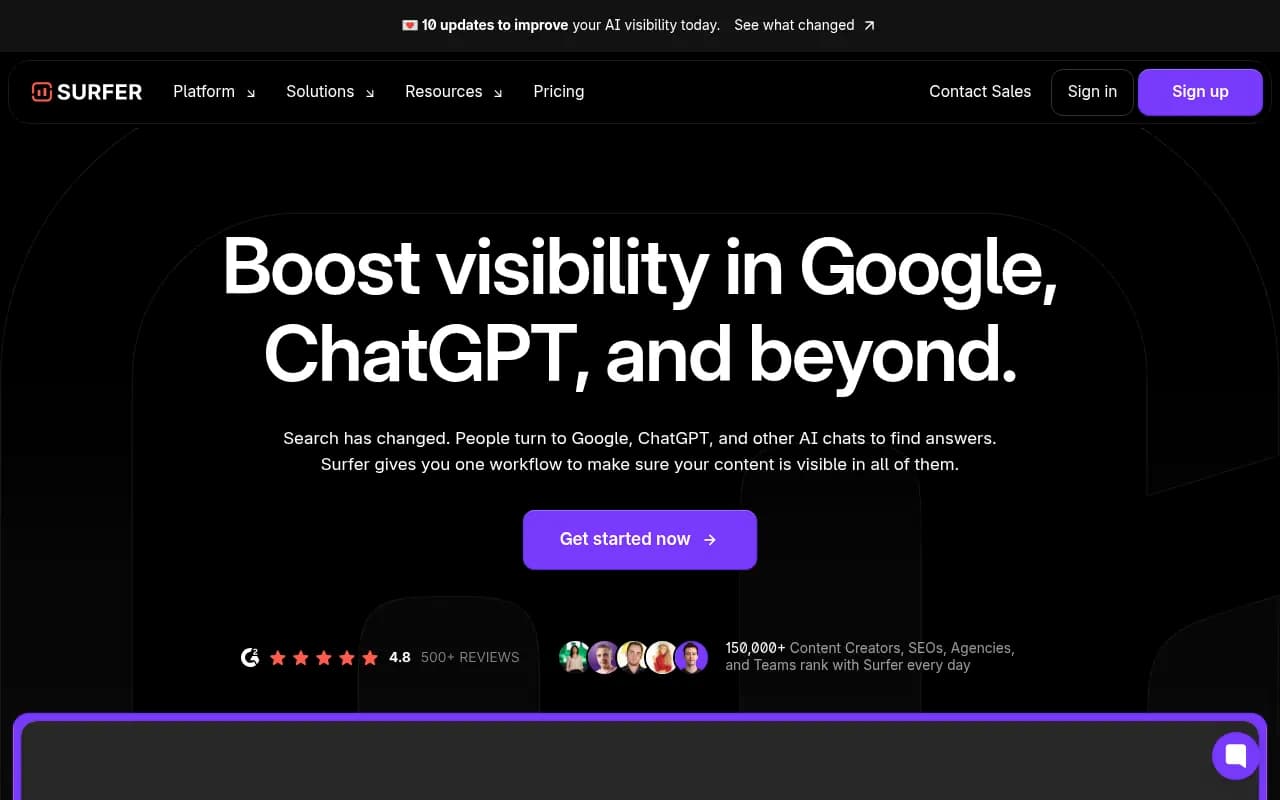
For content optimization and briefing, Clearscope and Surfer SEO are both strong alternatives to MarketMuse's brief and scoring features, often at lower price points.

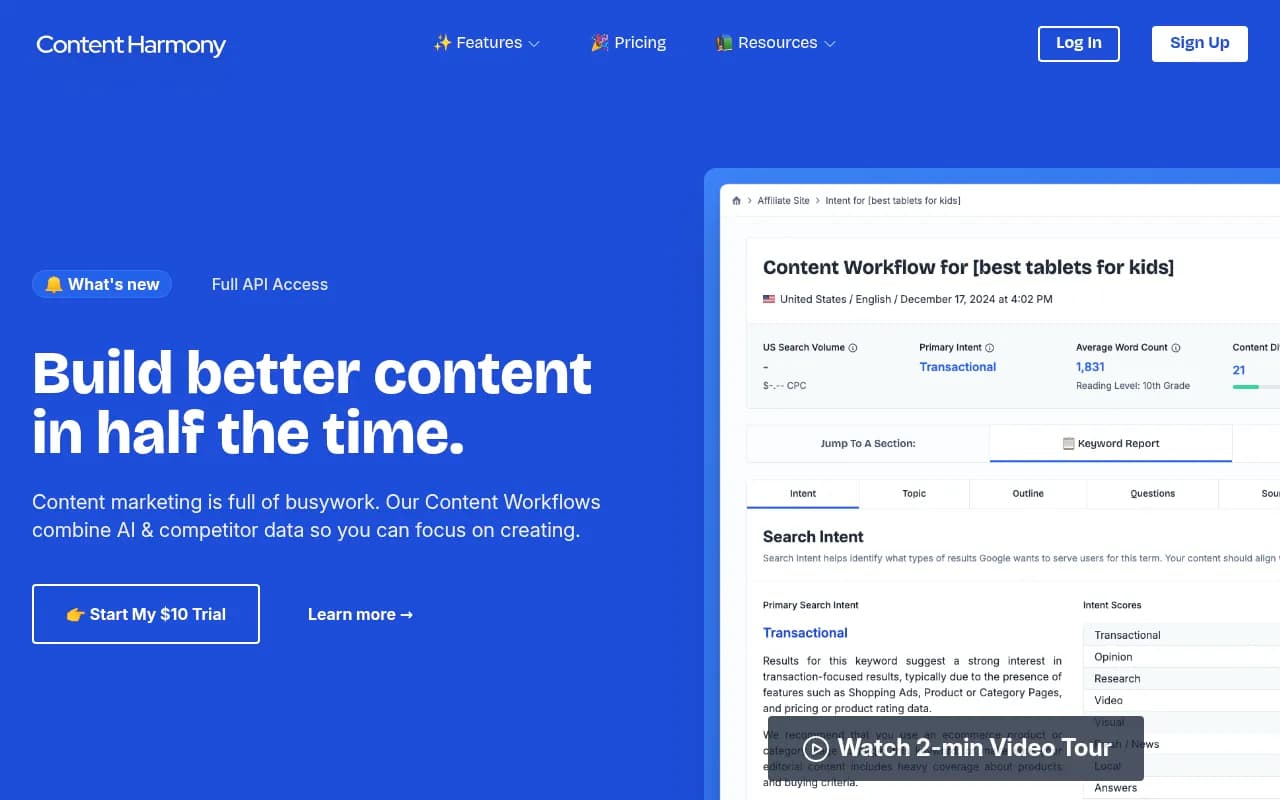
For content brief creation specifically, Content Harmony is worth a look -- it's more focused than MarketMuse and tends to be faster for teams that just need good briefs without the full topic modeling layer.
For AI writing at scale, Jasper has built out more sophisticated brand governance controls than AirOps, which matters if consistent brand voice is a hard requirement.
For teams that need workflow automation connecting content tools to the rest of their stack, n8n or Zapier can fill gaps that neither AirOps nor MarketMuse covers natively.
A note on pricing
MarketMuse's Standard plan starts around $149/month and covers basic research and brief features. The Team plan (around $399/month) unlocks more queries and the full suite of competitive analysis features. Enterprise pricing is custom.
AirOps pricing starts higher -- around $499/month for meaningful usage -- and scales with content volume and CMS integrations. For agencies, there are custom plans.
Neither is cheap. If you're a small team or just starting out, the cost-benefit calculation looks different than it does for an established SEO team with a real content production operation.
The honest verdict
MarketMuse is a genuinely good research tool that makes content strategy more defensible and data-driven. If you're a content lead who needs to convince stakeholders about editorial priorities, or an SEO strategist building topical authority in a competitive space, it earns its cost.
AirOps is a genuinely good production tool that removes operational friction from large-scale content programs. If you're running a content operation where the bottleneck is execution speed rather than strategic clarity, it earns its cost.
The mistake most teams make is buying the wrong one for their actual problem. Buying MarketMuse when your real issue is publishing speed won't help. Buying AirOps when your real issue is not knowing what to write won't help either.
Figure out where your pipeline actually breaks down first. The tool choice follows from that.