Key takeaways
- Competitor analysis in AEO isn't just about knowing who ranks -- it's about seeing which specific prompts your rivals own and why AI models prefer their content
- Most monitoring-only tools stop at showing you a visibility score; the platforms worth paying for show you the gap between you and competitors at the prompt level
- The best AEO tools in 2026 combine competitor heatmaps, source attribution, and content gap analysis -- not just brand mention counts
- A handful of platforms (Promptwatch, Profound, SE Visible, Writesonic) stand out for depth of competitor intelligence; the right choice depends on whether you need to monitor or actually fix the problem
- Free trials exist across most platforms -- test with your actual competitors before committing
The question most marketing teams are asking in 2026 isn't "are we showing up in AI search?" It's "why is our competitor showing up instead of us?"
That's a harder question to answer. It requires more than a visibility score. You need to know which prompts a competitor owns, which sources AI models are pulling from when they recommend that competitor, and what content gap on your site is causing you to lose.
This guide focuses specifically on the competitor analysis capabilities of AEO platforms -- what each one actually shows you, where they fall short, and which tools are worth your time if beating rivals in answer engines is the goal.
What competitor analysis in AEO actually means
Before diving into tools, it's worth being precise about what "competitor analysis" means in this context, because platforms use the term loosely.
There are roughly four levels of competitor intelligence in AEO tools:
- Share of voice comparison -- how often your brand appears vs. competitors across a set of prompts. Basic, but useful as a starting point.
- Prompt-level breakdown -- which specific questions your competitor ranks for that you don't. This is where it gets actionable.
- Source attribution -- which pages, domains, Reddit threads, or YouTube videos AI models are citing when they recommend a competitor. Knowing the source tells you where to publish or what to optimize.
- Content gap analysis -- a structured view of the topics and angles your site is missing that would close the gap. The rarest capability, and the most valuable.
Most tools offer level one. Fewer offer level two. Level three and four are where the real competitive edge lives.
The tools worth knowing about
Promptwatch
Promptwatch is the platform that goes furthest on all four levels. The Answer Gap Analysis feature shows you exactly which prompts competitors appear for that you don't -- not just a count, but the actual prompt text, the competitor's response, and the source being cited. That's level two and three in one view.
What separates it from most competitors is what happens after the analysis. The built-in AI writing agent generates content specifically designed to close those gaps -- articles, comparisons, and listicles grounded in citation data from over 880 million citations analyzed. You're not just learning where you're losing; you're getting a direct path to fix it.
The competitor heatmaps are particularly useful for teams managing multiple rivals. You can see, across all 10 AI models it monitors (ChatGPT, Perplexity, Claude, Gemini, Google AI Overviews, Grok, DeepSeek, Copilot, Meta AI, Mistral), exactly who's winning for each prompt and why. Combine that with Reddit and YouTube source tracking -- which most competitors ignore entirely -- and you get a much clearer picture of why AI models trust certain brands.

Pricing starts at $99/month for the Essential plan (1 site, 50 prompts). The Professional plan at $249/month adds crawler logs, which show you in real time which pages AI bots are visiting on your site and which ones they're ignoring -- directly relevant to understanding why a competitor's page might be getting cited over yours.
Profound
Profound takes a similar approach to prompt-level competitor tracking and is one of the more mature platforms in this space. Its Answer Engine Insights feature shows where your brand appears across AI responses and lets you benchmark against competitors at the prompt level. The platform also has prompt volume data, which helps prioritize which competitive gaps are actually worth closing.

Where Profound is strong: enterprise teams that need structured workflows and detailed reporting. Where it's weaker: the content creation side is less developed than Promptwatch's, so you'll likely need a separate tool to act on what you find. Pricing is also higher, which matters for smaller teams.
SE Visible
SE Visible (from SE Ranking) is a solid mid-market option with genuine competitor intelligence built in. It tracks AI visibility across Google AI Overviews, AI Mode, Gemini, ChatGPT, and Perplexity, and includes sentiment scoring alongside competitor share of voice.
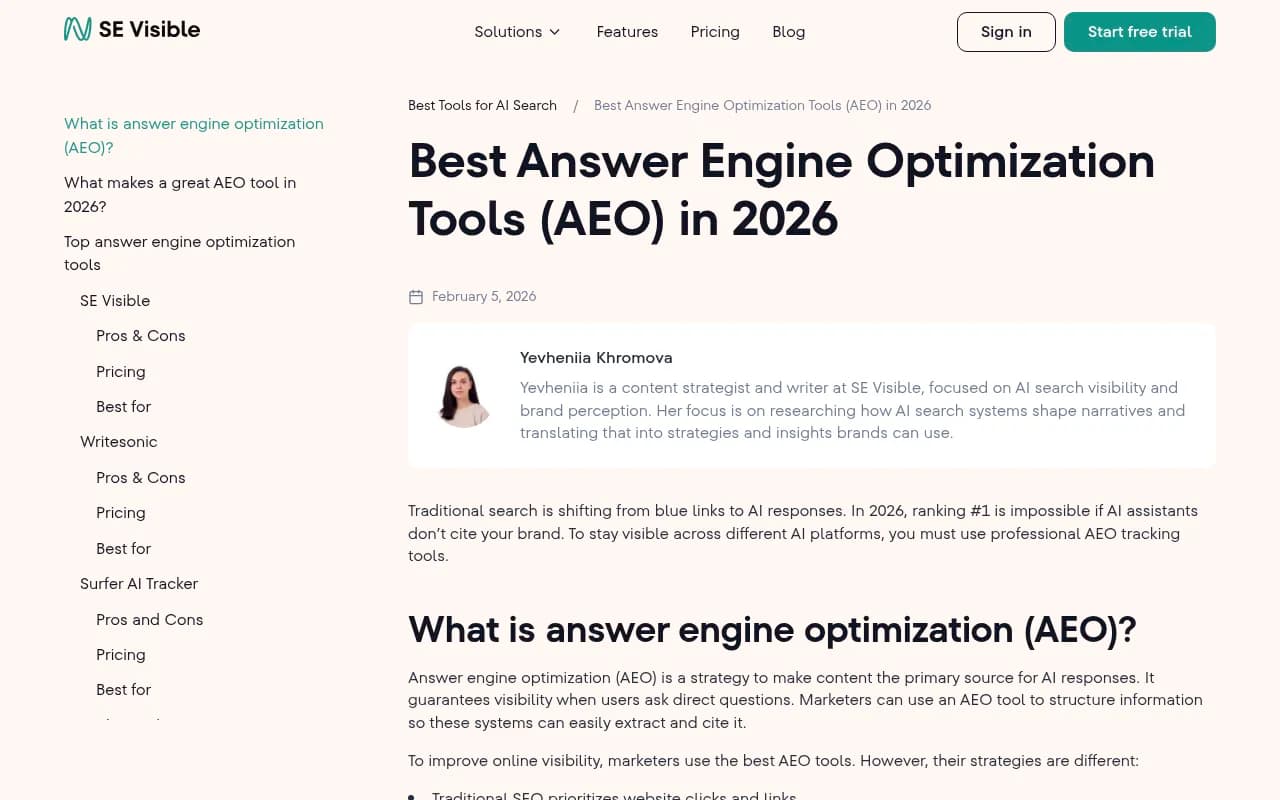
The competitor benchmarking is clear and easy to read -- you can see which rivals are appearing in AI responses for your tracked prompts and how their visibility has changed over time. It's not as deep as Promptwatch or Profound on the gap analysis side, but for teams that already use SE Ranking for traditional SEO, the integration makes it a natural extension.
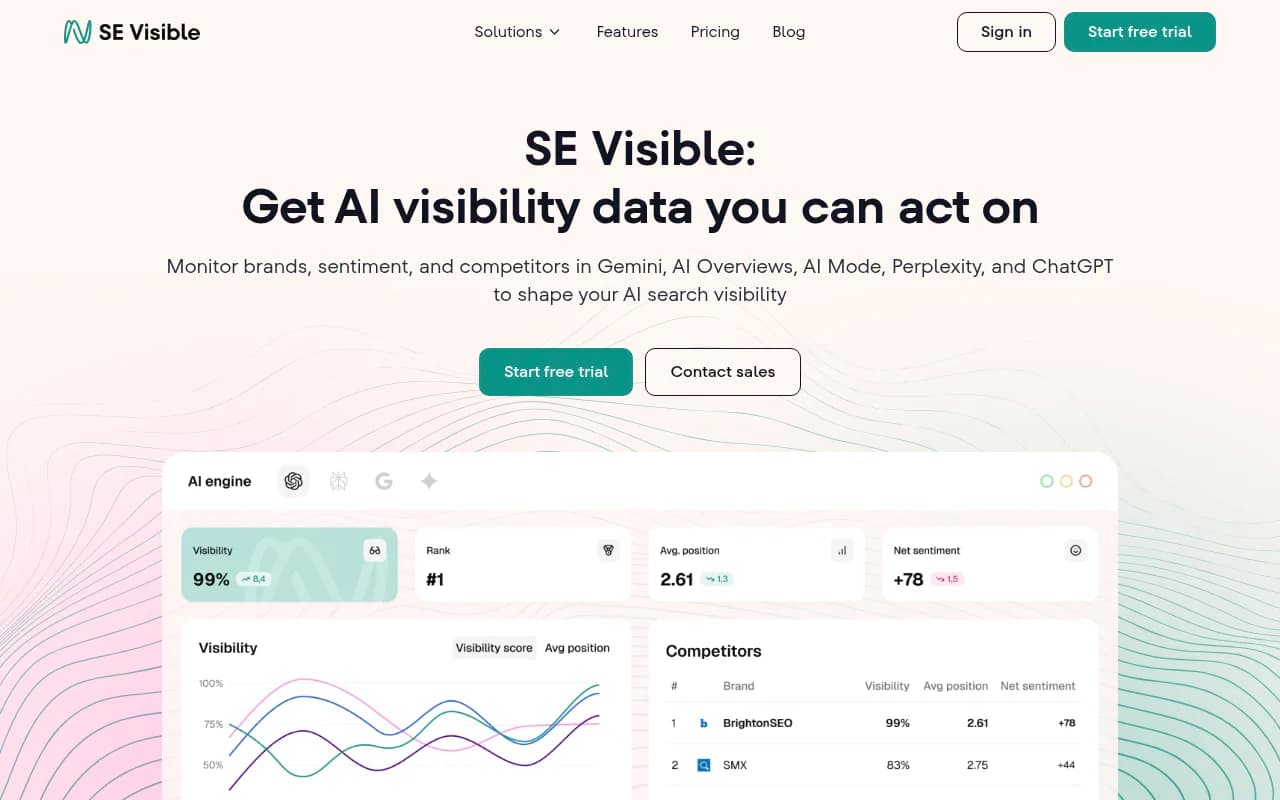
Starts at $99/month. Good value if you want a single platform for both traditional SEO and AI visibility tracking.
Writesonic
Writesonic has evolved from a content generation tool into a more complete AEO platform. Its GEO workflows combine visibility tracking with citation analysis and in-platform content optimization -- which means you can identify a competitive gap and create content to address it without switching tools.
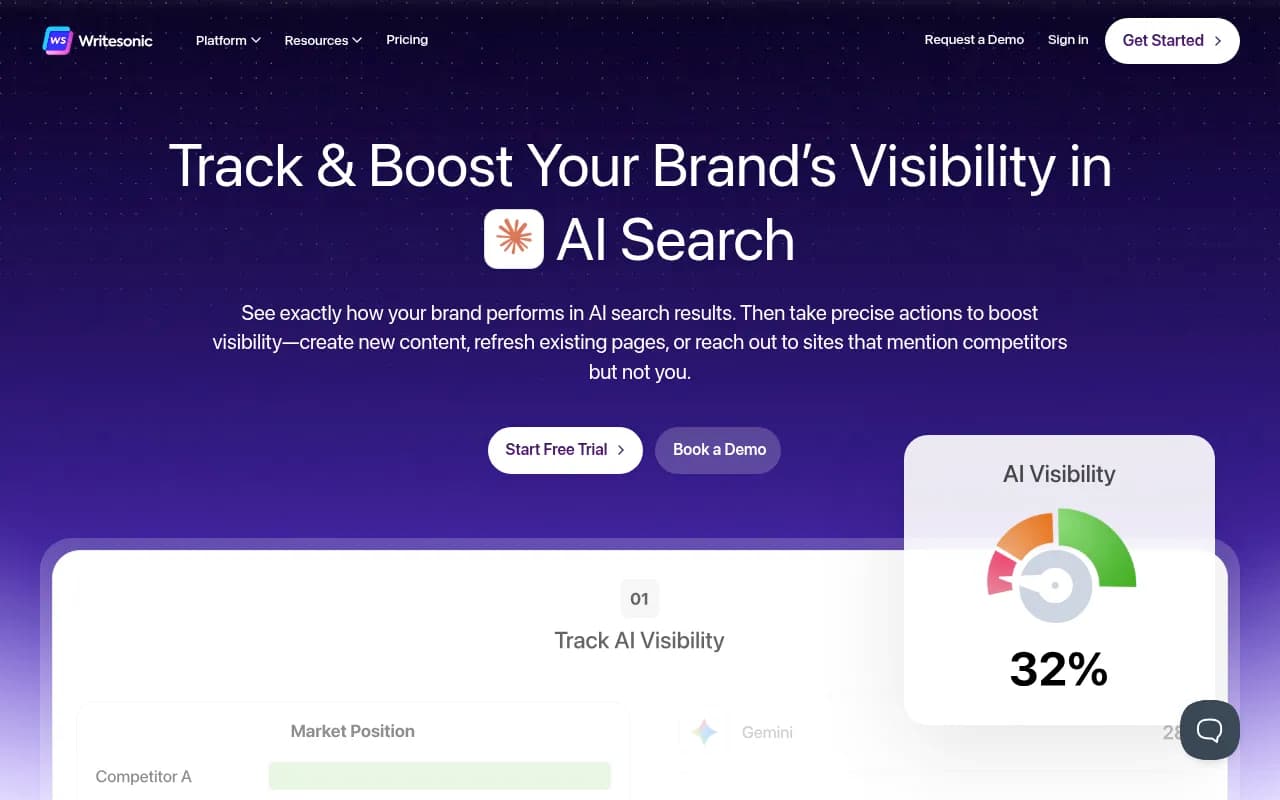
The competitor analysis features show which brands are being cited for your target prompts and what content is driving those citations. It covers ChatGPT, Google AI Mode, AI Overviews, Gemini, Perplexity, and Claude. At $199/month, it's positioned for marketing agencies and enterprises that want an end-to-end workflow.
AthenaHQ
AthenaHQ tracks your brand across 8+ AI search engines and includes competitor benchmarking in its core feature set. The interface is clean and the data is reliable, but it's primarily a monitoring platform -- you'll see where competitors are winning, but the platform doesn't help you do much about it.

Worth considering if your team already has a content production process and just needs better competitive intelligence to feed it. Less useful if you're looking for a tool that closes the loop from insight to action.
Otterly.AI
Otterly is one of the more affordable options for basic competitor share-of-voice tracking. It's straightforward: set up your prompts, add competitors, and see who's appearing where. The data is useful for quick competitive snapshots.

The limitation is that it stops there. No source attribution, no content gap analysis, no crawler data. For teams just getting started with AEO monitoring, it's a reasonable entry point. For teams that need to understand why a competitor is winning and how to respond, it's not enough.
Peec AI
Peec AI is worth mentioning for teams with multi-language or multi-region needs. Its competitor tracking works across languages, which is genuinely useful for brands operating in markets where most AEO tools only cover English.

The depth of competitor analysis is moderate -- share of voice and prompt-level visibility, but limited source attribution. A reasonable choice for international teams that need basic competitive benchmarking across languages.
Rankscale
Rankscale focuses on AI search ranking and visibility with competitor comparison built in. It's a newer platform but has been adding features quickly. The competitor heatmap view is useful for getting a quick read on who's dominating specific topic clusters.
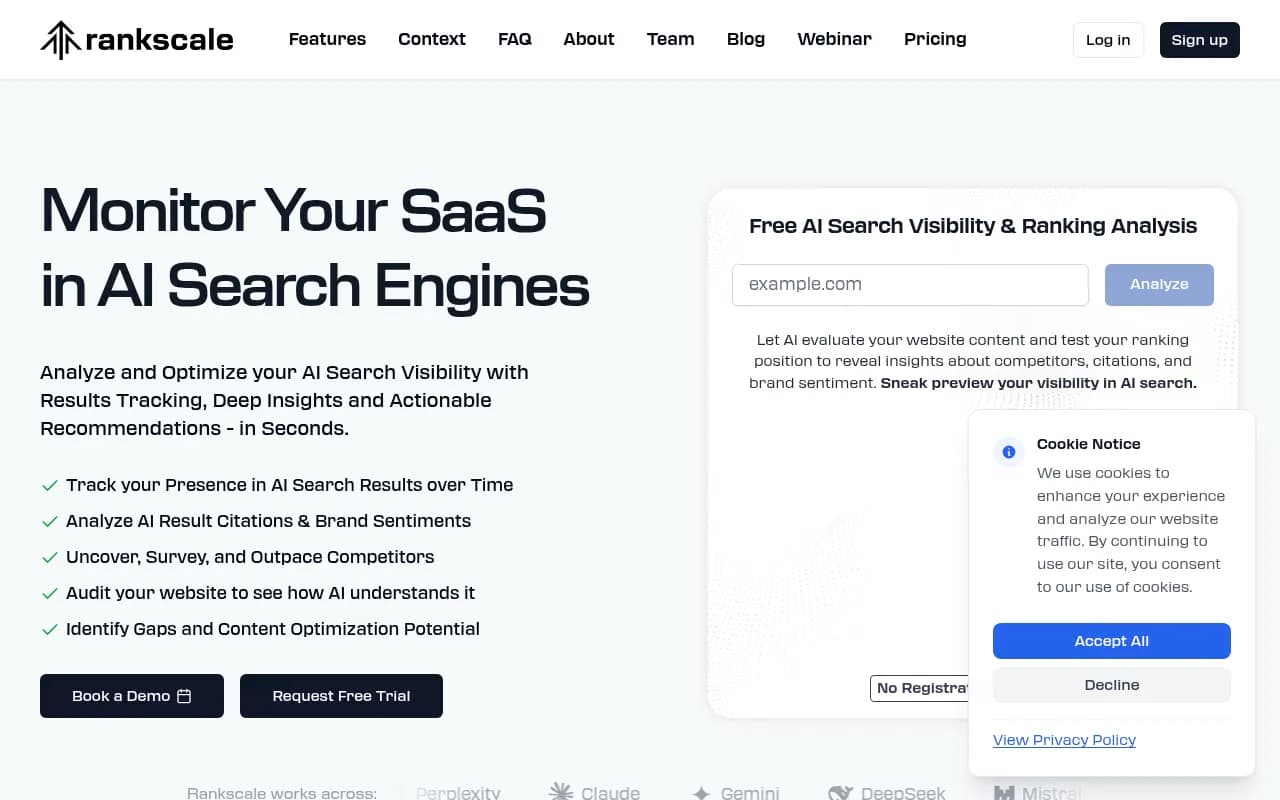
Still maturing compared to Promptwatch or Profound, but worth watching if you're evaluating options and want to see where the mid-market is heading.
Nightwatch
Nightwatch is primarily a traditional SEO rank tracker that has added AI visibility monitoring as an add-on. The competitor tracking in the AI module is basic -- share of voice across ChatGPT, Google AI Overviews, Bing Copilot, Perplexity, and Claude -- but it integrates cleanly with the classic SEO data.
The AI add-on costs $99/month on top of the base plan. If you're already a Nightwatch customer and want a lightweight way to add AI competitor monitoring without switching platforms, this is the path of least resistance.
How the platforms compare
Here's a direct comparison across the dimensions that matter most for competitor analysis:
| Platform | Prompt-level competitor gaps | Source attribution | Content gap analysis | Content generation | AI models tracked | Starting price |
|---|---|---|---|---|---|---|
| Promptwatch | Yes | Yes (incl. Reddit/YouTube) | Yes | Yes (built-in AI writer) | 10 | $99/mo |
| Profound | Yes | Partial | Limited | Limited | 6+ | Higher |
| SE Visible | Partial | No | No | No | 5 | $99/mo |
| Writesonic | Partial | Yes | Partial | Yes | 6 | $199/mo |
| AthenaHQ | Yes | No | No | No | 8+ | Custom |
| Otterly.AI | Basic | No | No | No | 4+ | Low |
| Peec AI | Basic | No | No | No | 5+ | Low |
| Rankscale | Partial | No | No | No | 5+ | Mid |
| Nightwatch | Basic | No | No | No | 5 | $39+$99/mo |
The pattern is clear: most platforms show you that a competitor is winning. Fewer show you why. Almost none help you fix it.
What to actually look for when evaluating these tools
Prompt coverage and customization
The value of competitor analysis depends entirely on whether you're tracking the right prompts. A platform that lets you define custom prompts -- the actual questions your customers ask -- will give you far more useful competitive data than one that uses fixed or generic prompt sets.
Watch out for tools that use fixed prompt libraries. If you can't add your own prompts, you're seeing a generic competitive picture, not one relevant to your market.
Source-level attribution
When a competitor appears in an AI response, the AI model is pulling that information from somewhere. Knowing the source -- a specific blog post, a Reddit thread, a YouTube video -- tells you exactly what you need to create or optimize. This is the difference between knowing you're losing and knowing how to win.
Most tools don't surface this. The ones that do (Promptwatch, Writesonic to some extent) give you a significant analytical advantage.
Multi-model coverage
Different AI models have different citation preferences. A competitor might dominate ChatGPT responses but barely appear in Perplexity. If your tool only monitors one or two models, you're missing that nuance. Look for platforms that cover at least 5-6 models and let you compare competitor performance across them.
The action gap
This is the most important question to ask any AEO tool vendor: what happens after I find a competitive gap? If the answer is "you export the data and figure it out yourself," that's a monitoring tool, not an optimization platform.
The platforms that close the loop -- from gap identification to content creation to tracking the result -- save significant time and are more likely to produce measurable outcomes.
A note on Reddit and YouTube as competitive signals
One thing that doesn't get enough attention: AI models heavily cite Reddit threads and YouTube videos when forming responses. If a competitor is winning for a particular prompt, there's a reasonable chance it's because a Reddit discussion or YouTube review is influencing the AI's answer -- not just their website content.
Most AEO tools ignore this entirely. Promptwatch surfaces Reddit and YouTube sources as part of its citation analysis, which gives you a more complete picture of why a competitor is being recommended. It also opens up a channel most brands aren't optimizing: if you can get your brand mentioned positively in the right Reddit communities or YouTube reviews, you can influence AI responses in ways that pure website optimization won't achieve.
Practical steps for running a competitive AEO analysis
If you're starting from scratch, here's a reasonable process:
-
Define 30-50 prompts that represent real buying-intent questions in your category. Include "best [category]", "[category] for [use case]", and comparison prompts like "[your brand] vs [competitor]".
-
Run those prompts through an AEO tool that supports competitor tracking. Note which competitors appear most frequently and for which prompt types.
-
For the prompts where a competitor appears and you don't, look at the source being cited. Is it a specific page on their site? A Reddit thread? A review on a third-party site?
-
Identify the content pattern. Are they winning because they have a dedicated comparison page? A detailed FAQ? A case study for a specific use case you haven't covered?
-
Create content that directly addresses the gap. This doesn't mean copying -- it means covering the topic more thoroughly, from a more specific angle, with better supporting evidence.
-
Track the result. Most AEO platforms will show you when your new content starts getting cited. Close the loop by connecting AI visibility changes to actual traffic using server logs or GSC integration.
This process is manual if you're doing it with a basic monitoring tool. Platforms like Promptwatch automate steps 2-5 significantly, which matters when you're tracking dozens of competitors across hundreds of prompts.
The bottom line
Competitor analysis in AEO is genuinely useful -- but only if the tool goes deep enough to show you why a competitor is winning, not just that they are. Share-of-voice dashboards are a starting point, not a strategy.
The platforms that stand out in 2026 are the ones that connect competitive intelligence to content action. Promptwatch does this most completely, with prompt-level gap analysis, source attribution across Reddit and YouTube, and a built-in content generation workflow. Profound and Writesonic are strong alternatives for teams with specific workflow needs. SE Visible is a solid choice if you're already in the SE Ranking ecosystem.
For everyone else: start with a free trial, run your actual competitor set through the tool, and see whether the data is specific enough to act on. If all you get is a score, keep looking.