Key takeaways
- Peec.ai was an early mover in AI visibility tracking, but recurring complaints about cost at scale, accuracy inconsistencies, and lack of actionability drove teams to explore alternatives
- The best alternatives don't just monitor -- they help you fix gaps with content generation, citation analysis, and prompt-level intelligence
- Most tools in this space fall into two camps: monitoring-only dashboards vs. full optimization platforms; knowing which you need saves a lot of wasted budget
- Pricing ranges from free tiers to $500+/mo for enterprise plans, so there's a real option for every team size
- The tools worth switching to in 2025 were the ones that expanded beyond Google AI Overviews to cover ChatGPT, Perplexity, Claude, Gemini, and more
Early 2025 was a strange time to be an SEO. AI Overviews were eating click-through rates, ChatGPT Search had just launched, and Perplexity was quietly becoming a real research destination. Peec.ai was one of the first platforms to take this seriously -- tracking brand mentions in AI-generated answers, monitoring Google AI Overview presence, and giving teams some sense of what was happening in this new layer of search.
But by mid-2025, the cracks were showing. Teams running large keyword sets were getting sticker shock on pricing. Accuracy complaints were surfacing in communities like TrafficThinkTank and r/SEO. And the bigger issue: Peec.ai told you what was happening but didn't help you do much about it.
That's when the migration started. This guide covers the 10 alternatives that teams actually switched to -- and why they were worth it.
What to look for in a Peec.ai alternative
Before diving into specific tools, it helps to know what separates a good AI visibility platform from a mediocre one. The monitoring part is table stakes now. The real differentiators are:
- How many AI engines does it cover? (ChatGPT, Perplexity, Claude, Gemini, Google AI Overviews, Grok, DeepSeek, Copilot -- the list keeps growing)
- Does it show you why you're missing from a response, not just that you're missing?
- Can it help you create content that fixes the gap, or do you have to figure that out yourself?
- Does it track actual traffic from AI sources, or just visibility scores?
- What does it cost at 100, 200, 500 prompts?
Keep those questions in mind as you read through the options below.
The 10 best Peec.ai alternatives
1. Promptwatch
Promptwatch is the most complete option on this list, and the one most worth considering if you're leaving Peec.ai because of its lack of actionability.
The core difference from most tools here is that Promptwatch doesn't stop at showing you where you're invisible. It runs an Answer Gap Analysis that identifies exactly which prompts competitors rank for that you don't -- and then a built-in AI writing agent generates content designed to close those gaps. That content is grounded in 880M+ citations analyzed across AI models, so it's not generic filler; it's engineered to get cited.
On the monitoring side, it covers 10 AI engines (ChatGPT, Perplexity, Claude, Gemini, Google AI Overviews, Google AI Mode, Grok, DeepSeek, Copilot, and Meta/Llama), tracks AI crawler logs in real time, and connects visibility to actual revenue through GSC integration, a code snippet, or server log analysis. Reddit and YouTube tracking is also included -- useful because those sources directly influence what AI models recommend.
Pricing starts at $99/mo for the Essential plan (1 site, 50 prompts, 5 articles), $249/mo for Professional (2 sites, 150 prompts, crawler logs), and $579/mo for Business (5 sites, 350 prompts). A free trial is available.

Best for: Teams that are tired of monitoring-only dashboards and want a platform that helps them actually improve their AI visibility, not just measure it.
2. Profound
Profound has built a solid reputation for precise AI Overview tracking and entity-level analysis. Where Peec.ai gave you brand mention counts, Profound goes deeper -- it extracts entities from AI responses, maps attribution, and shows you which competitors are appearing alongside you (or instead of you).
The platform is particularly strong for teams doing entity-driven SEO, where understanding how AI models represent your brand's topical authority matters as much as raw citation counts.

Pricing starts around $99/mo. Best for: AIO visibility teams, entity-focused SEO, and brands that need granular competitor presence monitoring.
3. Scrunch AI
Scrunch AI takes a different angle -- it focuses on brand narrative analysis. Rather than just tracking whether your brand appears in AI responses, it analyzes how you're described: what descriptors AI models use, whether the sentiment is accurate, and how that narrative compares to competitors.
This is genuinely useful for brand teams who care not just about visibility but about reputation. If an AI model consistently describes your product in outdated or inaccurate terms, Scrunch surfaces that.
Best for: Enterprise brand teams, PR and communications leads, and companies where brand narrative accuracy in AI responses is a business risk.
4. AthenaHQ
AthenaHQ covers multi-engine AI visibility across Google AI Overviews, Perplexity, ChatGPT, and Claude, with a GEO scoring dashboard and competitive intelligence features. It's a monitoring-focused platform, which means it's strong on data but lighter on the "now what?" side.
The GEO scoring system is one of the better-designed visibility metrics in the space -- it gives you a single number that reflects your overall AI presence, which is useful for reporting to stakeholders who don't want to dig into prompt-level data.
Pricing starts around $295/mo. Best for: Brands competing across multiple AI search engines who need clean, reportable visibility metrics.
5. Otterly.AI
Otterly.AI is one of the more affordable options in the space and has a clean, no-frills interface that smaller teams appreciate. It tracks brand mentions across AI platforms and gives you share-of-voice data without a steep learning curve.
The honest caveat: it's a monitoring tool. There's no content generation, no crawler logs, no traffic attribution. If you're leaving Peec.ai because you want more than dashboards, Otterly isn't the answer. But if you just want reliable tracking at a lower price point, it does that well.

Best for: Small teams, solo consultants, or anyone who needs basic AI visibility monitoring without enterprise complexity.
6. SE Visible
SE Visible (from SE Ranking) is positioned toward marketing leaders and CMOs who need strategic visibility data -- competitor benchmarking, sentiment analysis, and trend reporting -- rather than technical SEO depth.
It's worth noting that SE Ranking has been building out its AI visibility toolkit seriously, and SE Visible benefits from that infrastructure. The platform is particularly good at presenting data in a way that's digestible for non-technical stakeholders.
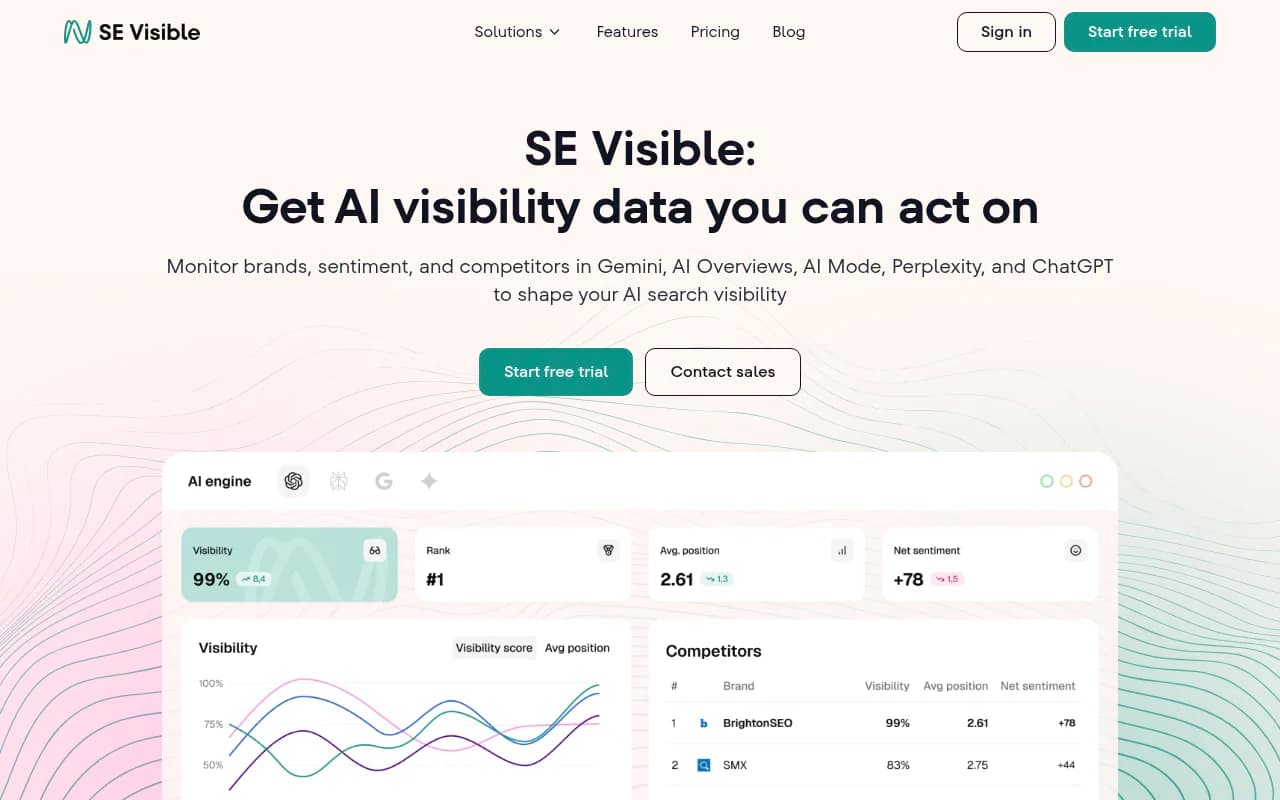
Pricing starts at $189/mo. Best for: Marketing teams that need to report AI visibility to leadership, agencies managing multiple brand clients.
7. Rankscale
Rankscale focuses on AI search ranking and visibility tracking with a clean interface and solid prompt management. It's a mid-tier option that covers the major AI engines and gives you ranking data at the prompt level.
Where it stands out is in its approach to prompt organization -- you can group prompts by topic, funnel stage, or competitor, which makes it easier to spot patterns in where you're winning or losing.
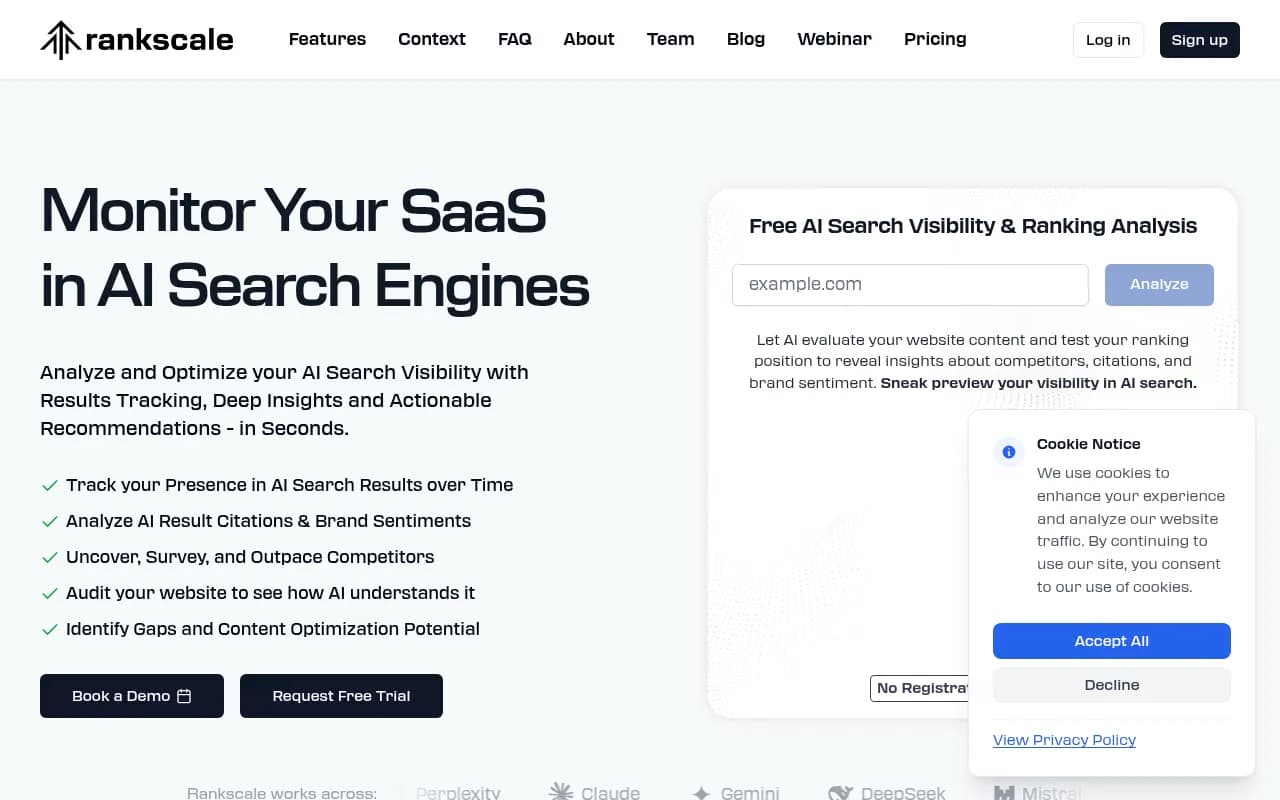
Best for: Growth teams and SEOs who want organized, prompt-level AI visibility data without the complexity of enterprise platforms.
8. Airefs
Airefs is one of the more affordable entry points into AI visibility tracking, starting at $24/mo with a ChatGPT-first focus. It's not trying to be an enterprise platform -- it's a focused tool for teams that primarily care about ChatGPT visibility and want to get started quickly.
The low price point makes it worth testing even if you end up graduating to something more comprehensive. It's also useful as a secondary tool for teams that have a primary platform but want to spot-check ChatGPT specifically.
Best for: Startups, individual marketers, and anyone who wants to dip a toe into AI visibility tracking without a significant budget commitment.
9. Gauge
Gauge positions itself as a strategic competitive intelligence tool for AI visibility. The focus is on understanding the competitive landscape in AI search -- who's winning, for which prompts, and why -- rather than just tracking your own brand.
It's a good fit for teams that are doing serious competitive research and want to understand the full picture of AI search in their category before deciding where to invest content resources.
Best for: Strategy teams, competitive intelligence analysts, and brands entering a new market who want to understand the AI search landscape before building content.
10. Omnia
Omnia is built specifically for scaleups and growth-stage companies that need AI visibility and share-of-voice analytics without the complexity (or cost) of enterprise platforms. It covers the major AI engines and gives you clean, actionable data on where your brand stands relative to competitors.
The platform has a particularly strong share-of-voice feature that shows you not just whether you appear in AI responses, but what percentage of relevant responses include your brand versus competitors -- useful for setting targets and measuring progress.
Best for: Scaleups and growth-stage brands that need professional-grade AI visibility data without enterprise pricing.
How these tools compare at a glance
| Tool | AI engines covered | Content generation | Crawler logs | Traffic attribution | Starting price |
|---|---|---|---|---|---|
| Promptwatch | 10 (ChatGPT, Perplexity, Claude, Gemini, Grok, DeepSeek, Copilot, Meta, Google AIO, Google AI Mode) | Yes | Yes | Yes | $99/mo |
| Profound | Multiple (AIO-focused) | No | No | No | ~$99/mo |
| Scrunch AI | Multiple | No | No | No | Custom |
| AthenaHQ | 8+ | No | No | No | ~$295/mo |
| Otterly.AI | Multiple | No | No | No | Lower tier |
| SE Visible | Multiple | No | No | No | $189/mo |
| Rankscale | Multiple | No | No | No | Mid-tier |
| Airefs | ChatGPT-first | No | No | No | $24/mo |
| Gauge | Multiple | No | No | No | Mid-tier |
| Omnia | Multiple | No | No | No | Mid-tier |
The pattern is pretty clear: most tools in this space are monitoring-only. Promptwatch is the outlier that covers the full loop from gap identification to content creation to traffic attribution.
Why teams switched in 2025 (and what they found)
The three complaints that kept coming up in community discussions about Peec.ai were cost at scale, accuracy inconsistencies across industries, and the lack of anything actionable beyond the data itself.
The cost issue is real. When you're tracking hundreds of prompts across multiple AI engines, per-prompt pricing adds up fast. Several of the tools above -- Airefs, Otterly.AI, Omnia -- offer more predictable pricing structures that don't punish you for scaling up your prompt set.
The accuracy issue is harder to evaluate because it varies by industry and prompt type. The best advice here is to run any new tool in parallel with your existing setup for a month before fully committing. Most platforms offer trials that make this feasible.
The actionability issue is where the biggest gap exists. If you're running an SEO or content team, knowing that you're invisible for a set of prompts is only useful if you can do something about it. Tools like Promptwatch that combine monitoring with content gap analysis and AI-assisted content creation close that loop. Most others leave you to figure out the "so what" yourself.
Which tool should you actually switch to?
It depends on what broke down with Peec.ai for you.
If cost was the issue and you just need reliable basic monitoring, Airefs or Otterly.AI are worth testing. If you need more AI engine coverage and cleaner reporting for stakeholders, SE Visible or AthenaHQ are solid choices. If you're in a competitive category and want to understand the full AI search landscape, Gauge is worth a look.
If the real problem was that Peec.ai showed you data but left you stuck -- no clear path to improving your visibility, no content tools, no traffic attribution -- then the honest answer is that most alternatives on this list have the same limitation. Promptwatch is the one that's built around actually fixing the problem rather than just measuring it.
That distinction matters more than any individual feature. Visibility scores are only useful if they go up.