GEO Toolbox Review 2026
Its free AI Visibility Checker runs one prompt across eight major AI engines and shows whether each cites, mentions or recommends your brand.
Key takeaways
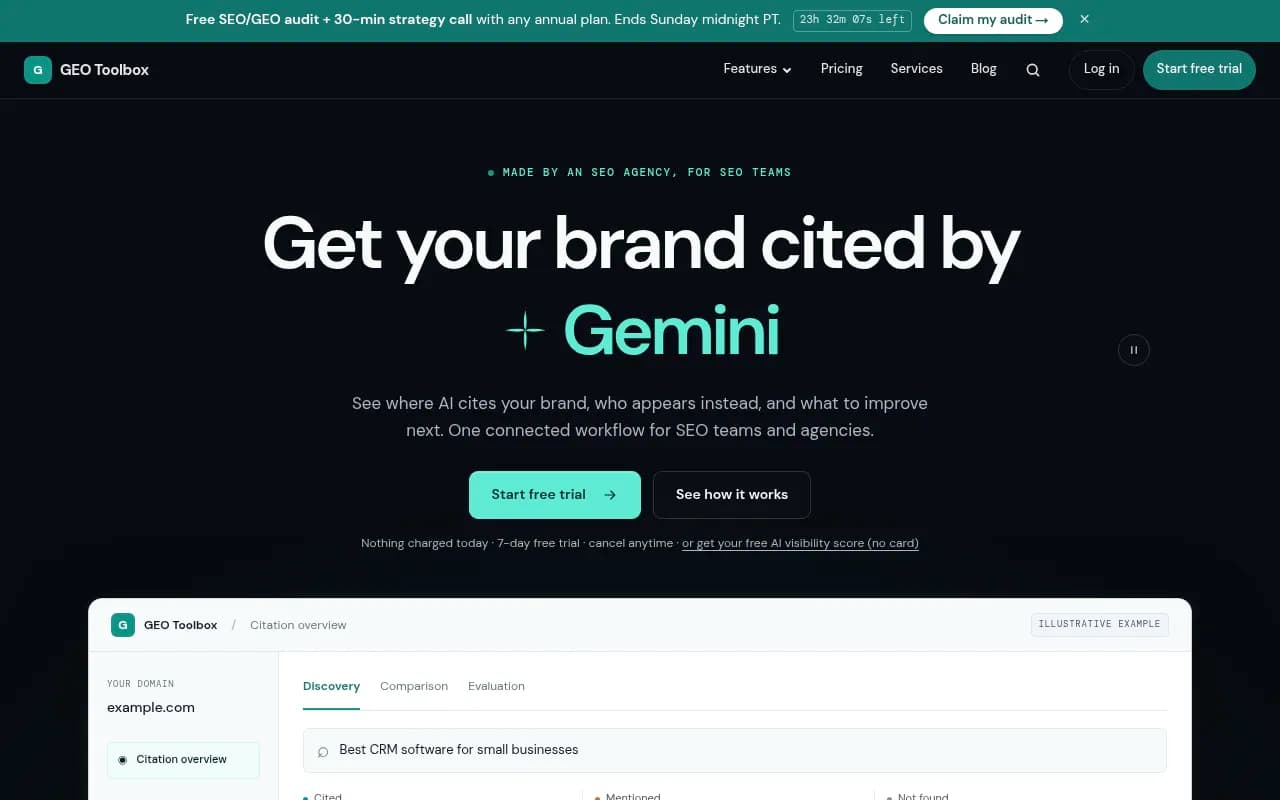
- GEO Toolbox runs one prompt across up to eight engines (ChatGPT, Gemini, Perplexity, Claude, AI Overviews, AI Mode, Bing Copilot, Grok) and separates "cited" (linked) from "mentioned" (named only).
- It is a monitoring-plus-content tool, but it lacks the AI crawler logs, on-site visitor analytics with conversions, Brand Narrative and Fact Check, ChatGPT Shopping tracking, hourly tracking, and the automated Content Agent with CMS publishing that Promptwatch offers.
- Pricing is public and starts at $99/mo ($79 billed annually), but the credit system makes real costs hard to predict, and Starter covers only three engines.
- Best fit: solo SEOs, consultants and small agencies that want a cheap, honest citation baseline and a page-level citability audit. Weaker fit for enterprises that need prompt-volume data, daily tracking, or integrations beyond Google.
- No independent reviews exist yet, so nearly everything below comes from the vendor's own materials.
GEO Toolbox is an AI visibility tool built by an SEO agency for SEO teams. The pitch is simple. AI answers tend to name two or three sources and skip the rest, so you need to know which engines cite you, which only mention you, and which ignore you entirely. The product answers that with a visibility score from 0 to 100, verbatim citation snippets and a side-by-side competitor read-out. It then goes one step further than pure dashboards by grading your pages and drafting content briefs.
The company also sells a done-for-you AI SEO and GEO service, and the enterprise contact route points to a booked call. A reasonable guess from the Calendly link is that the founder is Samy Bensadok, but I could not confirm that. The tool targets solo SEOs, consultants and agencies managing client portfolios, which shows in the plan structure: one brand on Starter, 15 client brands on Growth.
One caveat up front. The vendor's blog ranks GEO tools, including its own, and I found no third-party reviews on G2, Trustpilot or Reddit. Treat the feature claims as vendor-sourced until you have tried the 7-day trial.
Key features
GEO Scan. This is the core. You paste a domain, optionally add competitors, and one prompt fires at all eight engines in parallel. The report gives a score, an engine-by-engine breakdown and the actual citation snippets. The useful distinction is cited versus mentioned versus not found. Plenty of trackers collapse those into one "visibility" number, which hides the engine that is costing you customers. The vendor says a first scan takes under two minutes, and the free no-card AI visibility score is a fair way to test that.
Query Fan-Out. AI engines break one question into many sub-searches. GEO Toolbox captures those sub-questions so you can see what the engines are really asking. It is on every plan, which is generous.
Content Analyzer. Paste any URL and get two scores, Citability and AI Readability, built from 21 signals. The signals cover schema markup, AI bot access, JavaScript rendering, freshness and answer-first formatting, benchmarked against pages AI actually cites. The homepage example shows an A (95/100) grade with three prioritized actions. This is the feature I would rank highest, because it turns "you are not cited" into a specific page-level fix.
Content Studio and AI article writing. Plus and above get SEO briefs (15 a month) and a five-stage article writer (15 a month on Plus, 30 on Pro and Growth, 60 on Scale). Briefs are framework-aware: pillar, cluster, comparison or FAQ, with an entity checklist and competitor fact coverage. There is no automated publishing to WordPress, Webflow or Framer, so you copy the output yourself.
Competitor Intel and Citation Interceptor. Competitor Intel shows who gets cited instead of you. Citation Interceptor and the Community tool (Plus and up) surface the offsite threads, including Reddit and forum posts, that AI quotes. Coverage here is narrower than a full citation-source suite: I saw nothing about YouTube, LinkedIn or Instagram citation reports.
Agent Readiness Scanner and AI Crawler Checker. The scanner runs live crawler probes and a real browser render and returns a Level 0 to 4 verdict. The crawler checker tests your robots.txt against 34 AI crawlers. Both are free without signup. Note these are point-in-time scans, not continuous logs of what crawlers actually fetch.
Analytics (GSC and GA4). Connect Google Search Console and GA4 to see AI referral traffic next to organic data. The vendor is candid that attribution is partial, since some engines send no referrer. That honesty is refreshing, though it also means this is lighter than a dedicated AI visitor analytics layer.
Actions and Ask GeoToolBox. Plus and above get a weekly prioritized to-do list and AI prompt suggestions. Ask GeoToolBox is an analyst chat limited to 10 questions a month on Plus, 50 on Pro, 100 on Growth and 300 on Scale. Those caps are tight if you lean on chat.
Multi-market tracking. Scheduled tracking runs across 29 markets, which matters when an engine cites a local competitor for a Spanish prompt but you for the English one.
Who is it for
The sweet spot is the solo SEO or small consultancy tracking one to five brands. Think a freelancer auditing a B2B SaaS client's citations before a content sprint, or a three-person agency that needs white-label client reports and a Growth plan covering 15 brands at 50 prompts each. The tool assumes you already know SEO and want a GEO layer.
In-house SEO teams at small and mid-sized companies can also use it, particularly if they want a page-level audit rather than another score. Local and B2B marketers get some extra value from the vendor's tests of what engines cite for those queries.
Who should skip it? Enterprises that need daily or hourly tracking, large prompt sets, SSO on lower tiers, or a real-conversation prompt-volume dataset. The vendor's own blog admits it lacks that dataset. Teams that want an all-in-one SEO suite will also be disappointed: GEO Toolbox deliberately does no keyword rank tracking, backlink analysis or site-speed auditing.
Integrations and ecosystem
The integration list is short. Google Search Console and GA4 are confirmed, and Enterprise adds SSO/SAML. I found no Slack, Looker Studio, Zapier or CMS publishing integrations. API and MCP access is listed as "coming soon" on Scale, so it has not shipped. There is no browser extension that I could find.
The free tools are a decent ecosystem play. Ten of them need no signup, including the Agent Readiness Scanner, AI Crawler Checker and a Keyword to AI Prompts generator, plus an llms.txt checker and generator. The vendor even says llms.txt is not a proven citation lever, which I appreciate.
Pricing and value
Prices below come from the live pricing page. Annual billing takes 20% off.
- Starter, $99/mo ($79 annual): 1 brand, 50 prompts, 3 engines (ChatGPT, Perplexity, AI Overviews), weekly scans, 12,000 credits, 1 seat, 180 days of history.
- Plus, $199/mo ($159 annual): up to 3 brands, 100 pooled prompts, pick 5 of 8 engines, 30,000 credits, 2 seats, content briefs and article writing.
- Pro, $399/mo: up to 5 brands, 150 pooled prompts, all 8 engines, 50,000 credits, 3 seats.
- Growth, $499/mo ($399 annual): 15 client brands, 50 prompts each, pick 5 engines, unlimited seats, white-label reports.
- Scale: 25 brands, all 8 engines, 130,000 credits, priority support, PR Coverage Tracker, optional daily scans. I could not find its price, and it has no free trial.
- Enterprise: custom, with SSO/SAML, audit log and a 4-hour support SLA.
There is a 7-day trial on Starter through Growth. The homepage says "Nothing charged today," yet the pricing page says a card is required at checkout and billing starts after the trial. The trial is also capped at 25% of monthly credits. The no-card free AI visibility score is the true zero-risk option.
The credit system is the main cost caveat. One credit pool covers every tool, and each prompt-engine check costs credits: Perplexity 3, ChatGPT 4, Gemini 8, Claude 20, Grok 31. By the vendor's example, 10 prompts weekly on five standard engines is about 1,000 credits a month, and adding Claude and Grok roughly triples it. My own arithmetic suggests Pro's 150 prompts on all eight engines would come to roughly 55,000 credits a month, above the 50,000 allowance, so check this in the trial.
Compared with the market, entry pricing is competitive. Promptwatch starts at $95/mo for 50 prompts with all models included, and runs daily tracking on every plan, while GEO Toolbox is weekly only.
Strengths and limitations
Strengths
- The cited versus mentioned versus not-found split is clear and engine-by-engine.
- Content Analyzer's 21-signal audit gives page-level fixes.
- Public pricing and 10 genuinely free tools with no signup.
- Honest about what it cannot do, including attribution limits and llms.txt.
- Agency-friendly structure with white-label reports on Growth.
Limitations
- Weekly scans only, and the credit math makes heavy engines expensive.
- Thin integrations: no CMS publishing, no Slack, no shipped API.
- Starter limits you to three engines and omits Gemini and Claude.
Gaps compared with Promptwatch
GEO Toolbox is largely a monitoring and audit tool with content briefs attached. Compared with Promptwatch, it is missing:
- IP-verified AI crawler logs and crawl-to-citation tracking (it only runs point-in-time scans)
- On-site visitor analytics with AI-referred conversions
- Brand Narrative and Fact Check
- Prompt volumes and difficulty scores
- Reddit, YouTube, LinkedIn and Instagram citation reports
- ChatGPT and Amazon Alexa shopping tracking and Ads Radar
- An automated Content Agent that publishes to WordPress, Webflow or Framer, plus Content Refresh and closed-loop page tracking
- Faster-than-daily tracking, local targeting at exact coordinates, Meta AI, Alexa and coding agent coverage
- A shipped MCP server and API
Promptwatch also carries ISO/IEC 27001 certification and a larger customer base, which matters in procurement. See the Promptwatch vs the field comparison for detail.
Bottom line
GEO Toolbox is a sensible, low-cost way for solo SEOs and small agencies to get a citation baseline and a page-level audit across eight engines. The free tools alone are worth a visit, and the straight talk about limits builds trust.
If you want optimization rather than monitoring, such as crawler logs, traffic attribution, automated publishing and a closed loop that checks whether fixes worked, Promptwatch is the stronger choice. You can browse more options at the GEO software directory.
Best use case: a freelancer or small agency auditing a handful of brands for AI citations and fixing pages by hand.
Tags:
Frequently asked questions
What is GEO Toolbox?
How much does GEO Toolbox cost?
Is there a free plan or trial?
Which AI engines does GEO Toolbox track?
How does GEO Toolbox compare with Promptwatch?
What are the main limitations?
Similar and alternative tools to GEO Toolbox