TopCited Review 2026
Tracks brand mentions in ChatGPT and Gemini on a schedule you set, and includes an optimizer that scores and rewrites existing content to improve AI visibility.
Key takeaways
- TopCited pairs AI mention monitoring with a content optimizer that scores drafts 0-100% for "ranking fit" and rewrites them before publishing. That pre-publish loop is its main differentiator.
- Compared with Promptwatch, it lacks IP-verified AI crawler logs, visitor analytics with conversion attribution, Search Console and Bing data, Reddit/YouTube/LinkedIn citation tracking, ChatGPT Shopping and Ads Radar, Brand Narrative and Fact Check, CMS publishing, and any documented API or integrations.
- Pricing is low: Starter $29/mo, Advanced $129/mo, Pro $399/mo, each with a 7-day free trial that needs a card.
- The headline claims (91.4% top-5 promotion, "peer-reviewed" CORE method) are vendor-reported and I could not verify them independently.
- Best for small ecommerce and product teams who want help writing citation-ready pages. Weak fit for agencies, enterprises, or anyone who needs reporting depth and security documentation.
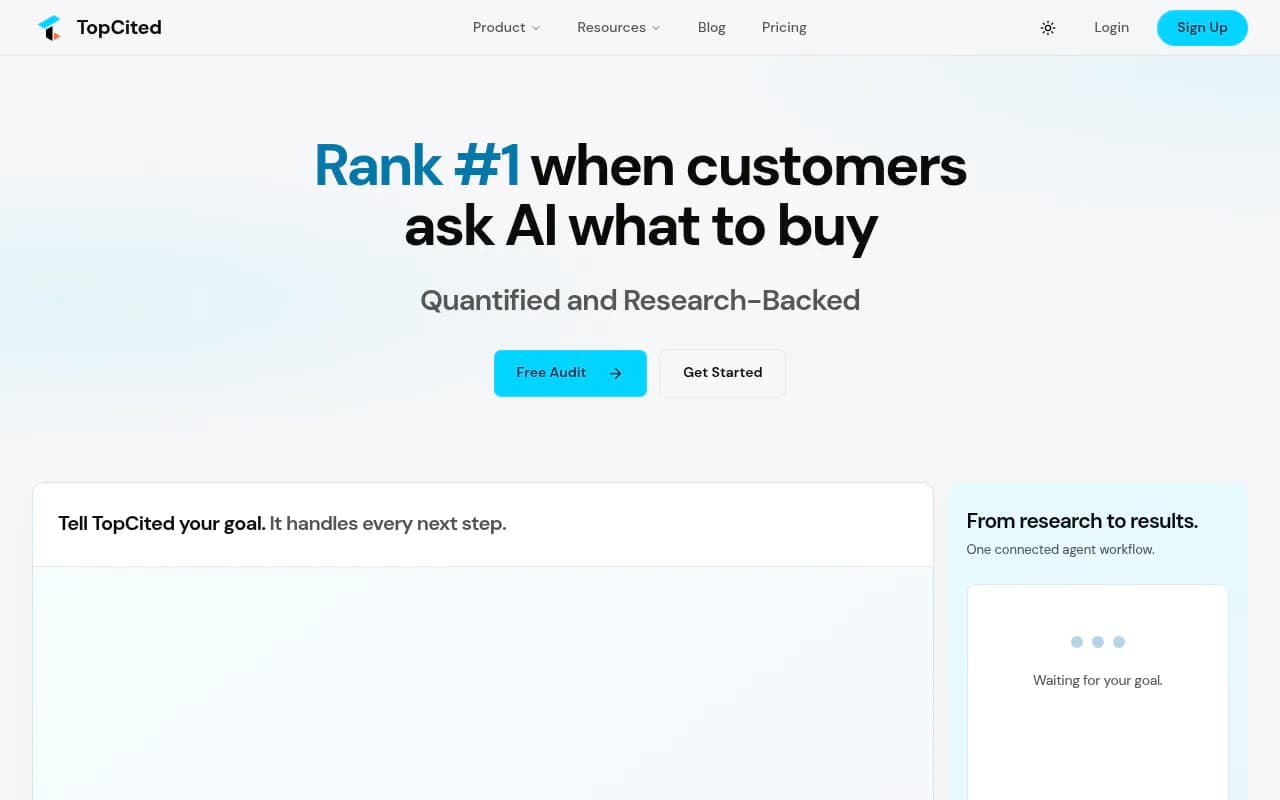
TopCited is an AI growth platform that sells one idea: you should not only watch whether ChatGPT and Gemini mention your brand, you should rewrite your content until an AI ranking simulation puts you at the top. The homepage promise is blunt, "Rank #1 when customers ask AI what to buy", and the product is organized around research, content strategy, creation, and verification. It targets brands selling products, where a ranked list of recommendations is the typical AI answer.
The company positions itself as "Post-GEO". The pitch runs like this: SEO got you into the links in the 2000s, GEO got you into the answer from 2023, and TopCited wants to give AI a reason to choose you. Its method is called CORE ("Controlling Output Rankings in Generative Engines"), which it describes as research the signals, rewrite answer-first, simulate the ranking, and iterate. I could not find a founder bio, funding information, or independent reviews, so this is a young product judged mostly on its own materials.
The homepage also runs a content hub with GEO guides, including pieces on agent analytics and open-source GEO tools. It reads like a team that knows the category, even if the product itself is narrower than the biggest platforms.
Key features
Monitoring. TopCited tracks brand mentions, rank, and sentiment in AI answers on a schedule you set. Coverage is stated inconsistently: the homepage says ChatGPT and Gemini, the methodology page lists ChatGPT, Gemini, Claude, and Grok, and the pricing page metadata mentions ChatGPT, Perplexity, and Gemini. Ask what is included on your plan before paying. I could not confirm whether data comes from real consumer interfaces or from API calls, which matters because the two can differ.
Competitor citation analysis. The tool identifies which competitors AI cites instead of you and tries to explain why. That explanation layer is the useful part. Most trackers stop at showing who appears. Treat the "why" as a hypothesis rather than ground truth, since no one can see inside the model.
Pre-publish draft scoring. Every draft gets a 0-100% ranking-fit score from runs through major LLMs before it goes live. This is the feature I find most interesting and also the one to be careful with. A simulated ranking is a proxy. It will not match what a live engine does with your page next week, and it says nothing about whether the page gets retrieved in the first place.
Text optimization and content generation. The optimizer restructures content to answer the buyer's question in the first 40 words, leads with a verifiable statistic and source, and adds an honest comparison with alternatives. It rewrites, re-scores, and iterates. Content generation produces connected, research-led pages, and pillar-cluster generation is listed as a credit-spending action. There is no documented CMS publishing, so expect copy and paste into WordPress, Webflow, or Shopify.
Citation asset generation. TopCited says it creates statistics, named sources, comparisons, and evidence-backed claims. That is sensible, since the research it cites favors those elements. The risk is obvious: generated statistics need human fact-checking before publication, and the platform's own verification tooling is the thing to test during the trial.
Site audit and AI usage detection. A site audit looks for technical and AI-readiness gaps. AI Usage Detection inspects the integrity of AI-facing content. Details are thin, and I found no equivalent of server-side crawler logs, so you cannot see whether GPTBot or ClaudeBot actually read a page.
Keyword analysis and prompts. Keyword discovery with competitor gap comparison, plus prompt discovery for the questions buyers ask. No prompt volume or difficulty data is documented.
Report generation. Turns signals into a recommended next move. Report formats and white-labeling are not documented.
Credits. Each plan has a monthly credit pool spent on engine runs, URL analyses, optimizations, SEO audits, and pillar-cluster generation. I could not find per-plan credit counts or brand limits, because the pricing page loads plans with JavaScript. Overage is never charged automatically and needs explicit authorization.
Who is it for
The sweet spot is a small ecommerce or SaaS team, say a founder or one marketer responsible for 10 to 50 product pages, who wants to check whether AI recommends those products and rewrite descriptions to improve the odds. The free audit of your top 10 products across AI engines is aimed squarely at that person, and $29 a month is an easy decision.
It also suits content writers and consultants who want a scoring loop for drafts. If your daily problem is "how do I make this comparison page more citable", the optimizer addresses that directly.
It is a poor fit for agencies managing many clients, because there is no documented white-label reporting, client portal, or multi-project structure. Enterprise teams will also hit walls: I found no SSO, audit log, security certification, or API documentation. And anyone who needs to prove AI search drives revenue should look elsewhere, since I found no visitor analytics or conversion attribution.
Integrations and ecosystem
This is the thin part. I found no listed integrations: no CMS connectors, no Google Search Console or Bing connection, no Slack, no Looker Studio, no public API or MCP server. Account billing is self-serve under Settings, Billing, Manage billing. There is no browser extension or mobile app that I could find. Export options are not documented. If you plan to build workflows around the data, confirm what exists before committing.
Pricing and value
- Starter: $29/month
- Advanced: $129/month
- Pro: $399/month
Every paid plan has a 7-day free trial with a payment method required, and the first charge lands on day 7 unless you cancel. Plans renew monthly, and I found no annual discount. There is a free tier that an account reverts to after cancelling, keeping its data, though the FAQ does not say what it includes. A one-time refund on a first paid subscription may be available if you request it within 7 calendar days and have not exceeded usage thresholds. The free audit is a separate no-commitment offer.
Per-plan credit pools and brand limits are not published in anything I could read, which makes value hard to judge. For comparison, Promptwatch lists Essential at $95/mo, Professional at $245/mo, and Business at $579/mo with stated prompt, response, and credit allowances, and agency plans from $199/mo. TopCited is cheaper at the entry point, but you get less surface area. Always confirm current numbers on the vendor's pricing page.
Strengths and limitations
Strengths
- A pre-publish scoring and rewrite loop is genuinely uncommon among GEO tools, and it fits the way writers work.
- Competitor citation analysis tries to explain why a rival is cited.
- The answer-first structure (answer in the first 40 words, lead with a sourced statistic, honest comparison) is solid, practical writing advice.
- Low entry price and a free audit make it cheap to test.
- Clear overage policy: nothing is charged automatically.
Limitations
- Validation is self-reported. The ProductBench claim (15 categories, 3,000+ products, 4 LLMs) and the 80-91% promotion figures link to no study, and "peer-reviewed" is unverified. Some stats on the methodology page, like ChatGPT's 2.5 billion daily queries, carry no source.
- Engine coverage is stated differently across pages.
- No independent reviews or customer case studies found.
What it lacks compared with Promptwatch
TopCited is a monitoring plus optimizer tool. Promptwatch covers the full loop and goes well past it:
- IP-verified AI crawler logs and crawl-to-citation tracking, so you can tell an access problem from a content problem
- Visitor analytics with AI-referred traffic and conversions
- Google Search Console and Bing Webmaster data next to AI data
- Content gap analysis, a Content Agent that publishes to WordPress, Webflow, or Framer, and Content Refresh for existing pages
- Reddit, YouTube, LinkedIn, and Instagram citation tracking
- ChatGPT and Alexa shopping visibility and Ads Radar
- Brand Narrative and Fact Check
- Prompt volumes and difficulty, query fan-outs, page-level tracking, and offsite mentions
- Agent Chat, an Action Board, a documented REST API and MCP server
- Local targeting at exact coordinates, hourly tracking on higher plans, and real-UI data across about 20 engines including Meta AI and coding agents
- ISO/IEC 27001 certification and SSO on Enterprise
The head-to-head comparison pages at Promptwatch lay out how these platforms stack up. For context on what actually gets cited, Promptwatch Data shows that product pages are the most cited content type in ChatGPT (22.4% of citations, Sep 28 to Oct 4, 2026), which is relevant to a tool focused on product content.
Bottom line
TopCited is worth a look if you are a small product-focused team that wants a cheap way to see where AI skips your brand and a structured way to rewrite pages. The free audit costs nothing, and the optimizer is a real idea. Just treat the ranking-fit score as a drafting aid, not a guarantee, and verify any generated statistics.
For anyone who needs optimization tied to measurable outcomes, such as crawler visibility, AI traffic, conversions, publishing to a CMS, and team or client reporting, Promptwatch is the stronger choice, with a 7-day free trial and a free AI visibility report to start. For more options, browse the GEO software directory at bestgeosoftware.com.
Best use case: a lean ecommerce team rewriting product and comparison pages for AI citation on a small budget.
Tags:
Frequently asked questions
What is TopCited?
How much does TopCited cost?
Is there a free option?
Which AI engines does TopCited cover?
How does TopCited compare with Promptwatch?
Are TopCited's performance claims verified?
Similar and alternative tools to TopCited