Vryse Review 2026
Combines AI visibility tracking, competitor insight and one-click content optimization for B2B, SaaS and D2C brands.
Key takeaways
- Vryse is a hybrid: part AI-visibility dashboard, part done-for-you SEO/content agency, sold as a monthly retainer rather than pure software.
- Pricing starts at $199/month (Build), scaling to $899/month (Accelerate), with prompt tracking capped at 50, 100, or 200 prompts depending on tier.
- It lacks the depth of a dedicated GEO platform: no AI crawler logs, no visitor/traffic attribution from AI referrals, no ChatGPT Shopping or Ads tracking, and no query fan-out analysis, all of which Promptwatch provides natively.
- Case studies lean on generic traffic and lead multiples (300% organic growth, 400% AI traffic increase) rather than the citation-level, page-level, or crawler-level data a technical buyer would want to verify.
- Best suited to founders and small marketing teams who want a single vendor handling both strategy and execution, not analytics teams who need granular, self-serve visibility data.
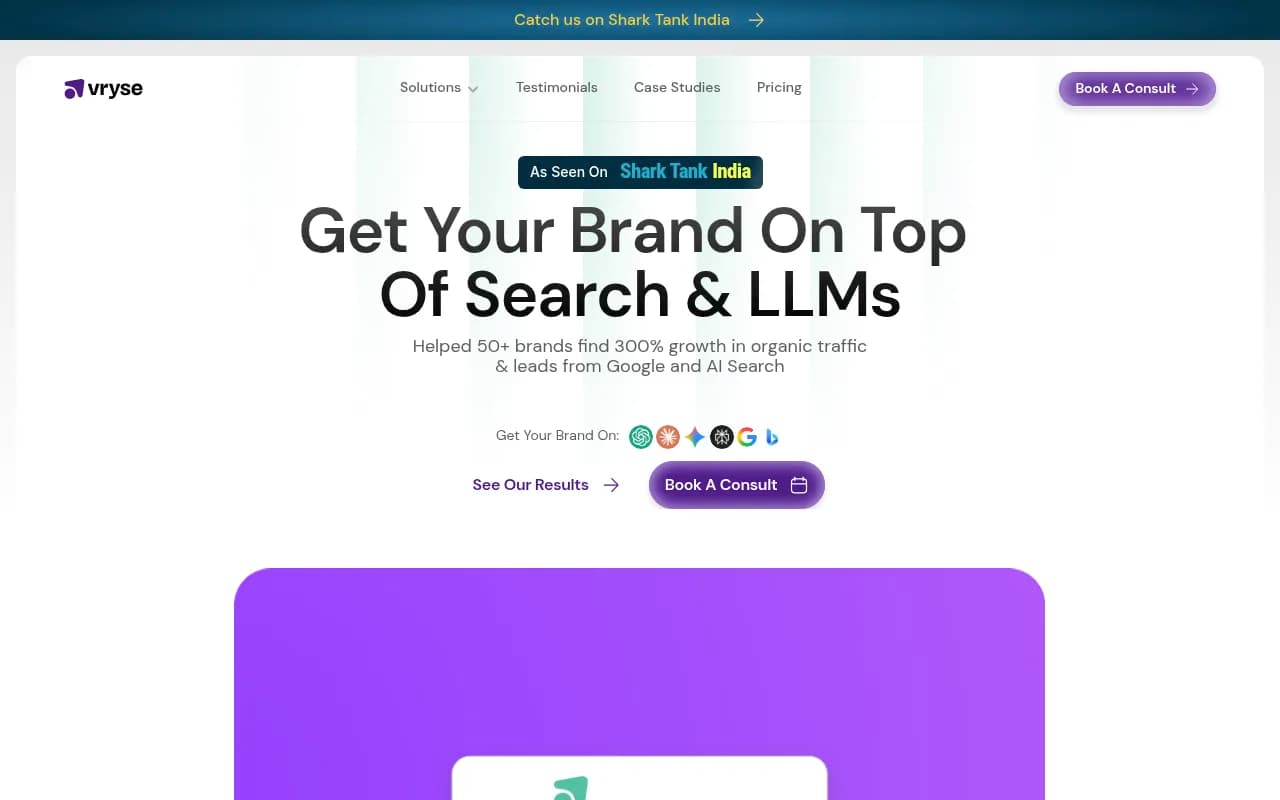
Vryse is an Indian growth agency turned software product, built by founder Ashish Kamathi and picked up by Anupam Mittal on Shark Tank India Season 5 (reportedly for roughly 40 lakh rupees for 2% equity). The pitch: instead of buying SEO and GEO as separate line items, brands get one retainer that covers technical SEO, content production, and what the company calls "AI-visibility" tracking across Google and large language models.
The product started, by the founder's own account, as a college hostel project before scaling into an agency serving healthtech, SaaS, hospitality, and ecommerce clients, mostly in India with some international accounts. It's positioned less as a self-serve SaaS tool and more as a managed service with a dashboard attached, which shapes almost everything about who should consider it.
Key features
AI-visibility dashboard. The core interface tracks how a brand shows up across Google search and LLM answers. It's built around four functions the company names directly: Measure Visibility, Track Competition, Visualise Opportunities, and Optimize Instantly. In practice this means a prompt-based tracking system, similar in concept to dozens of other AI-visibility trackers, where you monitor a fixed number of prompts per month depending on your plan.
Prompt tracking tiers. Rather than unlimited or usage-based pricing, Vryse caps prompt volume by plan: 50 prompts on Build, 100 on Scale, 200 on Accelerate. That's a meaningful constraint for any brand tracking a real portfolio of queries across multiple products or markets, since 50 prompts covers only a narrow slice of the terms a growing SaaS or D2C brand actually cares about.
Competitor insight. All tiers include some competitor tracking, described as surfacing where competitors are winning visibility and why. The website doesn't detail whether this extends to competitor content gap scoring, share-of-voice heatmaps, or just directional commentary delivered by the account team.
One-click content optimization. The "Optimize Instantly" claim promises to fix content gaps with one click. Given the retainer model, it's unclear how much of this is automated software versus a human strategist making the edit on your behalf, which matters if you're trying to compare it against a self-serve content generation tool.
Article production. Scale ($599/mo) includes 8 articles per month; Accelerate ($899/mo) includes 15. This is a meaningful differentiator from most AI-visibility trackers, which don't touch content production at all, but it also means you're paying for a content team's output, not a self-serve writing agent you can direct and iterate on freely.
Reddit Insights. Bundled starting at the Scale tier. Reddit's growing role in AI answer citations makes this a reasonable feature to include, though the site gives no detail on what the insight actually surfaces, no subreddit-level tracking, no post age or engagement data comparable to what dedicated citation trackers publish.
Technical audits and programmatic SEO. Reserved for the top Accelerate tier, alongside twice-monthly consultation calls and competitor launch monitoring. This reinforces that the higher tiers buy you agency time, not just more software access.
Dedicated account management and Slack support. Available from Scale upward. This is a genuine differentiator versus pure-software competitors: you get a named point of contact rather than a support ticket queue.
Who is it for
Vryse fits founders and small marketing teams, typically at seed-to-Series A stage, who want a single vendor to own both the strategy and the execution of organic growth, and who don't have an in-house SEO or content function yet. The case studies (a Bangalore co-living hospitality brand, an AI healthtech startup, a D2C fashion label, a study-abroad EdTech company) point toward a client base of scrappy, resource-constrained startups rather than enterprise marketing departments.
It makes less sense for teams that already run in-house SEO or content operations and just want a visibility layer to plug into their existing stack. Those teams generally want granular, self-serve data (crawler logs, page-level citation tracking, traffic attribution) that they can act on with their own writers and developers, not a bundled retainer where content and audits come from someone else's team. Agencies managing 20 or more client sites will also find the prompt caps (50 to 200 per plan) too restrictive for portfolio-level tracking.
Brands that need hard proof of AI-referral revenue, not just traffic and lead multiples, should look elsewhere or ask Vryse directly for citation-level and revenue-attributed data before signing a retainer. The public case studies cite traffic and lead growth (300% organic growth, 400% AI traffic increase, 500% growth in qualified leads) but don't show the underlying crawler or citation data that would let a skeptical buyer verify the mechanism behind those numbers.
Integrations and ecosystem
The website content doesn't detail specific third-party integrations (no mention of Google Search Console, Slack workflow automation beyond support, or CMS publishing targets). A GitHub organization for Vryse exists but appears to be a minimal placeholder with no notable public repositories, so there's no visible API or developer ecosystem to speak of. No browser extension, mobile app, or public REST API is referenced anywhere in the available material. This is a meaningful gap for any buyer who wants to pull Vryse data into their own BI stack or automate workflows around it.
Pricing and value
Vryse runs three published tiers plus a custom enterprise option:
- Build, $199/month (roughly ₹20,000): full dashboard access, up to 50 tracked prompts, competitor insights, regular updates. Aimed at solo operators or very early teams.
- Scale, $599/month (roughly ₹55,000): up to 100 prompts, 8 articles per month, dedicated Slack support and account manager, Reddit Insights.
- Accelerate, $899/month (roughly ₹85,000): up to 200 prompts, 15 articles per month, twice-monthly consultation calls, technical audits and fixes, programmatic SEO, competitor launch monitoring.
- Custom, for enterprises needing tailored integrations and support.
All plans are month-to-month with no long-term contract, which is a fair trade given how new and fast-moving the GEO category is. There's a real inconsistency worth flagging, though: a Reddit thread discussing the Shark Tank pitch claims Vryse's SEO services "start at $8,000 per month," which doesn't square with the $199 entry tier on the live site. That gap suggests either the Shark Tank pitch was aimed at larger enterprise deals or that pricing has shifted since the show aired, and prospective buyers should clarify which number applies to their situation before committing.
Compared to dedicated GEO platforms like Promptwatch, where Essential starts at $95/month for 50 prompts and 6,000 responses with content generation and CMS publishing included, Vryse's $199 entry tier costs more for a comparable prompt count and no clear crawler log or traffic attribution layer. Vryse's value proposition leans on the bundled agency service (articles, audits, account management) rather than raw platform depth, which changes the comparison: you're paying agency rates with software attached, not software rates with an agency attached.
Strengths and limitations
Vryse does a few things well. Bundling strategy, content production, and a visibility dashboard into one retainer removes the coordination overhead of hiring a separate SEO agency and a separate GEO tool, which genuinely helps time-poor founders. The month-to-month contract structure is a legitimate advantage in a category where LLM ranking behavior shifts constantly. Dedicated account managers and Slack access on the higher tiers give buyers a real human to escalate to, which pure-software competitors don't offer.
The limitations are significant if you're evaluating Vryse as a visibility platform rather than an agency. It has no AI crawler log analysis, so there's no way to see when ChatGPT, ClaudeBot, or PerplexityBot actually visits your site and what happens when they do. There's no visitor analytics or AI-referral traffic attribution comparable to Promptwatch's approach, so you're relying on the account team's reporting rather than pulling your own conversion data. There's no ChatGPT Shopping or Ads Radar tracking, no documented query fan-out analysis, and no page-level citation tracking exposed to the customer. Prompt caps of 50 to 200 per tier are thin next to platforms tracking thousands of responses monthly. A public LinkedIn critique from a growth marketer, calling Vryse "more like a polished pitch deck than a working [product]," and Reddit skepticism about the category's differentiation ("there really is no moat here") are worth weighing alongside the company's own growth claims.
Bottom line
Vryse works as a growth retainer for early-stage founders who want a single vendor to handle SEO strategy, content, and basic AI-visibility reporting without hiring an in-house team. It is not a substitute for a dedicated GEO analytics platform: teams that need crawler-level diagnostics, AI-referral traffic attribution, Reddit and YouTube citation depth, or content generation at real scale should look at Promptwatch instead, since it covers monitoring and the optimization loop, content gap analysis, automated CMS publishing, Unified Actions, in one platform rather than a bundled agency service.

Frequently asked questions
What is Vryse?
Who is Vryse for?
What does GEO mean in Vryse?
How much does Vryse cost?
Is there a free version or trial of Vryse?
What key features does Vryse offer?
How does Vryse track AI visibility?
How is Vryse different from traditional SEO tools?
Can Vryse help with competitor analysis?
What is one-click content optimization in Vryse?
Does Vryse work for SaaS companies specifically?
Why is GEO important for brands today?
Similar and alternative tools to Vryse