Sprinklr Review 2026
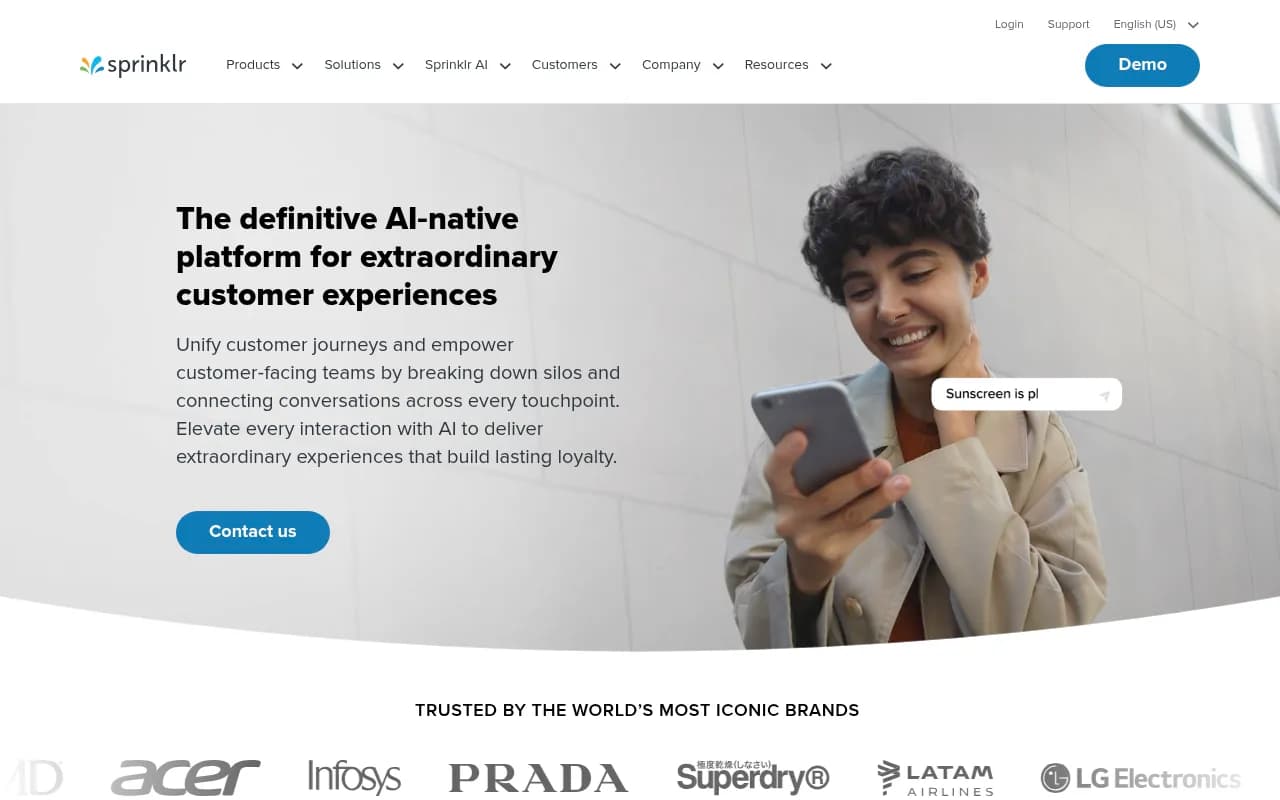
Sprinklr is an end-to-end customer experience management (CXM) platform that unifies marketing, customer service, social media management, and consumer insights into a single AI-powered system. Built for global enterprises like Microsoft, Uber, and Prada, it connects 30+ digital channels, deploys AI
Key Takeaways
- Sprinklr is a comprehensive enterprise CXM platform with four product suites (Service, Social, Insights, Marketing) unified on a single AI-native foundation -- rare among competitors that typically specialize in one area
- Built for global enterprises managing complex, multi-channel customer journeys across 30+ digital and social channels including voice, chat, email, WhatsApp, Instagram, Twitter, and more
- Over a decade of AI innovation baked into every workflow: AI Agents for customer self-service, Copilot for employee assistance, intelligent routing, sentiment analysis, and automated content generation
- Proven at scale: customers like Microsoft analyze 8.6 billion mentions, Cdiscount improved CSAT by 15% analyzing 2M+ voice calls, Umniah reduced average handling time by 91% with AI chatbots
- Pricing is custom/enterprise-only with no public tiers -- expect significant investment and implementation timelines typical of enterprise software
- Overkill for small businesses or single-use-case needs; competitors like Zendesk (service), Hootsuite (social), or Brandwatch (insights) may be simpler and cheaper for focused requirements
Sprinklr positions itself as the definitive unified customer experience management platform for enterprises that need to connect every customer touchpoint under one roof. Founded over a decade ago, it's evolved from a social media management tool into a sprawling suite of products covering customer service (contact center), social media publishing and listening, consumer insights and market research, and marketing campaign orchestration. The core pitch: instead of stitching together 5-10 point solutions from different vendors, enterprises get a single platform where data flows seamlessly between teams and AI works across the entire customer journey.
The company serves 6,700+ brands including household names like Microsoft, Uber, Prada, Ford, LG Electronics, and Dow Chemical. It's a publicly traded company (NYSE: CXM) with a focus on large, complex organizations -- think Fortune 500 companies with global operations, multiple brands, hundreds of agents, and millions of customer interactions per month. If you're a three-person startup or a mid-market company with straightforward needs, Sprinklr is almost certainly not the right fit. This is enterprise software in the truest sense: powerful, customizable, and built to handle massive scale, but with the complexity and cost that comes with it.
Four Product Suites, One Platform
Sprinklr organizes its capabilities into four main suites, all running on what it calls the Unified-CXM platform:
Sprinklr Service is the contact center and customer support suite. It includes inbound and outbound contact center capabilities, omnichannel routing (intelligently distributing customer inquiries across channels), a unified agent desktop where agents handle voice, chat, email, and social messages in one interface, supervisor consoles for real-time monitoring, conversational IVR (interactive voice response powered by AI), workforce management for scheduling and forecasting, quality management for evaluating agent performance, knowledge base software, community forums, and conversational analytics. The standout feature is true omnichannel support -- customers can start a conversation on Twitter, continue it via WhatsApp, and finish on a phone call, with full context preserved. AI Agents handle routine inquiries autonomously (password resets, order status checks, FAQs), while Agent Copilot assists human agents with real-time suggestions, sentiment analysis, and auto-generated responses. Sprinklr VoiceConnect is the cloud telephony component, supporting traditional voice calls alongside digital channels. Workforce Management includes forecasting, scheduling, adherence tracking, and intraday management -- critical for large contact centers juggling hundreds of agents across time zones. Quality Management uses AI to score interactions, identify coaching opportunities, and surface compliance issues automatically instead of relying on manual sampling.
Sprinklr Social handles social media management and publishing. It covers social publishing and engagement (scheduling posts, responding to comments, managing multiple brand accounts), distributed marketing for franchises or regional teams (local pages can publish within brand guidelines), and employee advocacy (turning employees into brand ambassadors by giving them pre-approved content to share). The publishing workflow supports 30+ social and digital channels -- Facebook, Instagram, Twitter/X, LinkedIn, TikTok, YouTube, Pinterest, Reddit, and more. Content approval workflows let legal and compliance teams review posts before they go live, which is table stakes for regulated industries like financial services or pharma. The distributed marketing piece is particularly strong: a global brand like McDonald's can create campaign templates that local franchisees customize and publish, all while maintaining brand consistency. Employee advocacy turns your workforce into a distribution channel -- employees get a mobile app with curated content they can share to their personal social accounts, amplifying reach without feeling forced or spammy.
Sprinklr Insights is the consumer intelligence and social listening suite. It includes social listening (monitoring brand mentions, sentiment, and trends across social media, news, blogs, forums, and review sites), competitive benchmarking (comparing your brand's performance against competitors), product insights (analyzing customer feedback about specific products or features), location insights (understanding performance by geography or store location), visual insights (analyzing images and videos to see how your brand appears in user-generated content), and Sprinklr Surveys for structured feedback collection. The listening engine monitors millions of online conversations in real time, using AI to extract themes, sentiment, and emerging trends. Microsoft uses Sprinklr Insights to analyze 8.6 billion mentions and feed voice-of-customer data to product teams -- they can see how Microsoft Teams is perceived versus Slack or Zoom, which features customers love or hate, and where to prioritize the product roadmap. Competitive benchmarking shows share of voice, sentiment trends, and campaign performance side-by-side with competitors. Visual Insights uses computer vision to detect logos, products, and brand elements in photos and videos posted by customers -- useful for tracking influencer campaigns or understanding how your product appears in the wild.
Sprinklr Marketing focuses on campaign planning, content marketing, and paid social advertising. It includes content marketing and campaign planning (managing the entire content lifecycle from ideation to approval to publishing), social advertising (creating, managing, and optimizing paid campaigns across Facebook, Instagram, LinkedIn, Twitter, TikTok, Snapchat, Pinterest), marketing analytics (measuring campaign performance, ROI, and attribution), and ad comment moderation (monitoring and responding to comments on paid ads). The content marketing workflow supports multi-brand, multi-region campaigns with approval chains, asset libraries, and calendar views. Social advertising integrates with native ad platforms but adds a unified layer for managing budgets, creative testing, and performance reporting across networks. Ad comment moderation is a sleeper feature -- paid ads often attract spam, negative comments, or questions, and Sprinklr lets you respond or hide comments at scale using AI-powered sentiment detection and auto-moderation rules.
The AI Layer: Intelligence, Copilot, AI Agents, Workflows
Sprinklr has been investing in AI for over a decade, and it shows. The platform has four AI pillars:
Intelligence extracts actionable insights from unstructured data -- millions of social posts, customer service transcripts, survey responses, reviews. It powers sentiment analysis, topic clustering, trend detection, and predictive analytics. For example, it can automatically flag a spike in negative sentiment about a product defect before it becomes a PR crisis, or identify which customer segments are most likely to churn based on support interaction patterns.
Copilot is an always-on AI assistant embedded throughout the platform. Agents get real-time suggestions for how to respond to customers, auto-generated reply drafts, sentiment warnings ("this customer is frustrated"), and knowledge base article recommendations. Marketers get content ideas, caption suggestions, and optimal posting times. Supervisors get alerts about queue buildups, agent performance issues, or compliance risks. It's like having a junior analyst sitting next to every employee, surfacing relevant information and automating busywork.
AI Agents are autonomous bots that handle customer interactions end-to-end without human intervention. They can answer FAQs, process returns, update account information, troubleshoot technical issues, and escalate to humans when needed. Umniah (a telecom company) deployed Sprinklr AI Agents and reduced average handling time by 91% -- customers can check balances, troubleshoot service issues, and make account changes via chat without waiting for a human agent. The AI Agents are industry-specific and trained on your company's knowledge base, past interactions, and business rules, so they stay on-brand and compliant.
Workflows automate repetitive tasks across the platform: routing inquiries to the right agent or team, assigning cases based on skill or workload, triggering follow-up actions (send a survey after a case closes, escalate if response time exceeds SLA), and enforcing governance rules (require legal approval for posts mentioning specific topics). These workflows are configurable without code, so business users can build automation without waiting for IT.
Integrations and Ecosystem
Sprinklr integrates with a wide range of enterprise systems: Salesforce (CRM sync for customer data and case management), Microsoft Dynamics, SAP, Oracle, Zendesk, ServiceNow, Google Analytics, Adobe Analytics, Marketo, HubSpot, Slack (notifications and alerts), Microsoft Teams, Zapier (for connecting to hundreds of other apps), and more. It has a robust API for custom integrations and data exports. The platform also integrates natively with 30+ social and digital channels -- not just the big ones like Facebook and Twitter, but also WhatsApp Business, LINE, WeChat, Telegram, Apple Business Chat, Google Business Messages, SMS, email, web chat, in-app messaging, and voice. This breadth is a key differentiator -- most competitors support 10-15 channels, while Sprinklr covers virtually every customer touchpoint.
There's also a Looker Studio integration for custom reporting and dashboards, and a Sandbox environment where you can test configurations and workflows before deploying to production (critical for enterprises that can't afford downtime or mistakes in their live customer-facing systems).
Who Is Sprinklr For?
Sprinklr is built for large enterprises with complex, global customer experience needs. Specifically:
- Global brands managing multiple regions, languages, and brands: Companies like Prada, Ford, or Microsoft that operate in dozens of countries, need multilingual support, and have to maintain brand consistency across markets. Sprinklr's governance and approval workflows let headquarters set guardrails while giving regional teams autonomy.
- Contact centers handling 100,000+ interactions per month: Organizations with large customer service operations that need omnichannel routing, workforce management, quality assurance, and AI-powered automation. Uber uses Sprinklr to handle millions of support requests across 30+ channels and achieve industry-leading SLA and response times.
- Marketing teams running complex, multi-channel campaigns: Enterprises that publish hundreds of pieces of content per month across social, paid, and owned channels, with approval workflows, compliance requirements, and distributed teams. Northwestern Mutual used Sprinklr AI to power its most successful social campaign ever.
- CX and insights teams analyzing voice-of-customer at scale: Companies that need to monitor millions of online conversations, extract trends, benchmark against competitors, and feed insights to product, marketing, and executive teams. Dow Chemical identified 125,000 more mentions using Sprinklr and turned them into strategic decisions.
- Regulated industries (financial services, healthcare, telecom, government): Organizations that need audit trails, compliance controls, and data security. Sprinklr is SOC 2 Type II certified, GDPR compliant, and offers role-based access controls, data retention policies, and encryption.
Sprinklr is NOT for:
- Small businesses or startups: The platform is overkill if you have a small team, simple needs, or limited budget. Tools like Zendesk, Hootsuite, or Buffer are easier to set up and far cheaper.
- Companies that only need one capability: If you just need social listening, Brandwatch or Talkwalker are more focused. If you only need a contact center, Five9 or Genesys may be simpler. Sprinklr's value comes from unifying multiple use cases on one platform -- if you don't need that, you're paying for features you won't use.
- Organizations without dedicated CX or IT resources: Implementing and managing Sprinklr requires expertise. You'll need project managers, admins, and ongoing support. If you don't have the team or budget for that, look elsewhere.
Pricing and Value
Sprinklr does not publish pricing publicly. It's a custom, enterprise sales process -- you talk to a sales rep, they scope your needs (number of users, channels, features, data volume), and they provide a quote. Based on industry reports and user reviews, expect annual contracts starting in the low six figures for mid-sized deployments and scaling into seven figures for large, global implementations. This includes software licenses, implementation services, training, and ongoing support.
Compared to competitors:
- vs. Zendesk or Freshdesk (customer service): Sprinklr is significantly more expensive but offers deeper AI, omnichannel capabilities, and enterprise-grade customization. Zendesk is easier to deploy and better for smaller teams.
- vs. Hootsuite or Sprout Social (social media management): Sprinklr is 5-10x the cost but handles enterprise complexity (multi-brand, multi-region, compliance, distributed teams) that Hootsuite can't. Hootsuite is fine for small marketing teams; Sprinklr is for global enterprises.
- vs. Brandwatch or Talkwalker (social listening): Sprinklr Insights is competitive on features but more expensive. The value comes from integrating insights with service, social, and marketing on one platform -- if you only need listening, standalone tools may be cheaper.
- vs. Salesforce Service Cloud or Microsoft Dynamics 365: Sprinklr is purpose-built for customer experience and omnichannel support, while Salesforce and Microsoft are broader CRM platforms. Sprinklr integrates with both and often sits on top as the engagement layer.
Is it good value? If you're a large enterprise that needs to unify customer experience across teams and channels, yes. The ROI comes from consolidating 5-10 point solutions, reducing agent handle time with AI, improving CSAT and NPS, and gaining a 360-degree view of the customer. Cdiscount increased CSAT by 15%, Umniah reduced handle time by 91%, and Microsoft turned 8.6 billion mentions into product roadmap decisions -- those are real, measurable outcomes. But if you're a small company or only need one piece of the puzzle, you'll find better value elsewhere.
Strengths
- True unified platform: Unlike competitors that bolt together acquisitions or offer loosely connected products, Sprinklr is built from the ground up as a single platform. Data flows seamlessly between service, social, insights, and marketing. An agent can see a customer's social media history while handling a support call. A marketer can see how a campaign impacted customer sentiment in real time. This level of integration is rare and valuable.
- Omnichannel breadth: 30+ channels supported natively, including emerging ones like WhatsApp Business, Apple Business Chat, and Google Business Messages. Most competitors support 10-15 channels. If you need to meet customers wherever they are, Sprinklr delivers.
- AI maturity: Over a decade of AI investment shows. The AI Agents, Copilot, and Intelligence features are production-ready and proven at scale, not beta experiments. Customers report real productivity gains and cost savings.
- Enterprise-grade governance and security: Role-based access controls, approval workflows, audit trails, data retention policies, SOC 2 Type II certification, GDPR compliance. Built for regulated industries and global operations.
- Proven at scale: Customers like Uber, Microsoft, and Prada trust Sprinklr with millions of interactions per month. The platform handles enterprise complexity (multi-brand, multi-region, multi-language) that breaks smaller tools.
Limitations
- Complexity and learning curve: Sprinklr is powerful but not intuitive. Expect a steep learning curve, lengthy implementation (3-6 months or more), and ongoing need for admins and power users. Small teams will struggle.
- Cost: Significantly more expensive than point solutions. You're paying for enterprise features, scale, and unification -- if you don't need those, it's overkill.
- Overkill for simple use cases: If you just need basic social scheduling or a simple help desk, Sprinklr is like using a bulldozer to plant a garden. Tools like Buffer, Hootsuite, Zendesk, or Freshdesk are easier and cheaper for straightforward needs.
- Limited self-service: No free trial, no public pricing, no self-service signup. You have to go through a sales process, which can take weeks or months. Not ideal if you want to test-drive the platform quickly.
- Reporting can be overwhelming: The platform generates a ton of data and reports, which is great for large teams with analysts but can be overwhelming for smaller teams. You'll need to invest time in configuring dashboards and training users on what metrics matter.
Bottom Line
Sprinklr is the right choice for large enterprises that need to unify customer experience across marketing, service, social, and insights on a single AI-powered platform. If you're managing complex, global operations with hundreds of agents, millions of customer interactions, and a need for omnichannel support, governance, and AI-driven automation, Sprinklr delivers real value. The ROI comes from consolidating tools, improving efficiency with AI, and gaining a 360-degree view of the customer journey.
But it's not for everyone. Small businesses, startups, and companies with simple needs will find it expensive, complex, and overkill. If you only need one piece (social media management, customer service, or social listening), standalone tools like Hootsuite, Zendesk, or Brandwatch are easier and cheaper. Sprinklr's value is in the unification -- if you don't need that, look elsewhere.
Best use case in one sentence: Global enterprises with 500+ employees, complex multi-channel customer journeys, and a need to break down silos between marketing, service, and CX teams.
Tags:
Frequently asked questions
What is Sprinklr and what does it do?
Who is Sprinklr designed for?
How much does Sprinklr cost?
What are the main features of Sprinklr?
How does Sprinklr compare to competitors like Zendesk and Hootsuite?
Does Sprinklr offer a free version or trial?
What AI capabilities does Sprinklr provide?
What results have companies achieved using Sprinklr?
Similar and alternative tools to Sprinklr