Elmo Review 2026
Self-hostable AEO/GEO tracker monitoring brand mentions and citations across major AI engines, built for teams that want data ownership.
Key takeaways
- Elmo is a genuinely open-source (MIT-licensed) AEO/GEO tracker you can self-host for free, which almost nobody else in this category offers.
- It's monitoring-only. There's no content generation, no AI crawler log analysis, no visitor/traffic attribution, and no automated optimization workflow, all of which Promptwatch builds into every plan.
- Cloud pricing starts at $29/mo and tops out at $649/mo for Business, consistently cheaper than Profound's equivalent tiers by Elmo's own marketing claims.
- It's effectively a solo-founder project (Jared Rhizor) with occasional outside contributors, fast release velocity, but a real bus-factor risk for teams depending on it long-term.
- Best suited to technical teams, bootstrapped startups, and agencies that want to own their AEO data and don't need the deeper optimization layer that platforms like Promptwatch provide.
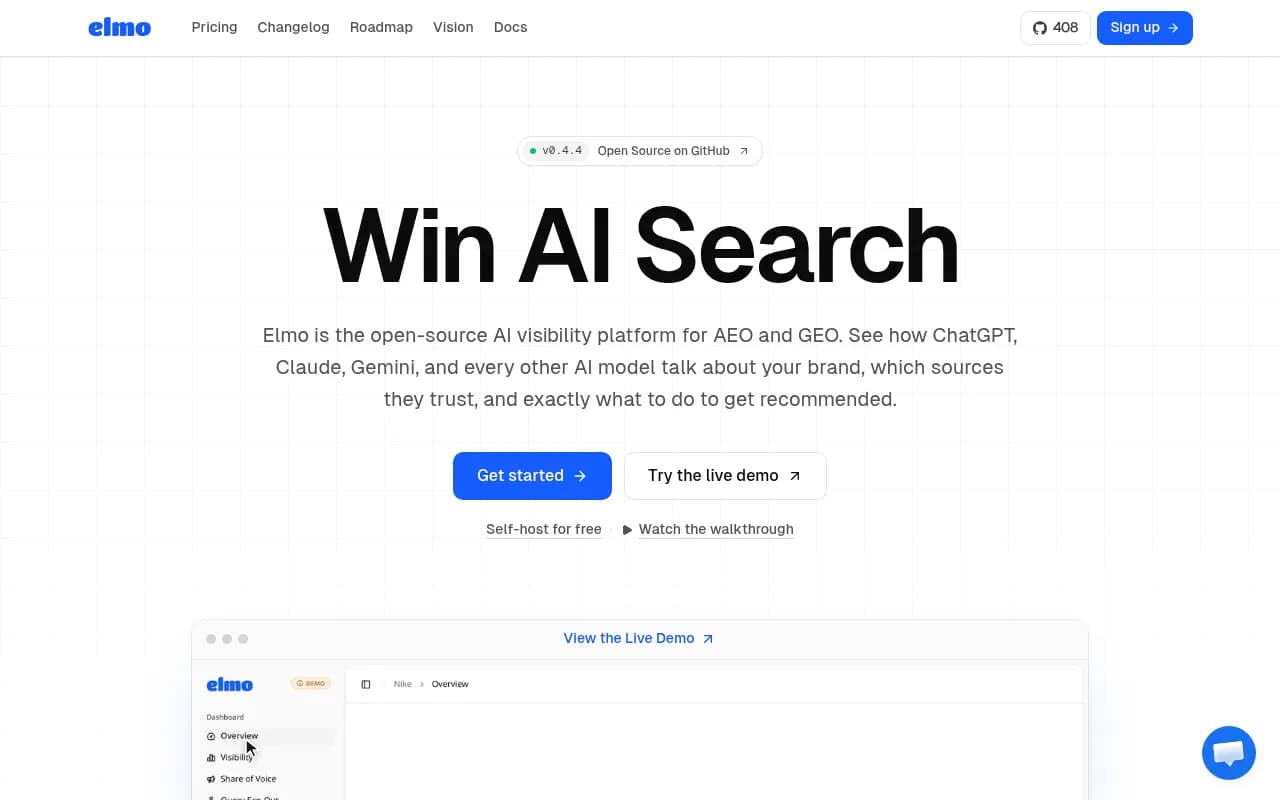
Elmo is an open-source Answer Engine Optimization (AEO) and Generative Engine Optimization (GEO) tracker built by Jared Rhizor, a self-described bootstrapped founder. It tracks how AI answer engines, ChatGPT, Claude, Gemini, Perplexity, Google AI Overviews, Google AI Mode, Copilot, Grok, DeepSeek, Mistral, Qwen, and anything available through OpenRouter, mention and cite a brand, and it does this either as a $29/mo-and-up cloud product or as a completely free, MIT-licensed self-hosted stack you run on your own Postgres database and Docker setup.
The pitch is straightforward: this is the open-source answer to Profound, Peec, Scrunch, and Otterly. Where those tools lock your visibility data inside their dashboards and charge enterprise prices, Elmo lets you read the source code, run it on your own servers, and pay only for the AI provider API keys and scraping services you choose to use. It launched with a fast release cadence (v0.4.4 as of October 2026, over 1,000 commits) and has picked up 408 GitHub stars and real paying customers like Speakeasy, TradeSites, and RecordRanks along the way.
The target audience skews technical. This isn't a tool a non-technical marketing coordinator spins up solo if they're self-hosting, it assumes comfort with Docker Compose, Node.js, and API key management. But for AEO consultancies, dev-savvy growth teams, and agencies that want a white-label AI visibility product without paying a SaaS vendor per client, it's one of the only serious options.
Key features
- Multi-engine tracking via scraping and API hybrid approach. Elmo doesn't just hit APIs. For consumer-facing engines like ChatGPT and Google AI Mode, it scrapes the actual interface real users see, using providers like BrightData, Oxylabs, Olostep, SearchApi, DataForSEO, or Cloro. For everything else it calls provider APIs directly (OpenAI, Anthropic, Mistral, OpenRouter). This matters because API responses and UI responses from the same model can genuinely differ, and most competitors only do one or the other.
- Visibility and share of voice dashboards. The Overview page shows aggregate visibility at a glance; the Visibility page breaks it down per prompt and per model over time; Share of Voice shows which competitors AI recommends instead of you. Standard stuff for this category, done cleanly.
- Query Fan-Out tracking. Shows the sub-searches an AI engine runs behind a single prompt response, useful for understanding why certain pages get surfaced and others don't.
- Citations page. Surfaces which domains and specific URLs each model trusts and cites within your category, classified by content type including developer docs, blog subdomains, and software directories.
- Opportunities page. A ranked list of recommended actions based on where you're losing visibility. This is the closest thing Elmo has to an optimization layer, but it stops at recommendations. It doesn't write content, publish it, or track the crawler activity that explains why a page isn't getting cited.
- REST API and MCP server on every plan. Unlimited seats plus full API and MCP access even on the $29/mo Starter tier is a genuinely differentiated move, most competitors gate API access behind higher tiers. The MCP server plugs into Claude Code, Cursor, Codex, OpenCode, and VS Code, including a dedicated Cursor Marketplace plugin.
- Self-hosted deployment.
npm install -g @elmohq/clithenelmo initspins up a Docker Compose stack (web, worker, Postgres, scraper and API connectors). Telemetry is opt-out and anonymous. You bring your own AI provider keys and, ideally, a scraping subscription if you want real-UI data for ChatGPT and Google AI Mode rather than approximations. - White-label option for agencies. Custom branding, custom domain, and SSO, though this is a "contact us" tier rather than self-serve.
Who is it for
Elmo fits technical marketing teams and AEO-focused agencies that are comfortable either paying Elmo Cloud or running their own infrastructure. A two-person AEO consultancy tracking 10 client brands across 150 prompts each would find the Pro plan ($299/mo) reasonable, especially next to Profound's pricing for similar scope. A solo indie SaaS founder tracking a single brand across ChatGPT only might start on Starter at $29/mo, which is about as cheap as this category gets.
It also appeals to privacy-conscious or infrastructure-heavy engineering orgs that don't want their AI visibility data sitting in a third-party vendor's database. If your company already runs Postgres and Docker in-house and has opinions about data residency, self-hosting Elmo for free, minus AI provider API costs, is a real option nobody else in the category offers at this level of completeness.
Who should skip it: enterprise buyers needing SOC 2, HIPAA, or SSO/SAML compliance on standard plans (Elmo only offers SSO on custom white-label deals), and teams that want the tracking data to turn directly into action, content gap analysis, automated AEO content generation and publishing, crawler log analysis, actual AI-driven traffic numbers. Elmo tells you where you stand; it doesn't close the loop on fixing it. Teams that need both monitoring and execution in one tool are better served elsewhere.
Integrations and ecosystem
Elmo's integration story centers on infrastructure rather than marketing-stack connections. On the data collection side, it supports BrightData, Oxylabs, Olostep, SearchApi, DataForSEO, and Cloro as scraping providers, and OpenAI, Anthropic, Mistral, and OpenRouter for direct API model access. The MCP server is the standout developer-facing feature, letting Claude Code, Cursor, Codex, OpenCode, and VS Code query visibility data and manage prompts programmatically, with a dedicated Cursor Marketplace listing.
There's no mention of Slack notifications, Google Search Console, Zapier, or CMS publishing integrations anywhere in Elmo's documentation or changelog, a notable gap compared to platforms built around a full content-to-publishing workflow. Database-wise, self-hosted installs run on bundled or external Postgres, giving full SQL access to your own data if you want to build custom reporting on top.
Pricing and value
Elmo Cloud has four tiers. Starter is $29/mo for 1 brand, 50 prompts, ChatGPT only, checked once daily. Basic jumps to $99/mo for the same brand/prompt count but adds any 4 AI platforms checked 4 times daily. Pro is $299/mo for 2 brands, 150 prompts, plus 20 included premium "grounded and cited" prompt/model pairings (Claude Sonnet 5 web, GPT-5 Search, Grok web) at $5/mo per extra pairing. Business runs $649/mo for 5 brands, 350 prompts, and 30 premium pairings.
Every cloud tier, even Starter, includes unlimited seats and full API/MCP access, which is unusual generosity in this category where API access is often an add-on. Self-hosting is free and MIT-licensed, with the caveat that you still pay for AI provider API keys and, if you want real-UI scraping data rather than API approximations, a scraping provider subscription. So "free" self-hosting has real ongoing costs once you factor those in.
Elmo's own marketing claims Starter is a third the price of Profound's equivalent plan and Basic delivers four times the data at the same price point. I can't independently verify Profound's exact plan parity, but directionally the pricing is clearly aimed at undercutting the big monitoring-only incumbents, and the self-host option means a sufficiently technical team can run this at near-zero licensing cost indefinitely.
Strengths and limitations
What Elmo does well: it's a legitimately open-source, auditable AEO tracker in a category otherwise dominated by closed-source SaaS vendors. The hybrid scraping-plus-API data collection is a smart technical choice that produces more representative data than API-only competitors. Pricing undercuts the established players by a wide margin, and giving unlimited seats and API/MCP access on every tier, including the cheapest one, is a real differentiator. Release velocity is also impressive for what's largely a one-person project.
Where it falls short compared to Promptwatch: Elmo has no content gap analysis or automated content generation, no AI crawler log monitoring to explain why pages aren't getting cited, and no visitor analytics tying AI mentions to actual site traffic or conversions. It also lacks Reddit and YouTube citation tracking, ChatGPT Shopping and Ads Radar monitoring, and prompt-level search volume or difficulty scoring, all things Promptwatch tracks natively. Elmo's Opportunities page gives you a ranked to-do list, but nothing executes that list for you; Promptwatch's Content Agents and Unified Actions actually plan, write, and publish GEO-optimized content to your CMS. If what you need is a platform that closes the loop from insight to published fix, Elmo stops short of that.
The other honest limitation is team risk. This is essentially a solo-founder project with occasional outside contributors. That's fine for a scrappy startup comfortable with some operational risk, less fine for an enterprise that needs guaranteed support SLAs.
Bottom line
Elmo is the right pick for technical teams, AEO agencies, and cost-sensitive startups who want real, auditable AI visibility tracking across ChatGPT, Claude, Gemini, Perplexity, and the rest, and who are comfortable either paying modest cloud fees or self-hosting for free. If what you actually need is a platform that doesn't just tell you where you're invisible but automatically fixes it with content generation, crawler log analysis, and traffic attribution, Promptwatch is the stronger choice for that end-to-end workflow. Elmo's best use case in one sentence: a budget-conscious or privacy-focused team that wants full ownership of its AEO monitoring data without paying enterprise SaaS prices for it.
Frequently asked questions
What is Elmo?
Is Elmo free?
How does Elmo compare to Profound?
Does Elmo offer content optimization or just monitoring?
Which AI models does Elmo track?
Who should use Elmo instead of a SaaS-only AEO tool?
Similar and alternative tools to Elmo