Anyword Review 2026
AI content generation tool aimed at marketers, with a unique predictive performance score that estimates how well copy will convert before publishing.
Key takeaways
- Anyword's core differentiator is its predictive performance scoring -- a proprietary system trained on real A/B test data that claims 82% accuracy in predicting which copy variation will outperform another, versus 52% for GPT-4o alone
- Covers the full marketing content stack: ads, email, social, blogs, landing pages, and product messaging -- all in one platform
- Strong enterprise positioning with SOC 2, ISO 27001, GDPR, and HIPAA compliance, plus SSO and role-based access
- The Brand Voice system is genuinely useful for teams that need consistency across channels and writers
- Best suited to mid-market and enterprise marketing teams; solo freelancers may find the pricing steep relative to simpler alternatives like Copy.ai or Jasper
- The API offering opens up interesting use cases for teams building internal AI content workflows
Anyword is an AI content generation platform built specifically for marketing teams. Founded in New York and originally launched as Keywee (a content distribution company), it pivoted to AI copywriting and rebranded as Anyword around 2020. The core premise is straightforward: most AI writing tools generate plausible-sounding text, but they have no idea whether that text will actually convert. Anyword's answer to that problem is a proprietary performance prediction engine trained on a large dataset of real A/B test results across marketing channels.
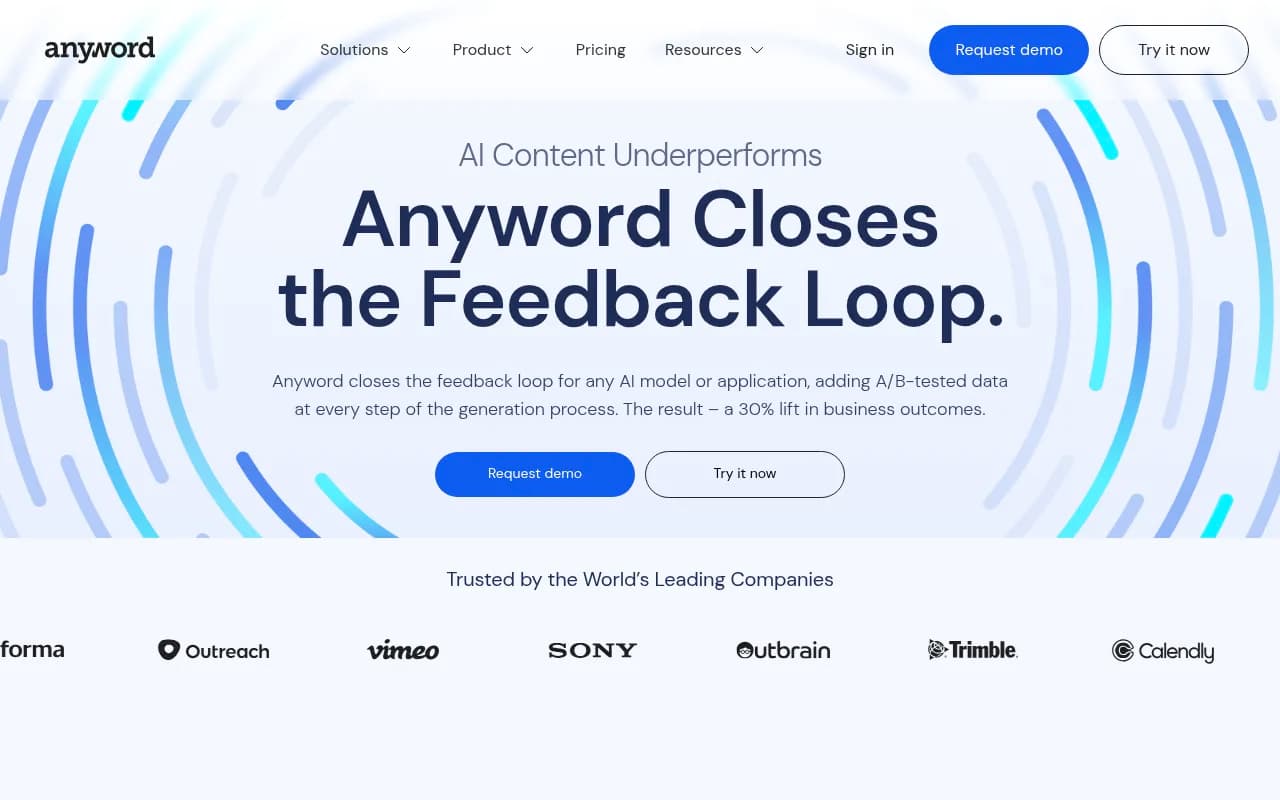
The platform targets marketing professionals -- demand gen managers, growth marketers, content teams, and product marketers -- who are already using AI to produce content at scale but are frustrated that generic LLM output doesn't reliably move business metrics. Anyword positions itself as the layer that sits on top of any AI model (including ChatGPT, Gemini, and others) and adds performance intelligence to the generation process. The claim is a 30% lift in business outcomes compared to baseline AI models, which is a bold number, though it's drawn from customer case studies rather than a controlled trial.
The company has raised funding (reportedly over $30M) and counts enterprise clients across automotive, SaaS, financial services, and e-commerce. It holds a G2 Winter 2024 Leader badge and has been featured in VentureBeat. The product has matured considerably since its early days as a short-form copy tool -- it now covers long-form content, email sequences, social posts, and a developer API.
Key features
Predictive performance scoring
This is the feature that sets Anyword apart from every other AI writing tool. When you generate copy variations, each one receives a numerical score (0-100) predicting how likely it is to perform well for your specified goal and audience. The scores are derived from Anyword's proprietary dataset of A/B test results across paid ads, email, and social content. The company claims 82% accuracy in head-to-head comparisons, versus 52% for GPT-4o without Anyword's data layer. In practice, this means you can generate five headline variations and immediately see which one the model predicts will drive the highest CTR -- without running a live test. For paid media teams burning budget on A/B tests, this is genuinely useful. The scoring is channel-aware and audience-aware, so the same copy might score differently for a "tech-savvy millennial" persona versus a "senior enterprise buyer."
Content intelligence
Content Intelligence is Anyword's analysis layer for existing content. You connect your published content (ads, emails, landing pages) and the system compares it against Anyword's industry-specific A/B test dataset to surface specific improvement opportunities. This is more than just a readability checker -- it's identifying which phrases, structures, and angles historically underperform in your vertical and suggesting replacements. For teams inheriting a large content library or running ongoing campaigns, this can surface quick wins without starting from scratch.
Data-driven editor
The main workspace for content creation. It generates multiple variations of any copy type -- ad headlines, email subject lines, CTAs, social captions, blog intros -- and displays performance scores alongside each variation. You can filter by persona, channel, and goal. The editor supports long-form content as well, though the performance scoring is most granular for short-form copy where A/B test data is densest. The interface is clean and the workflow is faster than most comparable tools.
Brand voice
Anyword lets you define and store your brand's tone, messaging pillars, audience profiles, and content guidelines in a centralized Brand Voice profile. Every piece of generated content is then filtered through this profile. For enterprise teams with multiple writers or agencies producing content, this is a real operational benefit -- it reduces the back-and-forth of brand reviews and keeps AI output from drifting into generic territory. You can create multiple brand voices for different product lines or markets.
Works with any AI model or app
One of Anyword's more interesting recent moves is positioning itself as a performance layer that integrates with tools you're already using. Through a browser extension and API, you can apply Anyword's performance scoring and brand voice to content generated in ChatGPT, Notion, Google Gemini, and other writing environments. This means you're not locked into Anyword's own editor -- you can keep your existing workflow and add the performance intelligence on top. In practice, the browser extension approach works reasonably well for short-form copy but is less seamless for complex long-form workflows.
Customer personas
Anyword lets you build detailed audience personas -- including demographics, pain points, and behavioral traits -- and then generate or score content specifically for those personas. The persona system connects directly to the performance scoring, so a piece of ad copy might score 78 for "SMB founder" and 61 for "enterprise IT buyer." This is particularly useful for demand gen teams running campaigns across multiple ICPs. One user testimonial on the site specifically calls out the ability to tailor email drips to actual LinkedIn profiles, which suggests some level of prospect-level personalization capability.
Email marketing tools
Anyword has a dedicated email workflow that goes beyond just generating subject lines. It can produce full email sequences, optimize for open rates and CTR, and score variations before sending. The claim that you can "generate a month's worth of engaging emails in less than an hour" is marketing copy, but the underlying capability -- batch generation with performance scoring -- is real and useful for marketing ops teams managing high-volume outbound or nurture sequences.
Performance API
For teams building internal AI content tools or integrating Anyword into existing martech stacks, there's a dedicated API. It exposes performance predictions, brand voice enforcement, and RAG (retrieval-augmented generation) capabilities. This is a meaningful differentiator for enterprise buyers who want to embed performance intelligence into custom workflows rather than using a standalone SaaS interface.
Enterprise security and compliance
Anyword meets SOC 2, ISO 27001, GDPR, and HIPAA requirements. It supports SSO, multi-factor authentication, and role-based access controls. Critically, the company states that customer data is never used to train third-party models -- a significant concern for enterprise buyers in regulated industries. The LLM-agnostic generation engine means Anyword isn't dependent on a single model provider, which also helps with data isolation.
Who is it for
Anyword's sweet spot is mid-market to enterprise marketing teams that are already producing content at scale and want to improve conversion rates without running endless A/B tests. Think: a demand gen team at a B2B SaaS company managing paid search, LinkedIn ads, and email nurture sequences simultaneously, or a growth marketing team at a consumer brand running dozens of ad variations across Meta and Google. These teams have enough volume that the performance scoring pays for itself quickly -- even a modest improvement in CTR on a significant ad budget is worth the subscription cost.
Product marketing teams at larger companies are another strong fit. The Brand Voice and messaging consistency features address a real pain point: keeping AI-generated content aligned with positioning when multiple people are creating assets. The ability to score messaging variations against specific personas is particularly relevant for product launches where you're testing different angles before committing to a campaign direction.
Content marketing teams producing blogs, landing pages, and long-form assets will find Anyword useful but may feel the performance scoring is less precise for long-form content than for short-form copy. The tool works, but the A/B test dataset is naturally richer for ads and email than for 2,000-word blog posts. Solo freelancers or very small teams might find the pricing hard to justify relative to simpler tools -- Anyword is built for teams, not individuals.
Who should probably look elsewhere: pure SEO content producers who need deep keyword research and SERP analysis integrated into their workflow (tools like Surfer SEO or Clearscope are better fits), and teams whose primary need is long-form research-heavy content rather than conversion-focused copy.
Integrations and ecosystem
Anyword integrates with a range of tools through its browser extension and API:
- ChatGPT, Google Gemini, Notion: Apply brand voice and performance scoring directly within these tools via the browser extension
- HubSpot: Email and CRM content workflows
- Google Ads and Meta Ads: Performance data import for scoring calibration
- Zapier: Workflow automation connections to hundreds of other tools
- API: Full programmatic access to performance predictions, brand voice enforcement, and content generation -- documented for developer use
The browser extension is a practical way to use Anyword without switching contexts, though it's not as deeply integrated as native plugins would be. The API is the most flexible integration path for enterprise teams with custom martech stacks. Import/export of content and brand assets is supported, and the platform works across web browsers without requiring a desktop app.
There's no dedicated mobile app mentioned, which is a minor gap for marketers who want to review or approve content on the go.
Pricing and value
Anyword's pricing has evolved over time and the current structure (as of 2026) includes:
- Starter: Around $39/month -- includes 1 seat, unlimited copy generation, 1 brand voice, 50 performance predictions, and 50 performance data rows. This is the entry point for individuals or very small teams.
- Data-Driven Teams: Higher tier with multiple seats, more brand voices, and significantly more performance predictions per month. Exact pricing requires checking the current pricing page as it has shifted.
- Business/Enterprise: Custom pricing with full API access, advanced security features (SSO, HIPAA compliance), dedicated support, and custom performance data integration.
A free trial is available -- no credit card required based on third-party sources. There's no permanent free tier.
Compared to Jasper (which starts around $49/month for one seat) and Copy.ai (which has a free tier and paid plans from around $49/month), Anyword is in a similar price range at the entry level but differentiates on the performance scoring capability. For enterprise buyers, the compliance certifications and API access justify a higher price point that competitors without those features can't match. The value proposition is strongest when you can quantify the ROI of improved conversion rates -- if you're spending $50K/month on paid ads, even a 5% improvement in CTR from better copy selection pays for the tool many times over.
Strengths and limitations
What Anyword does well:
- The performance prediction system is genuinely differentiated. No other mainstream AI writing tool offers this level of data-backed scoring, and the 82% accuracy claim (if it holds in practice) is meaningful for teams making real budget decisions.
- Enterprise readiness is thorough. SOC 2, ISO 27001, GDPR, HIPAA, SSO, role-based access -- this is a complete compliance story that many AI writing tools still can't match.
- Brand Voice enforcement works well for teams and reduces the quality control burden on editors and brand managers.
- The API is a real differentiator for companies building internal AI workflows -- not just a checkbox feature.
- Customer persona targeting in the scoring engine is more sophisticated than most competitors, which treat all audiences as interchangeable.
Honest limitations:
- The performance scoring is most reliable for short-form, high-volume content types (ads, email subject lines, social captions) where A/B test data is abundant. For long-form blog content or niche B2B verticals with limited historical data, the scores are less trustworthy.
- Long-form content quality is solid but not exceptional -- tools like Jasper or even direct GPT-4o usage with good prompting can produce comparable blog drafts. Anyword's edge is in the scoring layer, not the raw generation quality.
- The browser extension integration with external tools is convenient but shallow compared to native integrations. It works, but it's not seamless.
- Pricing can feel steep for small teams or freelancers who don't have the content volume to make the performance scoring pay off.
Bottom line
Anyword is the right tool for marketing teams that are already producing content at scale and want a data-backed way to improve conversion rates without running more A/B tests. The performance prediction engine is the real product here -- everything else (the editor, brand voice, personas) is infrastructure that makes the scoring actionable. If you're managing significant paid media budgets or high-volume email programs and you're frustrated that AI-generated copy performs inconsistently, Anyword's approach of training predictions on real A/B test data is a credible solution.
Best use case in one sentence: A demand gen or growth marketing team at a mid-market SaaS or e-commerce company that wants to generate and score dozens of ad and email copy variations quickly, with confidence that the top-scoring options are grounded in real performance data rather than guesswork.
Tags:
Frequently asked questions
What is Anyword?
How does Anyword's performance prediction work?
How much does Anyword cost?
Who is Anyword best suited for?
Does Anyword work with other AI tools like ChatGPT?
Is Anyword compliant with enterprise security standards?
Similar and alternative tools to Anyword