Key Takeaways
- Promptwatch is the best all-around alternative if you need content creation tools and crawler logs alongside visibility tracking -- it's the only platform that helps you fix gaps, not just monitor them
- Profound matches Azoma's enterprise focus with similar pricing but adds prompt volume data and automated content agents
- Semrush works if you already use their SEO suite and want to add basic AI visibility tracking without learning a new platform
- AthenaHQ offers strong monitoring at $295/mo but lacks the content optimization and generation features that make visibility actionable
- Evertune targets Fortune 500 brands with $3,000+/mo pricing and focuses on website optimization for AI crawlers
Azoma positions itself as an end-to-end agentic commerce platform for consumer brands and retailers who want to get discovered by AI shopping agents like ChatGPT, Amazon Rufus, Walmart Sparky, and Google Gemini. It monitors product visibility, generates optimized listings, and tracks performance across AI platforms. The catch: enterprise-only pricing with no transparent tiers, no free trial, and custom quotes that start high and go higher based on SKU count and markets covered.
If you're a mid-market brand, a B2B company, or anyone who doesn't fit Azoma's enterprise commerce mold, you're stuck. Even if you do fit, the lack of pricing transparency and the focus on product listings over broader content strategy might leave you wanting more. Here's what else is out there.
Promptwatch

Promptwatch is the top recommendation if you want a platform that doesn't just show you where you're invisible in AI search -- it helps you fix it. Most competitors (including Azoma) are monitoring dashboards. Promptwatch is built around an action loop: find content gaps, generate AI-optimized content, track the results.
The difference starts with Answer Gap Analysis. It shows you exactly which prompts competitors rank for but you don't, then surfaces the specific topics and angles your website is missing. From there, the built-in AI writing agent generates articles, listicles, and comparisons grounded in real citation data (880M+ citations analyzed), prompt volumes, and competitor research. This isn't generic SEO filler -- it's content engineered to get cited by ChatGPT, Claude, Perplexity, and other AI models.
Promptwatch monitors 10 AI models: ChatGPT, Perplexity, Google AI Overviews, Google AI Mode, Claude, Gemini, Meta AI, DeepSeek, Grok, Mistral, and Copilot. You get page-level tracking that shows which pages are being cited, how often, and by which models. Close the loop with traffic attribution (code snippet, GSC integration, or server log analysis) to connect visibility to revenue.
Additional capabilities that matter: AI Crawler Logs show real-time logs of AI crawlers hitting your site -- which pages they read, errors they encounter, how often they return. Most competitors lack this entirely. Prompt Intelligence gives you volume estimates and difficulty scores for each prompt, plus query fan-outs that show how one prompt branches into sub-queries. Citation & Source Analysis shows exactly which pages, Reddit threads, YouTube videos, and domains AI models cite. Reddit & YouTube Insights surface discussions that directly influence AI recommendations. ChatGPT Shopping Tracking monitors when your brand appears in product recommendations and shopping carousels. Competitor Heatmaps compare your AI visibility vs competitors across LLMs.
Pricing is transparent: Essential $99/mo (1 site, 50 prompts, 5 articles), Professional $249/mo (2 sites, 150 prompts, 15 articles, crawler logs, state/city tracking), Business $579/mo (5 sites, 350 prompts, 30 articles). Free trial available. Annual billing discounts.
Best for: Marketing teams, SEO teams, and agencies that want to optimize for AI search, not just monitor it. If you need content creation tools, crawler logs, and Reddit/YouTube tracking alongside visibility metrics, Promptwatch is the clear choice. If you only need basic monitoring and already have a content team, you might prefer a simpler tracker.
vs Azoma: Promptwatch is broader (tracks brand visibility across all AI models, not just shopping agents) and more actionable (content gap analysis + AI writing agent). Azoma is narrower (product listings for shopping agents only) and more expensive (enterprise custom pricing vs transparent tiers starting at $99/mo). If you're a B2B brand or a content publisher, Azoma isn't even an option. If you're an e-commerce brand, Promptwatch gives you the AI visibility foundation plus content tools; Azoma gives you product listing optimization at a much higher price point.
Profound

Profound is an enterprise Answer Engine Optimization (AEO) platform used by MongoDB, Ramp, and Zapier. It monitors brand visibility across ChatGPT, Perplexity, Claude, Gemini, and other LLMs, then adds prompt volume data, AI crawler analytics, and automated content creation to help you rank in AI search results.
The core offering is Answer Engine Insights: track how often your brand appears in AI-generated answers, which competitors are winning, and what sources AI models cite. Prompt Volumes show you which queries are high-traffic and winnable. Agent Analytics (AI crawler logs) show which pages AI models are reading and how often they return. The Agents feature (automated content creation) generates AI-optimized content at scale using templates like listicles, how-tos, and comparisons.
Profound also tracks ChatGPT Shopping -- when your brand appears in product recommendations and shopping carousels. This overlaps with Azoma's focus but isn't the entire platform. Profound is broader: it's built for any brand that wants AI visibility, not just e-commerce.
Pricing is custom enterprise (estimated $1,000-$3,000+/month). No public tiers, no free trial. This is similar to Azoma's model: if you have to ask, you're probably not the target customer.
Best for: Enterprise brands with budget for custom pricing who want a full-featured AEO platform with prompt volume data and automated content creation. If you're already talking to Azoma and want a comparable alternative with more transparent capabilities (but still opaque pricing), Profound is worth a demo.
vs Azoma: Both are enterprise-only with custom pricing. Profound is broader (tracks all AI search, not just shopping agents) and includes prompt volume data and AI crawler logs. Azoma is narrower (product listing optimization for shopping agents) and emphasizes multi-market SKU management. If you're a retailer with thousands of SKUs across multiple countries, Azoma's focus might be worth the premium. If you're a B2B brand or a publisher, Profound is the better fit.
AthenaHQ

AthenaHQ is a GEO (Generative Engine Optimization) platform that monitors brand visibility across 8+ AI search engines: ChatGPT, Perplexity, Google AI Overviews, Claude, Gemini, and others. It's used by ZoomInfo, Coinbase, and OneSignal. The pitch is straightforward: track how AI models talk about your brand, analyze sentiment, and benchmark competitors.
The platform shows visibility scores, citation rates, and sentiment analysis. You can see which prompts your brand appears in, how often, and what AI models say about you. Competitor tracking shows who's winning for each prompt and why. The interface is clean and the data is reliable.
What's missing: content creation tools, AI crawler logs, and prompt volume estimates. AthenaHQ is a monitoring platform, not an optimization platform. It shows you the problem but doesn't help you fix it. If you have a content team that can act on the insights, that's fine. If you need the platform to generate content or show you what's missing, look elsewhere.
Pricing starts at $295/mo (self-serve) or $95/mo annual. Enterprise custom pricing available. No free trial.
Best for: Marketing teams and brand managers who need reliable AI visibility tracking and already have a content team to act on the insights. If you want a clean dashboard without the complexity of content tools or crawler logs, AthenaHQ is solid.
vs Azoma: AthenaHQ is broader (tracks all AI search, not just shopping agents) and cheaper ($295/mo vs custom enterprise pricing). Azoma is narrower (product listing optimization) and more expensive. If you're a B2B brand or a content publisher, AthenaHQ is the better fit. If you're an e-commerce brand with a large SKU catalog, Azoma's product focus might justify the premium -- but you'll need to decide if the lack of broader visibility tracking is worth it.
Semrush
Semrush is a comprehensive SEO and marketing suite that added AI visibility tracking as an add-on. The AI Visibility Toolkit ($99/mo add-on) monitors brand mentions across ChatGPT, Perplexity, Gemini, and Google AI Overviews. You get visibility scores, sentiment analysis, and competitive benchmarking.
The advantage: if you already use Semrush for SEO, you can add AI tracking without learning a new platform. The data integrates with your existing workflows. The disadvantage: Semrush uses fixed prompts (you can't customize them), lacks AI crawler logs, and doesn't support traffic attribution. It's a basic monitoring layer on top of a traditional SEO platform.
Pricing: Semrush One from $165.17/mo (annual billing) + $99/mo AI Visibility Toolkit add-on. 7-14 day free trial.
Best for: Existing Semrush users who want to add basic AI visibility tracking without switching platforms. If you're not already a Semrush customer, the combined cost ($264+/mo) is hard to justify when dedicated AI visibility platforms offer more features for less.
vs Azoma: Semrush is broader (traditional SEO + basic AI visibility) but shallower on AI-specific features. Azoma is narrower (product listing optimization for shopping agents) and deeper on e-commerce use cases. If you're a B2B brand or a content publisher, Semrush's all-in-one approach might appeal. If you're an e-commerce brand, Azoma's product focus is more relevant -- but you'll pay a premium for it.
Brandlight
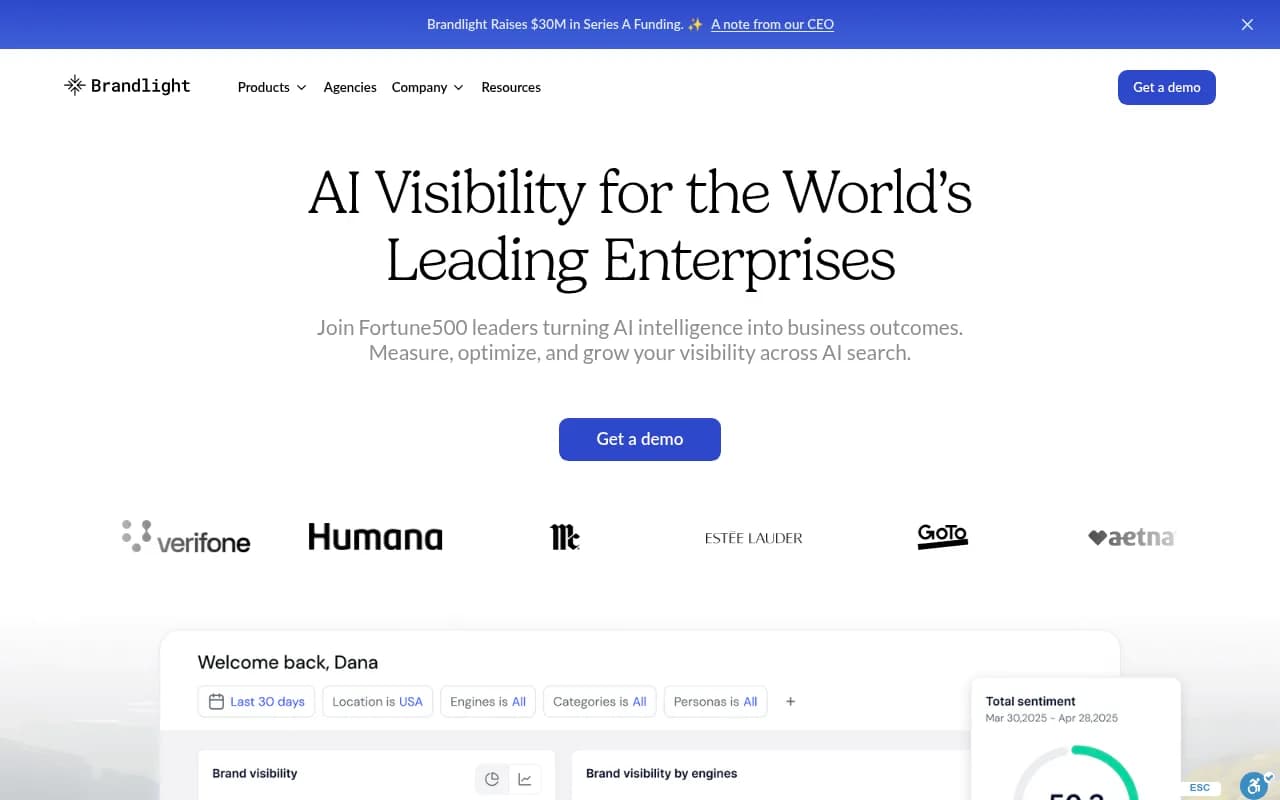
Brandlight is an AI-powered brand visibility tracking solution that monitors brand presence across AI search engines. It recently raised $30M in Series A funding and targets enterprise customers. The platform tracks how AI models talk about your brand, analyzes sentiment, and benchmarks competitors.
The feature set is similar to AthenaHQ: visibility tracking, sentiment analysis, competitive intelligence. What's missing: content creation tools, AI crawler logs, and prompt customization. Brandlight is a monitoring dashboard, not an optimization platform.
Pricing ranges from $199/mo (base tier) to $750/mo (activation plan), with custom enterprise pricing available.
Best for: Enterprise brands that want a well-funded, enterprise-focused monitoring platform with a clean interface. If you need content tools or crawler logs, look elsewhere.
vs Azoma: Brandlight is broader (tracks all AI search, not just shopping agents) and offers transparent mid-market pricing ($199-$750/mo). Azoma is narrower (product listing optimization) and more expensive (custom enterprise pricing). If you're a B2B brand, Brandlight is the better fit. If you're an e-commerce brand with a large SKU catalog, Azoma's product focus might justify the premium.
Rankshift
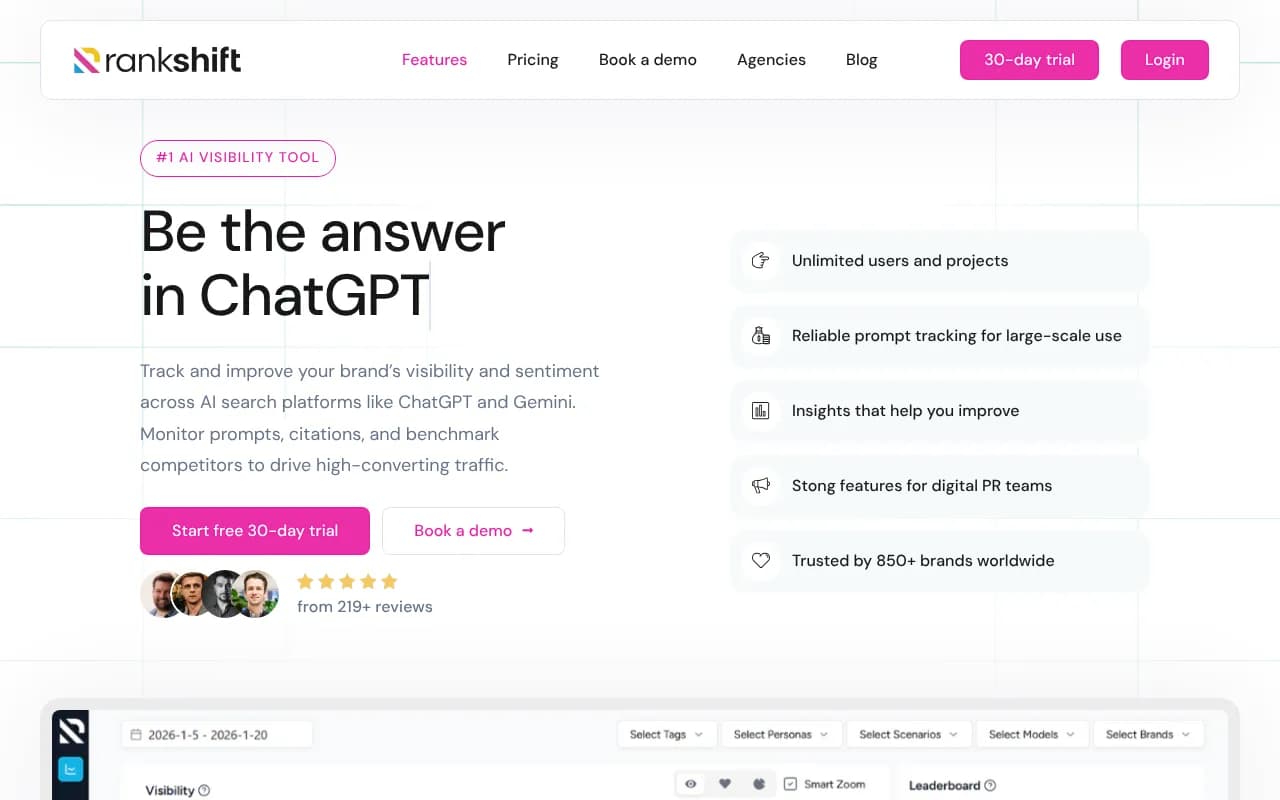
Rankshift is an LLM tracking tool focused on GEO and AI visibility. It monitors brand mentions across ChatGPT, Perplexity, Claude, Gemini, and Google AI Overviews. The platform tracks visibility scores, citation rates, and sentiment analysis. You can see which prompts your brand appears in and benchmark competitors.
Rankshift emphasizes reliability and scale: "reliable prompt tracking for large-scale use" and "insights that help you improve." The interface is straightforward and the data is solid. What's missing: content creation tools, AI crawler logs, and prompt volume estimates. Like AthenaHQ and Brandlight, Rankshift is a monitoring platform.
Pricing is transparent: from €69/mo (Starter: 150 prompts/day, 9,500 credits) to €359/mo (Business: 850 prompts/day, 53,000 credits). All plans include unlimited users and projects. 30-day free trial. 10% discount on annual billing. Custom pricing for agencies and enterprise.
Best for: Marketing teams and agencies that need reliable AI visibility tracking at a reasonable price. If you want content tools or crawler logs, look elsewhere. If you want a clean dashboard with transparent pricing, Rankshift is solid.
vs Azoma: Rankshift is broader (tracks all AI search, not just shopping agents) and cheaper (€69-€359/mo vs custom enterprise pricing). Azoma is narrower (product listing optimization) and more expensive. If you're a B2B brand or a content publisher, Rankshift is the better fit. If you're an e-commerce brand, Azoma's product focus might justify the premium -- but you'll need to decide if the lack of broader visibility tracking is worth it.
Evertune
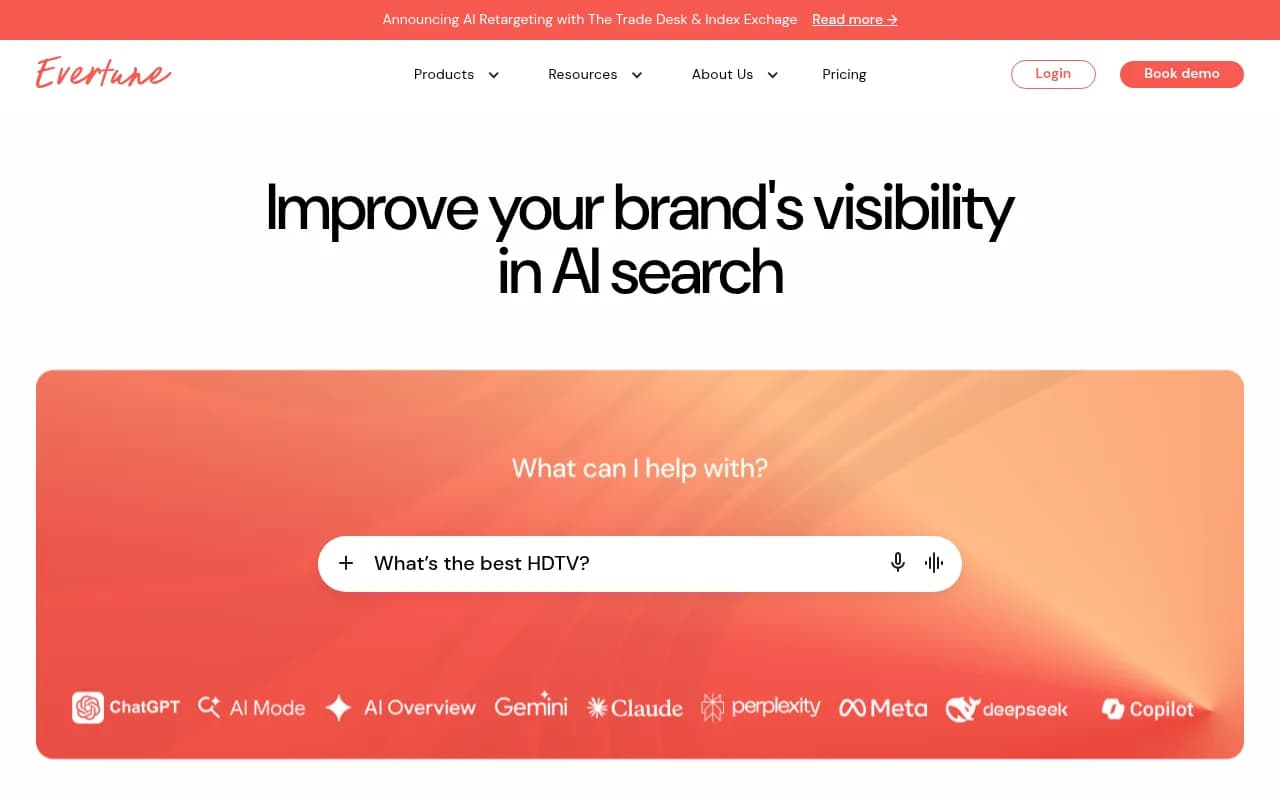
Evertune is an enterprise GEO platform built for Fortune 500 brands and agencies. It monitors AI visibility across ChatGPT, Google AI Overviews, Gemini, Claude, and other AI search engines, then focuses on website optimization for AI crawlers and data-driven content strategy.
The core offering: AI Brand Monitoring (track visibility and sentiment), AI Website Optimization (audit how AI crawlers interpret your site and get step-by-step fixes), and content strategy based on the most influential sources and partnerships. Evertune emphasizes statistical confidence and an easy-to-use platform.
Clients include Athenahealth, Miro, Roku, Virgin Voyages, and WPP. Pricing starts at $3,000/mo (enterprise pricing, annual contracts).
Best for: Fortune 500 brands with budget for enterprise pricing who want website optimization for AI crawlers and strategic content guidance. If you're a mid-market brand or need transparent pricing, look elsewhere.
vs Azoma: Both are enterprise-only with high pricing. Evertune is broader (tracks all AI search, not just shopping agents) and emphasizes website optimization for AI crawlers. Azoma is narrower (product listing optimization for shopping agents) and emphasizes multi-market SKU management. If you're a B2B brand or a content publisher, Evertune is the better fit. If you're an e-commerce brand with thousands of SKUs, Azoma's product focus might justify the premium.
Limy AI
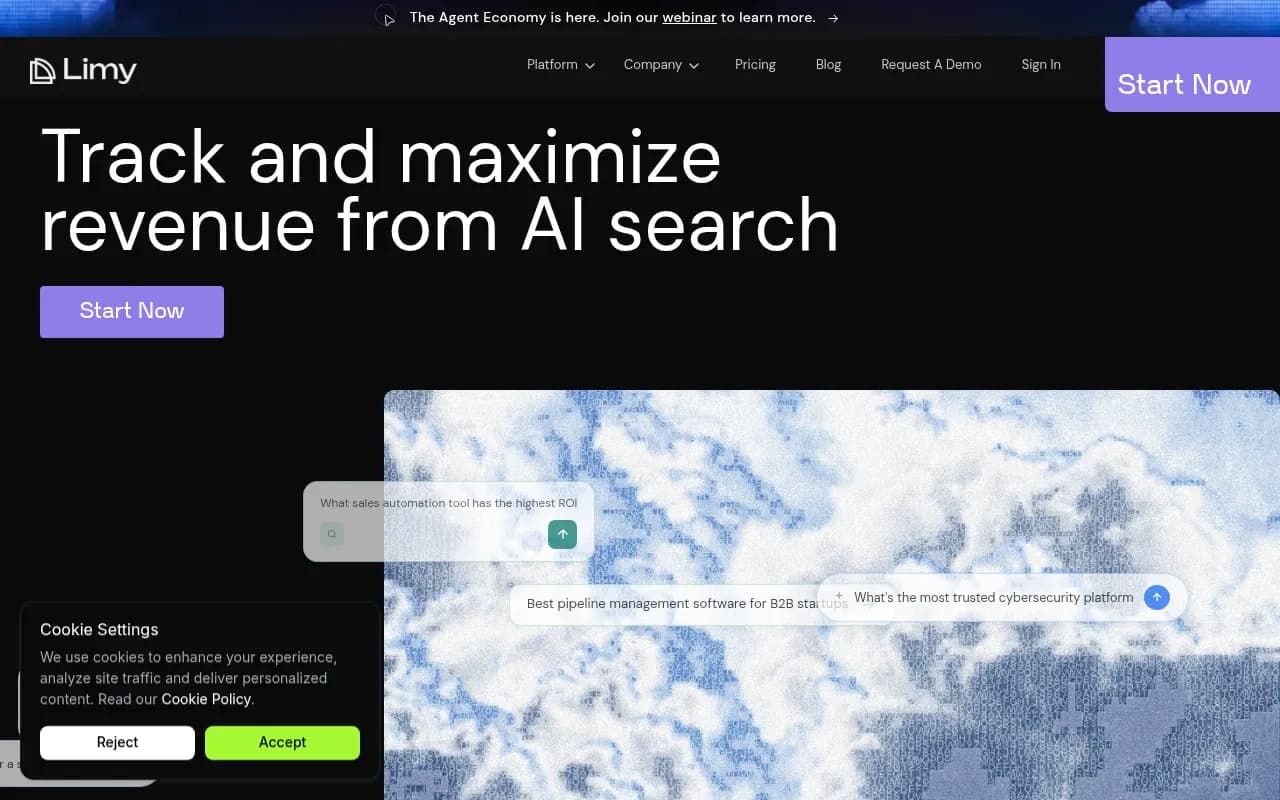
Limy AI is a B2A (Business-to-Agent) optimization platform that helps brands monitor, measure, and improve how AI search engines like ChatGPT, Perplexity, and Claude recommend their products. The pitch: "Unlike monitoring-only tools, Limy provides step-by-step optimization actions, sentiment analysis, and revenue tracking."
The platform tracks visibility, sentiment, and performance across AI models. It provides "step by step actions that boost how often and how well LLMs recommend your brand." The interface emphasizes prompt analytics and optimization guidance.
Pricing starts at $449/mo.
Best for: Brands that want optimization guidance alongside monitoring and are willing to pay a premium for it. If you need content creation tools or AI crawler logs, look elsewhere.
vs Azoma: Limy AI is broader (tracks all AI search, not just shopping agents) and offers transparent pricing ($449/mo). Azoma is narrower (product listing optimization) and more expensive (custom enterprise pricing). If you're a B2B brand, Limy AI is the better fit. If you're an e-commerce brand with a large SKU catalog, Azoma's product focus might justify the premium.
How to choose
If you need content creation tools and crawler logs alongside visibility tracking, Promptwatch is the clear choice. It's the only platform that helps you fix gaps, not just monitor them.
If you're an enterprise e-commerce brand with thousands of SKUs and need product listing optimization for shopping agents specifically, Azoma or Profound are worth demos. Both have custom pricing and similar feature sets.
If you need reliable monitoring at a reasonable price and already have a content team, AthenaHQ ($295/mo) or Rankshift (€69-€359/mo) are solid choices.
If you already use Semrush for SEO and want to add basic AI visibility tracking, the Semrush AI Visibility Toolkit ($99/mo add-on) is the path of least resistance.
If you're a Fortune 500 brand with budget for enterprise pricing and want website optimization for AI crawlers, Evertune ($3,000+/mo) is worth a look.
The common thread: Azoma's enterprise-only pricing and narrow focus on product listings for shopping agents make it a tough sell unless you're a large e-commerce brand with a specific need for multi-market SKU optimization. For everyone else, the alternatives offer better pricing, broader visibility tracking, and more actionable tools.