Key Takeaways
- Hyros is the top choice for high-ticket businesses and call-based funnels that need AI-powered attribution across long sales cycles (from $379/mo)
- RedTrack offers the most affordable server-side tracking with strong affiliate network integrations and CAPI support (from $48/mo)
- Northbeam combines MTA, MMM, and incrementality testing for enterprise DTC brands managing $500k+/month in ad spend (from $400/mo)
- Rockerbox provides multi-method measurement (MTA + MMM + testing) in one SOC2-certified platform for brands like Unilever and Weight Watchers (from $2,000/mo)
- ClickMagick delivers precise first-party tracking with bot filtering and cross-device attribution for direct response marketers (from $69/mo)
AnyTrack built its reputation on no-code conversion tracking that feeds enriched first-party data to ad platforms via Conversion APIs. It's solid for eCommerce, affiliate, and lead-gen funnels that need to recover the 20-30% of conversions iOS and ad blockers hide.
But it's not the only option. Some alternatives offer stronger AI attribution for complex sales cycles. Others cost less while delivering comparable server-side tracking. A few provide multi-method measurement that goes beyond what any single attribution model can show.
Here's how the top AnyTrack alternatives stack up when you need accurate conversion data, better ROAS visibility, or features AnyTrack doesn't provide.
Hyros
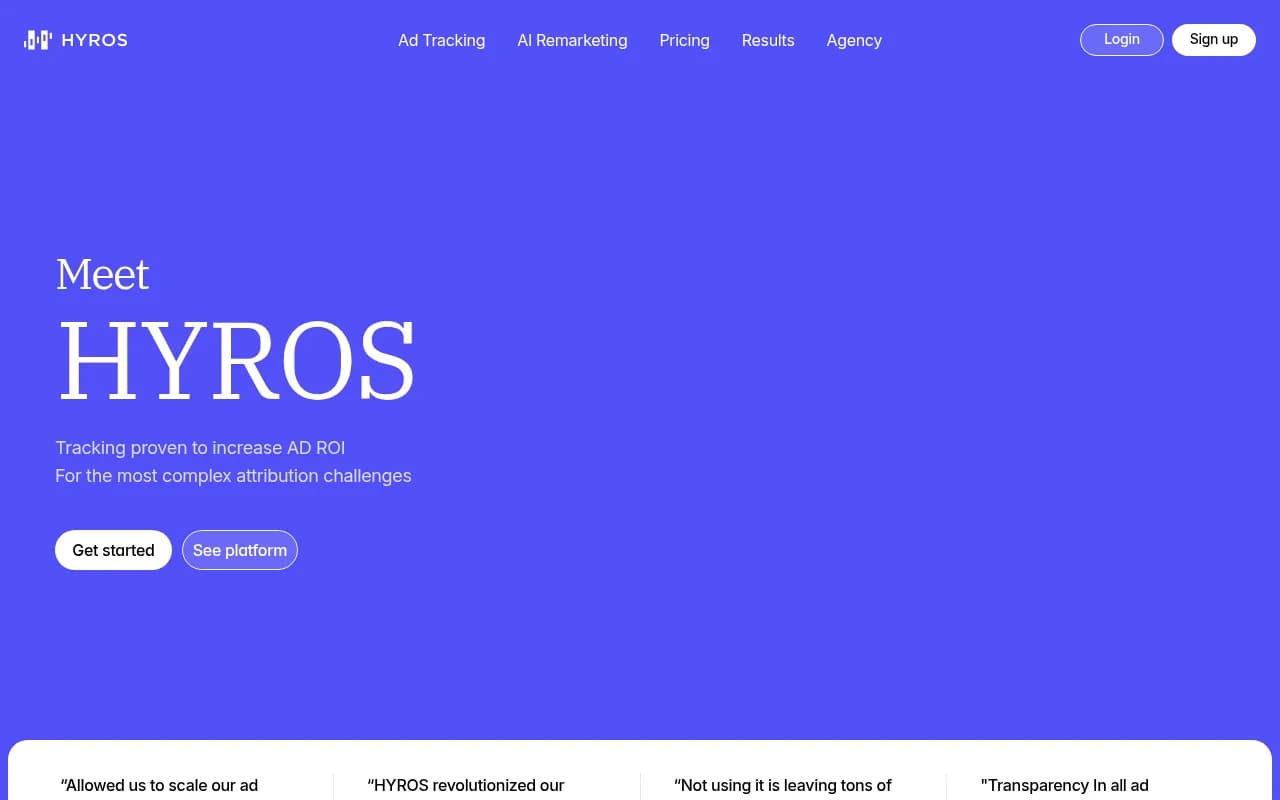
Hyros uses AI to track every sale back to its true source across multi-touch customer journeys that span weeks or months. Where AnyTrack focuses on immediate conversions in eCommerce and affiliate funnels, Hyros specializes in high-ticket products, info businesses, and call-based sales cycles.
The core difference: Hyros captures conversions that happen offline or outside your funnel -- phone calls, Zoom demos, CRM deals -- and attributes them to the original ad, keyword, or campaign. It then feeds this enriched data back to Meta, Google, TikTok, and other platforms to improve targeting.
AnyTrack handles standard eCommerce and affiliate tracking well. Hyros goes deeper with call tracking, CRM integrations, and AI models that assign credit across touchpoints most platforms never see. If you're selling $1,000+ products or running webinar funnels where the sale happens days after the click, Hyros will show you which ads actually drive revenue.
The trade-off: Hyros costs more (from $379/mo vs AnyTrack's $100/mo) and requires setup time to connect your CRM, call tracker, and sales pipeline. But for businesses where a single customer is worth $500-$5,000+, the attribution accuracy pays for itself immediately.
Best for: High-ticket offers, info products, SaaS with long sales cycles, call-based businesses, and anyone running webinar or VSL funnels where conversions happen offline.
RedTrack
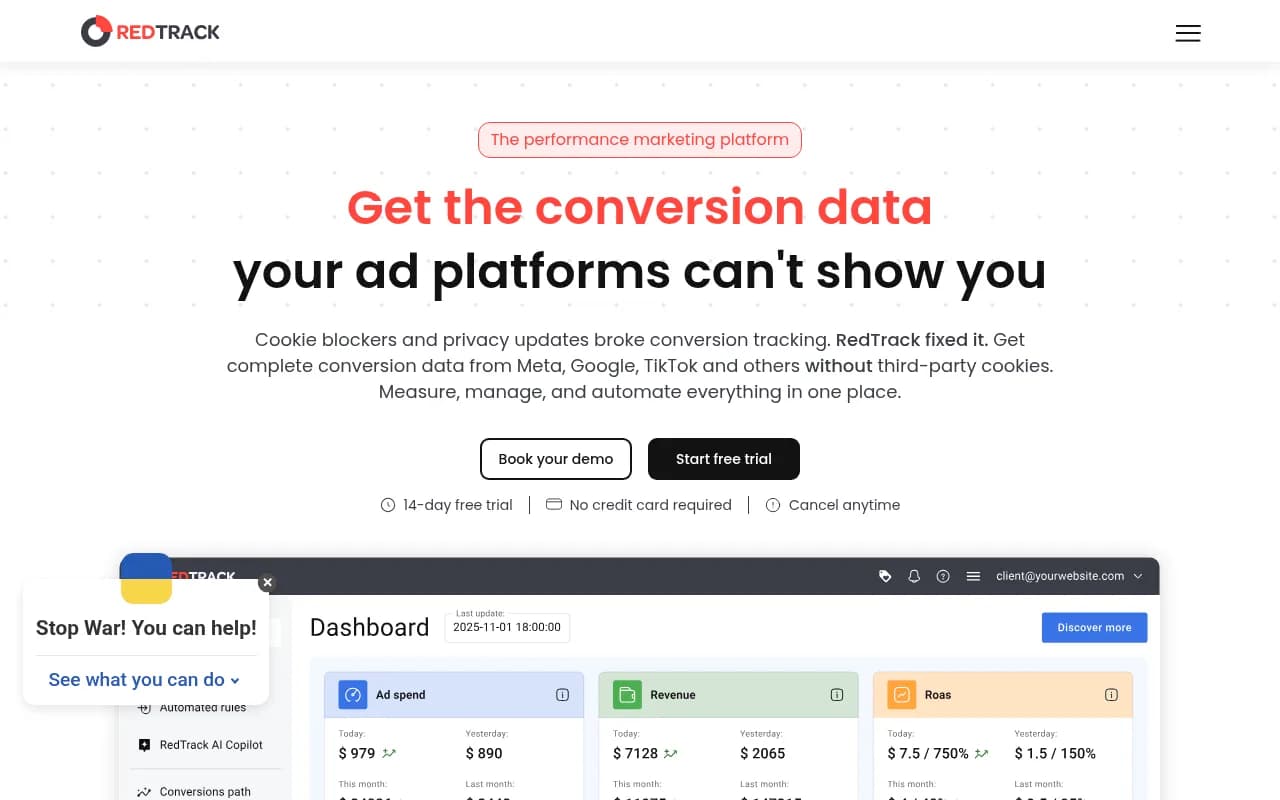
RedTrack solves the same iOS14 and ad blocker problem as AnyTrack but costs less and includes stronger affiliate network integrations. Both platforms use server-side tracking and first-party cookies to capture 100% of conversions, then send enriched data to ad platforms via CAPI.
The pricing difference is significant: RedTrack starts at $48/mo (billed annually) vs AnyTrack's $100/mo. You also get a free Relay product for CAPI-only use if you don't need full tracking.
Where RedTrack pulls ahead: it's built specifically for performance marketers running campaigns across dozens of affiliate networks and traffic sources. The interface is designed around multi-offer testing, traffic distribution, and granular cost tracking -- things affiliate marketers and media buyers need but eCommerce brands often don't.
AnyTrack is cleaner and easier for eCommerce stores that primarily run Meta and Google ads. RedTrack gives you more control and flexibility if you're buying traffic from PropellerAds, MGID, Taboola, or running CPA offers through MaxBounty and ClickBank.
Both platforms handle server-side tracking and CAPI well. RedTrack just costs less and caters more explicitly to affiliate and performance marketing workflows.
Best for: Affiliate marketers, media buyers, and performance marketers running campaigns across multiple traffic sources and affiliate networks on a budget.
Northbeam
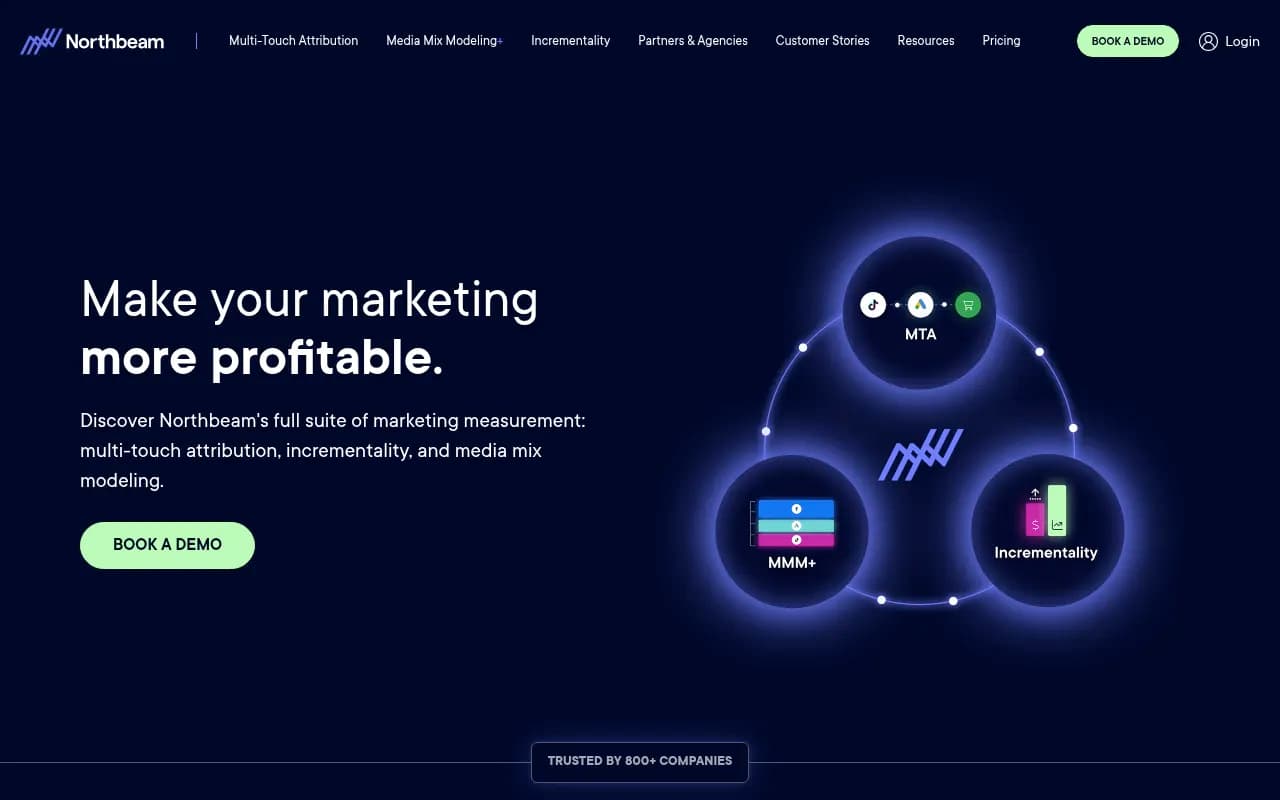
Northbeam combines Multi-Touch Attribution (MTA), Marketing Mix Modeling (MMM), and Incrementality Testing in one platform. AnyTrack focuses exclusively on MTA -- tracking individual customer journeys and attributing conversions to specific touchpoints.
That's fine for most brands. But if you're spending $500k+/month on ads across Meta, Google, TikTok, YouTube, podcasts, and TV, you need more than MTA. You need to understand how channels work together, measure incrementality (what would have happened without the ad), and model scenarios MMM provides.
Northbeam gives you all three methods in one SOC2-certified system. It shows you where MTA and MMM align, where they diverge, and which insights you can act on with confidence. Used by 800+ companies tracking $10B+ in ad spend, it's built for DTC brands and agencies managing complex, multi-channel marketing at scale.
AnyTrack costs $100-$300/mo and works great for brands spending $50k-$200k/month. Northbeam starts around $400/mo and scales to $1,000-$2,500/mo+ for brands spending significantly more. You're paying for enterprise-grade measurement that goes beyond what any single attribution model can show.
The trade-off: Northbeam requires annual contracts and custom pricing for high-spend accounts. AnyTrack offers monthly billing and transparent pricing. If you're a mid-market DTC brand, AnyTrack is probably enough. If you're Warby Parker or Allbirds, you need Northbeam.
Best for: Enterprise DTC brands and agencies spending $500k+/month on ads who need multi-method measurement (MTA + MMM + incrementality testing) to optimize complex, multi-channel strategies.
Rockerbox
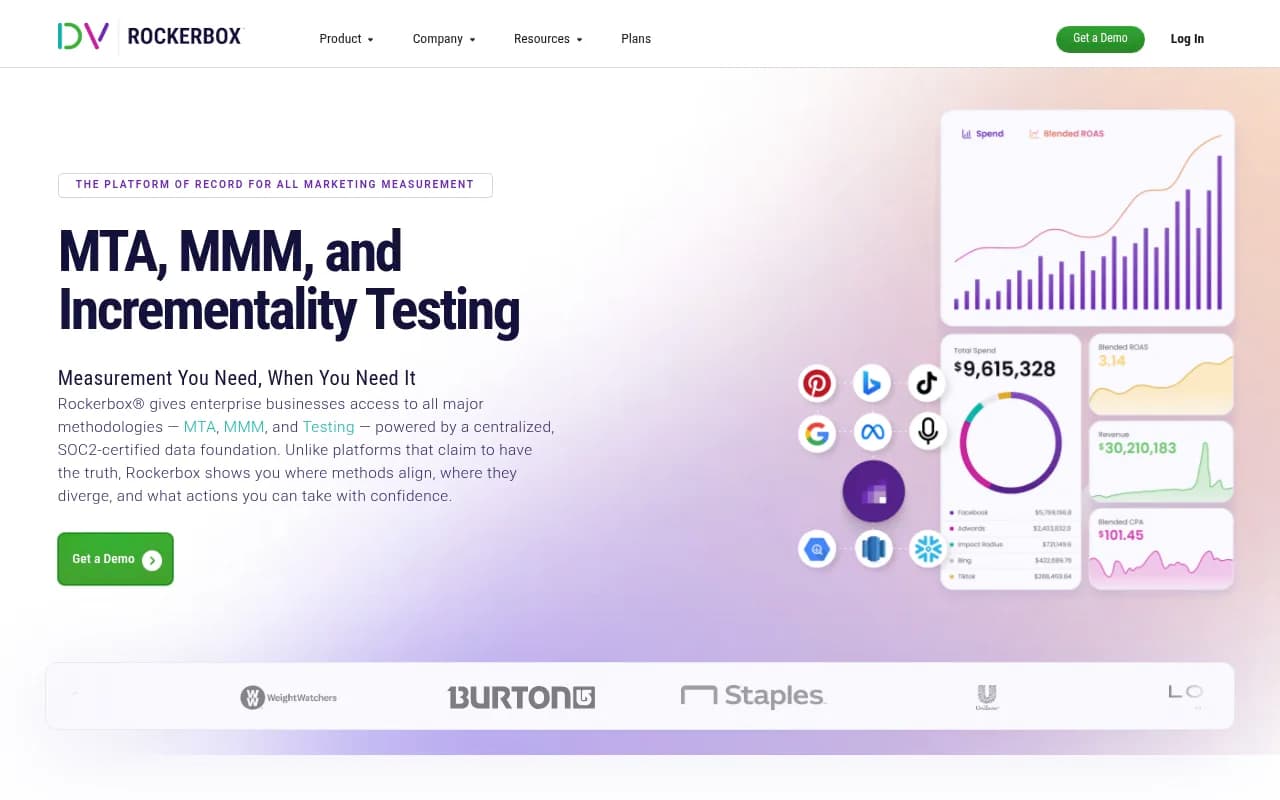
Rockerbox is similar to Northbeam -- it unifies MTA, MMM, and Incrementality Testing in one platform. Both are enterprise solutions used by major brands (Rockerbox counts Unilever, Weight Watchers, and FIGS as customers).
The difference: Rockerbox positions itself as the "Platform of Record" for all marketing measurement. It centralizes data from 100+ channels into a SOC2-certified foundation, then lets you compare how different attribution methods (MTA vs MMM vs testing) interpret the same data.
AnyTrack gives you one view: MTA based on first-party tracking and CAPI. Rockerbox shows you multiple views and helps you understand where they agree and where they don't. That's valuable when you're managing a $5M+/year marketing budget and need to defend budget allocation decisions to a CFO.
Pricing reflects the target audience: Rockerbox starts around $2,000/mo (custom enterprise pricing). AnyTrack starts at $100/mo. You're paying for enterprise infrastructure, dedicated support, and measurement sophistication most mid-market brands don't need.
If you're spending $100k-$300k/month on ads, AnyTrack or RedTrack will serve you well. If you're spending $1M+/month and need to prove marketing impact with the same rigor as a balance sheet, Rockerbox is built for that.
Best for: Enterprise brands spending $1M+/month on marketing who need multi-method measurement, SOC2 compliance, and a centralized system of record for all attribution data.
Voluum
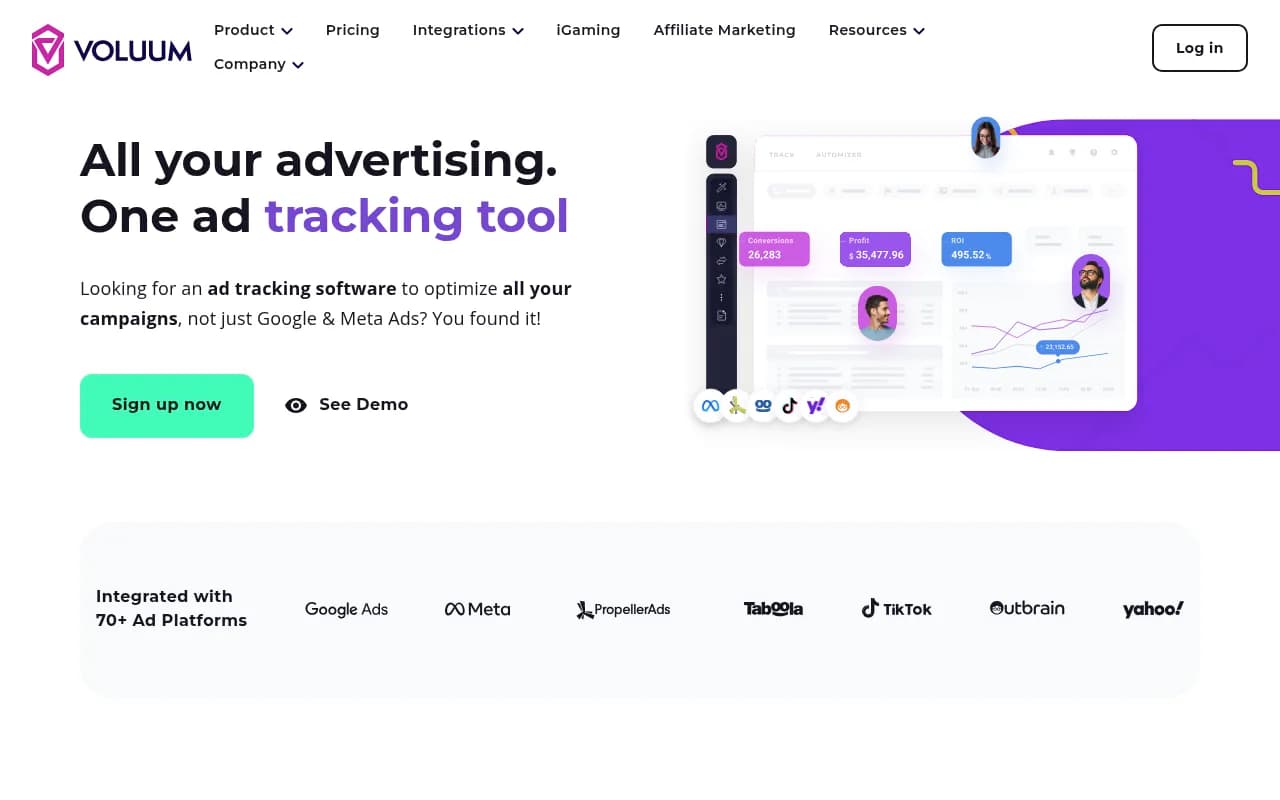
Voluum is a cloud-based ad tracker built for performance marketers running campaigns beyond Google and Meta. Where AnyTrack focuses on eCommerce and affiliate funnels with strong Shopify and WooCommerce integrations, Voluum is designed for media buyers running native ads, push traffic, pop campaigns, and display ads across 70+ networks.
Both platforms track conversions in real-time and optimize campaign performance. The difference is audience and workflow. AnyTrack is cleaner and easier for eCommerce brands. Voluum gives you granular control over traffic distribution, A/B testing, and cost tracking across dozens of traffic sources most eCommerce brands never touch.
Voluum also includes AI-powered traffic distribution that automatically shifts budget to winning combinations of traffic source, landing page, and offer. AnyTrack focuses on feeding better data to ad platform algorithms. Voluum optimizes traffic distribution at the tracker level before it even reaches the ad platform.
Pricing is comparable: Voluum starts at $119-$149/mo, AnyTrack at $100/mo. Both offer business and enterprise tiers. The decision comes down to use case: if you're running Shopify stores and scaling Meta/Google ads, AnyTrack is the better fit. If you're a media buyer running campaigns on PropellerAds, Taboola, and MGID, Voluum is built for you.
Best for: Performance marketers, affiliates, and agencies running campaigns across 70+ ad networks (native, push, pop, display) who need AI-powered traffic optimization and granular cost tracking.
ClickMagick
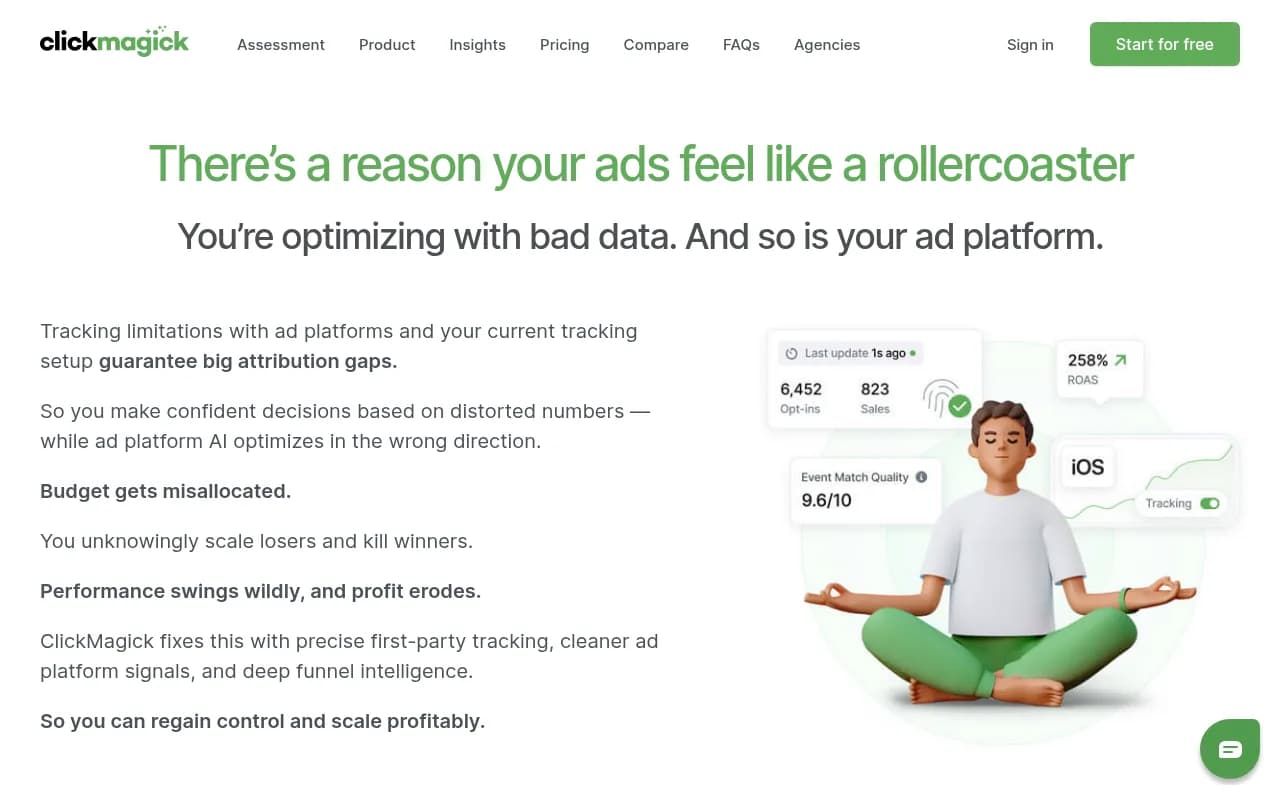
ClickMagick started as a link tracker and evolved into a full attribution platform trusted by 122,000+ advertisers. It provides first-party tracking, cross-device attribution, bot filtering, and Conversion API integrations to Meta, Google, TikTok, and other platforms.
The positioning is similar to AnyTrack: recover lost conversions, feed better data to ad platforms, and optimize campaigns with accurate attribution. Both platforms solve the iOS14 and ad blocker problem with server-side tracking.
The difference is philosophy and interface. AnyTrack is built around no-code simplicity and eCommerce workflows. ClickMagick gives you more control and flexibility but requires more setup. It's designed for direct response marketers who want to track every click, split-test every funnel element, and optimize based on metrics like ROAS24 (24-hour return on ad spend).
ClickMagick also includes features AnyTrack doesn't: bot filtering to remove fake clicks, link cloaking for affiliate links, and funnel-level tracking that shows exactly where visitors drop off. If you're running VSL funnels, webinar funnels, or multi-step lead gen campaigns, ClickMagick gives you deeper visibility.
Pricing: ClickMagick starts at $69/mo (vs AnyTrack's $100/mo) but the Starter plan is limited. The Standard plan at $149/mo is more comparable to AnyTrack's $150/mo Personal plan. Both offer annual discounts.
Best for: Direct response marketers running VSL funnels, webinar funnels, and multi-step lead gen campaigns who need bot filtering, link cloaking, and deep funnel-level tracking.
Segment
Segment is a Customer Data Platform (CDP), not an ad tracker. It collects, cleans, and unifies first-party data from websites, apps, and devices into customer profiles, then routes that data to 550+ destinations including analytics tools, ad platforms, email systems, and data warehouses.
AnyTrack is purpose-built for conversion tracking and ad optimization. Segment is infrastructure -- it sits upstream and feeds data to tools like AnyTrack, Google Analytics, and Meta CAPI.
You'd use Segment if you need to centralize customer data across multiple systems and send it to dozens of downstream tools. You'd use AnyTrack if you specifically need to track conversions and optimize ad campaigns.
Many brands use both: Segment as the data collection layer, AnyTrack (or similar) as the ad tracking and attribution layer. Segment handles the "collect and route" problem. AnyTrack handles the "track conversions and feed ad platforms" problem.
Pricing reflects the difference: Segment offers a free tier up to 1K monthly tracked users (MTUs), then starts at $120/mo for 10K MTUs. Full CDP pricing runs $1,000-$2,000/mo+. AnyTrack is $100-$300/mo. You're comparing infrastructure (Segment) to a specialized tool (AnyTrack).
Best for: Data teams, product managers, and marketers who need to unify customer data across websites, apps, and devices, then route it to 550+ destinations including analytics, ad platforms, and data warehouses.
Google Tag Manager
Google Tag Manager (GTM) is a free tag management system that deploys tracking codes without editing website code. It's not a conversion tracker or attribution platform -- it's the mechanism that loads tracking pixels and scripts.
AnyTrack includes a tag manager as part of its platform, but it also provides server-side tracking, attribution logic, and CAPI integrations. GTM just manages tags. You still need to configure Google Analytics, Meta Pixel, TikTok Pixel, and other tools separately.
Most marketers use GTM as the foundation, then layer conversion tracking tools like AnyTrack on top. GTM loads the AnyTrack script. AnyTrack captures conversions and sends data to ad platforms.
The advantage of GTM: it's free and integrates with the entire Google ecosystem (GA4, Google Ads, etc.). The disadvantage: it requires technical knowledge to set up properly, doesn't include server-side tracking by default, and doesn't solve the iOS14/ad blocker problem on its own.
AnyTrack is a complete solution. GTM is a component you'd use as part of a larger tracking stack.
Best for: Marketers and developers who need a free, flexible tag management system and are comfortable building their own tracking infrastructure using GTM + GA4 + ad platform pixels.
Elevar
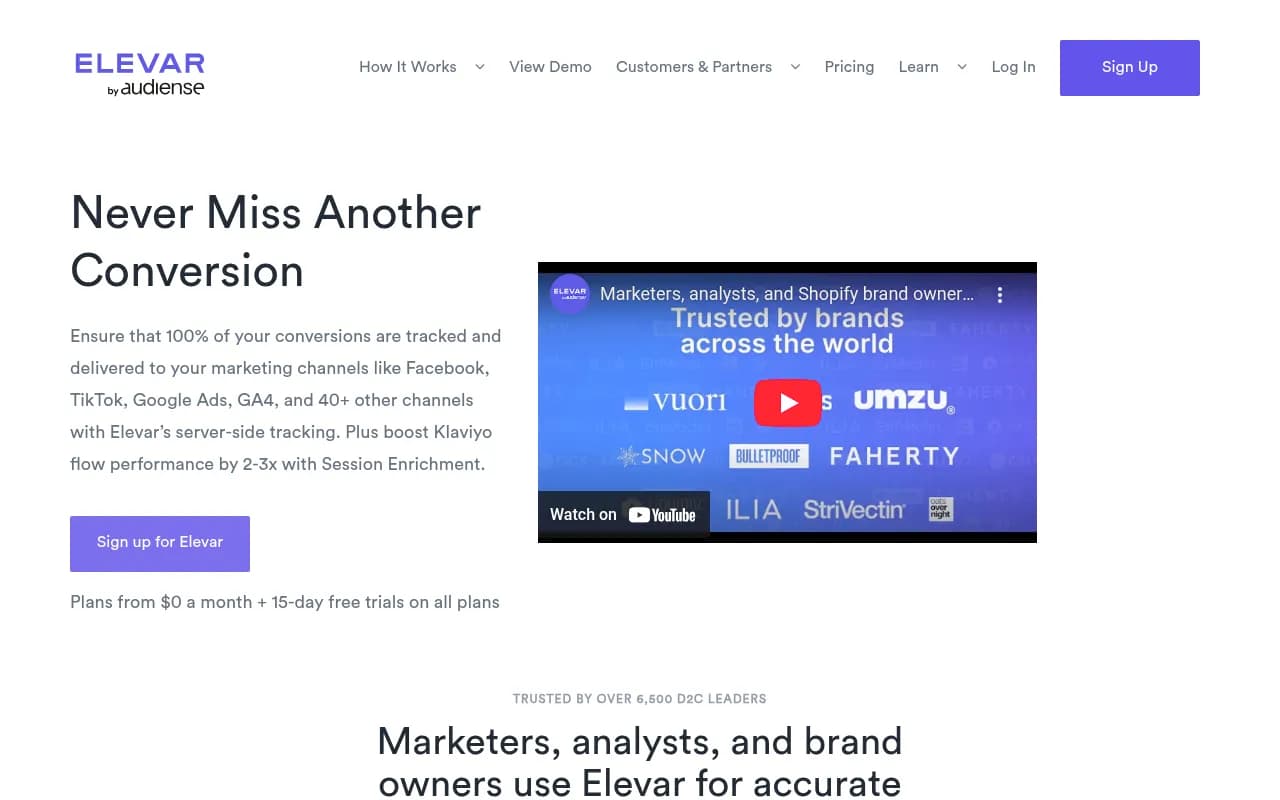
Elevar is a conversion tracking platform built specifically for Shopify and D2C brands. Like AnyTrack, it deploys server-side tracking to Meta, Google Ads, TikTok, GA4, and 40+ channels to recover conversions iOS and ad blockers hide.
The core difference: Elevar is Shopify-native and includes Session Enrichment for Klaviyo. It captures browsing behavior (product views, category visits, search queries) and sends it to Klaviyo to power more targeted email flows. AnyTrack focuses on ad platform optimization; Elevar extends that to email marketing.
Both platforms guarantee high conversion accuracy (Elevar claims 99%, AnyTrack claims 100% capture with server-side tracking). Both integrate with the same ad platforms via CAPI. The decision comes down to platform focus and email marketing needs.
If you're on Shopify and Klaviyo is a major revenue driver, Elevar's Session Enrichment can boost flow performance by 2-3x according to their claims. If you're on WooCommerce, BigCommerce, or a custom platform, AnyTrack supports more eCommerce platforms.
Pricing: Elevar starts at $200/mo (up to 1,000 orders/month) vs AnyTrack's $100/mo (100k sessions). Elevar is more expensive but includes the Klaviyo integration. There's also a free data layer tier if you just need basic tracking.
Best for: Shopify and D2C brands who rely heavily on Klaviyo for email marketing and want to enrich flows with browsing behavior data while also deploying server-side tracking to ad platforms.
Which AnyTrack alternative should you choose?
If you're running high-ticket offers or call-based sales cycles, Hyros will show you which ads drive revenue across touchpoints standard trackers miss. If you're an affiliate marketer or media buyer on a budget, RedTrack delivers comparable server-side tracking for half the price with stronger affiliate network integrations.
For enterprise DTC brands spending $500k+/month, Northbeam or Rockerbox provide multi-method measurement (MTA + MMM + incrementality testing) that goes beyond what any single attribution model can show. For direct response marketers running complex funnels, ClickMagick adds bot filtering, link cloaking, and deep funnel tracking AnyTrack doesn't provide.
If you're on Shopify and Klaviyo drives significant revenue, Elevar enriches email flows with browsing data while handling server-side ad tracking. If you need to centralize customer data across dozens of systems, Segment is infrastructure that feeds tools like AnyTrack.
AnyTrack remains a solid choice for eCommerce and affiliate marketers who need no-code server-side tracking at a reasonable price. But depending on your business model, ad spend, and specific needs, one of these alternatives might serve you better.