Rockerbox Review 2026
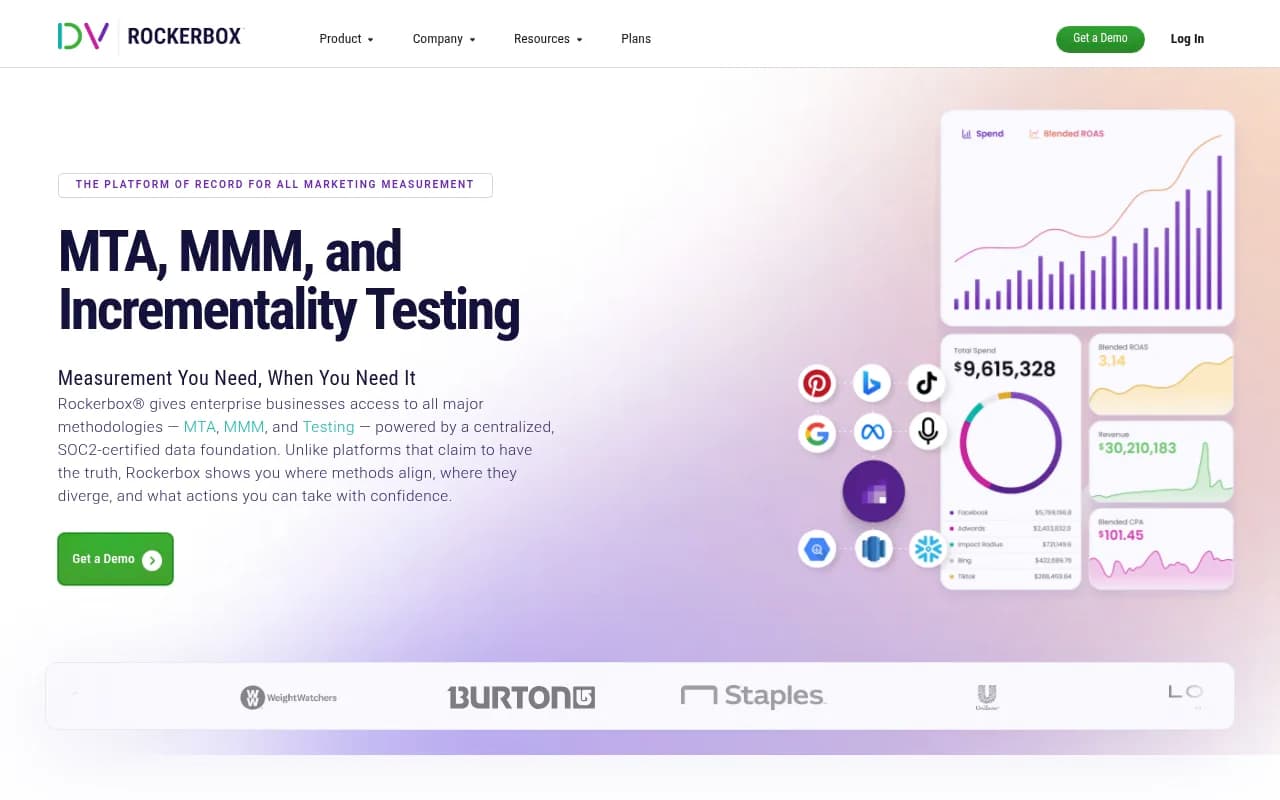
Rockerbox is an enterprise marketing measurement platform that unifies Multi-Touch Attribution (MTA), Marketing Mix Modeling (MMM), and Incrementality Testing into a single SOC2-certified system. Used by brands like Unilever, Weight Watchers, and FIGS, it centralizes data from 100+ channels to help
Summary
- Multi-method approach: Rockerbox combines MTA, MMM, and incrementality testing in one platform -- most competitors force you into a single methodology
- Enterprise data foundation: SOC2-certified infrastructure that centralizes 100+ online and offline channels (social, Google Ads, direct mail, podcasts, affiliate, etc.)
- Honest about measurement: Doesn't claim to have "the truth" -- shows where methods align, where they diverge, and what actions you can take with confidence
- Pricing: Starts at $2,000/month, enterprise-focused with custom plans
- Best for: Mid-to-large brands spending $5M+ annually on marketing who need to prove ROI across complex channel mixes
- Limitations: High price point excludes small businesses; requires significant marketing spend to justify; no self-serve option
Rockerbox is a marketing measurement platform built for enterprise brands that have outgrown platform-reported metrics and need a unified view of what's actually driving conversions. Founded as an attribution company and now part of DoubleVerify (acquired in 2024), Rockerbox serves brands like Unilever, Weight Watchers, FIGS, Burton, and Staples -- companies spending millions on marketing and tired of reconciling conflicting reports from Google, Meta, TikTok, and their MMM vendor.
The core insight behind Rockerbox is that no single measurement methodology tells the complete story. Multi-Touch Attribution (MTA) is great for understanding customer journeys and optimizing day-to-day spend, but it struggles with upper-funnel channels and offline media. Marketing Mix Modeling (MMM) handles those gaps but updates too slowly for tactical decisions. Incrementality testing validates true impact but can't run continuously across every channel. Most platforms force you to pick one approach. Rockerbox gives you all three, built on the same centralized data foundation, so you can triangulate truth instead of chasing it.
Multi-Touch Attribution (MTA)
Rockerbox's MTA tracks the full customer journey across 100+ channels -- paid social, search, display, affiliate, email, direct mail, podcast ads, influencer campaigns, and more. Unlike platform-reported attribution (which credits itself generously), Rockerbox uses a first-party pixel and server-side tracking to build an independent view of what actually happened. You see every touchpoint a customer encountered before converting, not just the ones Facebook or Google want credit for.
The platform supports multiple attribution models (first-touch, last-touch, linear, time-decay, position-based, data-driven) and lets you compare them side-by-side. Most brands use a custom weighted model that reflects their actual funnel dynamics -- for example, giving more credit to awareness channels early in long consideration cycles. You can adjust attribution windows, set custom conversion events, and segment by product, audience, or campaign type. Path-to-conversion reports show the most common sequences (e.g. "Instagram ad -> Google search -> email -> purchase") so you understand how channels work together, not in isolation.
Rockerbox also handles deduplication across platforms. If someone clicks a Facebook ad, then a Google ad, then converts, both platforms will claim 100% credit in their dashboards. Rockerbox assigns fractional credit based on your chosen model and shows the real incremental contribution of each channel. This is critical for brands running omnichannel campaigns where overlap is high.
Marketing Mix Modeling (MMM)
Rockerbox's MMM uses regression analysis on historical data to quantify the impact of every marketing channel, including those MTA can't track well -- TV, radio, out-of-home, sponsorships, PR, brand campaigns. It accounts for external factors like seasonality, promotions, competitor activity, and macroeconomic trends. The output is a set of response curves showing diminishing returns for each channel, plus elasticity estimates that tell you how much incremental revenue you'd get (or lose) by shifting budget.
Unlike traditional MMM vendors that deliver a static report every quarter, Rockerbox's MMM runs continuously and updates monthly. You're not waiting 12 weeks for results -- you get refreshed models as new data comes in. The platform also includes scenario planning tools that let you model "what if" budget allocations. For example: "What happens to revenue if I cut Meta spend by 20% and reallocate it to Google?" or "How much would I need to increase TV spend to hit my Q2 target?" You can test dozens of scenarios before committing budget.
Rockerbox's MMM is designed to calibrate and validate the MTA model. If MTA says TikTok drives 15% of conversions but MMM says it's only 8%, that's a signal to investigate -- maybe TikTok is getting last-click credit for awareness work done by other channels. The platform surfaces these discrepancies and helps you reconcile them, so your measurement improves over time instead of staying siloed.
Incrementality Testing
Rockerbox's testing module helps you run geo holdout tests, conversion lift studies, and PSA (public service announcement) tests to measure true incrementality. This is the gold standard for validating whether a channel is actually driving new conversions or just taking credit for sales that would have happened anyway. For example, you might pause Meta ads in 20% of zip codes for two weeks and compare conversion rates to a control group. If conversions drop significantly in the test group, Meta is incremental. If they don't, you're overpaying for credit.
The platform handles test design, statistical power calculations, and results analysis. It integrates with your existing campaigns so you don't need to rebuild everything in a separate tool. You can test individual channels, creative variations, audience segments, or budget levels. Rockerbox tracks the results in real-time and flags when a test has reached statistical significance. The findings feed back into the MTA and MMM models to improve their accuracy -- for example, if a test shows that branded search is 80% non-incremental, you can adjust how much credit it gets in attribution.
Testing is expensive and slow (you need weeks of data and enough volume to detect meaningful differences), so most brands can't test everything. Rockerbox helps you prioritize which tests will have the biggest impact on decision-making. If MTA and MMM already agree on a channel's performance, testing it is lower priority. If they diverge significantly, a test can break the tie.
Data Centralization and Integrations
Rockerbox connects to 100+ data sources via API integrations, including all major ad platforms (Google Ads, Meta, TikTok, Snapchat, Pinterest, LinkedIn, Reddit, Amazon Ads, Criteo, The Trade Desk), affiliate networks (Impact, CJ, Rakuten), email/SMS tools (Klaviyo, Iterable, Braze), analytics platforms (Google Analytics, Adobe Analytics, Mixpanel), CRMs (Salesforce, HubSpot), and offline channels (direct mail via Lob or Postie, podcast ads via Magellan AI or Podscribe). It also ingests data from your data warehouse (Snowflake, BigQuery, Redshift) if you have custom sources or internal systems.
The platform normalizes everything into a consistent taxonomy so you can compare apples-to-apples across channels. For example, "cost per acquisition" means the same thing whether you're looking at Meta, Google, or affiliate -- no more reconciling different definitions. Rockerbox also handles currency conversions, time zone adjustments, and deduplication of overlapping data sources.
You can push Rockerbox's attribution results back to your data warehouse or BI tools (Looker, Tableau, Power BI) for custom reporting. The platform provides a REST API for programmatic access to attribution data, so engineering teams can build internal dashboards or feed results into other systems. Unlike black-box attribution tools, Rockerbox is designed to be open -- you own the data and can export it anytime.
Professional Services and Support
Rockerbox includes a dedicated customer success team that helps with onboarding, model customization, and ongoing optimization. This isn't a self-serve tool -- you work with analysts who understand your business and help interpret results. They assist with data onboarding (connecting all your sources, mapping conversion events, setting up tracking), model tuning (choosing attribution windows, adjusting MMM parameters, designing incrementality tests), and change management (training your team, aligning stakeholders, integrating findings into planning processes).
The professional services team also runs quarterly business reviews where they benchmark your performance against industry peers, identify optimization opportunities, and recommend tests or model adjustments. For example, if your cost-per-acquisition is trending up faster than the market average, they'll dig into which channels are driving the increase and suggest reallocation strategies. This hands-on support is a big differentiator vs. self-serve attribution tools that dump data on you without context.
Who Is Rockerbox For
Rockerbox is built for mid-to-large enterprise brands spending $5M+ annually on marketing across multiple channels. The typical customer is a DTC brand, retailer, or consumer services company with a complex marketing mix that includes paid social, search, affiliate, email, influencer, podcast, TV, and offline channels. They've outgrown Google Analytics and platform-reported metrics but don't have the in-house data science team to build custom attribution models.
Common user personas include VP of Marketing or CMO (who needs to justify budget to the CFO and board), Director of Performance Marketing (who optimizes day-to-day spend), and Marketing Analysts (who build reports and run experiments). Team size is typically 10-50 people in marketing, with dedicated channel managers for paid social, search, email, etc. Industries include ecommerce, subscription services, financial services, travel/hospitality, and CPG brands selling DTC.
Rockerbox is NOT a good fit for small businesses spending under $1M/year on marketing -- the platform costs $2,000+/month and requires enough volume to make multi-touch attribution and MMM statistically meaningful. It's also not ideal for B2B companies with long sales cycles and small deal volumes, where attribution is less about channel mix and more about account-based tracking. Startups in growth mode who need to move fast and don't have time for quarterly MMM refreshes will find the platform too heavyweight.
Pricing and Plans
Rockerbox starts at $2,000/month with custom enterprise pricing based on marketing spend, number of channels, and which methodologies you use (MTA only, MTA + MMM, or the full suite with testing). Most customers pay $3,000-$10,000/month depending on complexity. There's no self-serve signup -- you request a demo, go through a scoping call, and get a custom quote.
The platform includes unlimited users, so your entire marketing team can access reports without per-seat fees. Professional services (onboarding, model tuning, quarterly reviews) are included in the subscription. Data storage and API access are also included -- no usage-based fees or surprise charges.
Compared to competitors, Rockerbox is mid-to-high priced. Standalone MTA tools like Rockerbox's earlier competitors (Measured, Northbeam, Triple Whale) range from $500-$3,000/month. Traditional MMM vendors (Nielsen, Analytic Partners, Marketing Evolution) charge $50,000-$200,000 per project. Rockerbox sits in between -- more expensive than basic attribution but cheaper than hiring a full-service MMM agency. The value proposition is that you get all three methodologies in one platform instead of stitching together multiple vendors.
Strengths
- Unified measurement approach: Combining MTA, MMM, and testing in one platform eliminates the need to reconcile conflicting reports from multiple vendors. You see where methods agree and where they diverge, which builds confidence in decision-making.
- Independent attribution: Rockerbox's first-party tracking and server-side data collection provide an unbiased view of channel performance, free from the self-serving metrics that platforms like Meta and Google report.
- Continuous MMM updates: Unlike traditional MMM vendors that deliver quarterly reports, Rockerbox refreshes models monthly so you can act on insights faster.
- Scenario planning tools: The ability to model budget reallocations and forecast outcomes before committing spend is a huge advantage for annual planning and in-flight optimization.
- Professional services included: Dedicated analysts who help interpret results and recommend actions make the platform accessible to teams without deep data science expertise.
Limitations
- High price point: Starting at $2,000/month, Rockerbox is out of reach for small businesses and early-stage startups. You need significant marketing spend to justify the cost.
- No self-serve option: The platform requires a sales call and custom quote -- you can't sign up and start using it immediately like you can with Google Analytics or Northbeam.
- Enterprise focus: The platform is designed for complex, multi-channel marketing operations. If you're only running Meta and Google ads, you're paying for capabilities you don't need.
- Learning curve: Even with professional services support, understanding how to interpret and act on MTA, MMM, and testing results takes time. Teams new to advanced measurement will need training.
- Limited B2B functionality: Rockerbox is optimized for DTC and ecommerce use cases. B2B companies with long sales cycles, account-based marketing, and offline deal closures will find the platform less relevant.
Bottom Line
Rockerbox is the right choice for enterprise brands spending $5M+ annually on marketing who need to prove ROI across a complex channel mix and are tired of conflicting reports from platforms and vendors. If you're a DTC brand, retailer, or consumer services company with 10+ marketing channels and a team that's ready to move beyond last-click attribution, Rockerbox delivers the unified measurement foundation you need to optimize spend with confidence. The combination of MTA, MMM, and testing in one platform -- backed by professional services that help you interpret and act on results -- makes it a strong alternative to stitching together multiple point solutions.
Best use case in one sentence: Mid-to-large DTC brands and retailers who need to justify marketing spend to the CFO and optimize a complex omnichannel mix with confidence.
Tags:
Frequently asked questions
What is Rockerbox and what does it do?
How much does Rockerbox cost?
Who is Rockerbox best for?
What makes Rockerbox different from other marketing attribution tools?
Does Rockerbox offer a free plan or trial?
How many marketing channels does Rockerbox integrate with?
Is Rockerbox suitable for small businesses?
What is Multi-Touch Attribution and does Rockerbox support it?
Similar and alternative tools to Rockerbox