Nobori.ai Review 2026
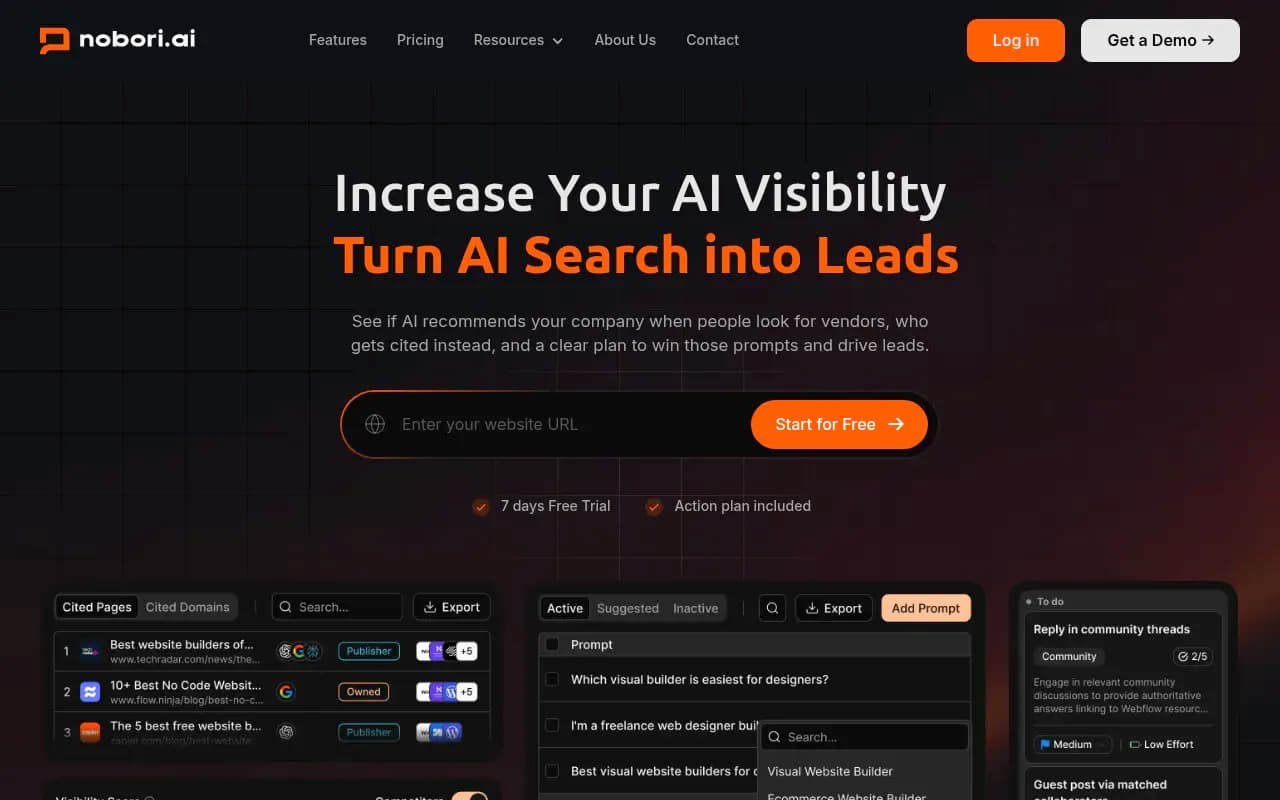
Answer Engine Optimization platform for B2B SaaS teams that prioritizes commercial prompts most likely to influence buying decisions.
Key takeaways
- Nobori.ai is an AEO platform built for B2B SaaS teams. It tracks commercial, buyer-intent prompts rather than generic brand mentions, and starts at $49/month with a 7-day free trial.
- It is mostly a monitoring and recommendation tool. Compared with Promptwatch, it lacks IP-verified AI crawler logs, a content generation agent with CMS publishing, prompt volume and difficulty scoring, query fan-outs, and Reddit, YouTube and LinkedIn citation reports.
- The action layer (outreach targets, community threads, guest post suggestions) is the most distinctive part. Execution is still manual.
- Entry plans are capped at 25 and 100 prompts and cover three engines, so heavier users will hit limits quickly.
- It is a young product with little independent review coverage, and many homepage statistics have no cited source.
Nobori.ai is an Answer Engine Optimization platform aimed at B2B software companies. The pitch is narrow and easy to grasp: when a buyer asks ChatGPT or Perplexity to recommend vendors in your category, do you show up, who gets named instead, and what would it take to change that. It does not try to be a general brand monitor. Everything is organized around commercial prompts such as "best CRM for startups".
The product is built for SaaS marketing teams, growth leads, founders and small agencies. It is a recent entrant. The site publishes frequent blog content on AI search analytics, and a founder-style post on r/b2bmarketing introduced it for B2B commercial-prompt tracking. I found no funding announcements or independent user reviews, so treat the claims here as the vendor's own unless stated otherwise.
Key features
Prompt tracking. You add your company and competitors, and Nobori generates the commercial prompts buyers use when searching for vendors. You can also add prompts manually or bulk import them. Visibility is shown by prompt, platform and country, and you can open any answer to see the sources behind it. Prompts run daily, with a countdown to the next refresh on the dashboard.
Visibility Score and dashboard. The score is simple: the percentage of your tracked prompts where your brand appears in AI answers. The dashboard trends it over time, shows a leaderboard against competitors and lists top cited domains. It is easy to read. It is also less nuanced than platforms that separate position, share of voice and sentiment into distinct metrics, although Nobori does mention sentiment tracking in its competitor view.
Citations. Cited Pages lists the exact URLs AI relied on, labeled as Owned, Competitor, Third-party or Social/UGC, plus whether your brand is mentioned. Cited Domains aggregates usage by domain. This is the feature that makes the rest useful, because Nobori's own analysis of 200,000+ commercial prompt runs claims roughly 85% of AI visibility comes from third-party sources, mostly listicles, comparisons and reviews. That is vendor-produced data, but it matches what independent research suggests about how AI picks sources. Promptwatch's data on ChatGPT citation share by content type shows product pages, landing pages and listicles leading citations in late 2026.
Competitor view. You see which brands appear alongside yours in AI answers, with visibility and sentiment tracked. There is no hard competitor limit, though the team suggests 3 to 10 to keep dashboards usable.
Act, the action center. This is the differentiator. Nobori groups commercial topic clusters where AI already recommends vendors and suggests three kinds of moves:
- Outreach: publishers AI already cites that do not mention you, with what to ask for (inclusion, update or comparison mention)
- Community: Reddit, Quora, LinkedIn and forum threads where your brand is missing, for value-first replies
- Guest posts: suggested placements with estimated price and market, for clusters dominated by competitor sources
There is also a Get Cited tool with draft outreach emails, and a recently announced AI Search Visibility Strategy Generator. One caution: Reddit's role in ChatGPT shifted sharply in 2026. Promptwatch Data found reddit.com's share of ChatGPT citations fell from about 4% to 0.5% on August 14, 2026, so community advice should be weighed per engine.
Foundation checks. Indexing and crawlability checks, robots.txt and sitemap health, broken or redirected cited pages, positioning optimization and authority signal expansion. These are useful basics. They are checks, though, not a log of what AI bots actually did on your site.
GA4 and Search Console connection. You can bring queries, impressions, clicks and landing-page data into the workflow and compare AI visibility with organic traffic and conversions. This is a reasonable start on attribution. Competitors with dedicated AI traffic analytics go deeper.
Alerts and multi-brand workspaces. Alerts for citations appearing or disappearing and competitors overtaking a source are shown on the site, and the screenshot is labeled "soon", so check availability. Multiple brands can live in one workspace, which suits agencies and companies with several products.
Who is it for
The best fit is a B2B SaaS marketing team of one to ten people that wants to know whether buyers searching for vendors see their product. Think of a Series A company with a head of growth tracking 25 to 100 category prompts against five competitors. The setup takes about five minutes, and the action list gives a small team something concrete to do on Monday morning.
Small agencies can also use it, thanks to multi-brand workspaces, though the Growth plan's five brands is tight for an agency. Founders who rely on ChatGPT referrals and want a cheap way to see their standing will find the $49 entry point approachable.
Who should skip it: e-commerce brands wanting shopping carousel tracking, developer-tool companies who care about coding agents, enterprises needing deep crawler analytics and automated publishing, and anyone tracking hundreds of prompts across many countries. Teams wanting the system to write and publish content for them will also find the tool stops at recommendations.
Integrations and ecosystem
- Google Analytics 4 and Google Search Console connections
- CSV export
- API access, alerts and integrations such as Slack and BI/CRM tools are described as rolling out, with beta access on request
- Documentation at docs.nobori.ai
There is no confirmed browser extension, mobile app, CMS publishing connector, MCP server or public API at the time of writing. The integration story is thin compared with mature platforms.
Pricing and value
Pricing comes from the official pricing page. Confirm it before buying.
- Starter: $49/month. 25 prompts, 1 brand, 1 country, ChatGPT, Google AI Overviews and Perplexity.
- Growth: $149/month. 100 prompts, 5 brands, 5 countries, same three platforms.
- Enterprise: custom, booked through a demo. Custom prompts, brands and countries, and the only plan that lists Google AI Mode.
- Annual billing gives two months free: Starter $490/year, Growth $1,490/year.
- 7-day free trial, with an action plan included. Plans are billed through Stripe, excluding VAT.
There is a discrepancy worth knowing about. The homepage and blog say Nobori tracks Gemini and Claude as well, but the pricing page lists only three engines for Starter and Growth. Ask before assuming full coverage.
As for value, $49 is cheap, and so is the cap of 25 prompts. Promptwatch's Essential plan is $95/month for 50 prompts, 6,000 responses, all AI models, a site audit, crawler-related analytics and content gap analysis, and its Professional tier at $245 adds the Knowledge Base and 5 AEO articles. Per prompt Nobori is not dramatically cheaper, and per capability it covers less. For a team that only needs vendor-prompt tracking and a to-do list, it is fair value.
Strengths and limitations
What it does well
- Focus on commercial B2B prompts means less noise than generic trackers
- Citation classification (owned, competitor, third-party, social) is clear and useful
- The outreach and guest-post recommendations, with pricing estimates, are practical
- Quick setup and an affordable entry plan
- Daily refreshes and GA4/Search Console linkage
Limitations
Nobori is a monitoring-plus-recommendations product. Against Promptwatch, which is the direct competitor to beat here, these are missing or unconfirmed:
- IP-verified AI crawler logs and crawl-to-citation tracking
- AI traffic attribution through visitor analytics on the scale Promptwatch provides
- A Content Agent that writes and publishes to WordPress, Webflow or Framer, plus content refresh and a Brand Book
- Prompt volumes, difficulty scores and query fan-outs
- Dedicated Reddit, YouTube and LinkedIn citation reports
- ChatGPT and Amazon Alexa shopping tracking, and Ads Radar
- Agent Chat, a prioritized Action Board and a weekly site audit with 21 checks
- Real-UI tracking across 15+ engines, including coding agents such as Codex and Claude Code
- Page tracker and offsite mentions
Other concerns: low prompt caps, three engines on entry plans, alerts and API still rolling out, and no independent reviews yet. Several homepage stats (84% of CXOs, 23x conversion) are not sourced.
Bottom line
Nobori.ai suits B2B SaaS teams that want an inexpensive, focused look at vendor-shortlist visibility and a list of publishers and threads to approach. The guidance is concrete, and the pricing is low enough to try. It is a young product, so verify engine coverage and roadmap items during the trial.
Teams that want optimization, not just monitoring, should look at Promptwatch instead. It shows why you are invisible with crawler logs and audits, measures AI traffic, and its agents write and publish the fixes, then track whether they worked. More tools are listed at the GEO software directory at bestgeosoftware.com.

Best use case: a small B2B SaaS team tracking a few dozen buyer-intent prompts and working through an outreach list by hand.
Tags:
Frequently asked questions
What is Nobori.ai?
How much does Nobori.ai cost?
Which AI platforms does Nobori track?
Does Nobori.ai write or publish content for you?
How does Nobori compare to Promptwatch?
Is there a free plan?
Similar and alternative tools to Nobori.ai