Key takeaways
- Brandlight holds a 4.8/5 rating on G2 from 194 reviews (96% five-star), but its entire review footprint is concentrated on G2 — no verified presence on Capterra, TrustRadius, Trustpilot, or Product Hunt as of our research date.
- Users consistently praise the dashboard, competitive benchmarking, multi-brand support, and hands-on customer service. The complaints cluster around pricing opacity, 30-90 day onboarding, and the fact that the tool monitors but doesn't fix.
- G2 reports an average implementation time of 2 months and an average time to ROI of 7 months. That's a real commitment for a category where cheaper tools exist.
- Switching patterns point three directions: mid-market teams trading down to cheaper trackers, buyers wanting execution rather than dashboards, and enterprises consolidating with Profound or Scrunch.
- All Brandlight pricing figures floating around ($199/mo entry, $750/mo activation, $4,000-$15,000/mo enterprise) are third-party estimates. The vendor publishes nothing.
What Brandlight actually is
Brandlight is an enterprise AI visibility platform founded in October 2024 in Israel by CEO Imri Marcus. It tracks how brands appear in AI answers across ChatGPT, Gemini, Copilot, Perplexity, and Grok, covering mentions, sentiment, citations, and competitive positioning. It has moved fast on funding: a $5.75M seed in April 2025, then a $30M Series A in February 2026 led by Pelion Venture Partners. Named customers include Kimberly-Clark, LG, The Hartford, Estée Lauder, Volkswagen, and TD Bank.
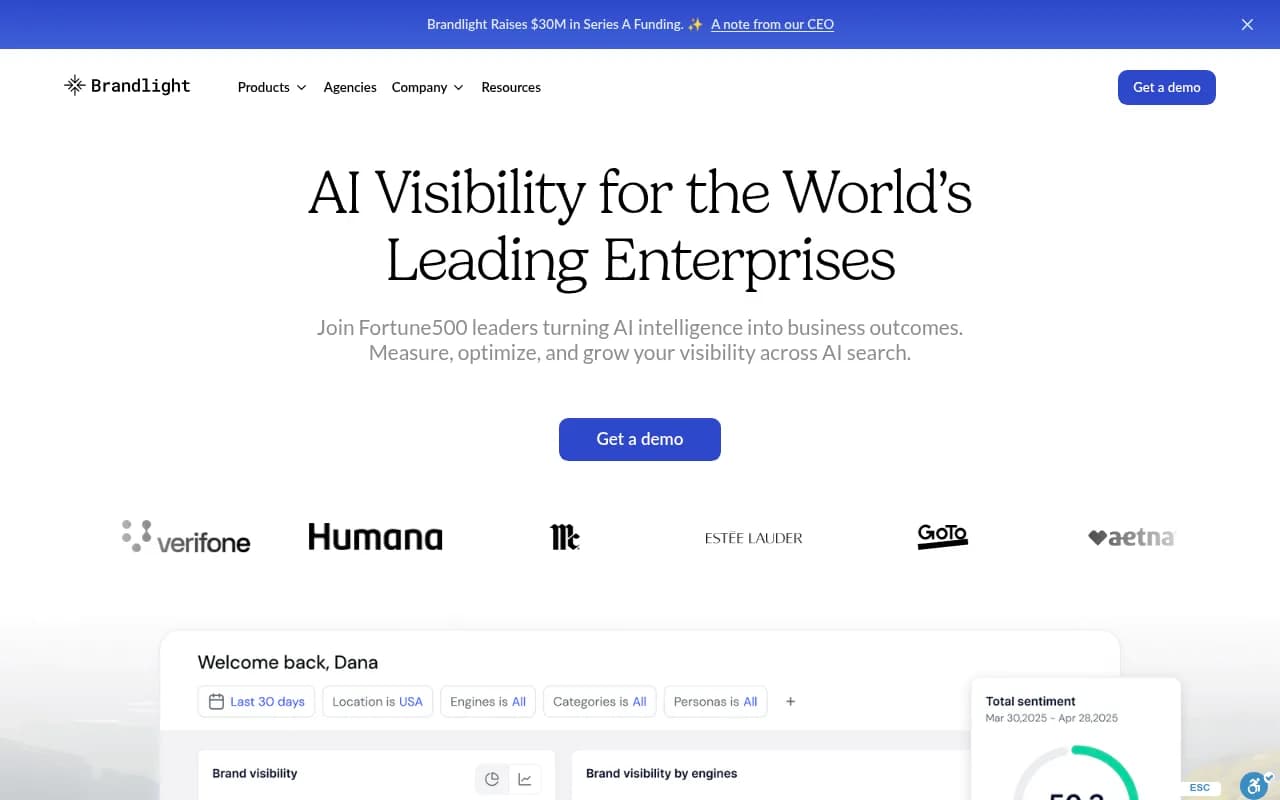
That enterprise positioning matters for everything that follows. Brandlight is built for multi-brand, multi-region organizations, and its pricing, sales process, and onboarding all reflect that. If you're not that buyer, the reviews suggest you'll feel the mismatch.
What the review data says
The headline numbers on G2 look excellent: 4.8/5 from 194 reviews, 96% five-star, 3% four-star, and zero reviews below four stars. G2 also reports an average implementation time of 2 months and an average time to ROI of 7 months.
The reviewer base skews mid-market: 110 reviews from companies with 51-1,000 employees, 36 from enterprise (1,000+), and 42 from small businesses. Geographically it's fairly split between Europe (59), North America (49), Latin America (44), and Asia (31).
Two caveats before you take the 4.8 at face value.
First, the review count is disputed. A third-party roundup from CheckThat.ai cites 4.7/5 from only 19 verified reviews, with the most recent dated February 2026. That's a big gap from 194. It could be timing (reviews accumulate fast in this category), or it could reflect how each source filters for "verified" status. Either way, when a vendor's reputation rests almost entirely on one platform, you should ask harder questions during evaluation.
Second, there's a category-wide trust problem with reviews themselves. An analysis of 245,000 reviews across Capterra, G2, and TrustRadius estimated that 10-30% of reviews posted after ChatGPT's launch were likely AI-generated. The estimate comes from a commercial AI-detection vendor, so treat it cautiously, but the direction is clear: polished review language doesn't guarantee a genuine customer behind it.
Harvard Business Review made a related point in July 2026: as AI mediates how customers research and choose suppliers, the feedback you can see (reviews, complaints, surveys) is becoming less reliable to interpret, while the bigger pool of customers is choosing you based on AI's description of you. That's exactly the problem Brandlight sells against — and it's also why the stakes of picking the right visibility tool are higher than a casual G2 browse suggests.
What users praise
Reading through the verified reviews, four themes come up again and again.
The dashboard and data presentation. Lauren C., a validated reviewer, calls it "very thorough and user-friendly, which provides a wealth of information... The different visualisation graphs available are very beneficial as well." Nicolas F., an SVP of Performance and Search, adds: "What I really like is the interface and the easy access to data. The fact that all of the dashboard capabilities are also exportable is great." Exportable dashboards sound mundane until you've built a monthly CMO deck by hand.
Actionable insights. Erin S., Head of AI Strategy & Creative Tech: "We're always looking for actionable data. Brandlight delivers. The insights we get from the tool have informed our GEO strategy & tactics. The results of those efforts have been clear, measurable, and exciting to watch." Courtney B., a Senior Manager of SEO, says Brandlight "goes beyond the basic AEO/GEO data and tactics" and helped her team prioritize AI efforts based on measurable insights.
Competitive benchmarking. Mark W., a Senior Marketing Analytics Manager: "Before Brandlight, we had no visibility into how AI tools were mentioning or citing us, or how they were referencing our competitors." Andrea M., VP of Marketing Operations & Analytics, says it helped her team "easily see how our brand is performing in key categories, relative to our competitors" and align multiple teams on centralized metrics.
Benchmarking is arguably the core value of any AI visibility tool right now, because the citation inventory is genuinely scarce. Promptwatch's data on average sources per response shows ChatGPT typically cites around five sources per web-search answer, while Google AI Overviews and Perplexity cite roughly ten. With only a handful of slots per answer, each one is contested, and knowing where you stand versus competitors is the first step to doing anything about it.
Multi-brand support and customer service. Andrea M. specifically chose Brandlight because she needed "an enterprise-level platform that could manage multiple brands that operate in different markets." On support, multiple reviewers name individuals — Courtney B. praises "Cory from Brandlight" for his knowledge and collaborative approach; Chris C. calls the team "friendly, responsive, and always keen to help."
What users complain about
No reviews below four stars sounds great until you read the four-star text and the caveats buried in positive reviews. Here's what actually frustrates buyers.
Pricing opacity
Brandlight publishes no pricing. The /pricing URL on its website returns a 404. G2's pricing page confirms it: no free trial, pricing "On Request," no listed plans. G2's own AI-generated review summary flags "a lack of transparent pricing as a common limitation," and one reviewer states pricing "can reach $750/month," calling it steep versus competitors that bundle optimization tools.
Third-party estimates vary wildly: around $199/month entry, an activation option near $750/month, and enterprise contracts somewhere in the $4,000-$15,000/month range. None of these are vendor-confirmed. For CMOs running competitive RFPs, this extends sales cycles and makes cost comparison genuinely annoying.
Onboarding takes months, not weeks
Brandlight's own documentation describes 30-90 days to full productivity for the Activation tier, with standard onboarding at 2-4 weeks and enterprise deployments at 6-8 weeks. G2's aggregate data puts average implementation at 2 months. Andrea M. — one of the positive reviewers — noted directly: "Brandlight gives us clear direction on where we can improve, but our internal bandwidth is limited."
That's the quiet complaint inside most of the positive reviews: the tool generates more recommendations than teams can act on.
It monitors, but doesn't fix
This is the structural complaint, and the one driving switching behavior. Brandlight surfaces what AI engines say about your brand but can't directly change source content. Nicolas F. put it well: "the part that's most difficult is to discern what actions to take from the insights we get from the data. When we're analyzing and finding an insight, it's hard to figure out what actions we can take to influence AI in a more favorable way for us."
Brandlight is candid about this — its own blog says "No tool can promise AI citations" and its Attribution module, designed to connect AI visibility to revenue, is still listed as "coming soon." But candor doesn't change the buyer experience: you're paying enterprise money for a diagnostic, then funding the treatment separately.
Marketing claims that don't hold up to scrutiny
Independent review site EchoWi found that Brandlight's homepage claims a "#1 in category" ranking with no named source, analyst, or report. When EchoWi tested it, an AI assistant repeated the claim back citing Brandlight's own homepage as the source. EchoWi also flagged that Brandlight's "best AI visibility tools" blog post ranks Brandlight #1 and Profound #7, written by Brandlight's AI GTM Lead with no disclosure that the publisher is also the subject.
None of this makes the product bad. But when a company selling AI visibility measurement has circular citations in its own marketing, it's worth remembering during your demo.
Thin review presence beyond G2
As of our research date, Brandlight has no verified profile on Capterra, TrustRadius, Trustpilot, or Product Hunt. Every independent data point funnels through one platform. Competitors are actively buying ads on Brandlight's own G2 pages (Scrunch appears as a sponsored listing there), which tells you how contested this category has become.
Switching patterns: where Brandlight buyers go
Based on G2's alternatives data, competitor positioning, and the complaint themes above, three distinct switching patterns emerge in 2026.
Pattern 1: mid-market teams trading down
The pricing and bandwidth complaints hit mid-market and small teams hardest. G2's own reviewer data notes that small businesses and solo marketers call out affordability concerns, while enterprise teams with structured workflows report stronger ROI. These buyers tend to move toward cheaper trackers with self-serve checkout.

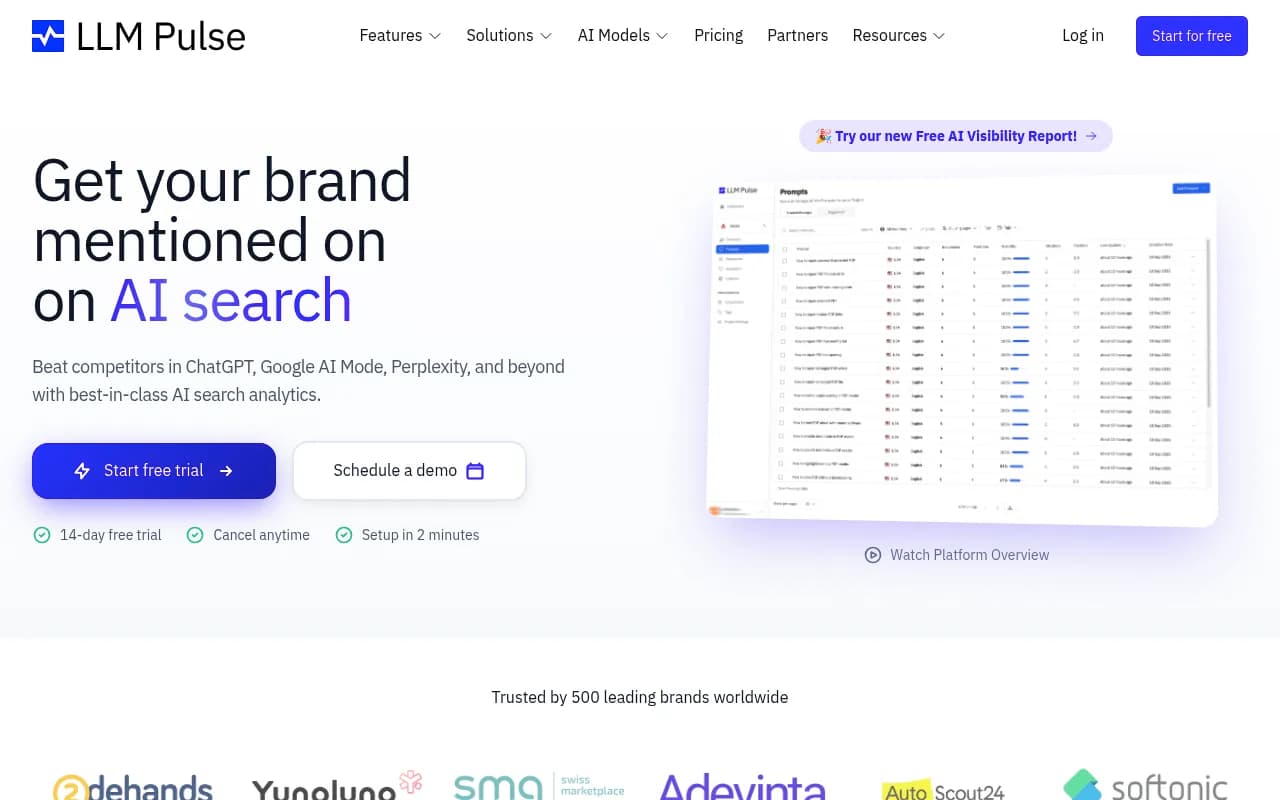
Otterly.AI sits at the budget end at around $29/month with a free trial. AthenaHQ has a free tier and a $295/month Starter plan. LLM Pulse runs €49-299/month across its tiers. None of these will give a Fortune 500 the same depth, but if your complaint is "I'm paying enterprise prices for dashboards my three-person team can't act on," they solve that problem.

Pattern 2: buyers who want execution, not just dashboards
The monitoring-only complaint has created a second switching pattern: toward platforms that close the loop from insight to action. This is where the category is heading in 2026 — from trackers to optimization platforms.
Promptwatch is the clearest example of this shift. Its agents don't just report where you're invisible; they plan, write, and publish GEO-optimized content to your CMS, generate a prioritized action list from visibility and crawler data, and track actual AI-driven traffic and conversions rather than mentions alone. For teams whose Brandlight complaint is "we know where we stand but lack the bandwidth to fix it," that's the specific gap being filled.

Pattern 3: enterprise consolidation
The third pattern is larger brands consolidating with better-funded or better-integrated competitors. G2's own alternatives page names Profound as the top overall alternative (4.5/5 from over 1,100 reviews), with reviewers saying Profound is "better at support" compared to Brandlight.

Scrunch AI is the other frequent enterprise destination, with a $250/month Core tier and an enterprise "Agent Experience Platform." Bluefish and Evertune also compete at the Fortune 500 level, with Evertune at $800/month for its Pro tier.
Worth noting: Profound has its own review problems. G2 reviewers there have complained about being "promised expert-level AEO support" that didn't materialize, with one writing that "the experts we were promised access to seemed to be deeply experienced in this domain. In our experience, that doesn't seem to be the case." Switching within the enterprise tier is trading one set of compromises for another.
How the alternatives compare
| Tool | Published pricing | Free trial | Execution features | Best fit |
|---|---|---|---|---|
| Brandlight | None (sales only) | No | Monitoring only; attribution "coming soon" | Multi-brand enterprises |
| Profound | From ~$99/mo (ChatGPT-only) | No | Monitoring; dedicated strategist at enterprise | Enterprise, agency-heavy workflows |
| Scrunch AI | From $250/mo | 7-day trial | Monitoring plus agent platform at enterprise | Brands with influencer/UGC overlap |
| AthenaHQ | Free tier; $295/mo Starter | Yes (free plan) | Monitoring-focused | Mid-market teams |
| Otterly.AI | From ~$29/mo | Yes | Basic tracking only | Solo operators, small teams |
| Promptwatch | Free tier; $95-$579/mo; agency plans | 7-day trial | Content agents, CMS publishing, crawler logs, AI traffic attribution | Teams that want monitoring and execution in one stack |
Pricing figures for Brandlight's competitors come from vendor pages and third-party comparisons as of mid-2026; Brandlight's figures are third-party estimates since the vendor publishes nothing.
Should you stay or switch?
EchoWi's assessment gets the split right, and it matches the review data. Brandlight is a reasonable call if you're a multi-brand, multi-region enterprise that needs crawler-level diagnostics, has the internal bandwidth to act on recommendations, and is comfortable with a sales-led, unpriced procurement process. The named customers and the Series A suggest the company is executing well for that buyer.
It's the wrong call if you want to compare on price before talking to sales, if you're not enterprise-scale, if you only need basic answer tracking, or if you expect the tool to help fix what it finds. The last one is the most common regret in the reviews: buyers who expected a partner in optimization and got a very good mirror instead.
One final dose of skepticism for the whole category: a July 2026 review of 45 GEO studies found no optimization technique with a demonstrated causal, stable, cross-platform effect. Any vendor promising predictable AI citation outcomes — Brandlight, its competitors, everyone — is ahead of what the research supports. Buy the tool for the visibility and benchmarking data. Treat the ROI promises as hypotheses you'll test on your own brand.
If you're evaluating options, the GEO software directory at bestgeosoftware.com and the AI rank tracking tools directory at ai-rank-tools.com both have current listings worth browsing before you commit to a sales cycle. And whatever you choose, ask the vendor two questions in the demo: how exactly are prompts executed and citations extracted, and what happens after the tool tells you you're invisible? The first question tests their data methodology. The second tests whether you're buying a mirror or a mechanic.