Key takeaways
- Qwairy is a GEO strategy dashboard, but most teams eventually hit a wall when they need to move from monitoring to action.
- The best alternatives either go deeper on data (prompt volumes, crawler logs, citation sources) or add content creation and optimization on top of tracking.
- Promptwatch is the only platform in this category rated as a "Leader" across monitoring, content generation, and optimization — making it the strongest pick for teams that need the full loop.
- Budget-conscious teams can start with lighter tools like Peec AI or Otterly.AI, but expect to outgrow them quickly.
- If you're already in the Semrush ecosystem, the AI Toolkit is a reasonable starting point — just know its prompt coverage is fixed and shallow compared to dedicated GEO platforms.
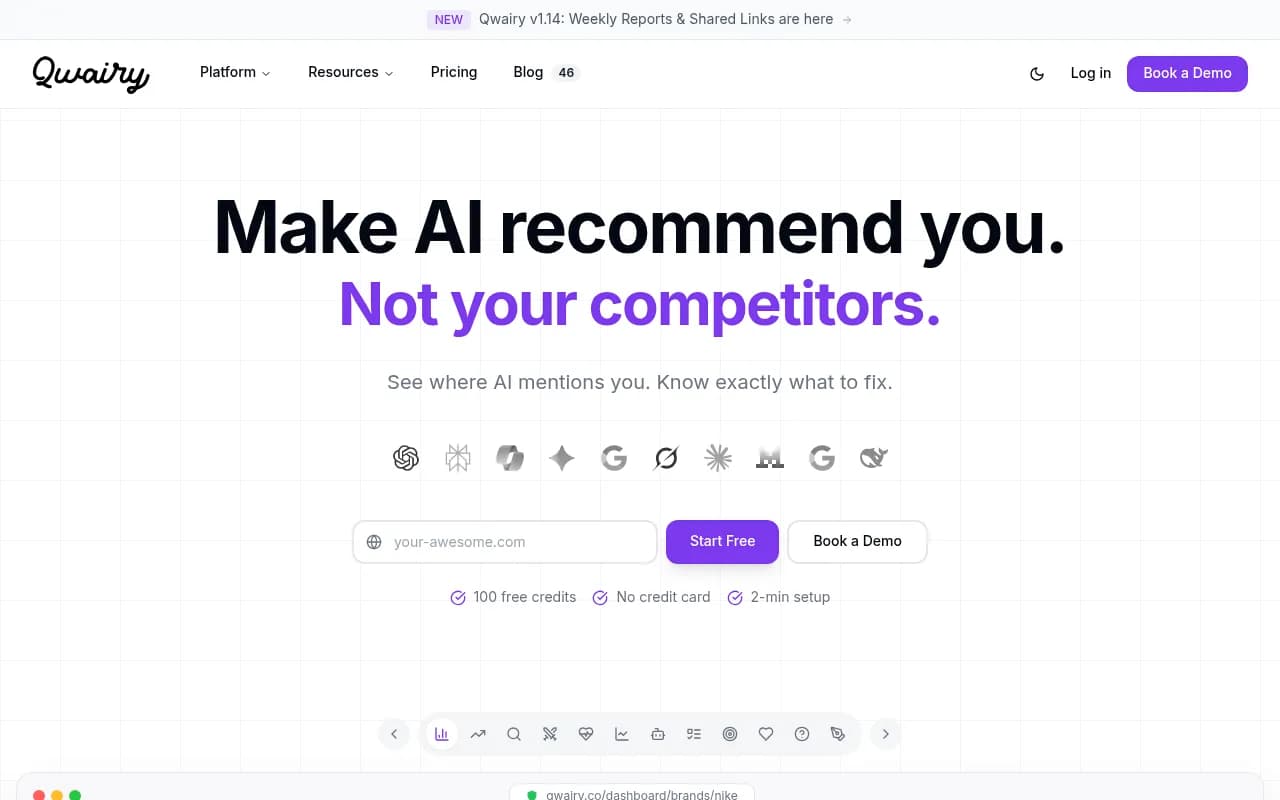
Qwairy positions itself as a GEO strategy platform, and for teams just getting started with AI search visibility, it does a decent job of framing the problem. You get a dashboard, some prompt tracking, a sense of where your brand stands. Fine.
But here's where things get frustrating: strategy without execution is just a slide deck. Most teams using Qwairy eventually run into the same wall — they can see their visibility score, they know competitors are appearing in ChatGPT and Perplexity responses they're not, and then... nothing. The tool doesn't tell them what to write, which pages to fix, or why they're being skipped by AI models.
That gap between "here's your data" and "here's what to do about it" is the defining problem in the GEO tools category right now. Some tools solve it better than others. This guide covers nine alternatives worth considering in 2026, ranked by how well they actually help you move the needle.
Why teams look beyond Qwairy
The core complaint isn't that Qwairy is bad — it's that it stops too early. A GEO strategy dashboard tells you where you are. It doesn't tell you how to get somewhere better.
Specifically, teams tend to hit limits around:
- No content gap analysis showing which prompts competitors rank for but you don't
- No AI crawler logs to understand how models are actually reading your site
- Limited prompt depth — fixed or shallow prompt sets that don't reflect real user queries
- No content generation to act on the gaps it surfaces
- Reporting that's hard to translate into concrete next steps for stakeholders
If any of those sound familiar, the tools below are worth a serious look.
The 9 best Qwairy alternatives in 2026
1. Promptwatch
Promptwatch is the most complete GEO platform available right now, and the gap between it and the rest of the field is meaningful. Where most tools (including Qwairy) stop at monitoring, Promptwatch runs a full loop: find gaps, create content, track results.
The Answer Gap Analysis is particularly useful — it shows you exactly which prompts your competitors are visible for that you're not, down to the specific content angles and question formats that AI models are pulling citations from. That's not a vague "you should write more content" nudge. It's a specific list of what's missing and why.
On top of that, Content Agents generate articles, listicles, and comparisons grounded in real prompt data and citation patterns. The AI Crawler Logs show you which pages ChatGPT, Claude, and Perplexity are actually reading on your site, how often they return, and when a crawled page starts getting cited. Most competitors don't have this at all.
It monitors 10 AI models including ChatGPT, Perplexity, Google AI Overviews, Claude, Gemini, Grok, DeepSeek, Meta AI, Copilot, and Mistral. Pricing starts at $99/month for the Essential plan (1 site, 50 prompts, 5 articles), with Professional at $249/month and Business at $579/month.
For teams that are serious about AI search visibility and need more than a dashboard, this is the one to start with.

2. Profound
Profound has built a strong reputation for enterprise prompt research. It covers up to 10 AI models at higher tiers and gives teams detailed share-of-voice data, sentiment analysis, and competitive benchmarking. The interface is clean and the data quality is solid.
Where it falls short relative to Promptwatch is on the action side. Profound is fundamentally a monitoring and research platform. There's no content generation, no crawler logs, and limited guidance on what to actually do with the visibility gaps it surfaces. For large enterprise teams with dedicated content resources who just need the data layer, that's fine. For teams that need the full workflow, it's a gap.
Pricing starts at $99/month and scales up significantly for enterprise tiers.

3. Peec AI
Peec AI has become a popular entry point for smaller teams and agencies. Its clean "Yes/No" visibility dashboard makes it immediately understandable, and the multi-language support is genuinely good — useful for brands operating across markets.
The platform covers up to 10 AI models depending on the plan, starting at around €85/month. It's accessible and well-designed, but it's firmly in the monitoring-only camp. There's no content generation, no crawler logs, and no gap analysis that tells you what to write. It's a solid first step, but most teams will want more within a few months.

4. Otterly.AI
Otterly.AI is the lowest-cost entry point in the category, starting at $29/month. It tracks four AI models at the base tier and gives you brand mention tracking, share of voice, and basic competitive comparisons.
The honest assessment: it's a good tool for teams that want to dip a toe in without committing budget. But as one user put it on Reddit, it "tracks the source, but gives zero actionable strategy on how to restructure content to get cited." That's not a knock — it's just what the tool is. If you know that going in, it can serve a purpose.

5. AthenaHQ
AthenaHQ tracks your brand across 8+ AI search engines and has a well-regarded interface for monitoring visibility trends over time. It's particularly strong on competitive benchmarking — you can see how your share of voice stacks up against specific competitors across different AI models.
Like most tools in this list, it's monitoring-focused. Content optimization and generation aren't part of the offering, and there's no crawler log functionality. It sits in a similar space to Profound but at a different price point and with a slightly different emphasis on competitive intelligence.

6. Scrunch AI
Scrunch AI takes a slightly different angle — it's built around helping teams understand not just where they appear, but what the AI models are actually saying about them. Sentiment analysis and response quality tracking are stronger here than in most monitoring tools.
It's a reasonable choice for brand teams that care about narrative control as much as citation frequency. The limitation is the same as most competitors: it shows you what's happening but doesn't help you change it.
7. SE Visible (by SE Ranking)
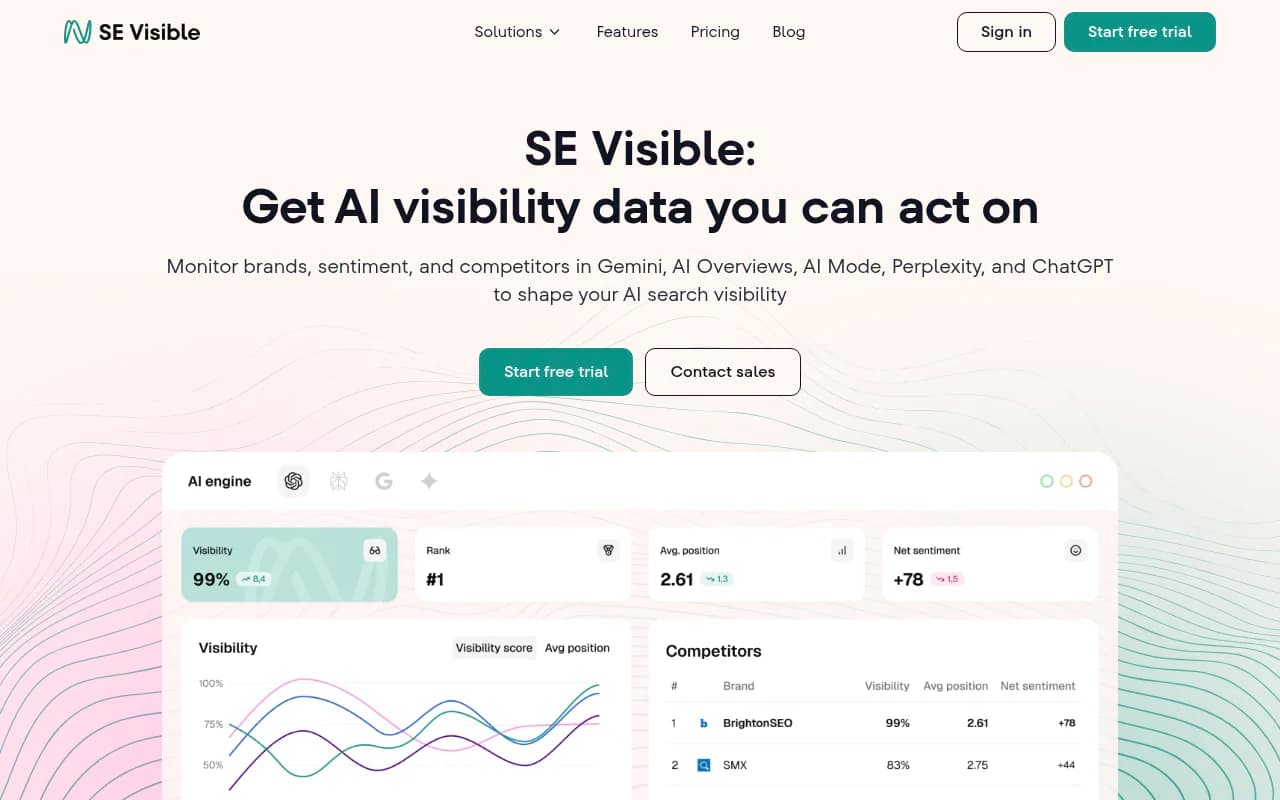
SE Visible is the AI visibility module from SE Ranking, and it benefits from being part of a mature SEO platform. If your team already uses SE Ranking for traditional SEO, adding AI visibility tracking through SE Visible is a logical extension — the data lives in the same place, and the workflow integration is smooth.
It covers 5 AI models and starts at $99/month. The multi-brand and multi-country support is solid. The main limitation is that it's still primarily a monitoring layer — it doesn't generate content or provide the kind of deep gap analysis that dedicated GEO platforms offer.
8. Semrush AI Toolkit
If you're already paying for Semrush, the AI Toolkit is worth activating. It adds AI visibility tracking on top of the traditional SEO suite you're already using, which means your team doesn't need to learn a new tool or manage another subscription.
The catch: Semrush uses fixed prompts, which means you're tracking a predetermined set of queries rather than the actual prompts your customers are using. There's also no AI traffic attribution connecting visibility to revenue. For teams that want a quick way to get some AI visibility data without adding a new vendor, it's convenient. For teams that need depth, it's not enough.
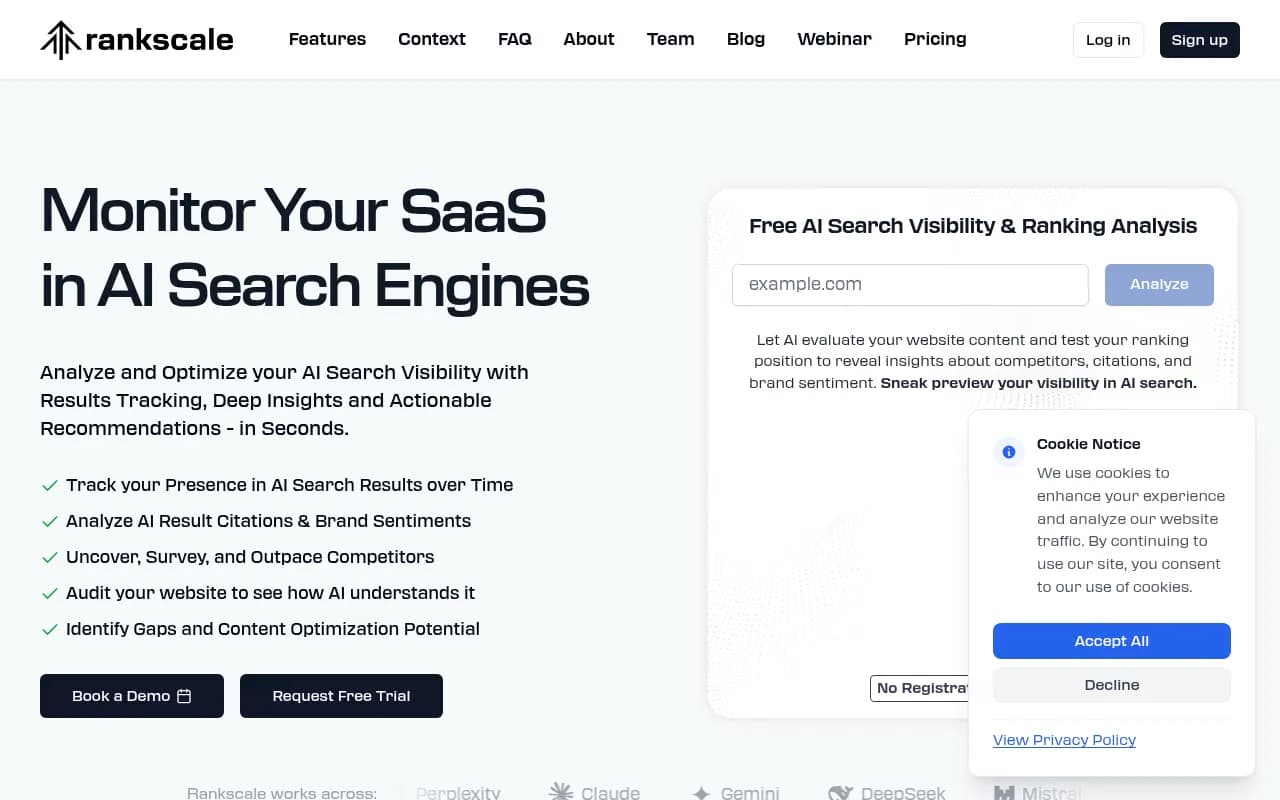
9. Rankscale
Rankscale is a focused AI search ranking and visibility platform that's worth considering for teams that want clean, straightforward tracking without a lot of complexity. It covers the major AI models and gives you ranking data, citation tracking, and basic competitive analysis.
It's not trying to be an all-in-one platform, and that focus shows in the interface — it's easier to get up and running quickly than some of the more feature-heavy options. The tradeoff is that you'll need other tools for content creation and optimization.
How these tools compare
Here's a direct comparison across the dimensions that matter most when choosing a Qwairy alternative:
| Tool | AI models tracked | Content generation | Crawler logs | Gap analysis | Starting price |
|---|---|---|---|---|---|
| Promptwatch | 10 | Yes (Content Agents) | Yes | Yes (Answer Gap Analysis) | $99/mo |
| Profound | Up to 10 | No | No | Limited | $99/mo |
| Peec AI | Up to 10 | No | No | No | ~€85/mo |
| Otterly.AI | 4 (base) | No | No | No | $29/mo |
| AthenaHQ | 8+ | No | No | No | Custom |
| Scrunch AI | Varies | No | No | No | Custom |
| SE Visible | 5 | No | No | No | $99/mo |
| Semrush AI Toolkit | 5 | No | No | No | Bundled |
| Rankscale | Varies | No | No | No | Varies |
The pattern is clear: most tools in this category are monitoring dashboards. Promptwatch is the outlier that closes the loop from data to action.
How to choose the right tool for your team
The right choice depends on where you are in your GEO journey and what your team actually needs to do next.
If you're just starting out and want to understand the landscape without committing significant budget, Otterly.AI or Peec AI are reasonable starting points. They're affordable, easy to set up, and give you a baseline sense of your AI visibility.
If you're already tracking visibility and frustrated that the data doesn't translate into action, that's the signal to move to a platform with content generation and gap analysis built in. Promptwatch is the obvious choice here — it's the only platform that covers monitoring, gap analysis, content creation, and crawler logs in one place.
If you're in an enterprise environment with a dedicated content team and just need the data layer, Profound or AthenaHQ are worth evaluating. They're strong on research and competitive intelligence even if they don't help with execution.
If you're already deep in the Semrush ecosystem, the AI Toolkit is the path of least resistance for getting started — just be honest with yourself about its limitations before treating it as a complete GEO solution.
One thing worth saying plainly: the teams getting the most out of GEO tools in 2026 aren't the ones with the best dashboards. They're the ones that have a workflow connecting visibility data to content production to results tracking. Whatever tool you choose, that workflow is what you're actually building. Pick the one that makes it easiest to close the loop.