Key takeaways
- The GEO tools market grew faster than the underlying discipline itself, producing dozens of "visibility trackers" that show you data but offer no path to improving it.
- The core difference between a real platform and a copycat is whether it closes the loop: find gaps, create content, measure results.
- Most tools stop at monitoring. A handful go further with content gap analysis, AI-native content generation, and traffic attribution.
- Red flags include: no crawler log access, no prompt volume data, fixed prompt libraries, and no way to connect visibility to revenue.
- Before buying, ask vendors five specific questions that separate genuine capability from polished marketing.
Something funny happened on the way to the AI search gold rush. The tools market got there before the discipline did.
By early 2026, there are well over 50 platforms claiming to help brands "win at GEO." Most of them launched in the 18 months after ChatGPT's usage numbers became impossible to ignore. Some are genuinely useful. A lot of them are monitoring dashboards with a fresh coat of paint and a new acronym on the homepage.
If you're a marketing director or SEO lead trying to evaluate this space right now, the noise is genuinely exhausting. Every tool shows you a score. Every tool has a dashboard. Every tool promises to tell you where you appear in AI answers. But very few of them tell you what to do about it -- and almost none of them help you do it.
This guide is about how to tell the difference.
Why the GEO tools market got so crowded so fast
GEO -- Generative Engine Optimization -- was formally defined in a 2024 research paper, but the term started spreading fast once brands noticed that their traffic from Google was behaving strangely. Pages that ranked well were getting fewer clicks. AI Overviews were absorbing queries. ChatGPT was recommending competitors without ever visiting a website.
The anxiety was real. And where there's anxiety, there's a market.
The problem is that building a monitoring dashboard is not that hard. You write a set of prompts, query a few LLM APIs, parse the responses for brand mentions, and display a score. That's a weekend project for a competent developer. It's not a GEO platform. But it looks like one if you put it behind a clean UI and charge $99 a month.
The result is a market where the majority of tools are doing roughly the same thing -- querying AI models with a fixed set of prompts and showing you whether your brand appeared. That's useful information. It's just not optimization. It's observation.
The three types of tools you'll actually encounter
When you strip away the marketing, most GEO tools fall into one of three categories.
Pure monitoring dashboards
These tools query AI models, track brand mentions, and show you a visibility score over time. They're useful for awareness and reporting, but they don't tell you why you're invisible or what to do about it. Most of the newer entrants in this space fall here.
Examples include tools like Otterly.AI and Peec AI -- both affordable, both decent for basic tracking, neither built to help you act on what they find.


Monitoring plus some analysis
A step up from pure dashboards. These tools add features like competitor comparisons, prompt libraries, or share-of-voice metrics. They give you more context but still leave the "what now?" question unanswered. You get a better picture of the problem without a clear path to solving it.
Tools like AthenaHQ and Profound sit in this tier. Solid data, meaningful competitive context, but the workflow stops at insight.


End-to-end optimization platforms
The rarest category. These tools don't just show you where you're invisible -- they help you figure out why, generate content to fix it, and track whether that content actually worked. The loop closes. You can connect a specific piece of content to a change in AI visibility, and eventually to traffic and revenue.
This is where Promptwatch sits, and it's genuinely a different product category from what most tools in this space are selling.

The five questions that separate real platforms from copycats
If you're evaluating GEO tools right now, here are the questions worth asking every vendor. The answers will tell you more than any feature comparison table.
1. Can you show me which prompts my competitors rank for that I don't?
This is the answer gap question. A real optimization platform should be able to tell you the specific prompts where your competitors appear in AI answers and you don't. Not just "you have 40% visibility" -- but "here are the 23 prompts where Competitor X is being cited and your content isn't being pulled."
If the answer is a vague "yes, we track competitor visibility," push for a demo. Most tools can show you your own score and a competitor's score side by side. Far fewer can show you the specific content gaps driving that difference.
2. What do you do after you find a gap?
This is the question that separates monitoring tools from optimization platforms. A monitoring tool will say "we show you the gap." A real platform will have a workflow for closing it -- whether that's content recommendations, a built-in writing tool, or structured guidance on what to publish.
The honest answer from most tools is "we show you the data, you figure out the content." That's fine if you have a content team with bandwidth. But it means you're paying for a dashboard, not a solution.
3. Do you have access to AI crawler logs?
This one catches people off guard. AI models don't just query your content when a user asks a question -- they crawl your site first, just like Googlebot does. Knowing which pages ChatGPT's crawler has visited, how often, and whether it encountered errors is genuinely useful for diagnosing why you're not being cited.
Very few tools surface this data. Most don't have it at all. If a vendor looks confused by the question, that tells you something.
4. How do you connect AI visibility to actual traffic and revenue?
This is the measurement problem that the whole industry is quietly struggling with. As the Martechify analysis from early 2026 noted, visibility no longer maps cleanly to traffic, and attribution is increasingly fragmented. A page can influence an AI answer without receiving a click. So how do you know if your GEO work is actually doing anything?
The honest answer from most tools: they don't know. They show you visibility scores and leave the revenue connection to you. A more complete platform will offer traffic attribution through a code snippet, Google Search Console integration, or server log analysis -- something that ties the visibility data to real business outcomes.
5. Are your prompts fixed or customizable?
This matters more than it sounds. A tool with a fixed prompt library is measuring a static snapshot of AI behavior. It's useful for benchmarking but not for understanding how your actual customers are searching. Real customers ask questions in their own language, with their own context, from their own location.
A platform that lets you define custom prompts -- including persona-based prompts, location-specific queries, and long-tail questions relevant to your specific business -- is measuring something much closer to reality.
A comparison of what's actually in the market
| Capability | Monitoring-only tools | Mid-tier analysis tools | End-to-end platforms |
|---|---|---|---|
| Brand mention tracking | Yes | Yes | Yes |
| Competitor visibility comparison | Sometimes | Yes | Yes |
| Answer gap analysis (prompt-level) | No | Sometimes | Yes |
| Custom prompts and personas | Rarely | Sometimes | Yes |
| AI crawler log access | No | No | Yes (rare) |
| Content gap recommendations | No | No | Yes |
| Built-in content generation | No | No | Yes (rare) |
| Traffic and revenue attribution | No | No | Yes (rare) |
| Prompt volume and difficulty data | No | Rarely | Yes |
| Reddit and YouTube citation tracking | No | No | Yes (rare) |
The table above is a rough map, not a definitive ranking. Individual tools vary. But the pattern holds: most of what's being sold as a "GEO platform" in 2026 covers the first two rows and stops there.
The red flags to watch for when evaluating vendors
Beyond the five questions above, here are some specific warning signs that a tool is more copycat than platform.
Fixed prompt libraries with no customization. If you can't add your own prompts, you're measuring the vendor's assumptions about your business, not your actual search landscape. Semrush's AI visibility features, for instance, use fixed prompts -- which limits how much you can tailor the data to your specific situation.
No data on why you're not being cited. A score going down is not useful without an explanation. If the tool can't tell you whether the problem is content gaps, crawlability issues, or a competitor publishing better answers, you're flying blind.
Vague "optimization tips" that aren't grounded in citation data. Some tools generate generic content recommendations ("add more FAQs," "use structured data") without connecting those recommendations to what AI models are actually citing. That's SEO advice dressed up as GEO advice.
No mention of AI traffic attribution. If a vendor's demo never shows you how to connect visibility to clicks or revenue, ask directly. The answer will be revealing.
Launched in 2024 or 2025 with no clear data foundation. This isn't a hard rule -- some newer tools are genuinely good. But a platform claiming to have analyzed billions of citations that launched 18 months ago should be able to explain where that data comes from.
What a real optimization workflow actually looks like
The best way to understand what separates a real platform from a dashboard is to walk through what a complete workflow looks like.
You start by identifying which prompts matter to your business -- the questions your customers are actually asking AI models. A good platform will give you volume estimates and difficulty scores for those prompts, so you can prioritize the ones worth pursuing.
Then you run an answer gap analysis. You find the specific prompts where competitors are being cited and you're not. You look at what content those competitors have that you don't -- what topics, angles, and questions they've answered that your site hasn't addressed.
Then you create content. Not generic content, but content specifically engineered to be cited by AI models -- structured, authoritative, grounded in what the citation data shows AI models actually want to pull from. A platform with a built-in writing tool trained on citation data can do this in a fraction of the time it would take a content team starting from scratch.
Then you track results. You watch your visibility scores change as AI models start picking up the new content. You use page-level tracking to see exactly which pages are being cited, by which models, and how often. And you connect that visibility data to actual traffic through attribution tools.
That's the loop. Find gaps, create content, track results. Most tools in this market only do step one.
Some tools worth knowing about beyond the top tier
The market isn't binary. There are tools that do specific things well without claiming to be end-to-end platforms, and they're worth knowing about depending on what you actually need.
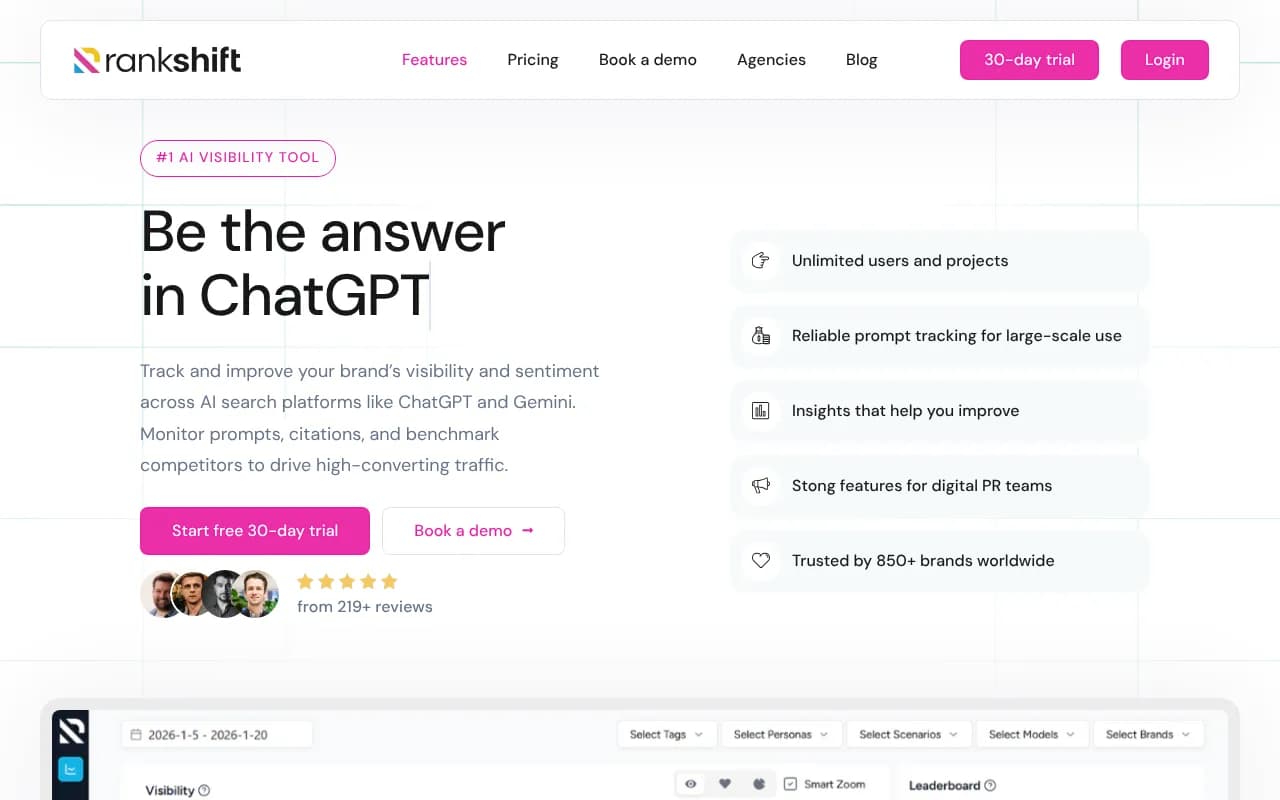
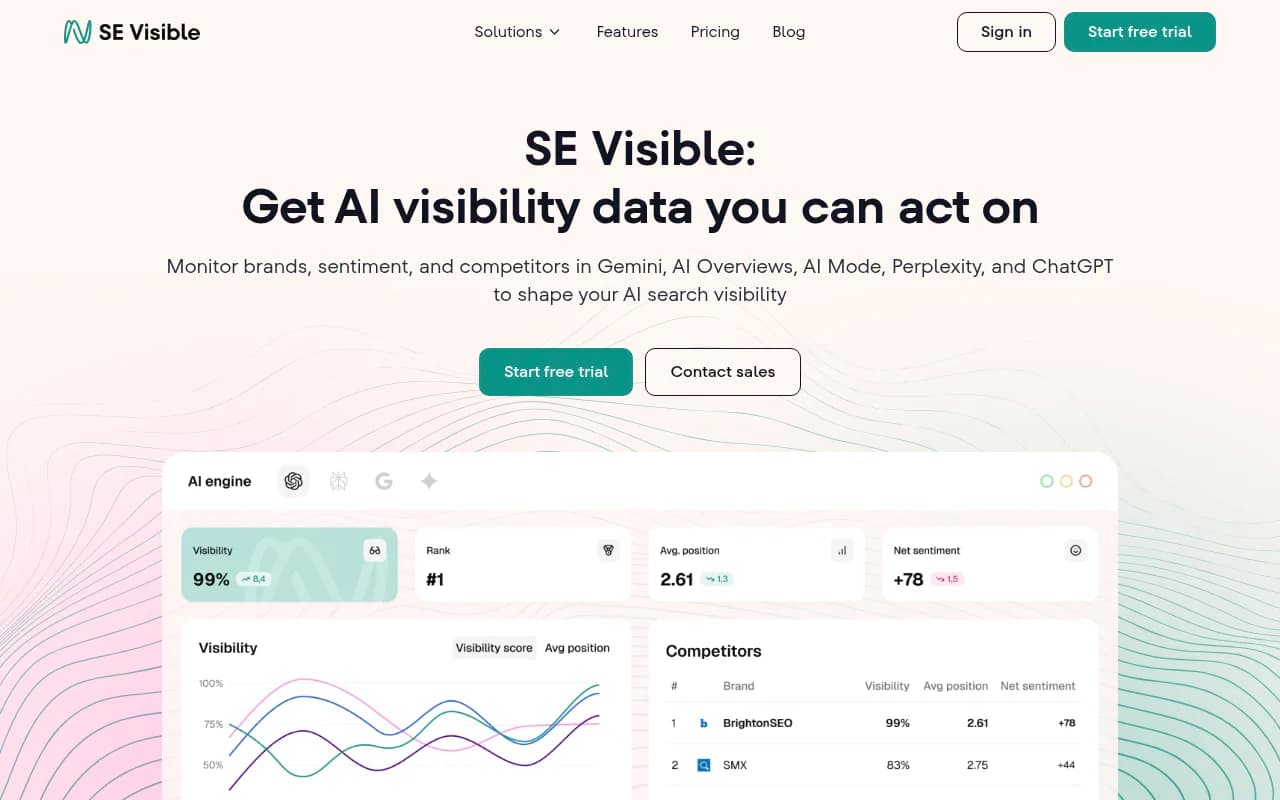
For basic monitoring on a tight budget, tools like Rankshift, SE Visible, and Airefs cover the fundamentals without a lot of overhead.
For teams that want deeper competitive intelligence without committing to a full platform, Gauge and Ranksmith offer more analytical depth than the average dashboard.
For enterprise teams already invested in traditional SEO platforms, BrightEdge and seoClarity have added AI visibility tracking to their existing suites -- though neither has the depth of a purpose-built GEO platform.
For tracking AI crawler activity specifically -- which pages AI bots are visiting and how often -- DarkVisitors is worth a look, though it's a narrow tool rather than a full platform.
The honest state of the market in 2026
The GEO space is real. AI search is genuinely changing how people find information, and the brands that figure out how to be cited by ChatGPT, Perplexity, and Google AI Mode will have a real advantage over those that don't. The underlying problem these tools are trying to solve is legitimate.
But the tools market got ahead of itself. There are too many dashboards, too many "visibility scores" that don't connect to anything actionable, and too many vendors using the same language to describe very different levels of capability.
The good news is that the questions above will cut through most of the noise pretty quickly. Ask any vendor to show you their answer gap analysis in a live demo. Ask them what happens after they find a gap. Ask them how they connect visibility to revenue. The answers -- or the absence of answers -- will tell you everything you need to know.
The market will consolidate. The tools that survive will be the ones that close the loop, not just open the dashboard.