Key takeaways
- The SEO workflow in 2026 spans at least five distinct stages: research, content planning, content creation, technical optimization, and AI visibility tracking. No single tool covers all of them well.
- Most tools marketed as "AI SEO platforms" are either repurposed content generators or monitoring dashboards. The ones worth paying for do something specific extremely well.
- AI search visibility (how your brand appears in ChatGPT, Perplexity, Gemini, etc.) is now a separate discipline from traditional SEO -- and requires its own tooling.
- The 8 tools below were chosen because each one owns a distinct stage of the workflow. Together, they form a complete stack.
- Budget matters: you don't need all 8. Identify which stage is your current bottleneck and start there.
The SEO toolkit has always been a mess of overlapping tools. Keyword research here, content optimization there, rank tracking somewhere else, technical audits in a fourth tab. That was already annoying in 2023.
In 2026, it's gotten more complicated. Now you also have to think about how your content appears in AI-generated answers -- ChatGPT, Perplexity, Google AI Overviews, Gemini. These platforms don't rank pages the way Google does. They cite sources. And whether your site gets cited depends on factors that traditional SEO tools don't measure at all.
So the modern SEO stack has a new layer on top of the old one. The good news: the tools have gotten sharper. The bad news: there are now hundreds of them, and most are either redundant or overhyped.
This guide cuts through that. Eight tools, eight distinct jobs, one coherent workflow from the first keyword idea to tracking whether AI engines are actually sending you traffic.
Stage 1: Keyword and topic research
Semrush
If you need one tool to start with, Semrush is still the most complete research platform available. Its keyword database is enormous, its competitor analysis is genuinely useful, and the 2025-2026 updates have added AI-specific features that go beyond the usual keyword volume metrics.
The AI Visibility Toolkit (part of Semrush One) lets you monitor how your brand appears in AI-generated responses across multiple platforms. It's not the deepest AI tracking tool on the market, but for teams that already live in Semrush, it removes the need for a separate monitoring subscription.
Where Semrush gets frustrating: it's expensive, the interface can feel overwhelming, and some of the AI features feel bolted on rather than native. But for raw research power -- keyword gaps, competitor traffic estimates, backlink analysis -- nothing else comes close at scale.
Ahrefs Brand Radar
Ahrefs has been the go-to for backlink analysis and content gap research for years. The Brand Radar feature, added more recently, tracks how your brand appears in AI search results. It's more limited than dedicated GEO platforms -- fixed prompts, no AI traffic attribution -- but if you're already using Ahrefs for traditional SEO, it gives you a baseline view of AI visibility without adding another tool.
Stage 2: Content planning and briefs
MarketMuse
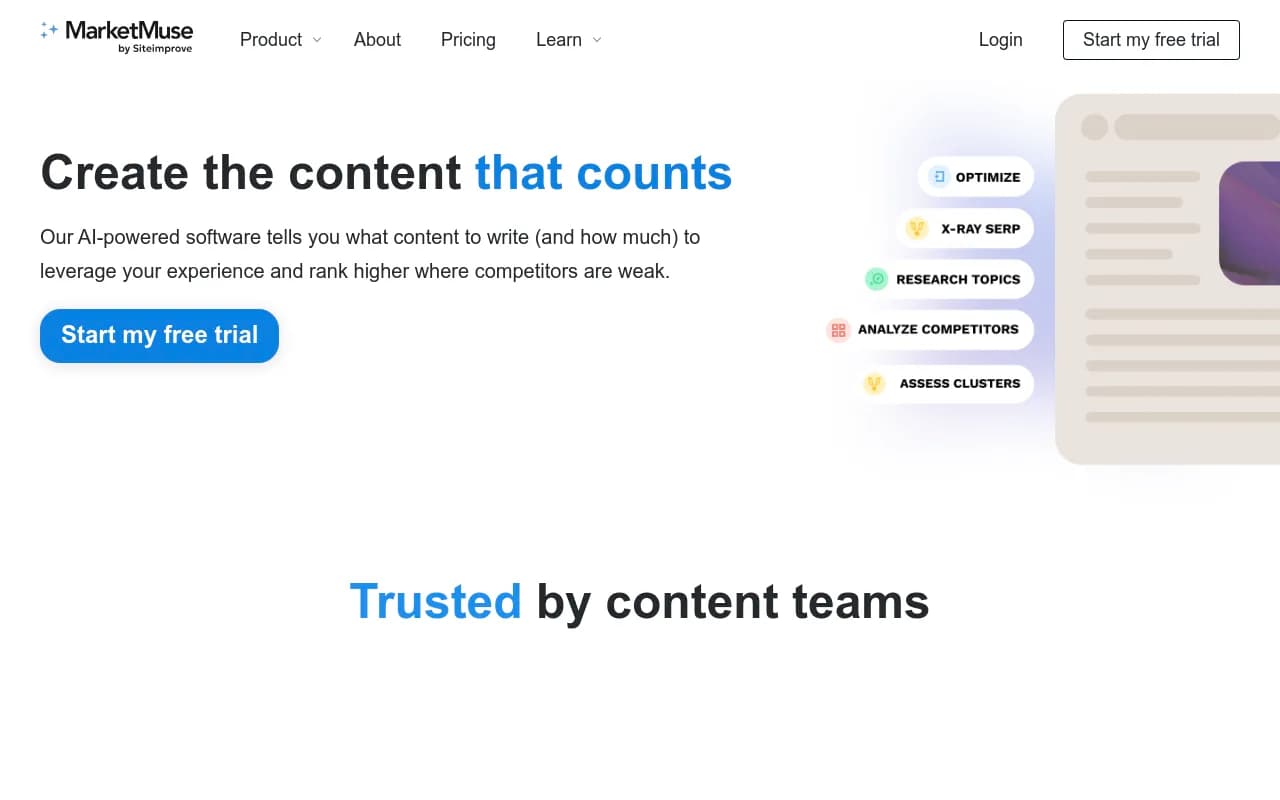
MarketMuse sits between research and writing. It analyzes your existing content, identifies topic gaps, and generates detailed content briefs that tell writers exactly what to cover and how deeply.
What makes it genuinely useful rather than just another AI content tool: it scores your content against competitors on a topic-by-topic basis. So instead of guessing whether your article on "project management software" is comprehensive enough, you get a score and a specific list of subtopics you're missing.
The pricing isn't publicly listed (you have to request a demo), which is always a bit of a red flag for smaller teams. But for content-heavy sites trying to build topical authority, it's one of the more thoughtful tools in this category.
Frase
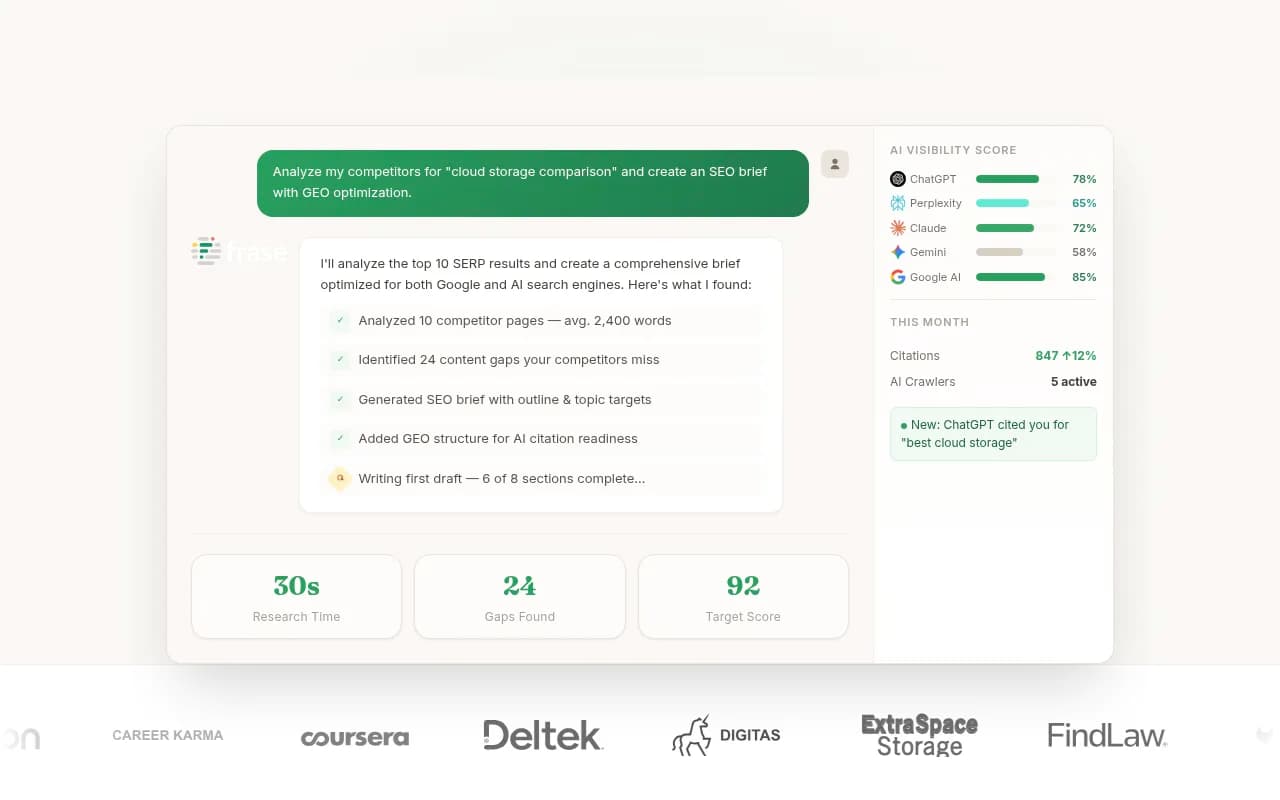
Frase is the more accessible alternative to MarketMuse. It pulls the top-ranking pages for any keyword, extracts the topics they cover, and helps you build a brief that matches or exceeds them. The workflow is faster and more intuitive than MarketMuse, and the pricing is significantly lower.
It also has a built-in editor that scores your content as you write -- similar to Surfer SEO but with a stronger emphasis on the research and briefing phase. For teams that need to move quickly from keyword to published article, Frase is hard to beat on value.
Stage 3: Content creation and optimization
Surfer SEO
Surfer is the tool most content teams actually use when they sit down to write. You paste in a keyword, it analyzes the top-ranking pages, and it gives you a real-time content score as you write -- tracking keyword usage, headings, word count, and semantic coverage.
The feedback loop is immediate and concrete. You're not guessing whether your article is optimized; you're watching a score change as you add or remove content. That's genuinely useful, especially for teams producing high volumes of content.
The criticism that comes up most often: Surfer can push writers toward keyword stuffing if they chase the score too aggressively. The score is a guide, not a target. Teams that understand that get a lot of value from it. Teams that treat it as gospel end up with content that reads like it was written by a robot.
Clearscope
Clearscope does something similar to Surfer but with a slightly different philosophy. It focuses more on semantic relevance -- making sure your content covers the full range of related concepts -- and less on raw keyword density.
It's also added AI search tracking features, so you can see whether your optimized content is getting cited in AI-generated responses. It's not as deep as a dedicated GEO platform, but it closes the loop between writing and AI visibility in a way that Surfer currently doesn't.
Pricing starts at $129/month, which is higher than Surfer. The extra cost makes more sense for teams that are actively trying to optimize for both Google and AI search simultaneously.
Stage 4: Technical SEO
Screaming Frog
Some tools age out. Screaming Frog hasn't. It's been the standard website crawler for technical SEO audits for over a decade, and it's still the most thorough option for finding crawl errors, broken links, redirect chains, duplicate content, and missing metadata.
The free version crawls up to 500 URLs, which is enough for smaller sites. The paid version ($259/year) removes that limit and adds JavaScript rendering, scheduled crawls, and Google Analytics/Search Console integration.
What it doesn't do: it won't tell you anything about AI visibility, content quality, or keyword rankings. It's purely a technical tool. But "purely a technical tool" is exactly what you need when something is broken on your site and you need to find it fast.
Stage 5: AI search visibility tracking and optimization
This is the newest stage in the SEO workflow, and it's where the most interesting tools are emerging right now.
Traditional SEO tracks your Google rankings. AI visibility tracking asks a different question: when someone asks ChatGPT or Perplexity a question relevant to your business, does your brand get mentioned? Which competitors get cited instead? What content would you need to create to change that?
Most tools in this category are monitoring-only -- they show you where you stand but don't help you do anything about it. The better ones close that loop.
Promptwatch
Promptwatch is the most complete platform in this category. It tracks how your brand appears across 10 AI models (ChatGPT, Perplexity, Claude, Gemini, Google AI Overviews, Grok, DeepSeek, Copilot, Meta AI, Mistral), but the tracking is only the starting point.
The Answer Gap Analysis shows you exactly which prompts your competitors are visible for that you're not -- and what content your site is missing to compete. The built-in AI writing agent then generates articles, listicles, and comparisons grounded in real citation data from over 880 million citations analyzed. This isn't generic content generation; it's content engineered to get cited by AI models.
It also has AI Crawler Logs, which show you in real time which pages AI crawlers are visiting, how often, and what errors they're encountering. Most competitors don't have this at all. For teams trying to understand why certain pages aren't getting cited, it's often the first place to look.
The pricing starts at $99/month for the Essential plan (1 site, 50 prompts, 5 articles), with Professional at $249/month and Business at $579/month. A free trial is available.

How the 8 tools fit together
Here's the honest picture: you probably don't need all 8. The right stack depends on where your biggest gap is right now.
| Stage | Tool | Best for | Starting price |
|---|---|---|---|
| Keyword research | Semrush | Comprehensive research + competitor analysis | $139.95/mo |
| Keyword research (backlinks) | Ahrefs Brand Radar | Backlink analysis + basic AI brand tracking | $29/mo |
| Content planning | MarketMuse | Topical authority, content scoring | Custom |
| Content planning (faster) | Frase | Brief creation, SERP analysis | ~$45/mo |
| Content optimization | Surfer SEO | Real-time writing optimization | $99/mo |
| Content optimization (AI-aware) | Clearscope | Semantic optimization + AI citation tracking | $129/mo |
| Technical SEO | Screaming Frog | Crawl audits, technical issues | $259/yr |
| AI visibility | Promptwatch | Full GEO cycle: track, gap analysis, create, measure | $99/mo |
A realistic starting stack for a mid-sized team: Semrush for research, Surfer for writing, Screaming Frog for technical audits, and Promptwatch for AI visibility. That covers the full workflow without significant overlap.
What to watch out for when evaluating AI SEO tools
A few patterns worth knowing before you commit to anything.
"AI-powered" means almost nothing. Every tool in this space now claims AI features. Some of those features are genuinely useful (Surfer's content scoring, Promptwatch's citation analysis). Others are just a ChatGPT API call wrapped in a UI. Ask specifically what the AI does and what data it's trained on before paying.
Monitoring and optimization are different things. A lot of AI visibility tools will show you a dashboard of where you rank in AI responses. That's useful for about five minutes. What you actually need is a tool that tells you why you're not ranking and what to do about it. Most tools stop at the dashboard.
Be skeptical of precision claims. As Leigh McKenzie at Backlinko put it: "If it claims to tell you exactly how you rank in AI results, it's probably selling certainty where there is none." AI search results vary by user, context, and model version. Directional data is valuable. Exact numbers should be treated with skepticism.
Integration matters more than features. A tool with 80% of the features that fits your existing workflow beats a tool with 100% of the features that requires rebuilding how your team works. Before buying anything, map out how it connects to what you're already using.
The stage most teams skip
Most SEO teams have some version of the research-to-content workflow covered. What's almost universally missing is the AI visibility layer.
This isn't a criticism -- it's a relatively new discipline. But the gap is real. About 60% of marketers are now piloting or scaling AI in their workflows (per the Marketing AI Institute's 2025 State of Marketing AI Report), and AI search engines are handling a growing share of informational queries. If your content strategy doesn't account for how ChatGPT or Perplexity cites sources, you're optimizing for a search landscape that's already changing underneath you.
The tools to address this exist and are maturing fast. The teams that build this into their workflow now will have a meaningful head start on the ones that wait until AI search traffic becomes impossible to ignore.
Picking your starting point
If you're building a stack from scratch, start with the stage where you're losing the most. If your content isn't ranking in Google, fix the research and optimization layer first (Semrush + Surfer). If your content ranks in Google but you're invisible in AI search, start with Promptwatch. If your site has technical issues that are blocking crawling, Screaming Frog before anything else.
The tools are good. The question is always sequencing -- fixing the right problem at the right time rather than collecting subscriptions that don't connect to outcomes.