Key takeaways
- Surfer SEO scores content in real time as you write, using NLP-driven keyword analysis. Clearscope grades content on topical completeness using a letter-grade system.
- According to an Originality.ai study cited by Surfer, Surfer's Content Score had a 26% correlation with rankings vs. Clearscope's 17.5%.
- Clearscope wins on enterprise workflow features: unlimited seats, cleaner editorial interface, and strong content monitoring.
- Neither tool was built specifically for AI search visibility. If ranking in ChatGPT, Perplexity, or Google AI Overviews matters to you, you'll need a dedicated GEO platform alongside either tool.
- For most teams, Surfer is the better starting point. Clearscope makes more sense once you're managing a large editorial operation and can justify the $170+/mo price.
What these tools actually do
Before getting into the comparison, it's worth being clear about what both tools are and aren't. Surfer SEO and Clearscope are content optimization tools. They analyze the pages currently ranking on Google for a target keyword, then tell you how to write content that looks more like those pages. That's the core loop.
Neither tool does keyword research in the traditional sense. Neither does backlink analysis. And neither was designed from the ground up to help you appear in AI search engines like ChatGPT or Perplexity. That distinction matters more in 2026 than it did two years ago, and I'll come back to it.
What they do well is help writers produce content that covers a topic thoroughly, uses the right language, and hits structural patterns that correlate with high rankings. If you're writing a lot of content and want a systematic way to improve quality, both tools are genuinely useful.

Core philosophy: the fundamental difference
Both tools analyze Google's top-ranking SERP results, but they produce very different outputs from the same data source.
Surfer SEO is built around a numerical Content Score. You open the Content Editor, enter a target keyword, and Surfer immediately starts scoring your draft. As you write, the score updates in real time. It tells you which NLP terms to include, how many times to use them, what word count to target, and how to structure your headings. It's prescriptive and data-dense. Writers who like clear targets tend to love it. Writers who find constant scoring distracting tend to find it exhausting.
Clearscope takes a different angle. Its letter-grade system (A+ down to F) measures how comprehensively your content covers a topic compared to what's already ranking. The emphasis is on topical authority rather than keyword frequency. The interface is cleaner and less cluttered, which is partly why editorial teams at larger companies tend to prefer it. There's less noise, but also less tactical detail.
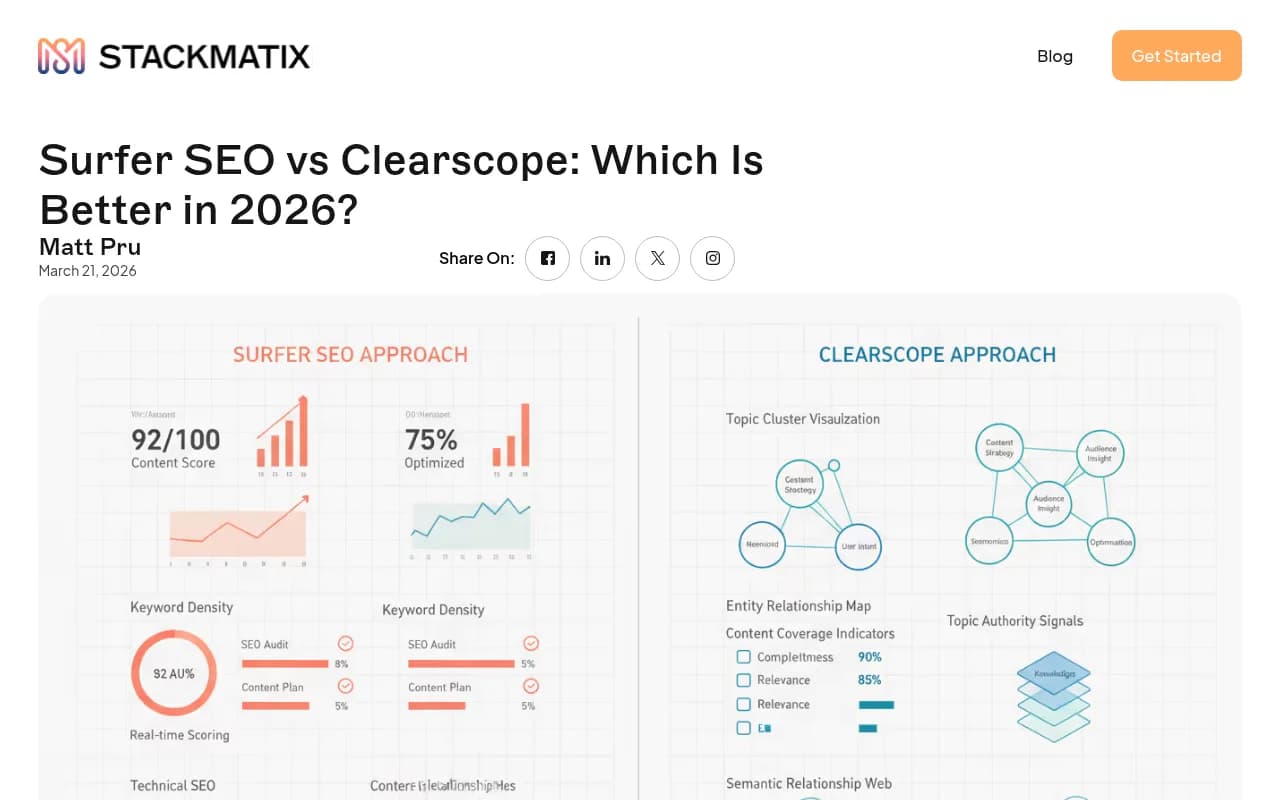
The Stackmatix comparison puts it well: Surfer optimizes for data-driven keyword scoring, while Clearscope builds topical authority. Both are legitimate approaches. The question is which one fits how your team actually works.
Feature-by-feature breakdown
Content editor
Surfer's Content Editor is its flagship feature. Real-time scoring, NLP keyword suggestions, word count targets, heading recommendations, and a built-in outline builder. It integrates directly with Google Docs and WordPress, which means writers can optimize without switching tools. That's a genuine workflow advantage.
Clearscope's editor is more minimal. It shows you which terms to include and grades your content, but it doesn't push you toward a specific word count or structure as aggressively. Some writers find this liberating. Others find it less actionable.
AI writing
Surfer has a native AI writer that can generate article drafts. It's serviceable for getting a first draft down quickly, though like most AI writers it produces content that mirrors what already ranks rather than introducing original angles. You'll still need editorial judgment on top of it.
Clearscope has no native AI writer. If you want AI-assisted drafting, you'll need to bring your own tool (Jasper, Claude, or similar) and then paste into Clearscope for grading.
Keyword research
Surfer includes basic keyword research and a keyword clustering feature. It's not a replacement for a dedicated keyword tool, but it's enough to get started without switching tabs constantly.
Clearscope doesn't really do keyword research. It assumes you already know what you're targeting and focuses entirely on content quality for that term.
Content auditing
Both tools let you audit existing content. Surfer's audit feature identifies pages that could be improved and suggests specific changes. Clearscope's monitoring feature tracks how your published content grades over time as the competitive landscape shifts.
Clearscope's content monitoring is arguably stronger here, especially for teams managing large content libraries. You can see when a page's grade drops because competitors have improved their content, which is a useful early warning signal.
Integrations
Surfer: Google Docs, WordPress, Jasper, Semrush. Clearscope: Google Docs, WordPress, HubSpot, Salesforce.
Both cover the essentials. Clearscope's HubSpot and Salesforce integrations make it more appealing to enterprise marketing teams with complex tech stacks.
Seats and collaboration
This is where Clearscope has a real structural advantage. Clearscope offers unlimited seats on all plans. Surfer charges per seat, which adds up fast for larger teams.
If you're running a content team of 10+ writers, Clearscope's pricing model can actually be cheaper in practice, even though its headline price is higher.
Pricing comparison
| Surfer SEO | Clearscope | |
|---|---|---|
| Entry price | $89/mo (Essential) | $170/mo (Essentials) |
| Mid-tier | $129/mo (Scale) | $350/mo (Business) |
| Seats | Per seat (adds cost) | Unlimited on all plans |
| AI writing | Included | Not included |
| Free trial | 7-day trial | Demo only |
| Annual discount | Yes | Yes |
Surfer is cheaper at entry. Clearscope is often cheaper at scale if you have a large team. The break-even point depends on how many seats you need.
Ranking correlation: does the score actually matter?
This is the question that should matter most, and there's at least one data point worth citing. An Originality.ai study found that Surfer's Content Score had a 26% correlation with Google rankings, while Clearscope's score had a 17.5% correlation. That's a meaningful gap (roughly 62% higher correlation for Surfer).
To be fair, this study was cited on Surfer's own blog, so take it with appropriate skepticism. But it's the most specific public data available on this question, and it aligns with the general consensus among practitioners: Surfer's scoring tends to produce more directly actionable guidance for ranking.
A 26% correlation also means 74% of ranking factors are explained by something else entirely. Both tools are useful, but neither is a ranking guarantee.
Where both tools fall short: AI search visibility
Here's the thing neither Surfer nor Clearscope will tell you directly: optimizing for Google's traditional blue links is increasingly only part of the job.
In 2026, a growing share of search traffic flows through AI-generated answers. ChatGPT, Perplexity, Google AI Overviews, Claude, and Gemini are all answering questions that used to send users to your website. Neither Surfer nor Clearscope was built to track or optimize for these channels.
Surfer's research page mentions "AI answer extraction hints" as a feature, which is a start. But neither tool shows you which AI engines are citing your content, which prompts your competitors are winning that you're not, or how to close those gaps systematically.
If AI search visibility is part of your strategy (and it probably should be), you'd need a dedicated GEO platform alongside whichever content tool you choose. Promptwatch is built specifically for this, tracking how your brand appears across ChatGPT, Perplexity, Google AI Overviews, Claude, Gemini, and others, and helping you identify the content gaps that are costing you AI citations.

The practical workflow for teams serious about both traditional and AI search in 2026: use Surfer or Clearscope to optimize content for Google rankings, and use a GEO platform to track and improve AI visibility. They solve different problems.
Who should use Surfer SEO
Surfer makes the most sense if:
- You're a small to mid-sized team (1-5 writers) where per-seat pricing doesn't hurt
- You want real-time feedback while writing, not just a post-draft grade
- You're doing a mix of content creation and optimization and want one tool that covers both
- Budget is a constraint and you need the most capable tool at the lowest price point
- You want AI-assisted drafting built in without paying for a separate tool
The honest weakness: Surfer optimizes for what already ranks. If you're in a competitive niche where differentiation matters, chasing a perfect Content Score can push you toward content that looks like everyone else's. The score is a guide, not a ceiling.
Who should use Clearscope
Clearscope makes more sense if:
- You're managing a content team of 10+ writers and unlimited seats justify the higher price
- Your editorial workflow prioritizes topic authority over keyword-by-keyword optimization
- You need enterprise integrations (HubSpot, Salesforce) that Surfer doesn't offer
- You want cleaner, less distracting interface for writers who find Surfer's scoring overwhelming
- You're already investing in a separate AI writing tool and don't need Surfer's native writer
The honest weakness: no native AI writer, no keyword research, and the entry price is steep for smaller operations. You're paying for enterprise workflow features, and if you don't need those, you're overpaying.
Head-to-head comparison table
| Feature | Surfer SEO | Clearscope |
|---|---|---|
| Real-time content scoring | Yes | No (post-draft grading) |
| Scoring methodology | Numerical (0-100) | Letter grade (A+ to F) |
| NLP keyword suggestions | Yes, detailed | Yes, less prescriptive |
| Native AI writer | Yes | No |
| Keyword research | Basic | None |
| Content audit | Yes | Yes (with monitoring) |
| Google Docs integration | Yes | Yes |
| WordPress integration | Yes | Yes |
| HubSpot / Salesforce | No | Yes |
| Unlimited seats | No (per seat) | Yes |
| Ranking correlation (Originality.ai) | 26% | 17.5% |
| Entry price | $89/mo | $170/mo |
| AI search visibility | Limited hints | None |
| Best for | Small-mid teams, tactical SEO | Enterprise editorial teams |
Alternatives worth considering
If neither tool feels like the right fit, a few others are worth a look:
MarketMuse is the right choice when you're planning content at scale and want deep topical authority modeling across an entire site, not just individual articles. It's more expensive than both Surfer and Clearscope, but the content strategy features are more sophisticated.
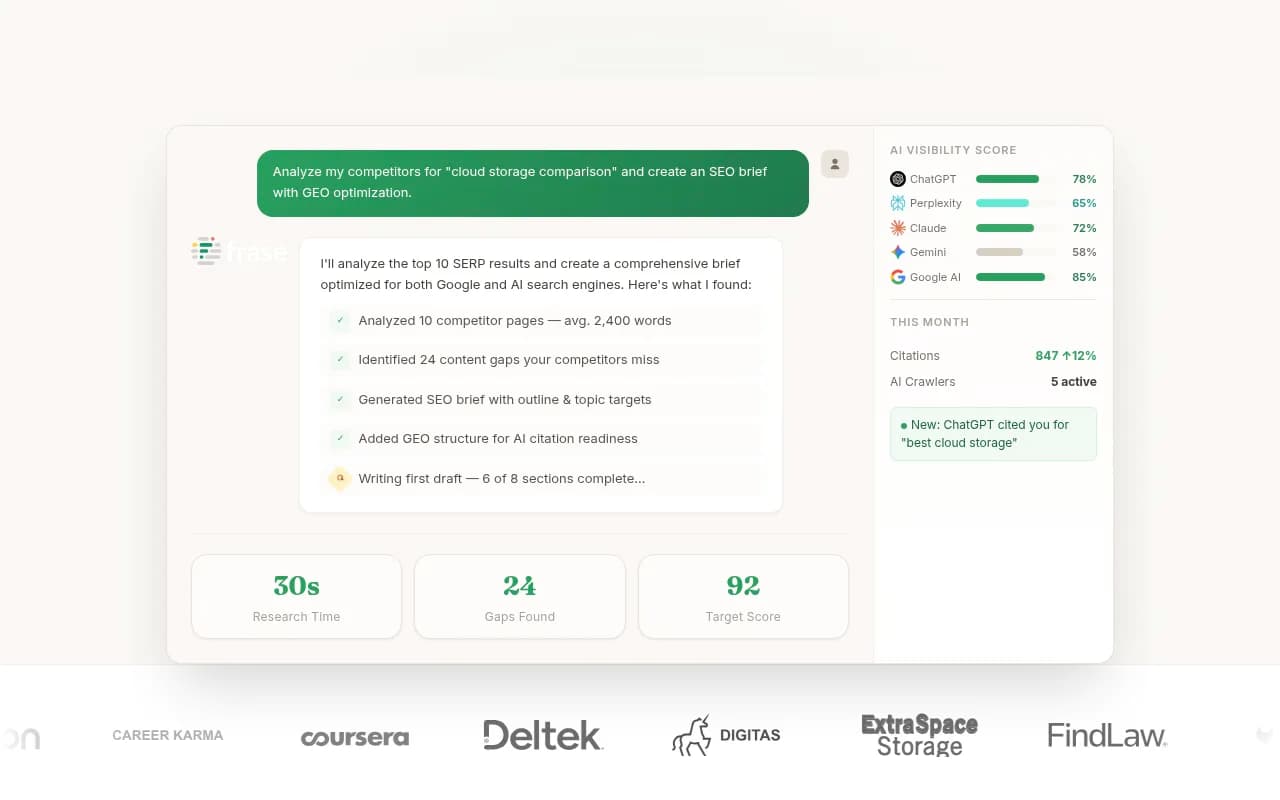
Frase sits between the two in terms of price and feature depth. It's particularly strong on content briefs and research, and it's a good option for teams that want AI-assisted research alongside optimization.
If your team is already on Semrush, the Writing Assistant integrates SEO scoring with readability, tone, and plagiarism checks in one place. It's not as deep as Surfer or Clearscope on pure content optimization, but the integration with Semrush's broader data is a real advantage.
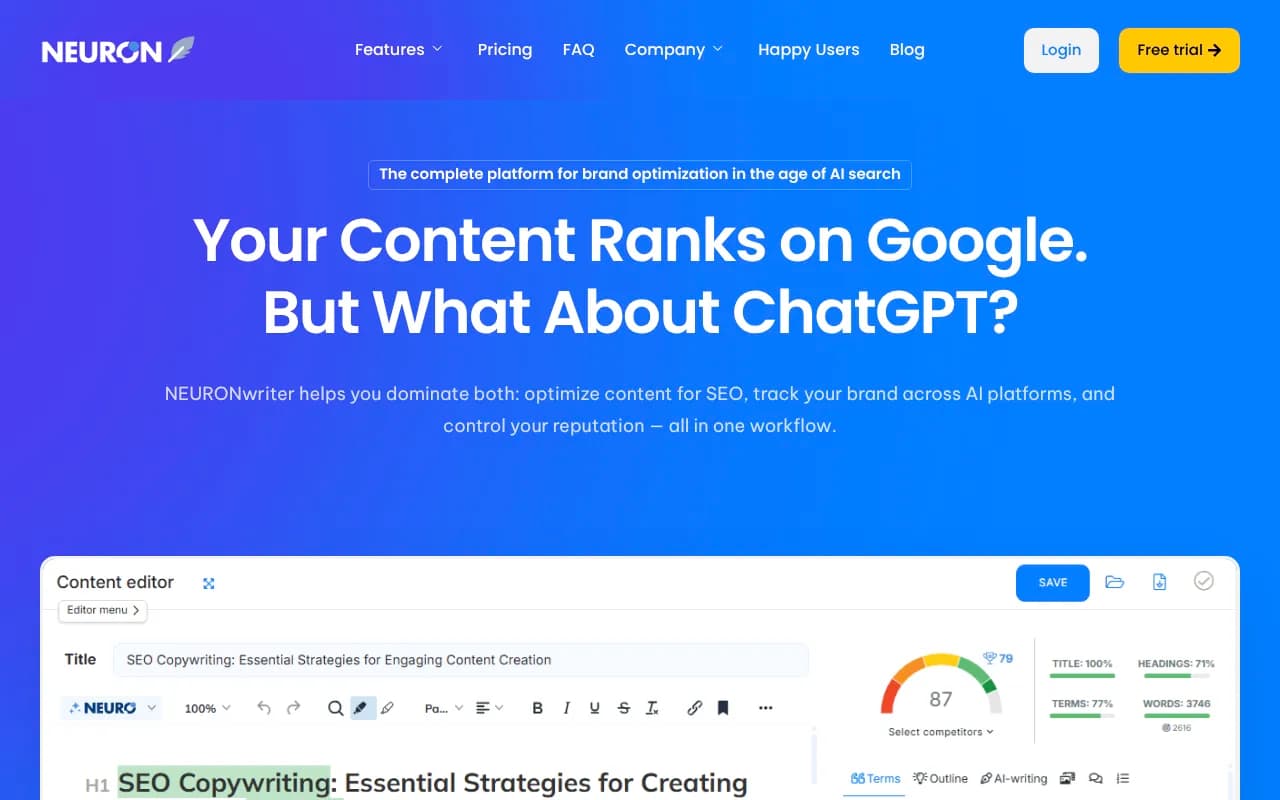
NeuronWriter is a lower-cost alternative that covers similar ground to Surfer, with semantic NLP analysis and content scoring. Worth considering if budget is tight and you want Surfer-like functionality at a lower price point.
The bottom line
For most teams in 2026, Surfer SEO is the better starting point. The real-time scoring, lower entry price, native AI writer, and stronger ranking correlation data make it the more practical choice for teams that are actively producing content and want clear, actionable feedback.
Clearscope earns its premium price at enterprise scale. If you're running a large editorial operation, the unlimited seats and cleaner workflow can justify the cost. But for a 2-3 person content team, $170/mo for Clearscope is hard to justify when Surfer delivers more tactical value at $89/mo.
The bigger picture: both tools optimize for Google's traditional ranking signals. As AI search engines handle more queries, the content that gets cited in ChatGPT or Perplexity answers isn't always the same content that ranks on page one of Google. That's a gap worth thinking about, and it's one that neither Surfer nor Clearscope is built to close on its own.