Key takeaways
- Searchable and Rankshift both target growing marketing teams that need AI visibility tracking without enterprise price tags, but they differ meaningfully in model coverage, content tools, and depth of data.
- Searchable tracks up to 7 AI models and includes built-in content creation features, making it closer to an end-to-end GEO platform at its price point ($50/mo entry).
- Rankshift focuses on LLM tracking and GEO monitoring with a clean interface, better suited for teams that primarily want to monitor brand mentions and share of voice.
- Neither tool offers crawler logs, AI traffic attribution, or prompt volume data -- capabilities that matter once your team moves beyond basic monitoring.
- For teams that need to act on what they find (not just watch dashboards), there are stronger options in the mid-tier and above.
Why this comparison matters in 2026
The AI visibility tool market has exploded. There are now over 40 platforms claiming to track how brands appear in ChatGPT, Perplexity, Claude, Gemini, and Google AI Overviews. Most of them launched in 2024 or 2025, which means the category is still shaking out -- and a lot of teams are making purchasing decisions without great information.
Searchable and Rankshift are two tools that frequently come up when marketing teams search for affordable alternatives to the bigger players like Profound or Semrush's AI Toolkit. Both sit in a similar price bracket. Both promise to show you where your brand appears in AI-generated answers. But they're built around different assumptions about what you'll actually do with that data.
This guide breaks down what each tool does well, where each falls short, and how they compare head-to-head. It also looks at when you might want to consider something else entirely.
What Searchable does
Searchable positions itself as a monitor-plus-create platform. At $50/month for the entry tier, it tracks up to 7 AI models and includes content tools designed to help you act on visibility gaps -- not just observe them.
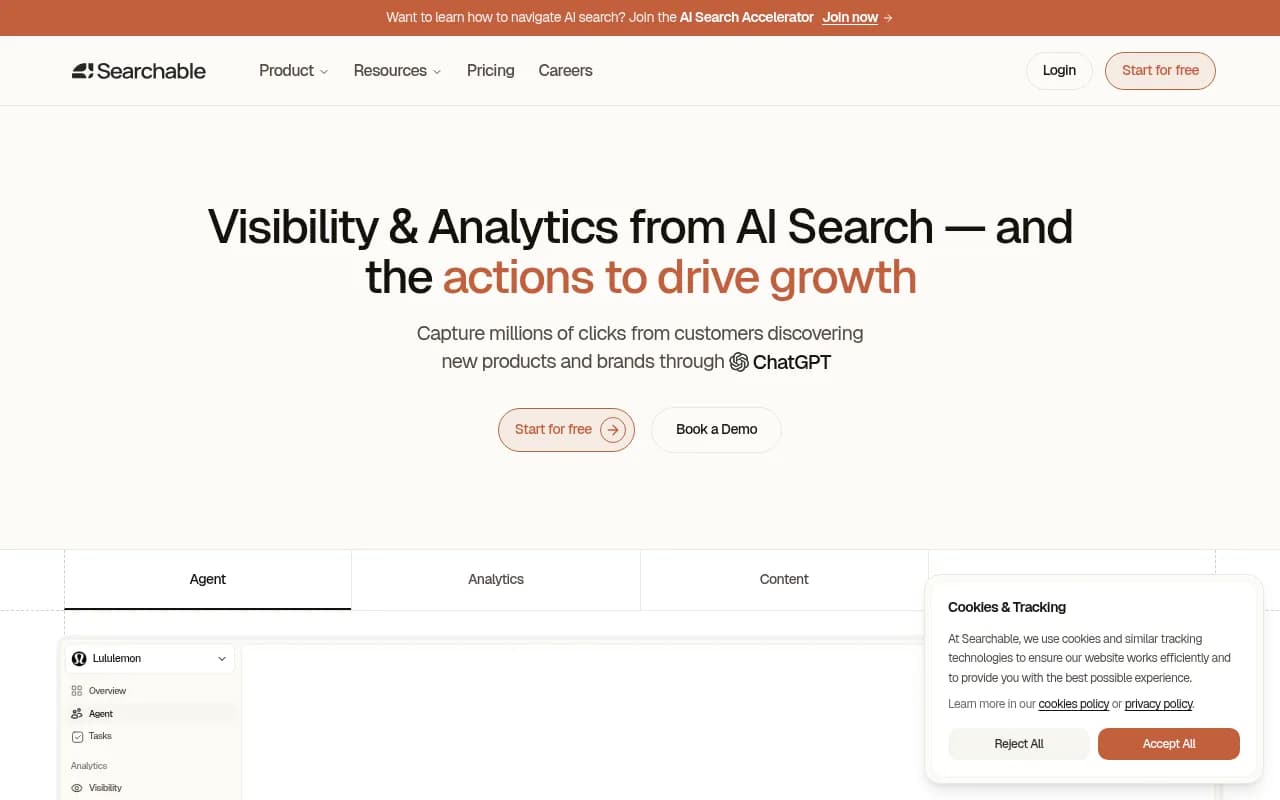
The content creation angle is the thing that sets Searchable apart from most tools in this price range. Most budget AI visibility tools are pure dashboards: you see your mention rate, your share of voice, maybe a sentiment score, and then you're on your own to figure out what to do about it. Searchable tries to close that loop by giving you tools to create content in response to what you're seeing.
That said, the content features are relatively basic compared to what you'd get from a purpose-built GEO platform. The briefs and suggestions are useful for teams just getting started, but they're not grounded in the kind of real prompt volume data or citation analysis that would tell you exactly which content gaps are worth prioritizing.
Model coverage at 7 is solid for the price. You're getting meaningful breadth -- enough to see whether your brand is appearing in ChatGPT vs. Perplexity vs. Gemini, and whether those patterns differ. That's genuinely useful information for a growing team.
Where Searchable is thinner: there's no crawler log data, no AI traffic attribution, and prompt tracking doesn't come with volume or difficulty scores. You can see that you're missing from a response, but you can't easily tell whether that prompt is asked by 500 people a month or 50,000.
What Rankshift does
Rankshift describes itself as an LLM tracking tool built specifically for GEO and AI visibility. It's designed for teams that want clean, focused monitoring without a lot of extra features getting in the way.
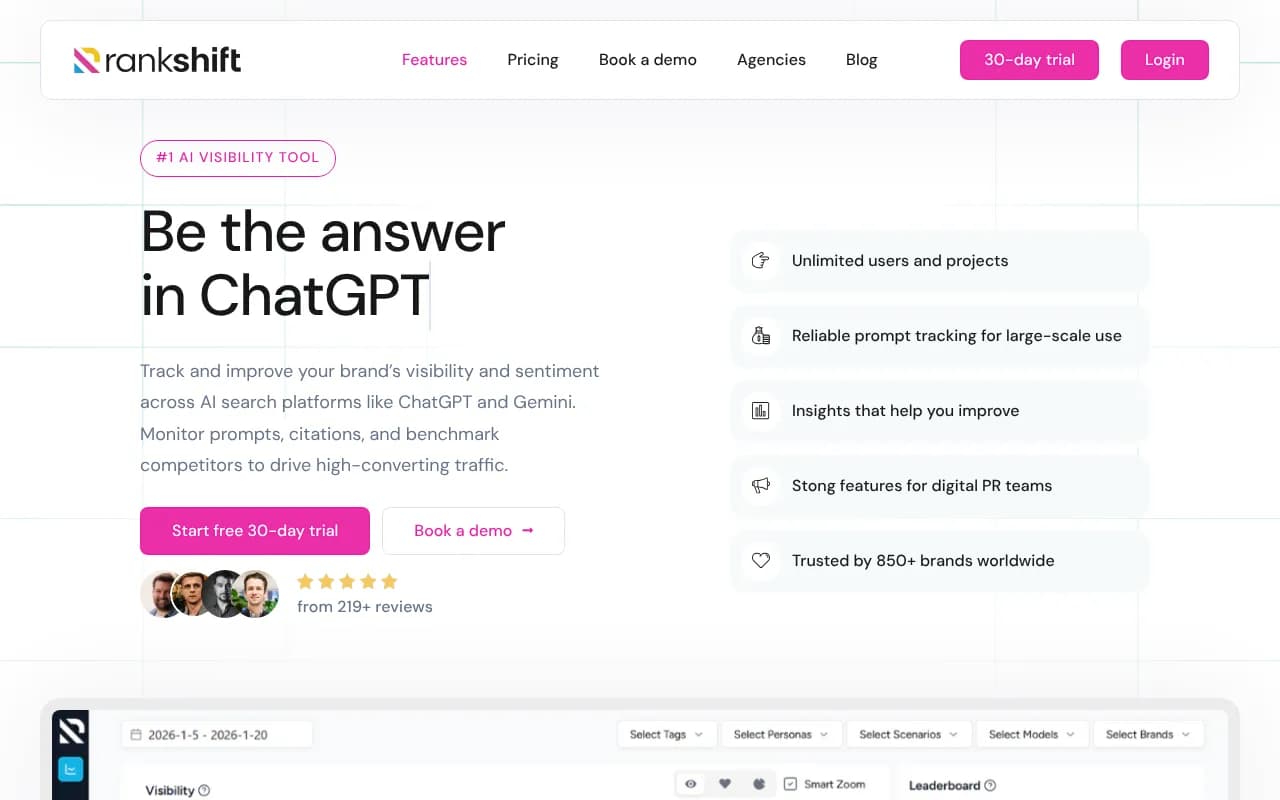
The interface is one of Rankshift's genuine strengths. Teams that have tried more complex platforms and found them overwhelming often appreciate that Rankshift surfaces the core metrics -- brand mention rate, share of voice, sentiment -- without burying them in configuration options.
Rankshift is a solid choice if your primary goal is to answer a simple question: "Is our brand showing up in AI answers, and how often?" For teams that are just starting to think about AI visibility and need to build a baseline before making bigger investments, that's a reasonable place to start.
The limitations become apparent when you want to go deeper. Rankshift is primarily a monitoring tool. There's no content generation, no gap analysis that tells you which topics competitors are winning that you're not, and no data on which specific pages are being cited by AI models. You get the "what" but not much of the "why" or "what to do next."
Head-to-head comparison
| Feature | Searchable | Rankshift |
|---|---|---|
| Starting price | $50/mo | Not publicly listed |
| AI models tracked | Up to 7 | LLM tracking (coverage varies) |
| Content creation tools | Yes (basic) | No |
| Answer gap analysis | Limited | No |
| Prompt volume data | No | No |
| Crawler / agent logs | No | No |
| AI traffic attribution | No | No |
| Sentiment tracking | Yes | Yes |
| Share of voice | Yes | Yes |
| Citation tracking | Basic | Basic |
| Reddit / YouTube insights | No | No |
| Multi-language support | Limited | Limited |
| Best for | Monitor + basic content creation | Clean monitoring dashboard |
Both tools are genuinely useful for teams that are new to AI visibility and need to establish a baseline. Neither is built for teams that want to move from monitoring to optimization at scale.
Where both tools fall short
This is worth being direct about: Searchable and Rankshift are monitoring tools with some optimization features layered on top. That's fine for certain use cases. But there are real gaps that matter as teams grow.
No prompt volume data. Knowing you're missing from a response is one thing. Knowing whether that prompt is high-volume or niche is what lets you prioritize. Neither tool gives you this, which means you're making content decisions without knowing the size of the opportunity.
No crawler logs. When AI models like ChatGPT or Perplexity crawl your site, they leave traces. Knowing which pages they read, how often they return, and whether they're encountering errors is genuinely useful for understanding why your content is or isn't being cited. Neither Searchable nor Rankshift surfaces this.
No AI traffic attribution. If your AI visibility improves, does that translate to more traffic? More conversions? Neither tool connects visibility metrics to actual business outcomes. That makes it hard to justify continued investment to stakeholders.
Limited competitive intelligence. Both tools show you your own brand's performance. Neither gives you a detailed view of which specific prompts competitors are winning that you're not -- the kind of gap analysis that would tell you exactly where to focus content efforts.
These aren't criticisms unique to Searchable and Rankshift. Most tools in this price range have the same gaps. But it's worth knowing what you're signing up for before you commit.
How they compare to the broader market
The AI visibility tool market in 2026 spans a wide range, from simple rank trackers at $29/month to enterprise platforms with custom pricing. Here's where Searchable and Rankshift sit relative to some of the other tools teams commonly evaluate:
| Tool | Price range | Model coverage | Content tools | Best for |
|---|---|---|---|---|
| Searchable | From $50/mo | Up to 7 models | Basic | Budget teams wanting monitor + create |
| Rankshift | Not listed | LLM tracking | None | Clean monitoring dashboard |
| Otterly.AI | From $29/mo | 4 models | None | Lowest entry price |
| Peec AI | From €85/mo | Up to 10 | None | Flexible model selection |
| SE Visible | From $99/mo | 5 models | None | Multi-brand monitoring |
| Profound | From $99/mo | Up to 10 (enterprise) | None | Enterprise prompt research |
| Promptwatch | From $99/mo | 10 models | Yes (AI content agents) | Full GEO optimization loop |


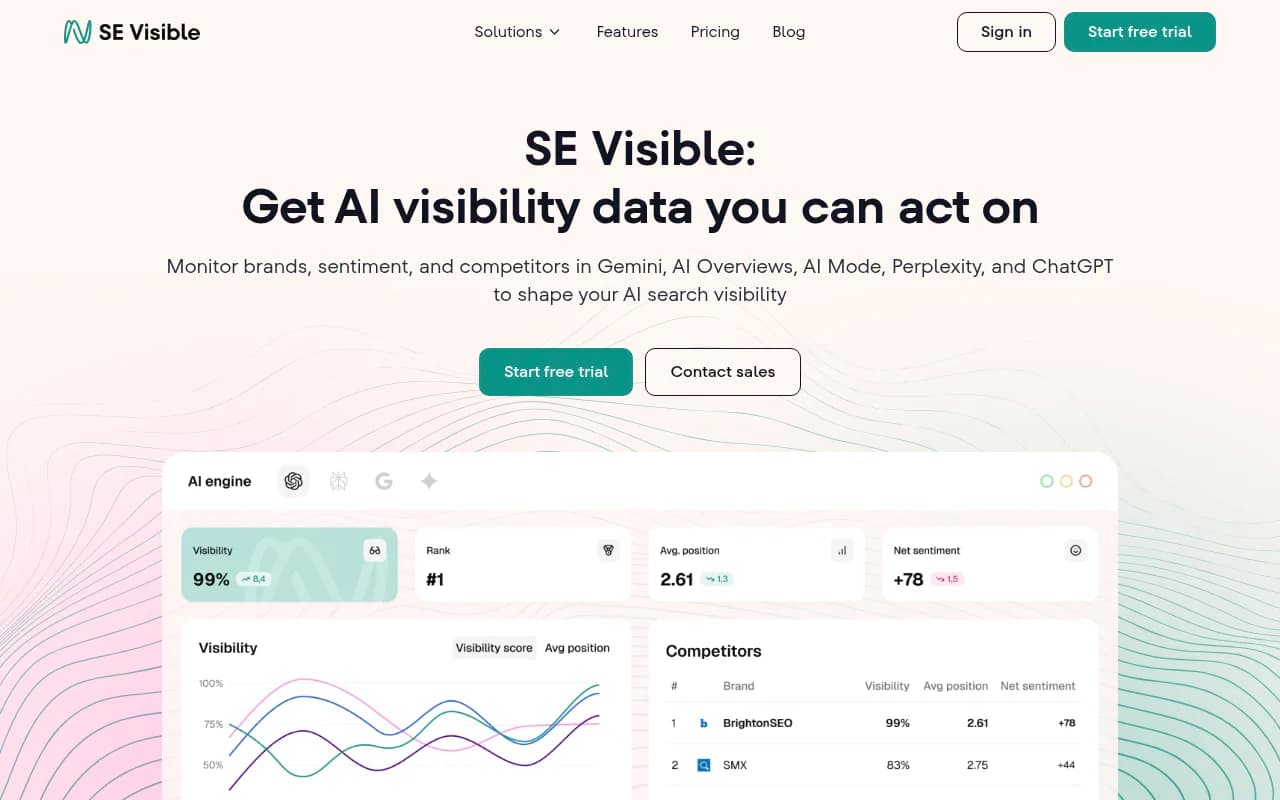

The pattern that emerges: most tools in the budget-to-mid-tier range are monitoring-only. Searchable is one of the few at this price point that tries to include content tools. Rankshift is a cleaner monitoring experience but doesn't try to help you act on what you find.
When Searchable makes sense
Searchable is a reasonable choice if:
- You're just starting to track AI visibility and need a low-cost entry point
- You want some content creation capability bundled in without paying for a separate tool
- Your team is small and doesn't need multi-seat access or complex reporting
- You're tracking a single brand across a handful of AI models and don't need deep competitive intelligence
It's not the right fit if you need prompt volume data, crawler logs, or the ability to connect AI visibility to revenue.
When Rankshift makes sense
Rankshift works well if:
- You want a focused, clean monitoring dashboard without feature bloat
- Your team is in the early stages of building an AI visibility practice and needs simple baselines
- You don't need content creation tools and prefer to handle that separately
- The interface simplicity is a genuine priority (this matters more than it sounds for teams with limited bandwidth)
It's not the right fit if you need to move beyond monitoring into optimization, or if you need detailed competitive gap analysis.
When to consider something more capable
Both Searchable and Rankshift are good starting points, but growing marketing teams often hit their limits within 6-12 months. The moment you start asking "why aren't we being cited?" or "what content should we create to fix this?" is the moment you need more than a monitoring dashboard.
Promptwatch is worth looking at when you reach that point. It's built around what it calls an action loop: find the gaps (Answer Gap Analysis shows exactly which prompts competitors are visible for that you're not), create content to address them (Content Agents generate articles grounded in real prompt data and citation analysis), and track the results (page-level tracking shows which pages are being cited, by which models, and how often). It also includes crawler logs that show when AI agents visit your site, which pages they read, and when those pages move from crawl to citation.

That's a meaningfully different proposition from a monitoring dashboard. It's also priced higher -- starting at $99/month for the Essential plan -- but for teams that are serious about improving their AI visibility rather than just measuring it, the gap in capability justifies the gap in price.
Other tools worth evaluating in the mid-tier and above:

The honest verdict
Searchable and Rankshift are both legitimate tools for growing marketing teams that need to start tracking AI visibility without a large budget. Searchable has the edge if you want content creation bundled in. Rankshift has the edge if you want a cleaner, simpler monitoring experience.
Neither is a long-term solution for teams that want to actually improve their AI visibility rather than just measure it. The monitoring-only approach tells you where you stand; it doesn't tell you how to move.
If you're evaluating tools right now, the most useful question to ask isn't "which dashboard looks better?" It's "what will I actually do with this data, and does this tool help me do it?" For many growing teams, the answer to that question points toward a platform that closes the loop between insight and action -- not just one that opens the dashboard.
Start with Searchable or Rankshift if budget is the primary constraint. Plan to revisit the decision when your team is ready to move from tracking to optimizing.