Key takeaways
- These four platforms cover a wide spectrum: from lightweight monitoring (Scrunch) to full-loop optimization (Promptwatch) to AI-native content publishing (Relixir) to enterprise-grade prompt intelligence (Profound).
- "AI visibility platform" is a broad label. Two tools can both claim it while doing fundamentally different things.
- Monitoring alone won't move the needle. If you can't act on what you're seeing, the data is just a dashboard you check and feel bad about.
- Promptwatch is the only platform here that closes the full loop: gap analysis, content generation, and traffic attribution in one place.
- Your best pick depends on team size, budget, and whether you need to understand your visibility or actually fix it.
AI search is no longer a trend worth watching. It's where buying decisions happen now. When someone asks ChatGPT to recommend a project management tool, a skincare brand, or a B2B software vendor, the brands that appear in those answers win the consideration. The ones that don't are invisible to a growing chunk of their potential customers.
That's pushed a whole category of tools into the spotlight: AI visibility platforms. But here's the problem -- the label covers an enormous range of products. Some are sophisticated monitoring dashboards. Some are content generation tools with a visibility angle bolted on. Some try to do everything. And some are genuinely useful for specific teams while being nearly useless for others.
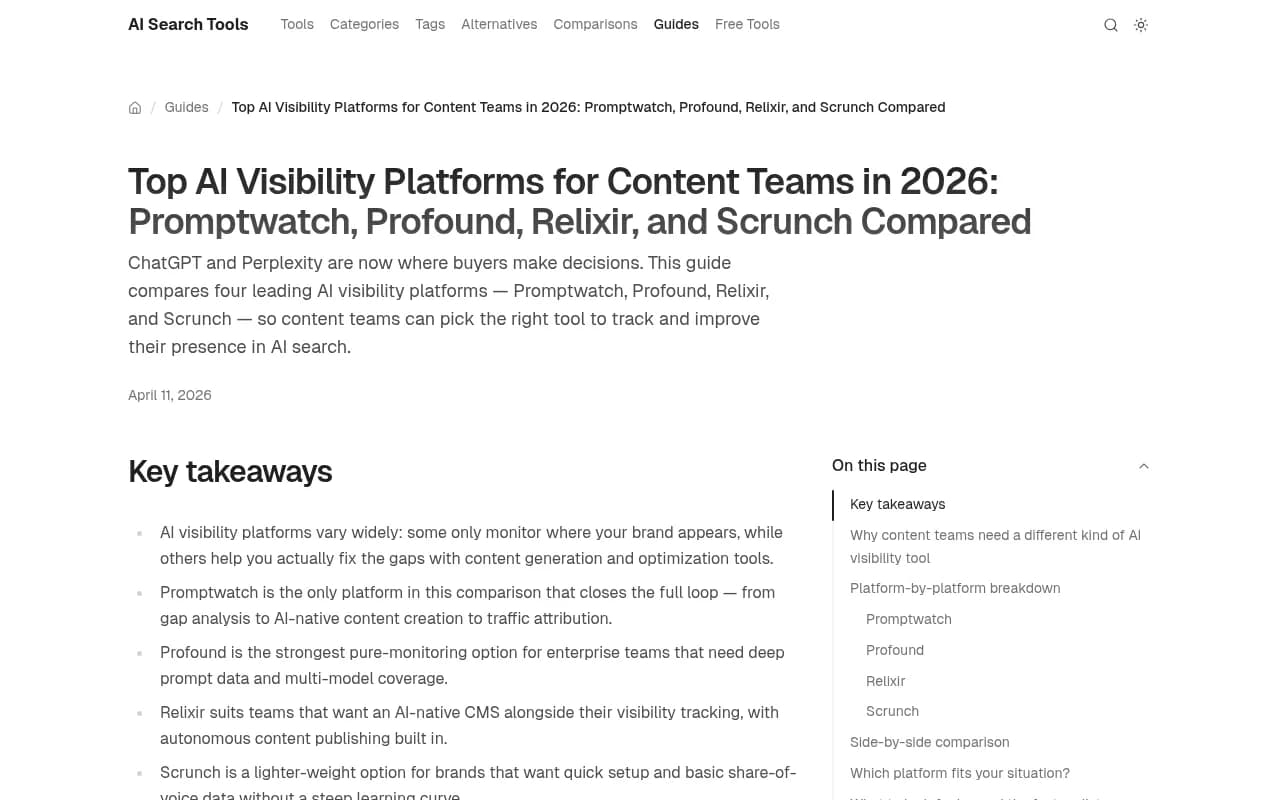
This guide focuses on four platforms that come up most often in 2026 evaluations: Profound, Promptwatch, Scrunch, and Relixir. I'll break down what each one actually does, who it's built for, and where it falls short.
What separates a good AI visibility tool from a mediocre one
Before getting into the individual platforms, it's worth being clear about what actually matters.
The basic capability -- querying AI models and checking whether your brand appears -- is table stakes. Any tool can do that. What separates useful platforms from expensive dashboards is what happens after you see the data.
Content teams, SEO managers, and growth marketers need to know:
- Which prompts are driving citations in their category, and what volume do those prompts get?
- What content is missing from their site that AI models are pulling from competitors instead?
- Which specific pages are being cited, and which are being ignored entirely?
- When they publish new content, does their visibility actually improve?
A tool that shows you "your share of voice is 14%" and stops there has told you something, but it hasn't helped you do anything. The platforms worth paying for are the ones that bridge monitoring and action.
With that framing, here's how the four compare.
Profound
Profound is the most enterprise-focused option in this comparison. It's built around deep prompt intelligence -- tracking how your brand appears across multiple AI models, with strong data on which prompts are driving citations and how that changes over time.

Where Profound genuinely excels is the depth of its monitoring data. It tracks a wide range of AI models, gives you prompt-level breakdowns, and is designed for teams that need to report on AI visibility to stakeholders who want to see numbers. If you're a large brand with a dedicated SEO or brand team and you need a reliable data layer, Profound is a serious option.
The limitation is that it stops at monitoring. Profound will show you where you're visible and where you're not. It won't tell you what content to create to fix the gaps, and it won't help you create it. For teams that have separate content workflows and just need the intelligence layer, that's fine. For teams that want to move from insight to action inside one platform, it's a gap.
Pricing sits at the higher end of the market, which makes it harder to justify for smaller teams or agencies managing multiple clients on tight margins.
Best for: Enterprise brand and SEO teams that need deep prompt monitoring and multi-model coverage, and have separate resources for content execution.
Scrunch
Scrunch (specifically Scrunch AI) is the lightest-weight option in this group. It's designed for brands that want to get started with AI visibility tracking quickly, without a steep onboarding process or a complex feature set to learn.
The core offering is share-of-voice monitoring across AI models -- you can see how often your brand appears relative to competitors, track changes over time, and get a basic sense of where you're winning and losing. Setup is fast, and the interface is clean enough that non-technical users can get value from it without much hand-holding.
The tradeoff is depth. Scrunch doesn't offer the prompt intelligence that Profound does, and it doesn't have content generation or gap analysis capabilities. It's a monitoring tool, and a fairly basic one. That's not a criticism -- it's a positioning choice. But if you're a content team trying to figure out what to write next to improve your AI citations, Scrunch won't tell you.
It works well as a first tool for teams just getting started with AI visibility, or for brands that need a simple way to show leadership that they're tracking this channel.
Best for: Smaller brands or teams new to AI visibility who want a quick, low-friction way to start monitoring without committing to a complex platform.
Relixir
Relixir takes a different approach entirely. Rather than positioning itself as a monitoring platform with some content features, it's built around autonomous content publishing. The idea is that Relixir doesn't just tell you what content to create -- it creates and publishes it for you, functioning as an AI-native CMS alongside the visibility tracking.
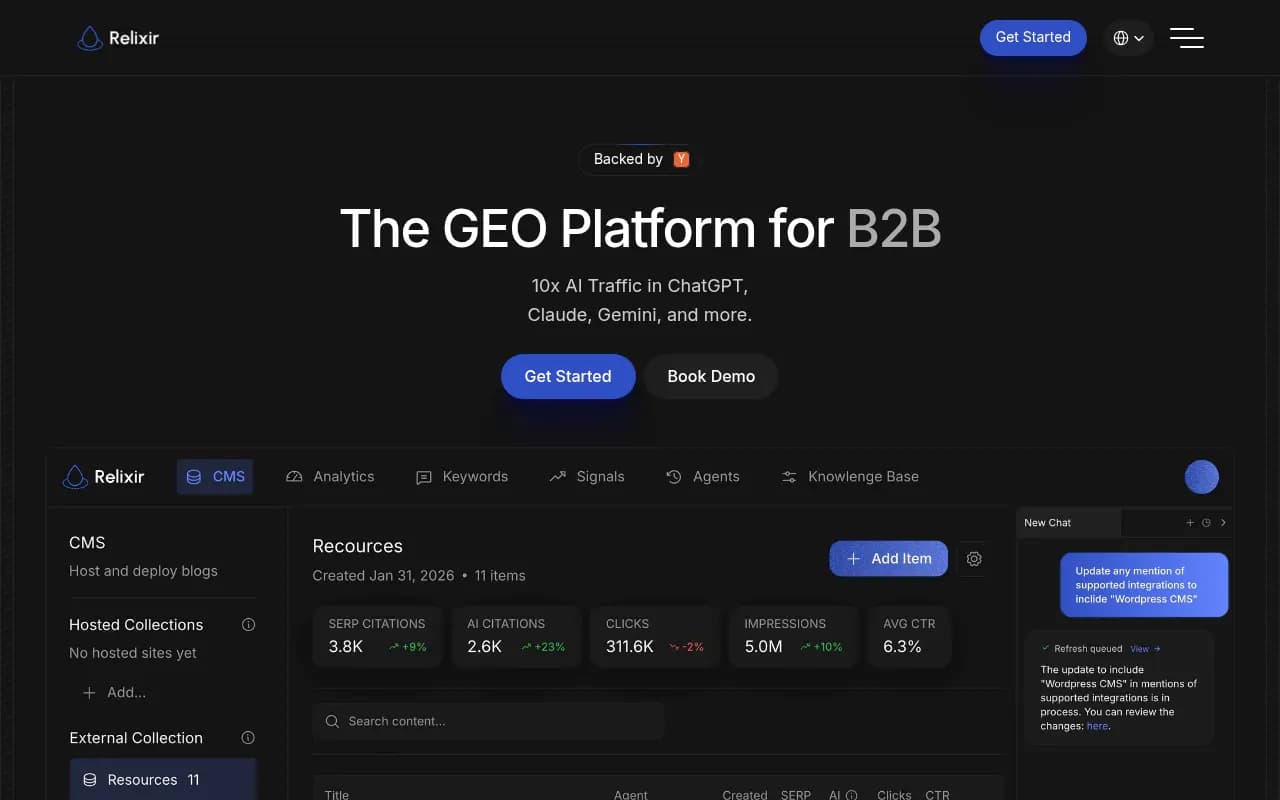
For teams that want to move fast and don't have a large content operation, that's genuinely appealing. You get visibility data and content execution in one place, and the autonomous publishing angle means you can scale content output without proportionally scaling headcount.
The question is how much control you want over what gets published. Autonomous publishing is powerful, but it requires trusting the platform's judgment on content quality, brand voice, and editorial decisions. Some teams are comfortable with that. Others -- especially in regulated industries or brands with strict editorial standards -- will find it uncomfortable.
Relixir also doesn't have the breadth of monitoring data that Profound offers, and its traffic attribution capabilities are more limited than Promptwatch's. It's a strong fit for a specific type of team, but it's not a universal solution.
Best for: Content teams that want AI-native content publishing alongside visibility tracking, and are comfortable with autonomous content workflows.
Promptwatch
Promptwatch is the platform that most directly addresses the full workflow a content or SEO team actually needs. It monitors AI visibility across 10 models (ChatGPT, Perplexity, Claude, Gemini, Google AI Overviews, DeepSeek, Grok, Copilot, Meta AI, and Mistral), but the monitoring is the starting point, not the end point.

The core differentiator is what Promptwatch calls the action loop:
- Find the gaps. Answer Gap Analysis shows exactly which prompts competitors are visible for that you're not. You see the specific topics and questions AI models want to answer but can't find on your site.
- Create content that gets cited. The built-in AI writing agent generates articles, comparisons, and listicles grounded in real citation data -- 880M+ citations analyzed. This isn't generic content; it's built to match what AI models actually cite.
- Track the results. Page-level tracking shows which pages are being cited, how often, and by which models. Traffic attribution (via code snippet, GSC integration, or server log analysis) connects visibility improvements to actual revenue.
Beyond the core loop, Promptwatch has capabilities that none of the other three platforms offer: real-time AI crawler logs that show which pages ChatGPT, Claude, and Perplexity are actually reading on your site; Reddit and YouTube citation tracking (because AI models pull heavily from those sources); ChatGPT Shopping monitoring; and prompt volume and difficulty scoring so you can prioritize which gaps to close first.
The pricing is transparent: Essential at $99/month (1 site, 50 prompts, 5 articles), Professional at $249/month (2 sites, 150 prompts, 15 articles, crawler logs), and Business at $579/month (5 sites, 350 prompts, 30 articles). There's a free trial available.
The main limitation worth acknowledging: the platform has more features than some teams will use, at least initially. If you genuinely only need basic monitoring and have no interest in content generation, you're paying for capabilities you won't touch. But for teams that want to actually improve their AI visibility rather than just measure it, the breadth is an asset.
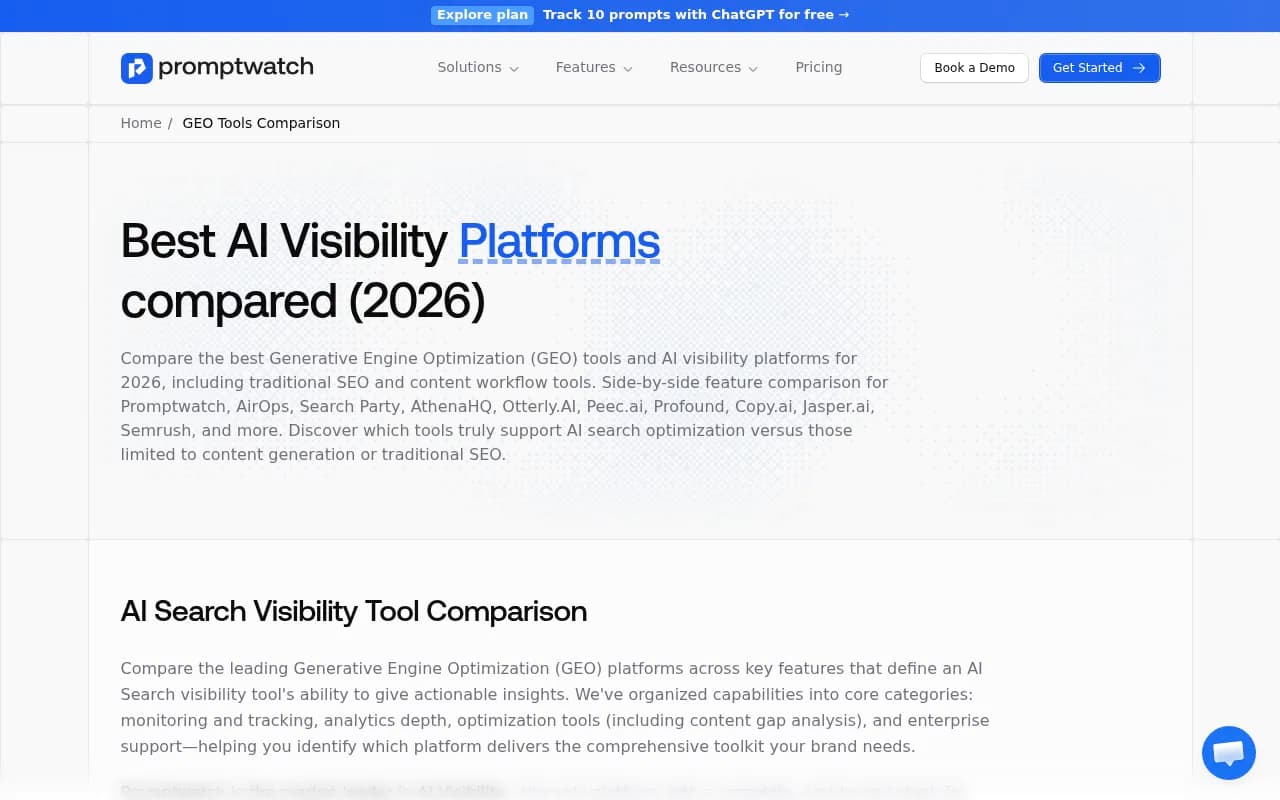
Best for: Marketing and SEO teams that want to move from monitoring to optimization -- find content gaps, generate content that gets cited, and track the revenue impact.
Side-by-side comparison
| Feature | Promptwatch | Profound | Scrunch | Relixir |
|---|---|---|---|---|
| AI models tracked | 10 | Multiple | Multiple | Multiple |
| Prompt volume & difficulty scoring | Yes | Partial | No | No |
| Answer gap analysis | Yes | No | No | Partial |
| AI content generation | Yes (built-in agent) | No | No | Yes (autonomous) |
| AI crawler logs | Yes | No | No | No |
| Reddit & YouTube citation tracking | Yes | No | No | No |
| ChatGPT Shopping tracking | Yes | No | No | No |
| Traffic attribution | Yes (3 methods) | Limited | No | Limited |
| Page-level citation tracking | Yes | No | No | No |
| Multi-language & multi-region | Yes | Yes | Limited | Limited |
| Starting price | $99/mo | Higher-end | Lower-end | Mid-range |
| Free trial | Yes | Yes | Yes | Yes |
| Best for | Full-loop optimization | Enterprise monitoring | Quick-start monitoring | Autonomous publishing |
How to choose
The honest answer is that the right platform depends on what you're actually trying to do.
If your goal is to understand your AI visibility at an enterprise level and you have a separate content team to act on the data, Profound is worth evaluating. The monitoring depth is real.
If you're just getting started and want to see whether AI visibility tracking is worth investing in before committing to a more complex tool, Scrunch is a reasonable entry point. Low friction, low cost, limited depth.
If you want to scale content output autonomously and you're comfortable with AI-driven publishing decisions, Relixir has a genuinely interesting approach. Just go in with clear expectations about editorial control.
If you want to close the full loop -- understand where you're invisible, create content that fixes it, and measure the revenue impact -- Promptwatch is the most complete option available. The fact that it combines gap analysis, content generation, crawler logs, and traffic attribution in one platform means you're not stitching together three different tools to do what one should do.
The category is moving fast. Six months from now, some of these platforms will have closed feature gaps. But right now, in mid-2026, the gap between monitoring-only tools and full-loop optimization platforms is significant. If you're serious about AI visibility as a growth channel, that gap matters.
Other tools worth knowing about
These four aren't the only options in the market. A few others worth a look depending on your specific needs:
For enterprise SEO teams already in the Semrush ecosystem:
Semrush has added AI visibility features, though they use fixed prompts rather than custom tracking. Useful if you want AI monitoring alongside your existing SEO workflow without adding another vendor.
For teams that want monitoring without the complexity:

Otterly.AI is a lightweight monitoring tool with a clean interface. Good for teams that want basic share-of-voice data and aren't ready for a full optimization platform.

Peec.ai is worth a look for teams with multi-language needs -- it has solid international coverage that some of the larger platforms don't match.
For agencies managing multiple clients:
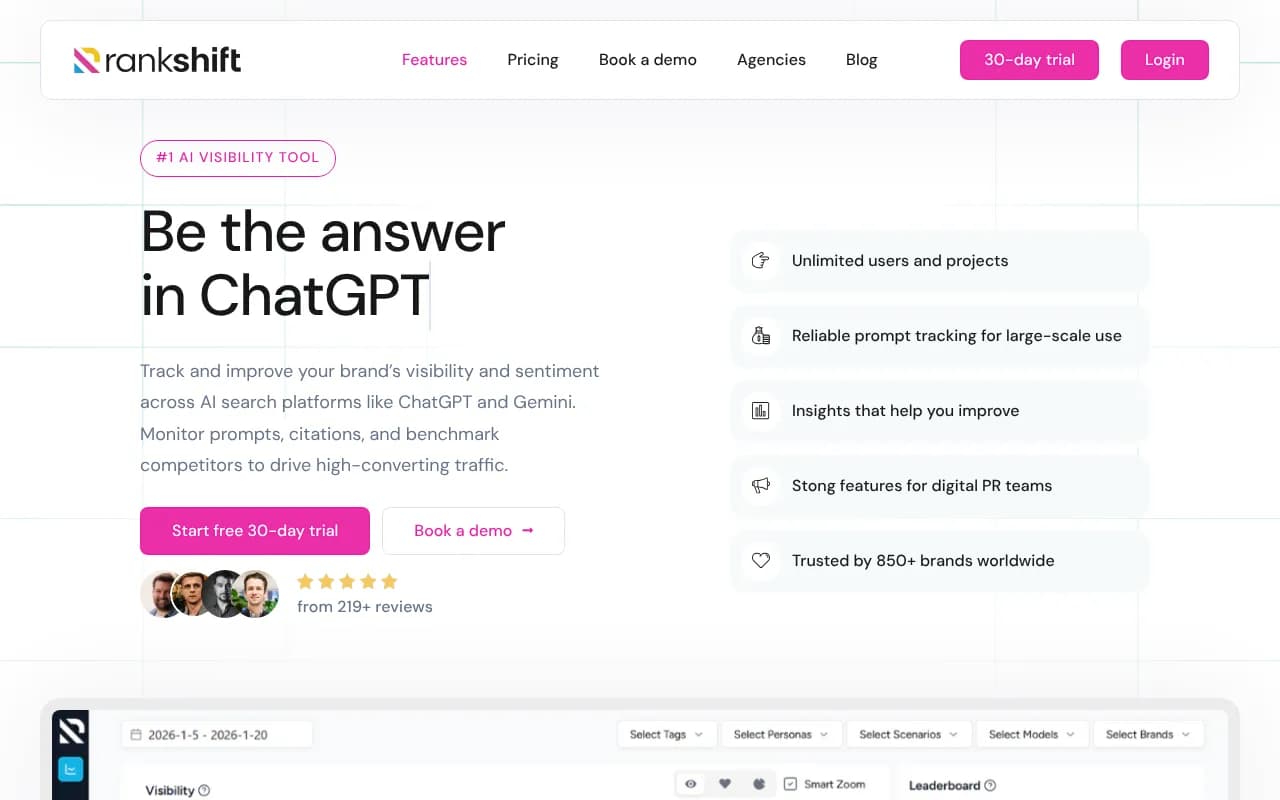
Rankshift is built with agency workflows in mind and handles multi-client reporting reasonably well, though it lacks the content generation capabilities of Promptwatch.
The bottom line: the platforms that just monitor are becoming table stakes. The ones that help you act on what you find are where the real value is.