Key takeaways
- Profound's pricing jumps fast: $99/mo covers ChatGPT only, and full multi-model coverage requires enterprise pricing that's not publicly listed
- Small businesses need tools that track multiple AI models, surface actionable gaps, and ideally help create content — not just dashboards
- Several solid alternatives exist under $100-$250/mo with broader model coverage than Profound's lower tiers
- The best picks go beyond monitoring: they help you understand why you're not being cited and what to do about it
- Promptwatch is the only platform in this comparison rated as a "Leader" across all GEO categories, with content generation built into the core workflow
Here's the thing about Profound: it's genuinely good. Real-user prompt volume data, front-end response capture, an Amazon Rufus module that competitors haven't caught up to. If you're a mid-market or enterprise brand with a dedicated SEO team and a budget to match, it's a reasonable choice.
But if you're a small business, you're going to hit a wall fast.
The Starter plan at $99/mo only covers ChatGPT. Want Perplexity and Google AI Overviews? That's $399/mo. Want Claude, Gemini, Grok, and the rest? You're looking at enterprise pricing that isn't even published. And at the Growth tier, you're still capped at 100 tracked prompts with only 3 user seats.
For a small marketing team trying to figure out why ChatGPT isn't recommending their product, that's a lot of money to spend before you even get the full picture.
The good news: the AI visibility space has grown up quickly. There are now tools that give you multi-model tracking, content gap analysis, and even content generation at a fraction of Profound's cost. Here are seven worth your time.
What to look for in a Profound alternative
Before diving into specific tools, it's worth being clear about what actually matters for a small business.
Prompt coverage is the obvious one: how many AI models does the tool track? ChatGPT alone isn't enough in 2026. Your customers are using Perplexity, Google AI Overviews, Gemini, and increasingly Claude. You need visibility across all of them.
But model count is table stakes. The more important question is: what do you do with the data? A lot of tools in this space are monitoring dashboards. They show you a score, maybe a chart of how your visibility has changed over time, and then leave you to figure out the rest. That's fine if you have a content strategist who knows what to do next. Most small businesses don't.
The tools worth paying for in 2026 are the ones that close the loop: they show you where you're invisible, tell you why, and help you create the content that fixes it.
Also worth checking: does the tool track real user-facing AI responses, or does it query APIs? The answers can differ meaningfully. User-facing responses include citations, shopping carousels, and follow-up suggestions that API outputs often omit.
The 7 best Profound alternatives for small businesses
1. Promptwatch
Promptwatch is the most complete option on this list, and the one most directly comparable to Profound in terms of depth — but it's built around a fundamentally different philosophy. Where Profound (and most competitors) are monitoring tools, Promptwatch is built around an action loop: find gaps, create content, track results.

The Answer Gap Analysis shows you exactly which prompts your competitors are visible for that you're not. Not just "you're missing coverage in this topic area" — it shows the specific questions AI models are already answering for your competitors, so you know precisely what content to create.
Then there are Content Agents that generate articles, listicles, and comparisons grounded in that prompt data. This isn't generic AI writing — it's content engineered around the actual gaps AI models are exposing on your site.
On the tracking side, Promptwatch monitors 10 AI models including ChatGPT, Perplexity, Google AI Overviews, Google AI Mode, Claude, Gemini, Meta/Llama, DeepSeek, Grok, and Copilot. It also has AI Crawler Logs that show you in real time which pages AI crawlers are reading, what errors they're hitting, and when a page moves from "crawled" to "cited." Most competitors don't have anything like this.
Pricing starts at $99/mo for the Essential plan (1 site, 50 prompts, 5 articles), $249/mo for Professional (2 sites, 150 prompts, 15 articles, crawler logs), and $579/mo for Business. For a small business, the Essential plan is a reasonable starting point, and the Professional plan is genuinely competitive with what Profound charges just for multi-model coverage.
Used by 1,480+ brands including Booking.com and Center Parcs. Free trial available.
2. Otterly.AI
Otterly.AI sits at the bottom of the price ladder at $29/mo for the Lite tier, which makes it the most accessible entry point in the category. It covers ChatGPT, Perplexity, and Google AI Overviews — three of the most important channels for most small businesses.

It's a monitoring tool, not an optimization platform. You get visibility scores, mention tracking, and competitor comparisons, but you won't find content gap analysis or content generation here. That's fine if you already have a content team that can act on the data. If you need the tool to help you figure out what to do next, you'll hit its limits quickly.
Still, for a small business that just wants to start tracking AI visibility without committing to a significant monthly spend, Otterly is a sensible first step.
3. Peec AI
Peec AI is worth considering if you operate in multiple markets or languages. Its multi-language tracking is more developed than most tools in this price range, and it covers the major AI models including ChatGPT, Perplexity, and Google AI Overviews.

Like Otterly, it's primarily a monitoring tool. The dashboards are clean and the competitor comparison features are useful for understanding share of voice across AI models. But there's no content generation, no crawler logs, and no traffic attribution connecting AI visibility to actual revenue.
For international small businesses or agencies with multilingual clients, Peec is one of the better options at this price point.
4. SE Ranking
SE Ranking takes a different approach: it's an all-in-one SEO platform that has added AI visibility tracking as part of a broader toolkit. If you're already paying for SEO software and want to add AI monitoring without adding another subscription, this is worth looking at.
The AI visibility features cover Google AI Overviews and some LLM tracking, though the depth isn't comparable to dedicated GEO tools. Where SE Ranking shines is the combination: keyword tracking, site audits, backlink analysis, and AI visibility in one place. For a small business that can't justify multiple tool subscriptions, that consolidation has real value.
The trade-off is that you're getting a generalist's take on AI visibility rather than a specialist's. If AI search is your primary concern, a dedicated tool will serve you better.
5. Scrunch AI
Scrunch AI is positioned as an enterprise-grade alternative, but its pricing is more accessible than Profound's for teams that want structured AI monitoring. It covers multiple AI models and offers competitor benchmarking and share-of-voice analysis.
The interface is clean and the reporting is solid. It's a good fit for small businesses that have outgrown basic monitoring tools but aren't ready for a full enterprise platform. Like most tools in this space, it's primarily a monitoring dashboard — you get the data, but the "what do I do about it" question is left to you.
6. LLM Pulse
LLM Pulse focuses specifically on tracking how AI models respond to prompts about your brand and category. It's a narrower tool than most on this list, but that focus means the tracking data tends to be detailed and reliable.
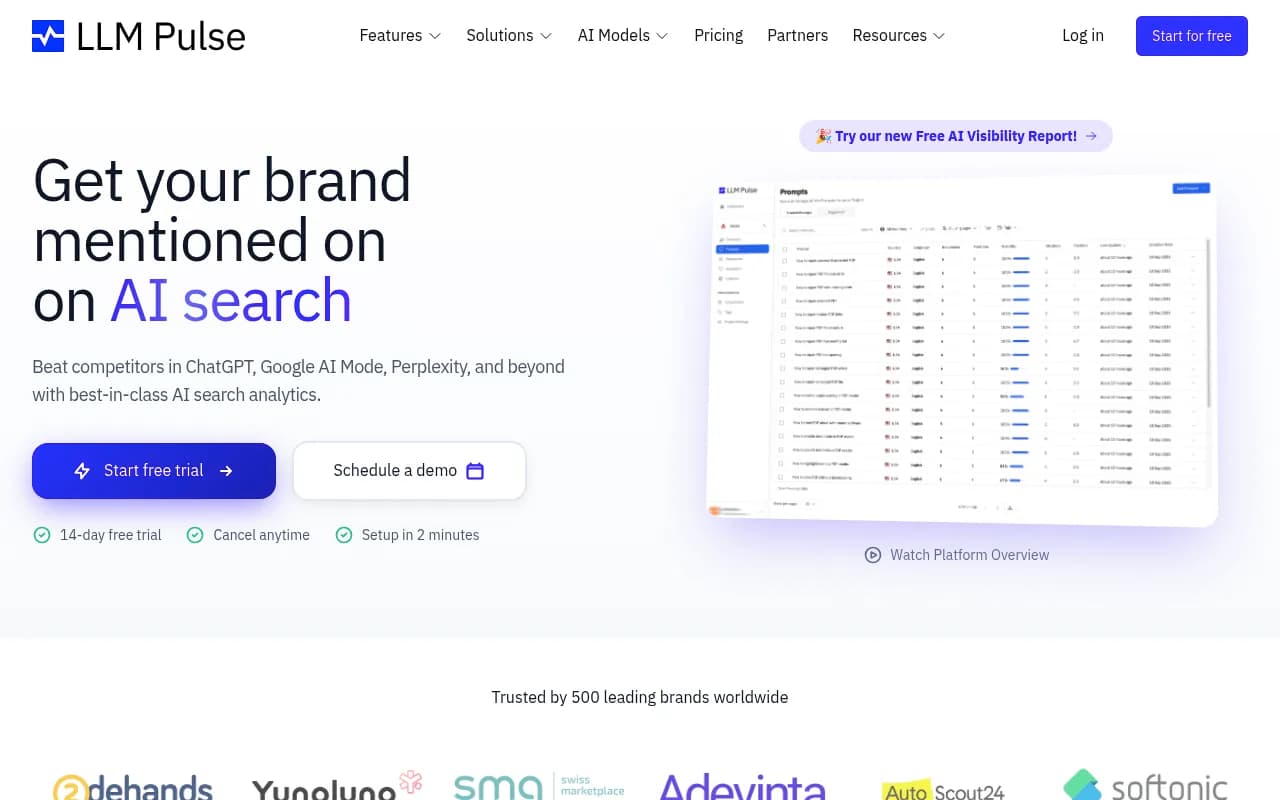
It covers multiple LLMs and gives you response-level data: not just whether you were mentioned, but how you were described, what context surrounded the mention, and how that changes over time. For small businesses that want to understand the quality of their AI mentions (not just the quantity), this level of detail is useful.
Pricing is more accessible than Profound's full-featured tiers, though it lacks content generation and crawler analytics.
7. AthenaHQ
AthenaHQ tracks your brand's visibility across 8+ AI search engines and gives you competitive benchmarking against other brands in your space. It's one of the more polished monitoring tools in the mid-market, with a clean interface and solid prompt management.

The limitation is the same one that affects most monitoring-focused tools: it shows you the data but doesn't help you act on it. There's no content gap analysis, no content generation, and no crawler logs. For a small business that wants a clear picture of where they stand in AI search, AthenaHQ delivers. For a business that wants to actually improve that picture, you'll need to pair it with other tools.
Side-by-side comparison
| Tool | Starting price | Models tracked | Content generation | Crawler logs | Best for |
|---|---|---|---|---|---|
| Profound | $99/mo (ChatGPT only) | 1 on Starter, more on higher tiers | No | No | Enterprise teams with budget |
| Promptwatch | $99/mo | 10 models | Yes | Yes (Professional+) | Small businesses wanting full action loop |
| Otterly.AI | $29/mo | 3 models | No | No | Budget-conscious first-timers |
| Peec AI | Mid-range | Multiple | No | No | Multilingual/international teams |
| SE Ranking | Varies | Google AIO + some LLMs | No | No | Teams wanting SEO + AI in one tool |
| Scrunch AI | Mid-range | Multiple | No | No | Structured monitoring without enterprise cost |
| LLM Pulse | Mid-range | Multiple | No | No | Response quality analysis |
| AthenaHQ | Mid-range | 8+ | No | No | Polished monitoring dashboards |
The pattern is hard to miss: most tools in this space are monitoring dashboards. They show you data. Promptwatch is the outlier that actually helps you do something with it.
How to choose the right tool for your situation
The right choice depends on where you are right now.
If you're just starting out and want to understand whether AI search is even relevant to your business, Otterly.AI at $29/mo is a low-risk way to find out. Run it for a month, see what the data shows, and decide if you need to go deeper.
If you already know AI visibility matters and you want to actually improve it, not just measure it, Promptwatch is the most complete option at a price point that works for small businesses. The Essential plan at $99/mo gives you 50 prompts, 5 articles per month, and coverage across 10 AI models. That's more model coverage than Profound's $399/mo Growth plan.
If you're running an international business or managing multilingual content, Peec AI is worth evaluating specifically for its multi-language capabilities.
If you're already paying for SE Ranking or a similar all-in-one SEO platform, check whether their AI visibility features are sufficient before adding a dedicated tool. You might not need both.
One thing to avoid: don't pick a tool based on the dashboard alone. The question to ask is "what do I do when I see this data?" If the tool can't help you answer that, you're paying for a report, not a solution.
The monitoring-only trap
This is worth saying directly: a lot of small businesses buy an AI visibility tool, look at their score, feel bad about it, and then don't know what to do next. The tool has done its job (it showed you the data) but you're no closer to actually improving your AI visibility.
The reason most tools stop at monitoring is that content generation and optimization are genuinely hard to build. It's much easier to build a dashboard that queries AI models and displays the results than it is to build a system that analyzes gaps, understands what AI models want to see, and generates content that actually gets cited.
That's why the tools that go beyond monitoring tend to be more expensive. But for a small business, the ROI calculation is different than for an enterprise. If a $99/mo tool helps you create content that gets you cited in ChatGPT responses for your key product category, that's potentially worth far more than the subscription cost. A $29/mo monitoring tool that tells you you're invisible but doesn't help you fix it is a sunk cost.
The research from Promptwatch's dataset of 4.5 billion+ citations and prompts consistently shows that brands that create content specifically targeting AI answer gaps see measurable visibility improvements within weeks of publishing. That's the kind of outcome worth optimizing for.
Bottom line
Profound is a strong product, but its pricing structure makes it a poor fit for most small businesses. You're paying $99/mo for single-model coverage, and multi-model coverage costs four times that before you even get to enterprise features.
The alternatives here range from $29/mo monitoring tools to full-stack optimization platforms. For most small businesses that are serious about AI visibility, the right answer is somewhere in the middle: a tool that covers the major AI models, surfaces content gaps, and ideally helps you create the content that fills them.
Promptwatch fits that description at a price point that's actually competitive with Profound's limited lower tiers. The free trial is worth using to see how your current AI visibility stacks up before committing to anything.