Key takeaways
- A brand hallucination is a confident answer that is false, incomplete, or outdated: wrong pricing, wrong founder, a product you discontinued, a partnership that never existed.
- Audit every assistant separately, in fresh sessions, with a fixed set of 12-15 factual questions. Meta AI deserves a spot on the list now that Meta is crawling the web heavily.
- Most hallucinations trace back to a source you can fix: a stale pricing page, an old listicle, a wrong Wikidata entry, or a Reddit thread. Pure model inventions are rarer and harder to correct.
- Fix the source, then re-test on a schedule. Answers drift as models and indexes update.
- Manual audits work for a small brand. Past a few dozen prompts, a monitoring tool saves real time.
What a brand hallucination actually looks like
A search engine gives you ten links and lets you judge them. An assistant gives you one fluent paragraph with no obvious way to interrogate it. That is why a wrong claim hurts more. A buyer reads "starts at $149" when your price is $299, and you never hear about the lost deal.
The common types, roughly in order of how much they cost you:
| Type | Example | Severity |
|---|---|---|
| Wrong availability | "No longer sold" when you still ship | Critical, hits revenue |
| Wrong pricing | "Starts at $149" vs. actual $299 | High, shapes purchase intent |
| Wrong category | "Acme is a software company" when it makes hardware | High, hurts positioning |
| Wrong leadership or founding facts | Wrong founder or year | High, hurts credibility |
| Fabricated affiliations | A partnership that does not exist | High, legal exposure |
| Wrong feature | Bluetooth 4.0 when the product has 5.3 | Medium |
| Outdated facts | Old model versions, old team | Low to medium |
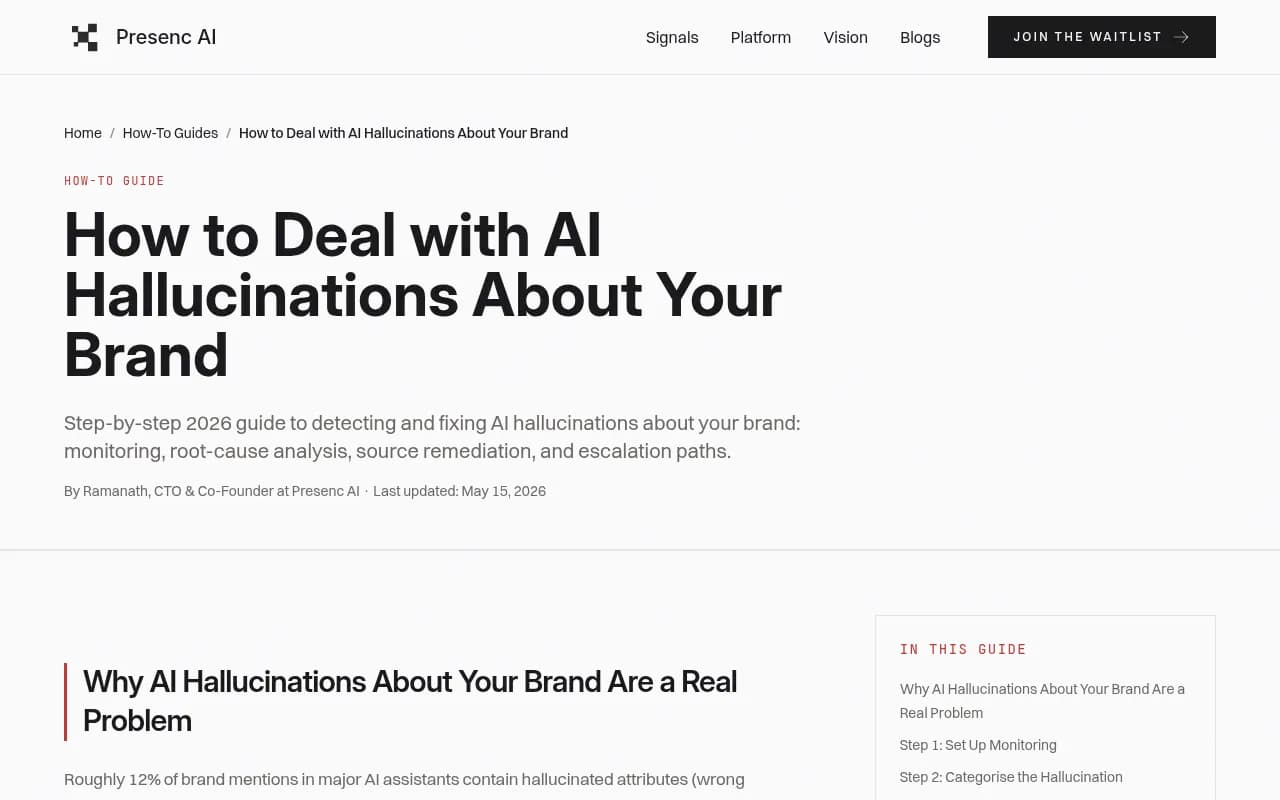
This table follows the categorization in Presenc AI's 2026 hallucination guide, which also claims roughly 12% of brand mentions in major assistants contain a hallucinated attribute. That is a vendor figure, not an independent study, so treat it as a ballpark. The categories are useful regardless of the exact rate.
Why assistants get your brand wrong
There are four usual causes.
- Training cutoff. Anything you changed after the model's cutoff is invisible unless the assistant retrieves live web data. Even then it may lean on what it already "knows".
- Stale third-party pages. A 2023 review or listicle still ranks, still gets retrieved, and still says your old pricing.
- Messy entity data. A confused Wikipedia article or an incorrect Wikidata entry (wrong founder, wrong year) gets repeated everywhere.
- Thin citation slots. Promptwatch's data on sources per response (published September 2025, so check for newer numbers) showed ChatGPT citing about 5 sources per web-search answer, while Google AI Overviews and Perplexity cite about 10. With five slots, one wrong page can shape the entire answer. The slot count differs by engine, which is another reason to audit each one on its own.
There is also the pure invention case, where the model has no source at all and makes something up. You cannot fix that by editing a page. You can only make the correct facts so consistent and so easy to retrieve that the model has less room to guess.
Why Meta AI needs its own check
Meta AI is easy to forget because it does not show up in most SEO dashboards. That is changing. According to Promptwatch Data's report on Meta's crawling, Meta-WebIndexer made up about 2.2% of tracked AI crawler requests in mid-July 2026 and 37.8% by August 9, 2026. That is roughly a 17x jump in under a month, and it made Meta-WebIndexer the heaviest AI crawler in Promptwatch's logs.
The report says the surge matches talk that Meta is building its own web index so Meta AI does not depend on Google or Bing. Meta has not confirmed that. The source is a secondhand claim, posted on X on August 6, 2026, so hold it loosely. What the logs do show is real crawl volume from an indexing bot built to improve Meta AI search results and cite sources.
Practical consequences:
- Check your server logs and robots.txt for
meta-webindexer,meta-externalagent,meta-externalfetcher, andFacebookBot. - If you block these crawlers, you may keep your content out of Meta's index, and Meta AI will answer about you from whatever else it can find.
- Budget for sustained crawl load if you let them in.
I could not find a public report on Meta AI hallucination rates or a dedicated correction channel for brands, so I will not pretend one exists. For Meta AI, the realistic lever is the same as everywhere else: fix the sources it can retrieve.
Step 1: Build a question set with known answers
Write 12-15 factual questions where you already know the right answer. Cover:
- What does [brand] do?
- How much does [brand] cost?
- Who founded [brand], and when?
- Where is [brand] based?
- What features does [brand] have?
- Who is [brand] for?
- Is [product] still available?
- How does [brand] compare to [competitor]?
- What are [brand]'s integrations or partners?
Add a few category questions too, such as "best [category] tools for [use case]". Those reveal whether you are named at all, which is a different problem from being described wrongly.
Step 2: Ask every assistant, in fresh sessions
Run the full set in Meta AI, ChatGPT, Gemini, Perplexity, Claude, and Google AI Overviews. Use a new session each time so earlier context does not bias the answer. Save responses verbatim, with the date. A spreadsheet is fine.
Two habits that save pain later:
- Ask the same question two or three times. Answers vary run to run, and a one-off error is different from a consistent one.
- Ask from the countries and languages that matter to you. Regional answers can differ.
For general-purpose assistants you can test by hand, the catalog includes Gemini and Claude.
Step 3: Mark every claim and categorize the error
Go response by response and mark each factual claim correct, incorrect, or unverifiable. Tag errors with the categories from the table above. Patterns show up quickly. If five assistants all say the wrong price, you have a source problem. If only one invents a partnership, it is likelier a model quirk.
Signs of a fabrication, even when you do not know the right answer:
- Statistics with no source
- Citations that do not exist or do not say what is claimed
- Overly vague answers that dodge specifics
- Confident detail on something obscure, like an exact founding date nobody publishes
Step 4: Trace each error to its source
For assistants that show citations (Perplexity, ChatGPT with search, AI Overviews), open them. For ones that do not, ask "show me your sources" and inspect what comes back. The culprit is usually one of these:
- Your own outdated page, often pricing or an old product page
- A stale review, profile, or listicle from a couple of years ago
- A mismatched Wikipedia article
- A wrong Wikidata entity
- A forum or Reddit thread that got amplified through repetition
- Nothing at all, a pure model invention
One caution on Reddit. Promptwatch Data found that reddit.com's share of ChatGPT citations fell from about 4% to 0.5% on August 14, 2026, while AI Overviews and AI Mode declined more gradually. And in the week of Sep 28 to Oct 4, 2026, ChatGPT drew 0.46% of its citations from social platforms while Google AI Overviews drew 12.2%. So a bad forum thread matters a lot more for Google's surfaces than for ChatGPT right now.
Step 5: Fix the source, not the symptom
You cannot edit an assistant's answer. You can edit what it reads.
Your own pages
- Update stale pricing, feature, and about pages, and put a visible "last updated" date on them.
- State the key facts in plain sentences near the top: what you do, who it is for, what it costs, where you are based, who founded it.
- Add structured data (Organization, Product, Offer) so the facts are machine-readable and consistent with the visible copy.
- Keep the same facts everywhere: homepage, about page, press kit, social bios, directory profiles.
Third-party pages
- Contact the publisher of the stale review or listicle and send the corrected facts. Many will update; some will not.
- Fix your profiles on directories and review sites. Promptwatch's software citation data (Sep 28 to Oct 4, 2026) shows G2 among the top ChatGPT sources for software prompts, so these profiles are worth the time.
- Correct Wikipedia and Wikidata through their normal editing and sourcing rules. Cite independent sources, and do not edit your own entry in bad faith.
Crawl access
Check that the assistants can actually read your corrected pages. If a crawler is blocked or hits errors, it falls back to whatever stale copy it already has. A crawler-log tool such as DarkVisitors can show which AI agents visit.
Content types that last
Promptwatch's content half-life report found that landing pages and docs stayed cited longest among pages ChatGPT cited on July 6, 2026, while news lost half its pages within 36 days. A clear, durable landing page and docs make better anchors for your facts than a press release.
Step 6: Re-test and keep a log
After publishing fixes, wait a few weeks, then rerun the same question set. Compare against your previous log. Do this monthly. Answers drift when models update, and fixes do not always stick.
A simple tracking sheet:
| Date | Assistant | Question | Claim | Correct? | Error type | Source found | Fix shipped |
|---|
When to use a tool instead of a spreadsheet
The manual method works for one brand and a dozen questions. It gets old when you have multiple products, markets, or languages. Dedicated tools run structured prompts on a schedule, compare answers against known facts, and flag differences.
A few options from our catalog, with honest caveats:
| Tool | Good for | Limitation to know |
|---|---|---|
| Promptwatch | Monitoring plus fixing: tracks real assistant UIs including Meta AI, shows crawler logs and cited sources, then helps publish corrections | More than you need if you only want a monthly spot check |
| Otterly.AI | Affordable prompt tracking | Monitoring only |
| Peec AI | Multi-language tracking | Monitoring only |
| Profound | Enterprise visibility tracking | Higher price point |
| Brand24 | General brand mention monitoring | Not built around AI answers |
Promptwatch is the one I would reach for when the goal is correcting the problem rather than just logging it. It monitors the actual interfaces of ChatGPT, Gemini, Perplexity, Meta AI and others, shows which pages get cited, and its IP-verified crawler logs tell you whether the bots even reach your corrected page. The Content Agent and Action Board then help you ship the fixes and check whether they worked.




If you want to compare more options, the GEO software directory at bestgeosoftware.com lists a wider set.
What not to do
- Do not spam assistants with corrective prompts. It does not retrain anything.
- Do not assume one assistant's answer represents all of them.
- Do not treat an AI error as only a PR problem. Pricing and availability errors are content problems you can fix with a page edit.
- Do not block AI crawlers broadly without checking what you lose. Blocking Meta's bots, for example, may remove you from Meta AI's index.
A realistic expectation
You will not get hallucinations to zero. Models are probabilistic, and some answers will always be a little off. The goal is narrower: make sure the high-severity facts (price, availability, category, founder) are right across the assistants your buyers use, and catch regressions fast. Start with the ten questions that would hurt most if answered wrongly, run them this week in Meta AI and four other assistants, and fix the first source you find.