Key takeaways
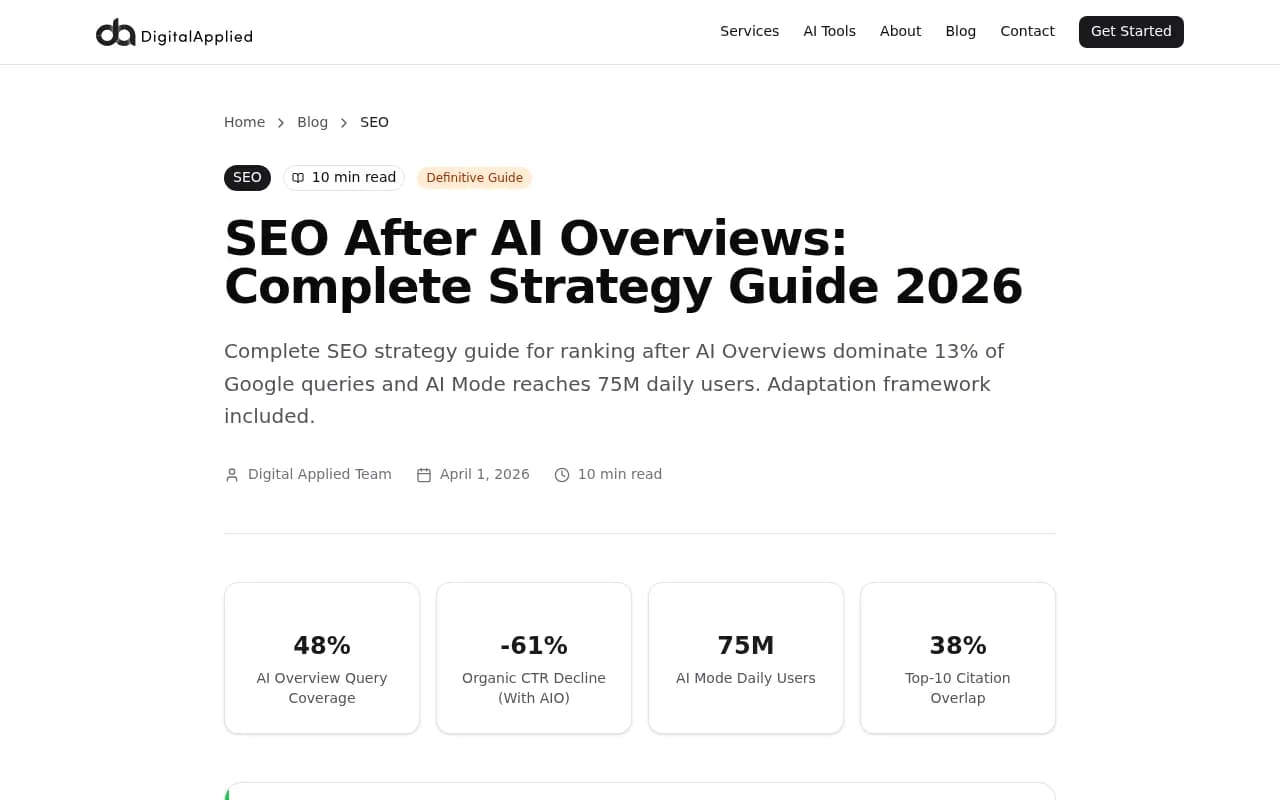
- AI Overviews now appear in 48% of all Google searches (up from 34.5% in December 2025), and only 38% of cited pages also rank in the traditional top 10 -- meaning rankings and citations are increasingly separate games
- Pages with more than 20,000 characters average roughly 10 AI citations each; pages under 500 characters average 2.4 -- depth still matters, but structure matters more
- You don't need to create new content first. Optimizing existing pages for AI citation patterns is faster and often more effective
- Technical signals like structured data, FAQ markup, and llms.txt are becoming meaningful differentiators in 2026
- Tracking AI visibility separately from organic traffic is now essential -- the metrics are different and so are the winning behaviors
Search changed faster in the past 18 months than in the previous decade. AI Overviews went from a limited US experiment to appearing in nearly half of all Google queries by March 2026. Google AI Mode hit 75 million daily users. ChatGPT, Perplexity, and Claude are now legitimate traffic sources for many brands -- and for some, they're the primary discovery channel.
The instinct for most marketing teams is to create more content. More articles, more landing pages, more blog posts. But here's the thing: if your existing content isn't structured to be cited by AI models, new content won't fix that problem. You'll just have more pages that AI ignores.
This guide is about the optimization-first approach -- going through what you already have, identifying what's holding it back from AI citations, and making targeted changes that compound quickly.
Why existing content is your fastest path to AI visibility
Creating new content takes weeks. Briefing, writing, editing, publishing, waiting for indexing -- you're looking at a month minimum before you see any signal. Optimizing an existing page that Google already knows about? You can see movement in days.
There's also a trust dimension. AI models tend to cite pages that already have some authority signals -- backlinks, traffic history, topical relevance. A two-year-old article that ranks on page two for a relevant query has more of those signals than a brand-new page. You're not starting from zero.
The gap between "ranking on page two" and "getting cited in AI Overviews" is mostly a structural one. AI models parse content differently than traditional crawlers. They're looking for clear answers, well-organized information, and content that directly addresses the question being asked. Most existing pages weren't written with that in mind -- but they can be updated to work that way.
Step 1: Audit your existing content for AI citation potential
Before touching anything, you need to know which pages are worth optimizing. Not every page on your site deserves the same attention.
Identify your highest-potential pages
Start with pages that already have some traction:
- Pages ranking in positions 4-20 for informational or how-to queries (these are close to the top and likely to be considered for AI Overviews)
- Pages with decent backlink profiles but declining click-through rates (a sign that AI Overviews are eating your clicks)
- Pages covering topics where AI Overviews already appear (use Google Search Console to check which queries have AIO appearances)
Google Search Console is your first stop here. The Performance report shows you which queries trigger impressions -- cross-reference that with your page rankings to find the gap between "Google knows this page exists" and "AI is actually citing it."
Check what AI models currently say about your topics
Search for your target queries in ChatGPT, Perplexity, and Google's AI Mode. Look at what gets cited. Is your site there? If not, which sites are? This tells you two things: what content structure is working, and what you're competing against.
Tools like Promptwatch can automate this at scale -- tracking which prompts your competitors appear for but you don't, across 10 different AI models simultaneously. That answer gap analysis is genuinely useful for prioritization.

Step 2: Restructure content for AI parsing
This is where most of the leverage is. AI models don't read pages the way humans do -- they parse structure, extract answers, and match content to query intent. Pages that are written as flowing essays are much harder for AI to extract clean answers from than pages with clear headers, direct answers, and organized information.
Lead with the answer
Every section of your content should answer the implied question in its heading, within the first two sentences. This is sometimes called the "inverted pyramid" approach -- the most important information comes first, with supporting detail below.
If your heading is "How does X work?", the next sentence should directly answer that. Not "X is a fascinating topic that has been studied extensively..." -- just the answer.
This pattern mirrors how AI models construct their responses. They pull the most direct, relevant answer to a query. If your content buries the answer three paragraphs in, it's much less likely to be cited.
Use specific, descriptive H2 and H3 headings
Vague headings like "Overview" or "More Information" are invisible to AI models. Specific headings like "How to set up two-factor authentication on iOS" or "What causes slow page load times" are far more useful -- they match the actual queries people ask.
Go through your existing pages and rewrite any heading that doesn't clearly state what the section answers. This is one of the highest-ROI changes you can make.
Add FAQ sections to existing pages
FAQ sections are one of the clearest signals you can send to AI models. They're structured as question-answer pairs, which is exactly how AI models retrieve and present information.
For each of your target pages, identify 5-8 questions that someone researching that topic would actually ask. Write direct, complete answers (2-4 sentences each). Add these as a FAQ section at the bottom of the page, and mark them up with FAQ schema.
According to Search Engine Land's 2026 analysis, FAQ markup adoption has grown significantly this year, partly because it's one of the few structured data types that directly helps with AI Overview citations.
Step 3: Fix the technical signals AI crawlers care about
Technical SEO for AI visibility is a bit different from traditional technical SEO. The fundamentals still matter -- fast pages, clean crawling, proper indexing -- but there are new layers specific to AI.
Add structured data where it's missing
Schema markup helps AI models understand what a page is about and how to categorize the information on it. For existing content, the most impactful schema types to add are:
- FAQ schema (as mentioned above)
- Article schema with author, date, and publisher information
- HowTo schema for any step-by-step content
- Product schema if you have product pages
You don't need to add all of these everywhere. Match the schema type to the content type on each page.
Create or update your llms.txt file
LLMs.txt is a relatively new convention (similar to robots.txt, but for AI crawlers) that tells AI models which pages on your site are most useful to read and how to navigate your content. Search Engine Land noted in April 2026 that decisions around llms.txt are becoming more complex -- but having one is increasingly a baseline expectation.
A basic llms.txt file lists your most important pages with brief descriptions of what each one covers. This helps AI crawlers prioritize your best content instead of spending time on thin or irrelevant pages.
Monitor how AI crawlers actually interact with your site
This is something most teams skip entirely. AI crawlers from ChatGPT, Perplexity, Claude, and others regularly visit websites to update their training data and retrieve real-time information. Knowing which pages they're reading, how often they return, and whether they're hitting errors is genuinely useful.
Promptwatch's crawler log feature shows exactly this -- which AI bots are visiting, which pages they read, and what errors they encounter. It's the kind of signal that helps you understand whether your technical setup is actually working.
Step 4: Improve content depth on your most important pages
The data on content depth is pretty clear. Pages with more than 20,000 characters average around 10 AI citations each. Pages under 500 characters average 2.4. This doesn't mean you should pad every page with filler -- but it does mean that thin content is a real liability.
For your highest-priority pages, the goal is comprehensive coverage of the topic. Not comprehensive in the sense of "mentions every tangentially related concept," but comprehensive in the sense of "answers every question someone researching this topic would have."
Identify content gaps on existing pages
Look at the pages that rank in your target queries and compare them to yours. What questions do they answer that you don't? What angles do they cover that your page ignores? What specific data, examples, or explanations are missing from your version?
Tools like Surfer SEO and Clearscope can help with this -- they analyze top-ranking pages and identify the topics and terms your content is missing.

For AI-specific gap analysis, Promptwatch's Answer Gap Analysis shows which prompts competitors appear for in AI responses but you don't -- which is a more direct signal than traditional keyword gap analysis.
Add original data, examples, and specifics
AI models are more likely to cite content that contains specific, verifiable information -- statistics, named examples, concrete steps, original research. Generic explanations that could apply to anything are less useful to AI models because they don't add anything that isn't already in the model's training data.
If your existing content is heavy on general advice and light on specifics, that's worth fixing. Add real numbers where you have them. Name specific tools, techniques, or approaches. Include examples that are concrete enough to be useful.
Step 5: Optimize for the prompts people actually use with AI
Traditional keyword research focuses on what people type into Google. AI search optimization requires thinking about what people ask AI models -- and those are often different.
AI queries tend to be longer, more conversational, and more specific. Someone might search Google for "best CRM software" but ask ChatGPT "what's the best CRM for a 10-person B2B sales team that uses HubSpot for marketing?" The intent is similar but the prompt is much more specific.
Map your content to AI prompt patterns
For each of your target pages, think about the specific prompts that would lead someone to want the information on that page. Write those prompts out. Then check whether your content directly answers those prompts.
If someone asks ChatGPT "how do I fix slow page load times on a WordPress site?", does your page on page speed optimization actually answer that specific question? Or does it cover page speed in general terms that don't address the WordPress-specific context?
The more specifically your content addresses the actual prompts people use, the more likely AI models are to cite it.
Use prompt volume and difficulty data
Not all prompts are worth optimizing for. Some have high volume but are dominated by authoritative sources you can't compete with. Others are winnable but low-volume. Prioritizing the right prompts is where a lot of teams waste time.
Promptwatch provides volume estimates and difficulty scores for individual prompts, plus query fan-outs that show how one prompt branches into related sub-queries. That kind of data makes prioritization much more systematic than guessing.
Step 6: Build topical authority through internal linking
AI models don't just evaluate individual pages -- they evaluate whether a site is a credible, comprehensive source on a topic. A site that has one good article about a topic is less likely to be cited than a site that has ten interconnected articles covering the topic from multiple angles.
This is where your existing content library becomes an asset. If you've been publishing content for years, you probably have more topical depth than you realize -- it just isn't connected properly.
Audit your internal linking structure
Go through your most important pages and check whether they link to related content on your site. If you have five articles about email marketing but none of them link to each other, you're missing an opportunity to signal topical authority.
Tools like Screaming Frog can crawl your site and show you the internal link structure -- which pages are well-connected and which are orphaned.
Create hub pages for your core topics
If you have multiple articles covering different aspects of the same topic, consider creating a hub page that organizes and links to all of them. This gives AI models a clear entry point to your topical cluster and signals that your site covers the topic comprehensively.
Step 7: Track AI visibility separately from organic traffic
This is where a lot of teams fall short. They optimize for AI search but measure success with the same metrics they've always used -- organic traffic, keyword rankings. Those metrics don't capture AI visibility, and they can actually be misleading.
When AI Overviews appear, organic CTR drops significantly (up to 61% on affected queries, according to recent data). But the visitors who do click through reportedly convert at much higher rates. If you're only looking at traffic volume, you might think your SEO is failing when it's actually working differently.
What to track for AI SEO
The metrics that matter for AI visibility are different:
| Metric | Traditional SEO | AI SEO |
|---|---|---|
| Primary signal | Keyword rankings | Citation frequency |
| Traffic measure | Organic clicks | AI referral traffic |
| Content signal | Backlinks | Prompt coverage |
| Competitive view | SERP position | Share of AI mentions |
| Page-level data | Impressions/CTR | Which pages get cited |
You need to know which of your pages are being cited by which AI models, how often, and for which prompts. That's a different data set from what Google Search Console provides.
Set up AI visibility monitoring
Several tools now track AI citations and brand mentions across AI models. For teams that want comprehensive tracking across ChatGPT, Perplexity, Claude, Gemini, and others, Promptwatch covers all 10 major AI models and connects visibility data to actual traffic through GSC integration and server log analysis.
For teams with simpler needs, tools like Otterly.AI and Peec AI offer more basic monitoring at lower price points.


The key is to have some measurement in place before you start optimizing, so you can actually see whether your changes are working.
Putting it together: a practical 30-day plan
Here's how to sequence the work if you're starting from scratch:
Week 1: Audit and prioritize
- Pull your top 50 pages by organic traffic from GSC
- Check which queries trigger AI Overviews using Google Search
- Identify 10-15 pages with the most AI citation potential (informational queries, positions 4-20, decent backlink profiles)
- Set up AI visibility monitoring so you have a baseline
Week 2: Structural fixes
- Rewrite headings on your priority pages to be specific and question-oriented
- Add FAQ sections with schema markup to your top 10 pages
- Update your llms.txt file (or create one if you don't have it)
- Fix any crawling or indexing issues surfaced by your technical audit
Week 3: Content depth
- Identify the 3-5 pages with the biggest content gaps
- Add specific data, examples, and answers to missing questions
- Improve internal linking between related pages
- Add Article or HowTo schema where appropriate
Week 4: Measure and iterate
- Check your AI visibility metrics against the baseline from week 1
- Identify which changes moved the needle
- Prioritize the next batch of pages based on what you learned
- Start the cycle again
The tools worth knowing about
A few tools that are genuinely useful for this workflow:
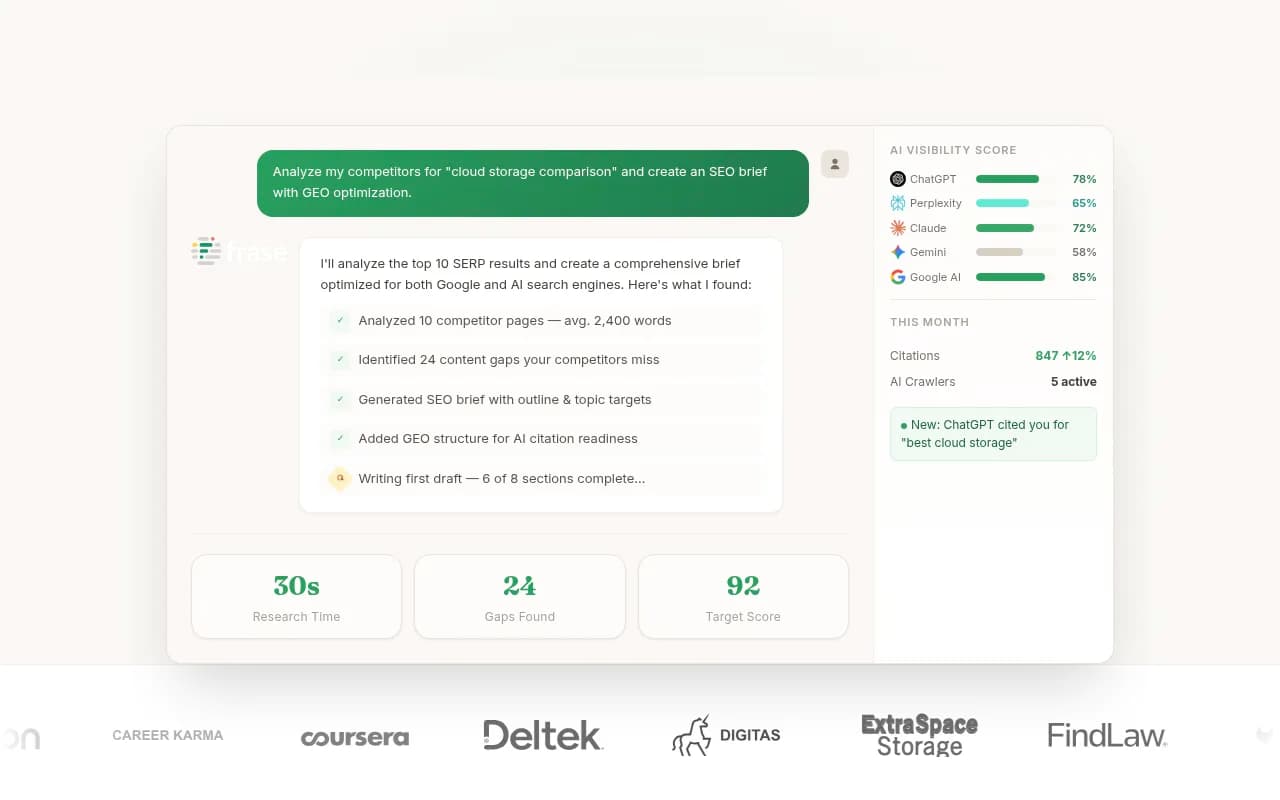
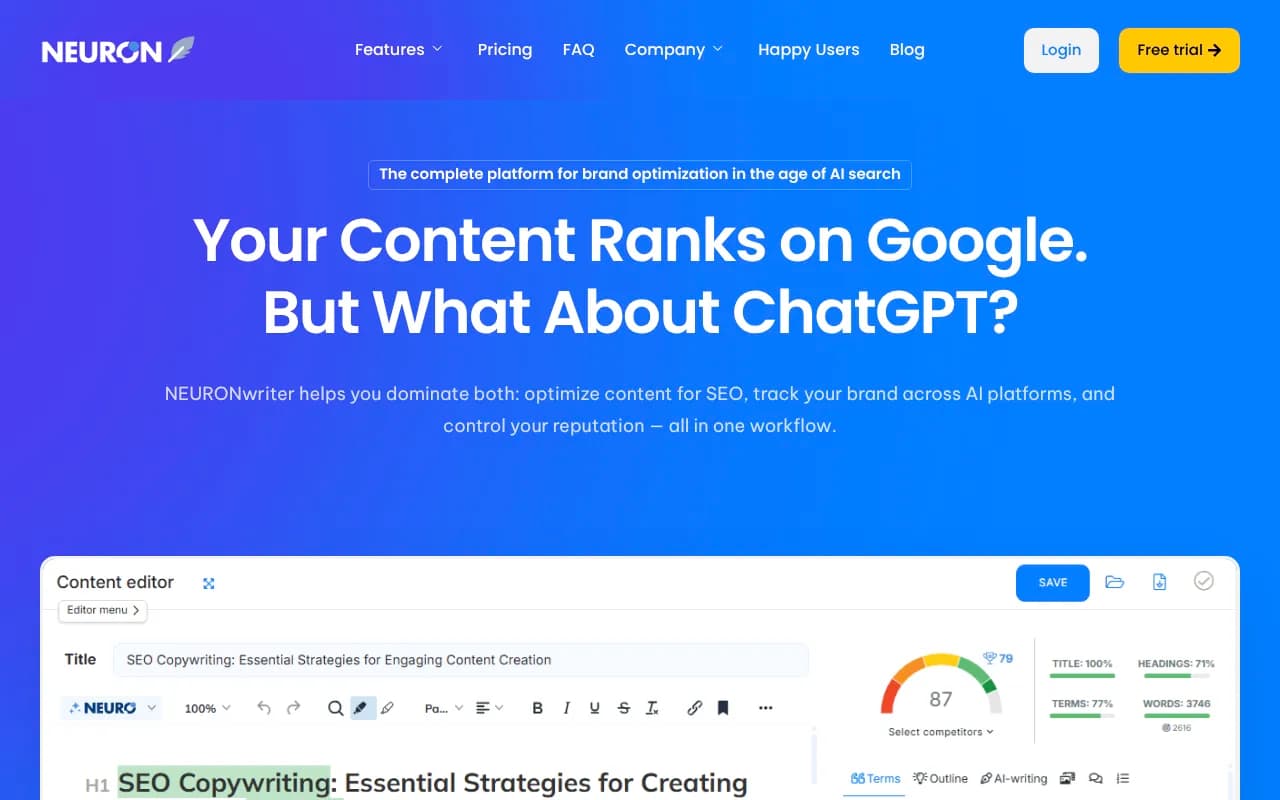
For content optimization specifically, NeuronWriter and Frase are solid for semantic analysis and content gap identification. SE Ranking has added AI visibility tracking to its traditional SEO toolkit, which is useful if you want everything in one place.
One honest note on expectations
Optimizing existing content for AI citations is faster than creating new content, but it's not instant. AI models update their responses on different schedules -- some in near real-time, others on longer cycles. You might update a page today and not see it reflected in AI responses for weeks.
What you can control is the quality of the signal you're sending. Clear structure, direct answers, specific information, proper schema markup, and comprehensive topic coverage -- these are the inputs that consistently produce citations across AI models. The optimization-first approach works because it improves all of those signals on pages that already have authority, which compounds faster than starting from zero.
The brands that will win in AI search in 2026 aren't necessarily the ones publishing the most content. They're the ones whose existing content is the clearest, most direct, and most trustworthy answer to the questions people are asking.