Key takeaways
- AI Overviews now appear in roughly 48% of tracked queries (up 58% year-over-year), so getting cited is no longer optional for visibility
- Brands cited in AI Overviews earn 35% higher organic CTR and 91% higher paid CTR compared to uncited competitors on the same query
- The fastest path to citation isn't publishing more -- it's publishing the right content in the right format, targeting prompts AI models are already answering
- Structured content (clear headers, direct answers, FAQ schema) gets picked up significantly faster than unstructured prose
- Tracking which AI models cite you -- and which pages they ignore -- is the only way to close the loop and compound your gains over time
There's a frustrating gap between "I published this" and "AI models are citing this." For most teams, that gap is measured in months. Sometimes it never closes at all.
The reason isn't usually content quality. It's that most content is built for traditional SEO -- keyword density, backlinks, domain authority -- and AI models use a different set of signals to decide what to cite. They want direct answers, clear structure, topical depth, and evidence that a source is trustworthy on the specific question being asked.
The good news: once you understand what AI models are actually looking for, you can engineer content to get there faster. These six shortcuts are the most reliable ways to compress that timeline.
Shortcut 1: Target prompts, not just keywords
Traditional keyword research finds terms people type into Google. That's still useful, but it's not enough for AI SEO. ChatGPT, Perplexity, and Google AI Overviews respond to prompts -- full questions, comparison requests, "best X for Y" queries -- and the content they cite is content that directly answers those prompts.
The practical shift: instead of optimizing a page for "project management software," optimize it for "what's the best project management software for remote teams under 20 people?" Those are different documents. The second one has a specific audience, a specific constraint, and a specific answer format. AI models prefer it.
The Digital Bloom's 2026 report maps how SERP position correlates with AI citation probability -- position 1-3 pages are cited dramatically more often, which means targeting the right prompts from the start matters enormously.
How to find the right prompts: manually query AI models with your topic and see what sub-questions they generate. Note the phrasing. Note what they cite. Then build pages that answer those exact questions better than whatever they're currently citing.
Tools that give you prompt volume data and difficulty scores -- so you're not just guessing which prompts are worth targeting -- include Promptwatch, which tracks prompt volumes across 10 AI models and shows you which prompts competitors rank for that you don't.

Shortcut 2: Answer the question in the first 100 words
This one sounds obvious but almost nobody does it. Most content buries the answer. There's an intro paragraph, some context, a few headers, and then finally -- three scrolls down -- the actual answer to the question the reader asked.
AI models don't have patience for that. They scan for the most direct, complete answer to the query and cite it. If your answer is buried, you lose to a shorter, clearer page even if your overall content is better.
The fix is simple: state the answer in the first 100 words. Then expand on it. Think of it like an inverted pyramid -- conclusion first, supporting detail second.
For example, if your page targets "how long does it take to rank in AI Overviews," your opening paragraph should say something like: "Most pages start appearing in Google AI Overviews within 2-8 weeks of publication, provided they're indexed, structured with clear headers, and directly answer the query. Pages that use FAQ schema and have existing domain authority tend to appear faster."
That's the answer. Everything after it is supporting evidence. AI models can extract that opening paragraph and cite it immediately.
Shortcut 3: Use structure that AI models can parse
AI models don't read pages the way humans do. They parse structure. H2s and H3s act as signals about what a section covers. Bullet lists make discrete facts easy to extract. Tables make comparisons easy to cite. FAQ sections map directly to question-based prompts.
The pages that get cited fastest tend to share a few structural patterns:
- A clear, descriptive H1 that matches the prompt
- H2 sections that each answer a sub-question (not just label a topic)
- At least one FAQ section with 4-6 questions in schema markup
- A summary or TL;DR near the top
- Numbered lists for processes, bullet lists for features or options
What doesn't work: long walls of prose, vague section headers like "More Information" or "Background," and content that meanders before getting to the point.
If you want to check whether your content structure is optimized for AI citation, tools like Clearscope and Surfer SEO can score your content against top-ranking pages.

Shortcut 4: Get indexed by AI crawlers, not just Google
Here's something most SEO guides skip entirely: AI models have their own crawlers, and they don't always crawl what Google crawls. ChatGPT's crawler (GPTBot), Perplexity's crawler (PerplexityBot), and Anthropic's crawler (ClaudeBot) all visit pages independently. If they're blocked by your robots.txt, or if they're hitting errors when they try to access your pages, you won't get cited -- regardless of how well you rank in Google.
The first thing to check: your robots.txt file. Many sites block AI crawlers by default, either intentionally or because a developer added a blanket disallow rule at some point. Open your robots.txt and look for rules that block GPTBot, PerplexityBot, ClaudeBot, or any wildcard rules that would catch them.
The second thing to check: whether AI crawlers are actually visiting your pages. Most analytics tools don't surface this. You need either server log analysis or a tool that specifically tracks AI crawler activity.
Promptwatch's crawler log feature shows you exactly which AI bots are hitting your site, which pages they're reading, how often they return, and what errors they encounter. It's one of the few ways to diagnose why a well-written page isn't getting cited -- sometimes the answer is simply that the crawler never saw it.
Shortcut 5: Publish content that fills citation gaps, not content you feel like writing
This is the biggest time-waster in AI SEO: publishing content based on what seems interesting or what your team knows well, rather than what AI models are actively looking for but not finding on your site.
Citation gaps are real and measurable. For any given set of prompts in your space, there are queries where your competitors show up in AI responses and you don't. Those gaps represent the exact content you need to create. Not guesses -- actual evidence of what's missing.
The manual way to find gaps: run 20-30 prompts relevant to your business through ChatGPT, Perplexity, and Google AI Overviews. Note which competitors get cited. Note which questions produce no good answer (those are opportunities). Build a spreadsheet.
The faster way: use a tool with answer gap analysis built in. Promptwatch's Answer Gap Analysis shows you exactly which prompts competitors rank for that you don't, with the specific topics and angles AI models want covered. You're not guessing -- you're filling documented gaps.
A structured, sequenced approach to AI SEO -- like the 49-step checklist above -- makes it easier to identify which gaps to fill first rather than publishing randomly.
Once you know the gaps, the next question is what to write. AI-cited content tends to fall into a few formats: direct answer articles, comparison pages ("X vs Y"), listicles ("best X for Y"), and how-to guides. Each format maps to a different type of prompt. Build content in the format that matches the prompt type, not the format that's easiest to write.
Shortcut 6: Track citations at the page level and iterate
Most teams publish content and then wait -- checking rankings every few weeks, hoping something improves. That's too slow and too vague. The teams that compound their AI visibility fastest are the ones tracking at the page level: which specific pages are being cited, by which AI models, for which prompts, and how that changes week over week.
Page-level tracking lets you do something powerful: identify your "almost cited" pages. These are pages that appear in AI responses sometimes but not consistently, or that get cited by one model but not others. A targeted update -- adding a FAQ section, sharpening the opening answer, adding a comparison table -- can push those pages over the threshold.
The citation decay curve is also real. According to The Digital Bloom's 2026 report, content freshness affects citation probability. Pages that haven't been updated in 6+ months start losing citations to fresher content on the same topic. Regular updates -- even small ones that add new data or expand a section -- reset that clock.
| What to track | Why it matters | How often |
|---|---|---|
| Citation count per page | Shows which content is working | Weekly |
| Which AI models cite you | Different models have different preferences | Weekly |
| Competitor citation share | Reveals gaps and threats | Monthly |
| AI crawler visits per page | Diagnoses indexing issues | Weekly |
| Traffic from AI referrals | Connects citations to revenue | Monthly |
The traffic attribution piece is worth emphasizing. AI citations don't always show up in standard analytics as "AI referral" -- some come through as direct traffic, some through branded search. Closing the loop between citation and revenue requires either a tracking snippet, Google Search Console integration, or server log analysis. Without it, you're optimizing blind.
Putting it together: the publish-to-citation workflow
These six shortcuts work best as a sequence, not as isolated tactics:
- Find a prompt with real volume where competitors are cited and you're not (gap analysis)
- Write content that answers that prompt directly in the first 100 words, with clear structure and FAQ schema
- Verify your robots.txt allows the relevant AI crawlers
- Submit the URL for indexing and monitor AI crawler visits
- Track citations at the page level starting week one
- Update the page at 30 and 90 days based on what the citation data shows
The teams seeing the fastest results in 2026 aren't the ones publishing the most content. They're the ones publishing the most targeted content, tracking it precisely, and iterating quickly. That loop -- find gaps, create content, track results -- is what separates brands that compound their AI visibility from brands that publish into the void.
Tools worth knowing
Beyond Promptwatch for the full optimization loop, a few other tools are worth having in your stack depending on your specific needs:
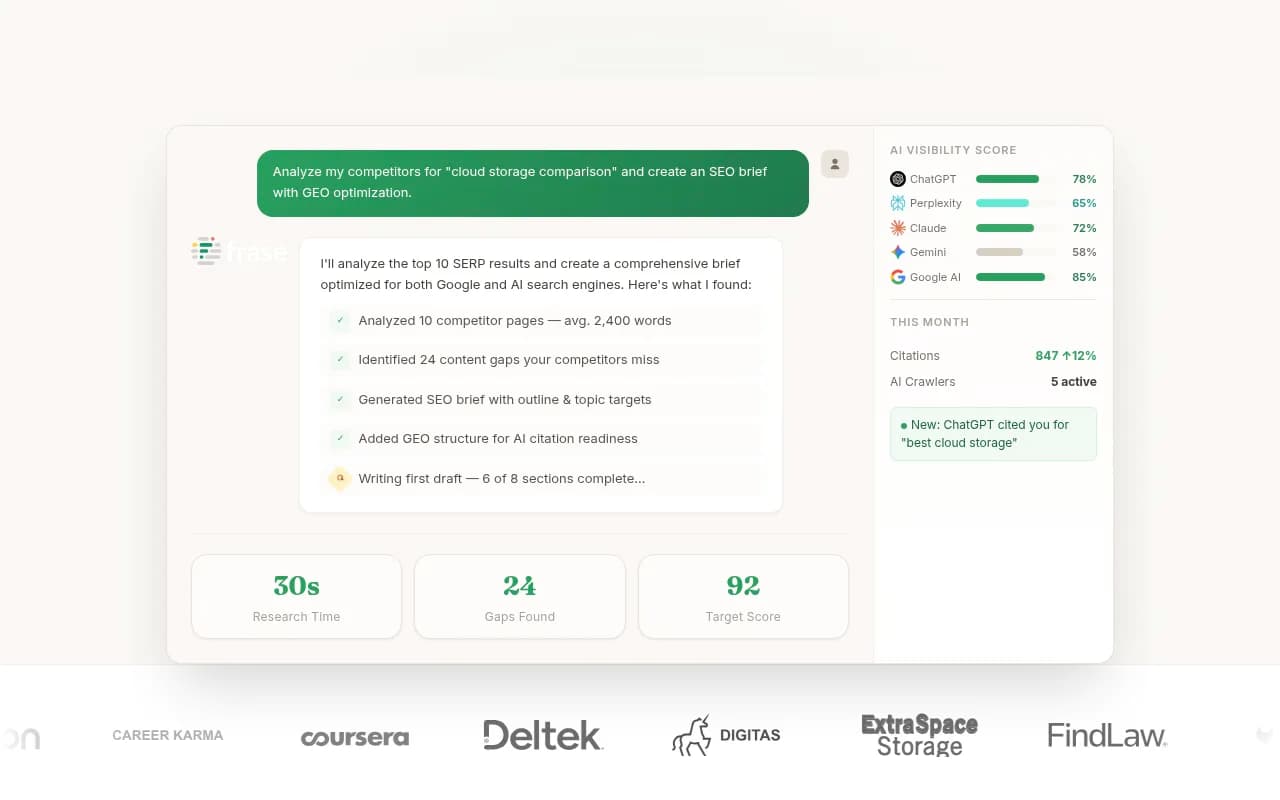
For content optimization before you publish, Frase and MarketMuse both help you build content that covers a topic thoroughly enough to satisfy AI models.
For tracking AI visibility across multiple models without the full optimization suite, Otterly.AI and Peec AI are lighter-weight options.


For technical SEO issues that might be blocking AI crawlers, Screaming Frog is still the most reliable crawler for diagnosing robots.txt issues, redirect chains, and page errors.
The core insight from 2026 data is simple: AI Overviews now appear in nearly half of all tracked queries, and brands cited in those overviews earn 35% higher organic CTR and 91% higher paid CTR than uncited competitors. The gap between "visible in AI" and "invisible in AI" is already a revenue gap. The six shortcuts above are the fastest way to close it.