Key takeaways
- Google's own documentation says structured data is not required for AI Overviews and that no special schema.org markup exists for generative AI search.
- Schema still earns its place for rich results, entity clarity and accurate machine reading, so keep the baseline types (Organization, Article, Person, Product, LocalBusiness).
- Many SEO blogs claim schema raises citation odds. None of them show causal evidence, and they conflict with Google's guidance.
- Observational data shows common types on cited pages, but that is correlation. Most pages carry baseline schema anyway.
- Spend your effort on content structure, crawlability and measuring citations. Treat schema as hygiene, not a growth lever.
The short answer
Schema markup does not unlock AI Overviews. That is the uncomfortable truth, and it is also what Google says in plain text.
Google's guide to optimizing for generative AI features lists "overfocusing on structured data" as something you do not need to do. It says structured data is not required and there is no special schema.org markup to add. The separate "AI features and your website" documentation says there are no extra technical requirements for appearing in AI Overviews or AI Mode. The one schema-related best practice it lists is that structured data must match the visible text on the page.
So why does every second SEO article tell you to add FAQ schema to "rank in AI Overviews"? Mostly because schema is easy to sell, easy to implement and easy to screenshot. I'm not saying it's useless. I'm saying the causal claim is weak, and you should know that before you spend a sprint on it.
What the sources actually say
Here is how the main sources line up. They disagree, and the disagreement is the interesting part.
| Source | Claim about schema and AI Overviews | Evidence offered |
|---|---|---|
| Google (AI optimization guide) | Not required, no special markup, still useful for rich results | Official documentation |
| Searchable | Not required; llms.txt ignored; chunking doesn't help | Summary of Google's guidance |
| SEOcrawl | FAQ, HowTo and Article schema help parsing and "increase citation likelihood" | Assertion, no data shown |
| Devenup | Partial or invalid schema "reduces eligibility" | Assertion, no data shown |
| SegMetrics | Schema helps AI understand context | Assertion |
| SALT.agency | Organisation schema on 82% of cited AI Overview pages, WebPage/Article on 76%; Google is not favouring special types | Observational tables |
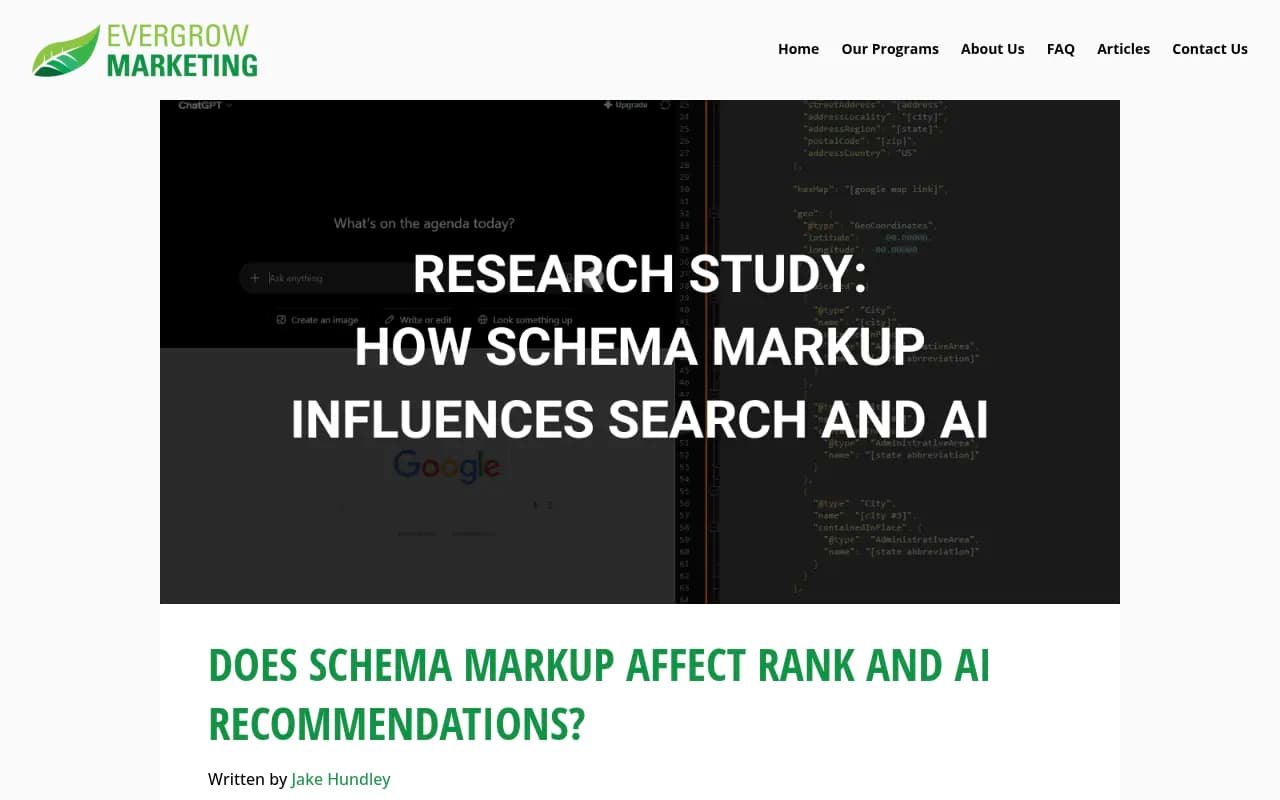
| Evergrow Marketing study | LocalBusiness schema did not change SERP or Maps rank; some LLMs, ChatGPT included, showed positive movement | 10-week test, Feb 27 to Apr 4, 2026, one business |
I'd weight these in order: Google's documentation first, controlled tests second, correlational data third, and unsourced "best practice" lists last.
Why the correlation data misleads
SALT.agency found Organisation schema on 82% of the AI Overview pages it checked. That sounds persuasive until you remember that most commercial sites already ship Organization, Article and breadcrumb markup through their CMS or an SEO plugin. Backlinko data cited by SEOptimer says at least 72% of first-page Google results use some schema. If nearly everything has it, finding it on cited pages tells you very little. SALT itself concluded that Google is not favouring special schema types.
What the Evergrow test adds
The Evergrow study is small (one business, one schema type, 10 weeks) so treat it as a data point, not a verdict. Its finding was that LocalBusiness schema did not move SERP rank or Google Maps rank, while there were signs of positive influence from some LLMs including ChatGPT. Note that ChatGPT is not Google AI Overviews. The test says nothing direct about Overviews.
Which schema types are worth having
None of these will "get you into" an AI Overview. They do four useful things: make you eligible for classic rich results, describe your entities unambiguously, keep your markup consistent with the page, and give other systems (Bing, assistants, knowledge graphs) cleaner input.
| Schema type | Use it for | Likely effect on AI Overviews | Verdict |
|---|---|---|---|
| Organization | Brand name, logo, social profiles, contact details | No proven direct effect; helps entity clarity | Keep, site-wide once |
| Article / BlogPosting | Editorial content with author and dates | No proven direct effect; very common on cited pages | Keep |
| Person | Author and expert identity | No proven direct effect; supports authorship signals | Keep if you have real author pages |
| Product + Offer + Review | Product and service pages | Matters for shopping and rich results, not shown to cause citation | Keep on e-commerce pages |
| LocalBusiness | Location-based businesses | No effect on rank in the Evergrow test | Keep for local accuracy |
| BreadcrumbList | Site hierarchy | Common on cited pages; low risk | Keep |
| FAQPage | Genuine Q&A sections | Unproven; rich result eligibility has been restricted by Google in the past, so check current status | Use only if the Q&A is visible and real |
| HowTo | Step-by-step instructions | Unproven; same caveat on rich result status | Verify current Google support first |
I did not verify the current rich result status of FAQ and HowTo markup while writing this, so check Google's structured data documentation before you invest in either. Do not assume they still produce visible rich results.
What doesn't help
- Piling on every schema type you can find. Google's own advice is that you do not need every schema available.
- Marking up content that isn't on the page. Structured data that doesn't match visible text violates Google's policies and can cost you rich result eligibility.
- Fake or boilerplate FAQ blocks added only to hold markup.
- Treating a validator pass as a ranking signal. Valid markup is a baseline, not an advantage.
- Creating an llms.txt file in the hope of Overview citations. Google says Search ignores it.
What the unverified claims get wrong
SEOcrawl, Devenup and SegMetrics all say schema helps AI parse content, and Devenup goes further, saying partial or invalid schema reduces extraction eligibility. These may be true for some AI systems. Nobody in the sources provides a test showing it for Google AI Overviews, and the claim runs against Google's documentation. I'd present them as plausible but unproven.
The fair middle ground: schema reduces ambiguity for machines that read it, so it is harmless to keep and sometimes useful. It is a long way from "add FAQ schema and get cited."
What actually gets pages into AI Overviews
Google's guidance and the better third-party analyses agree on a short list.
Target queries that trigger Overviews
Overviews show mostly on informational queries. Navigational and transactional queries typically don't trigger them. According to Searchable's spot-check of three US SERPs in July and August 2026, 12 of 24 AI Overview citations went to a URL that also ranked in the top 10. For how-to queries it was only seven of 18, versus five of six for definitional queries. Small sample, but the direction makes sense: definitions lean on pages that already rank, advice queries pull from a wider pool.
Write extractable sections
Make each section self-contained and answer the heading in the first sentence beneath it. Google says it can understand multiple topics on a page, so you don't need contorted "AI-friendly" chunking. But a clear answer under a clear heading helps humans and machines alike.
Publish non-commodity content
Google recommends unique content that isn't a rewrite of everything else on page one. Original data, first-hand testing and specific examples are what separate you from the commodity pile.
Keep pages crawlable and indexed
The basics: pages must be indexable, internal links must work, and key content must be in the rendered HTML. A technical crawler such as Screaming Frog is the usual way to catch problems.
Think in page formats, not markup
Promptwatch Data on ChatGPT (not AI Overviews) shows which formats get cited. For Sep 28 to Oct 4, 2026, product pages were 22.4% of classified citations, landing pages 16.8%, listicles 13.6%, and how-tos 8.7%. FAQ pages were 3.3% overall but reached 4.8% for branded prompts. See the full breakdown in Promptwatch's ChatGPT content type report. That report measures page format, not schema, but it makes the point: what the page is matters far more than what it is tagged as. For Google specifically, Promptwatch's AI Overviews citation types report for July 2026 notes product pages overtaking listicles as the most cited format late in the month.
And for anyone tempted by exotic file formats: markdown files are just 0.05% of AI search citations, per Promptwatch's markdown report.
A practical schema checklist
This is what I'd actually do on a typical site.
- Audit what you already have. Most CMS themes and SEO plugins emit Organization, Article and breadcrumb markup. Don't duplicate it.
- Fix errors, then stop. Validate with Google's Rich Results Test and the Schema Markup Validator. Resolve errors on templates that matter.
- Match markup to visible content. Author name, dates, prices and ratings in the schema must appear on the page.
- Add Product, Offer and Review only on real product or service pages with real reviews.
- Use Person markup only where an actual author bio page exists.
- Skip FAQ and HowTo markup unless the content is visible, genuinely useful, and you've confirmed current rich result support.
- Don't expect a lift. If you want to test it anyway, change one template, leave a comparable template alone, and watch for several weeks.
Schema management tools can speed this up. InLinks handles entity-based internal linking and schema, and a crawler like Sitebulb can flag missing or broken structured data at scale.
How to measure whether anything worked
This is where most schema advice falls apart: nobody measures. Google Search Console's generative AI report, launched June 3, 2026, shows which pages appear in AI Overviews, AI Mode and Discover's generative features. It does not show the queries behind those appearances, so you need extra tooling to connect pages to prompts.
For tracking, tools like Promptwatch can show which pages AI systems cite and which crawlers hit your site, so you can check whether a markup change coincided with any movement. It also tracks Google AI Overviews and AI Mode alongside ChatGPT and others.

Other options in the catalog include Knowatoa for AI Overviews and AI Mode monitoring, Finseo for the same Google surfaces, and Thruuu for AI Overview monitoring on content teams. For a wider list, the GEO software directory at bestgeosoftware.com is a good place to compare.
| Tool | Focus | Good for |
|---|---|---|
| Promptwatch | Citations, crawler logs, content gaps, multi-model tracking | Teams who want to act on the data, not just watch it |
| Knowatoa | AI Overviews and AI Mode brand monitoring | Google-focused monitoring |
| Finseo | AI Mode and AI Overviews visibility | Tracking Google AI surfaces |
| Thruuu | AI Overview monitoring | Content teams |
| Screaming Frog | Technical crawling, structured data extraction | Checking markup at scale |
When schema is still worth the effort
Plenty of reasons to keep doing it, none of them magic:
- Rich results in classic search for products, reviews and breadcrumbs.
- Clean entity data for your brand, authors and locations, which helps wherever machines read your site.
- Accurate product information in shopping surfaces.
- Consistency: structured data forces you to state facts on the page the same way every time.
If an SEO vendor sells schema as the route into AI Overviews, ask for a controlled test. The Seobility guide, which does list schema as step five of an eight-step framework, at least frames it as one part of a broader checklist alongside technical foundations, direct answers, human insight and off-page brand signals.
Bottom line
Keep your baseline schema accurate and matched to visible content. Don't build a strategy around it. If you have a free week, spend it on writing sharper answers under each heading, publishing something competitors can't copy, and fixing crawl problems. Then measure which pages Google actually cites, and let that data tell you what to do next.