Key takeaways
- AI crawlers now account for a meaningful share of bot traffic, and their behavior changes fast. Meta-WebIndexer went from roughly 2% to nearly 38% of tracked AI crawler requests between mid-July and August 9, 2026, according to Promptwatch's Meta web indexer data.
- Most teams monitor AI crawlers manually or not at all. The fix is a pipeline: collect logs, detect anomalies, alert, and route each alert to a specific remediation.
- The highest-value alerts are crawl errors, robots.txt and rate-limit blocks, and crawl-to-citation gaps, where a page gets crawled but never cited.
- Automation should handle detection and first-pass diagnosis. Humans should handle judgment calls like robots.txt policy and content strategy.
- A GEO platform with built-in crawler logs, like Promptwatch, removes most of the plumbing work because ingestion, classification, and alerting are already wired together.
Why AI crawler log monitoring became a real job in 2026
Two years ago, "AI crawler monitoring" meant checking your access logs once a month for GPTBot. That era is over. There are now 400+ AI bots in circulation, and their traffic patterns are volatile. Meta's new web indexer went from about 2% of tracked AI crawler requests to nearly 38% in under a month, per Promptwatch's crawler data. ChatGPT Search started using the site: operator at scale on August 8, 2026, jumping from roughly 0.4% to 17% of fanout queries overnight, which changed how its crawler hits your site. If you're not watching this, you're guessing.
The business stakes are also clearer now. AI crawls are the upstream of AI citations, and citations drive traffic and revenue. A crawler hitting a 429 or a broken redirect isn't an infrastructure curiosity. It's a potential lost citation in ChatGPT, Gemini, or Perplexity.
The problem is volume. A mid-sized site can log tens of thousands of AI crawler requests per day. Nobody reads that manually. You need automation, and you need it to end in a fix, not a Slack message that everyone mutes.
What you're actually monitoring
Before automating anything, get specific about the signals that matter. There are four, and only one of them is a traditional ops metric.
Crawl volume and frequency per bot. How often ChatGPTBot, ClaudeBot, PerplexityBot, GoogleOther, Google-Agent, and Meta's crawlers hit your site, and whether the pattern changes. A bot that suddenly stops crawling your key pages is as much a red flag as one that errors out.
Crawl errors. 404s, 500s, redirect chains, timeouts, and JavaScript-rendered content the crawler can't see. These are the most direct cause of lost citations.
Access policy blocks. Robots.txt disallows, 403s, and rate-limit responses (429s). These are often intentional, but they're frequently accidental, like a WAF rule that quietly blocks ClaudeBot, or a robots.txt written in 2023 that disallows a bot you now want crawling you.
Crawl-to-citation gap. The most interesting one. A page gets crawled repeatedly but never cited. That means the crawler found it, read it, and decided it wasn't useful for answering relevant prompts. This is a content problem, not an infrastructure problem, and it's where monitoring turns into optimization.
The pipeline: from logs to alerts to fixes
Here's the architecture that works. You can build it yourself or buy most of it pre-assembled, but the stages are the same either way.
1. Collect and normalize
AI crawler logs come from your CDN or server layer. Cloudflare, AWS CloudFront, Fastly, Vercel, Netlify, Akamai, and Google Cloud CDN all expose log streams, and you can also pipe from a custom HTTP endpoint. The first job is normalizing these into a single format: timestamp, bot identity (from user agent), URL, status code, response time, and bytes returned.
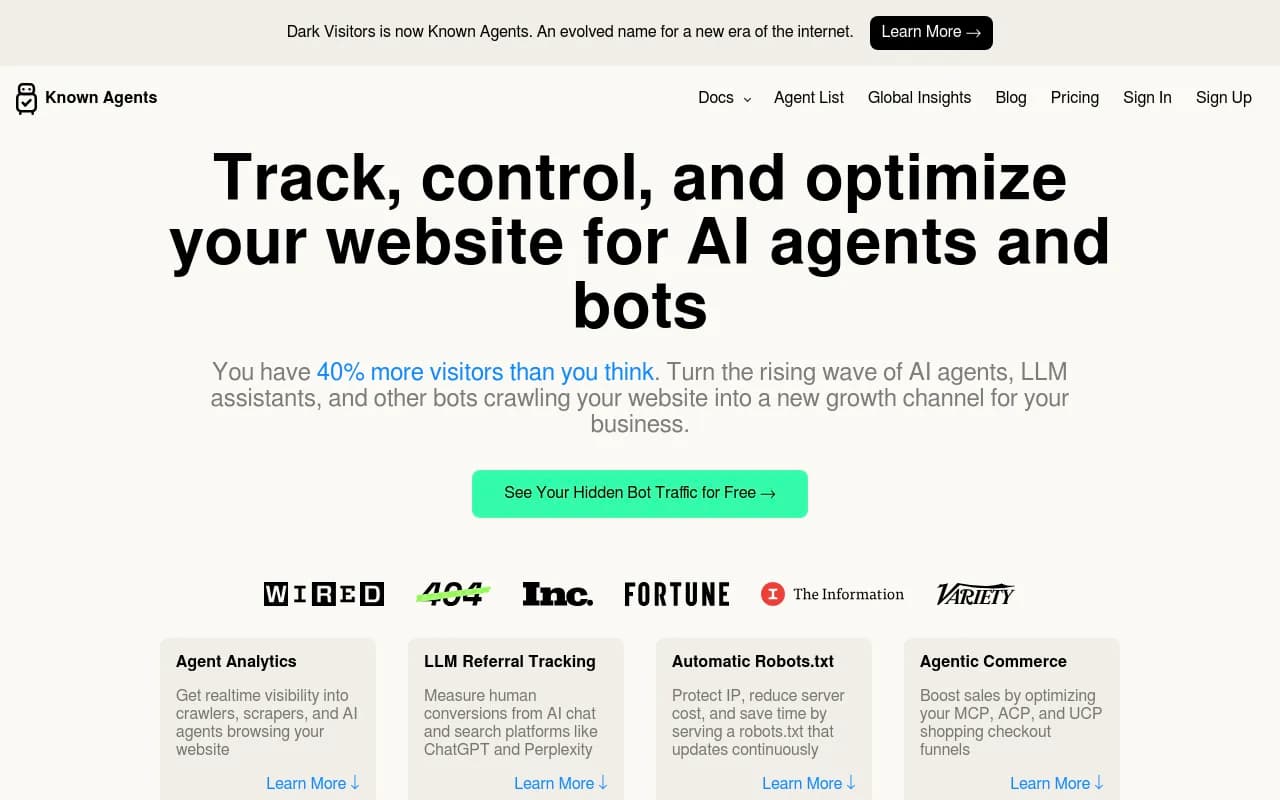
Bot identification is its own small project. There are 400+ AI bots, and user agent strings are messy. Promptwatch's free AI Bots & Web Crawlers Directory catalogs them, and DarkVisitors maintains a live list as well. Whatever you use, plan to update the bot list monthly, because new crawlers appear constantly.
2. Detect
Raw logs are useless without detection rules. The ones worth setting up:
- Error rate per bot above a threshold (say, 5% of requests in a 24-hour window returning 4xx/5xx)
- A specific high-value page or section returning errors to any AI crawler
- A bot that previously crawled regularly going silent for 7+ days
- A spike in 429 or 403 responses to a bot you want crawling you
- Crawl-to-citation rate dropping on pages that used to get cited
That last one requires joining crawler logs with citation data, which is where DIY pipelines get expensive. It's the difference between knowing a page was crawled and knowing whether the crawl produced anything.
3. Alert with context
An alert that says "ChatGPTBot error rate 12%" is a start. An alert that says "ChatGPTBot hit 340 404s on /pricing in the last 24 hours, mostly from links in your July newsletter" is something a person can act on immediately. The Dropzone AI SOC automation guide makes the same point about security alerts: the value of automation is delivering a documented verdict with evidence, not a raw queue. The same principle applies here.
Practical alerting rules:
- Route infrastructure errors (500s, timeouts) to your engineering or DevOps channel
- Route robots.txt and WAF blocks to whoever owns crawler access policy
- Route crawl-to-citation gaps to content and SEO
- Keep a weekly digest of overall crawler trends for the marketing lead, so nobody gets paged for a slow drift
4. Fix
This is where most setups stop and where the actual value starts. Each alert type maps to a specific remediation:
| Alert | Likely cause | Fix | Owner | | --- | --- --- | --- | --- | | 404s on a key page | Broken internal link or deleted page | Restore page or 301 to the replacement | Engineering | | 429s to a wanted bot | Aggressive rate limiting | Raise the limit for verified AI bots | DevOps | | 403s from WAF | Bot signature match | Allowlist the bot's verified IP ranges or UA | Security | | Bot goes silent | Robots.txt disallow added by mistake, or crawler behavior changed | Audit robots.txt against current bot list | SEO | | Crawled but never cited | Content doesn't answer the prompts it's crawled for | Rewrite with content gap analysis, add structured answers | Content | | Crawl spike on junk pages | Faceted nav or parameter URLs | Add robots.txt or canonical handling | SEO |
The crawled-but-never-cited row is the one most teams miss, and it's the one with the biggest upside. Promptwatch's data on ChatGPT citation types shows product pages made up roughly a third of ChatGPT citations in July 2026, with listicles the fastest-growing format. If your product pages get crawled constantly but never cited, the format or the content is the problem, and no amount of infrastructure fixing will help.
Build vs. buy
You can assemble this pipeline from parts: CDN log export, a log aggregation tool, a detection layer, Slack or PagerDuty for alerting, and a workflow automation tool to route fixes. Teams doing this well often use n8n or Zapier as the connective tissue.
The honest assessment: building it yourself works if you have engineering capacity and unusual requirements, like strict data residency or a bespoke CDN setup. But the crawl-to-citation join is genuinely hard to DIY, because citation data isn't in your server logs. You'd need to run prompt monitoring across multiple AI engines separately and stitch the two datasets together.
The alternative is a platform that ships with the pipeline pre-built. Promptwatch ingests crawler logs from all the major CDNs, classifies 400+ bots, tracks citations across ChatGPT, Gemini, Claude, Perplexity, Grok, Meta, and Google's AI surfaces, and computes the crawl-to-citation rate per page. Its Unified Actions feature turns detected issues into a prioritized task list, and its Content Agents can draft and publish fixes to Webflow, Framer, or WordPress. That's the full loop: detect, diagnose, fix.

For comparing what's available across the category, the GEO software directory at bestgeosoftware.com covers platforms with varying depth of crawler log support.
Common mistakes
Blocking crawlers you want. The most common self-inflicted wound. A security engineer adds a bot rule, or an SEO adds a blanket disallow, and six months later nobody remembers why ClaudeBot gets 403s. Audit your robots.txt and WAF rules against your current AI visibility goals quarterly.
Monitoring without a citation baseline. If you only watch crawler logs, you'll fix infrastructure issues and still not know whether visibility improved. You need citation tracking on the same pages you're monitoring crawls for, or you're optimizing blind.
Alerting on everything. Crawler behavior is noisy by nature. Bots come and go, crawl patterns shift with model updates, and a page getting crawled less this week isn't always a problem. Alert on errors, blocks, and citation gaps, and put trends in a weekly digest instead of a real-time channel.
Treating it as an ops project. The infrastructure half is ops. But the highest-value output, the crawl-to-citation gap, is a content problem. If the alert only goes to engineering, the fixes that matter most never happen.
Forgetting that crawler behavior changes under you. The Meta-WebIndexer surge and the ChatGPT site: operator shift both happened within weeks. Any pipeline with a hardcoded bot list or fixed assumptions about how crawlers behave will silently go stale. Plan for monthly reviews of what's crawling you and how.
A realistic rollout plan
Week 1: Export logs from your CDN, identify which AI bots are hitting you, and get a baseline of volume, errors, and blocked requests. Promptwatch's free AI Crawler URL Inspector is a quick way to check how specific bots see specific pages.
Week 2: Set up detection rules for the four signal types, starting with crawl errors and access blocks. Route alerts to named owners, not a general channel.
Week 3: Add citation tracking for your most valuable pages, and compute crawl-to-citation rates. This is where a platform saves you the most time, but you can approximate it by running manual prompt checks against your tracked pages.
Week 4: Close the loop. For each recurring alert type, define the fix, the owner, and the turnaround time. Add a weekly digest for trend review. At this point the pipeline is less about firefighting and more about a standing feedback loop between how AI systems read your site and what you publish.
The bottom line
AI crawler log monitoring in 2026 is a solved problem in the sense that the data exists and the tooling is mature. What most teams still lack is the last mile: turning a detected issue into a shipped fix, especially when the fix is content rather than code. Get the pipeline running, assign owners to each alert type, and treat the crawl-to-citation gap as your primary optimization target. That's the difference between watching AI search happen to you and participating in it.