Key takeaways
- Bluefish AI publishes no pricing. Every plan is quote-based, invoiced annually in advance, non-refundable, and subject to overage fees if you exceed usage limits, according to its own Terms of Service.
- Third-party estimates conflict wildly: comparison sites report $99–$799/month entry tiers, while competitive-intelligence firm CheckThat.ai sizes annual contracts at $100,000–$500,000+. Treat every number you see online as an estimate, not fact.
- What you're actually paying for is Fortune 500-grade brand safety: AI Accuracy with a Brand Vault, Custom AI Audiences, and agentic commerce tracking (Amazon Rufus, Alexa for Shopping) that almost no competitor offers.
- The gaps matter too: no Google Search Console integration, no MCP server, no API on most plans, and no GA4 or revenue attribution. You're buying an AI-channel lens, not a full measurement stack.
- Transparent alternatives exist at every budget: Otterly.AI from $29/month, LLM Pulse from €49/month, Profound from $99/month, and Promptwatch from $95/month with a free tier, and most of them will let you try before you buy.
What Bluefish AI actually is
Bluefish is a New York-based enterprise AI marketing platform founded in 2024 by Alex Sherman, Andrei Dunca, and Jing Feng, a founding team with two prior exits to Microsoft and Facebook. It raised a $20M Series A led by NEA with Salesforce Ventures, then a $43M Series B in April 2026 co-led by Threshold Ventures and NEA, bringing total funding to $68 million. Its customer list reads like a Fortune 500 roster: Adidas, American Express, Hearst, Ulta Beauty, Tishman Speyer, Omnicom.
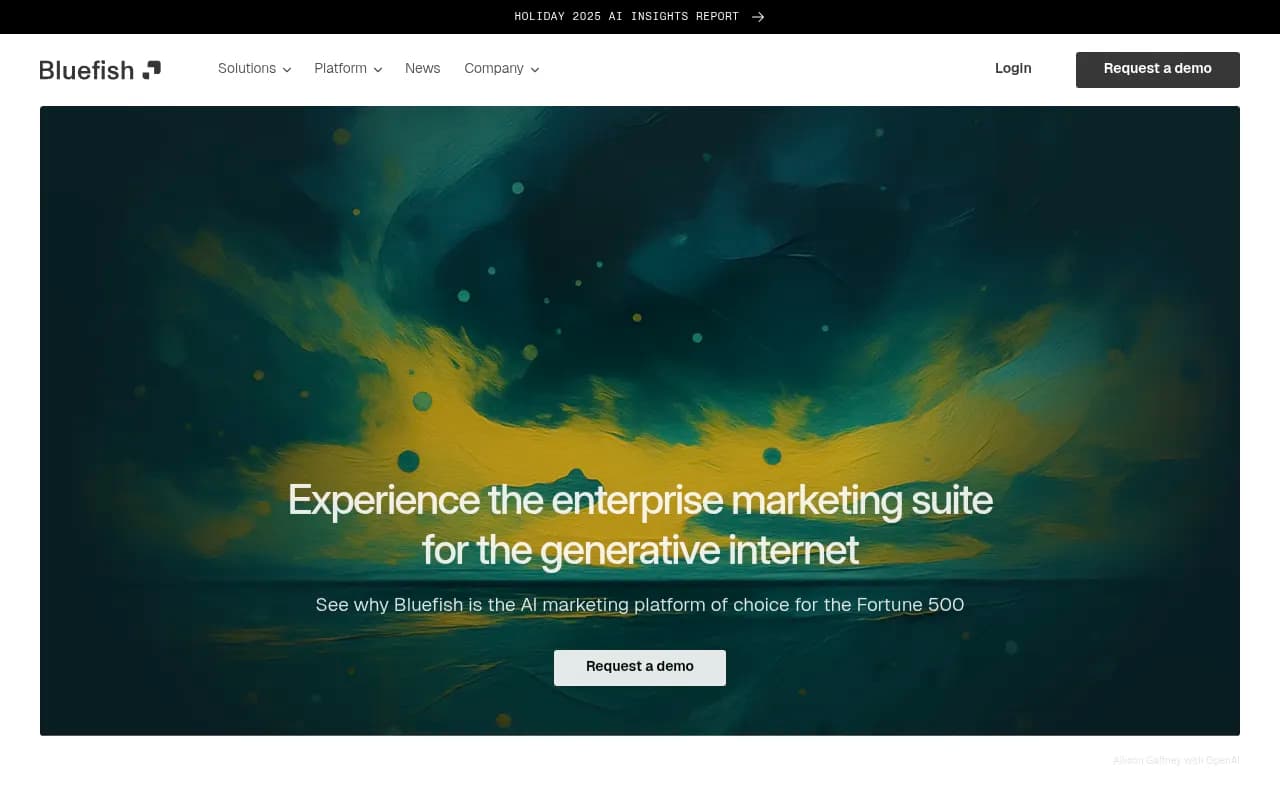
That last part is the point. Bluefish's CEO has said publicly that the platform is built for Fortune 500 buyers, and the product reflects it. There is no self-serve signup, no free trial, no free tier, and no pricing page. The only call to action on the entire website is "Request a demo."
Bluefish AI pricing in 2026: what we know and what's rumor
What Bluefish's own terms reveal
Bluefish doesn't publish prices, but its Terms of Service (last updated November 3, 2025) tell you a surprising amount about the commercial model:
- Fees are set in a custom Order Form, negotiated per customer.
- Fees are invoiced annually in advance.
- All fees are non-refundable.
- If you exceed user or usage limits, you're billed overage fees at rates specified in your Order Form, or at Bluefish's "then-current standard overage rates" if none are specified.
So even without a price list, we know the shape of the deal: a hybrid subscription plus usage-overage model, sold on annual contracts, with no money-back escape hatch. That's a standard enterprise structure, but it means budgeting for Bluefish requires knowing your usage ceiling before you sign, because overage rates are whatever Bluefish says they are at the time.
The third-party estimates, and why they conflict
Since Bluefish won't quote publicly, everyone else has tried. The numbers you'll find online fall into two very different camps:
| Source | Estimate | Notes |
|---|---|---|
| CheckThat.ai (March 2026) | $100K–$150K/yr "Essential", $250K–$350K/yr "Growth", $500K+/yr "Enterprise" | Competitive-intelligence estimate of annual contract value; explicitly unofficial |
| Comparison sites (QuickSEO, others) | $99–$799/month entry and mid tiers, 5–6 figure annual enterprise contracts | Monthly-equivalent estimates, labeled as reported ranges |
| One Profound-affiliated comparison | Growth $299/mo, Business $799/mo, extra seats $50/mo, crisis response add-on $300/mo | Single data point, conflicts with the ACV framing above |
The spread between "$299 a month" and "$250,000 a year" is enormous, and I'd be skeptical of both extremes. The monthly figures likely come from early or small-team deals that Bluefish may no longer offer as it leans into enterprise. The six-figure ACV estimates probably describe the full Fortune 500 package with custom AI audiences and consulting. The honest answer: nobody outside Bluefish's sales team knows, and any article presenting a specific Bluefish price as fact is guessing.
One more caution. A few third-party writeups describe a "Bluefish AI" with public $99 and $249 monthly plans focused on citation-source analytics. That description conflicts with everything on Bluefish's own site and looks like confusion with a different product or a stale review. Don't budget off it.
What you're actually paying for
The five pillars
Bluefish's product breaks into five areas, per its own site:
- AI Monitoring: tracking how and where your brand appears across ChatGPT, Claude, Gemini, Perplexity, Copilot, and Amazon Rufus.
- AI Optimization (GEO): tools to influence those appearances.
- GEO Measurement: measuring the ROI of digital marketing campaigns in the AI channel, largely through its Collections feature (launched February 2026), which groups owned content, earned coverage, and AI visibility data into a single campaign view.
- AI Commerce: tracking product recommendations inside retail AI assistants. This is Bluefish's genuine differentiator. Almost no visibility platform tracks Amazon Rufus, and a September 2026 post shows Bluefish expanding into Alexa for Shopping. If you sell physical products at Fortune 500 scale, this is the thing you can't easily buy elsewhere.
- AI Accuracy: launched with the Brand Vault, which ingests first-party brand content into a continuously updated, verified source of truth that can be shared with LLMs as training material to reduce hallucinations about your brand.
Brand safety at this level is expensive to build. Verifying brand claims across models, maintaining a vault of approved content, and negotiating data-sharing with AI companies all cost real money, and that's part of what the enterprise contract funds.
What's missing at every tier
The gaps are consistent across every review and comparison I found:
- No Google Search Console integration. Bluefish is an AI-channel-only lens on your marketing.
- No GA4, CRM, or conversion-data connection. Collections only counts what Bluefish itself ingests, so "ROI" here means AI-channel visibility metrics, not revenue.
- No MCP server, so you can't query Bluefish data from Claude, ChatGPT, or other MCP clients.
- No API access on most plans.
None of these are fatal if you're a Fortune 500 brand team that already has a measurement stack and wants a dedicated AI-channel instrument. But if you're a growth-stage team trying to prove that AI search drives pipeline, paying six figures for a tool that can't connect to your analytics is a strange use of budget.
Why even a big budget doesn't buy stable visibility
Here's the part that should temper anyone's expectations, at any price point. AI search citations are volatile month to month, and no platform fee insulates you from that.
Promptwatch's data on average sources per response shows ChatGPT cites roughly 5 sources per web-search response, while Google AI Overviews and Perplexity each cite around 10. Fewer slots means more contested citations: getting into a ChatGPT answer is a tighter fight than getting into an AI Overview. And Promptwatch's ChatGPT citation share data for June 2026 shows how fast things move: Reddit's share of ChatGPT Search citations fell from 6.11% in May to 3.71% in June, a roughly 40% single-month drop for the most-cited domain on the platform. No single domain held even 4% of citations, which tells you AI search share is a long tail, not a winner-take-all SERP you can buy your way into.
The lesson for buyers: monitoring data is perishable, and the platforms that help you act on it (fix content, fill gaps, publish) tend to return more per dollar than platforms that only measure it. That framing matters for the alternatives below.
Alternatives that give you more (per dollar)
Every tool here publishes its prices, offers a trial or free tier, and lets you self-serve. That alone puts them ahead of Bluefish for any team without enterprise procurement.
Promptwatch: the one that fixes things, not just reports them
Promptwatch is the alternative I'd point most teams toward, for one specific reason: it closes the loop. Most platforms in this category, Bluefish included, stop at monitoring. Promptwatch's agents plan, write, and publish GEO-optimized content to your CMS (Webflow, Framer, WordPress), generate a prioritized GEO to-do list from your visibility and crawler data, and give you an AI analyst you can chat with about your own numbers. It also tracks things Bluefish doesn't surface for most customers: AI crawler logs showing when ChatGPTBot or ClaudeBot actually hit your pages and what errors they found, Reddit and YouTube citation tracking, ChatGPT Shopping and ads monitoring, and real visitor analytics tying AI traffic to conversions.
Pricing is public: a free Explore tier, Essential at $95/month, Professional at $245/month, Business at $579/month, and agency plans from $199/month with unlimited projects. It's used by 1,840+ brands and agencies and rated 4.7/5 on G2. If Bluefish's pitch is "control your brand in AI," Promptwatch's pitch is "grow AI-driven revenue," and at 1/50th of a six-figure contract, most mid-market teams will get more done with it.

Profound: the enterprise-flavored option with public prices
Profound is the closest cultural match to Bluefish if you want enterprise compliance (SOC 2, HIPAA) without quote-only pricing. Starter is $99/month but only covers ChatGPT with 50 prompts and no exports, which reviewers fairly call a funnel tier. Growth at $399/month adds three engines (ChatGPT, Perplexity, Google AI Overviews), 100 prompts, and 9,000 responses. Enterprise is custom and unlocks up to 9–10 engines, API access, and SSO. Recent additions like FactCheck (AI accuracy measurement) put it in direct competition with Bluefish's AI Accuracy pillar, at a price you can read before talking to sales.

Otterly.AI: the budget entry point
At $29/month for the Lite plan (15 prompts, 4 engines), Otterly is the cheapest credible way to start tracking AI visibility. Standard jumps to $189/month and Premium to $489/month, and the 6.5x leap from Lite to Standard with no mid-tier is a real complaint, but the base tier covers the fundamentals most small teams actually need. Annual billing takes 15% off.

LLM Pulse: transparent European pricing
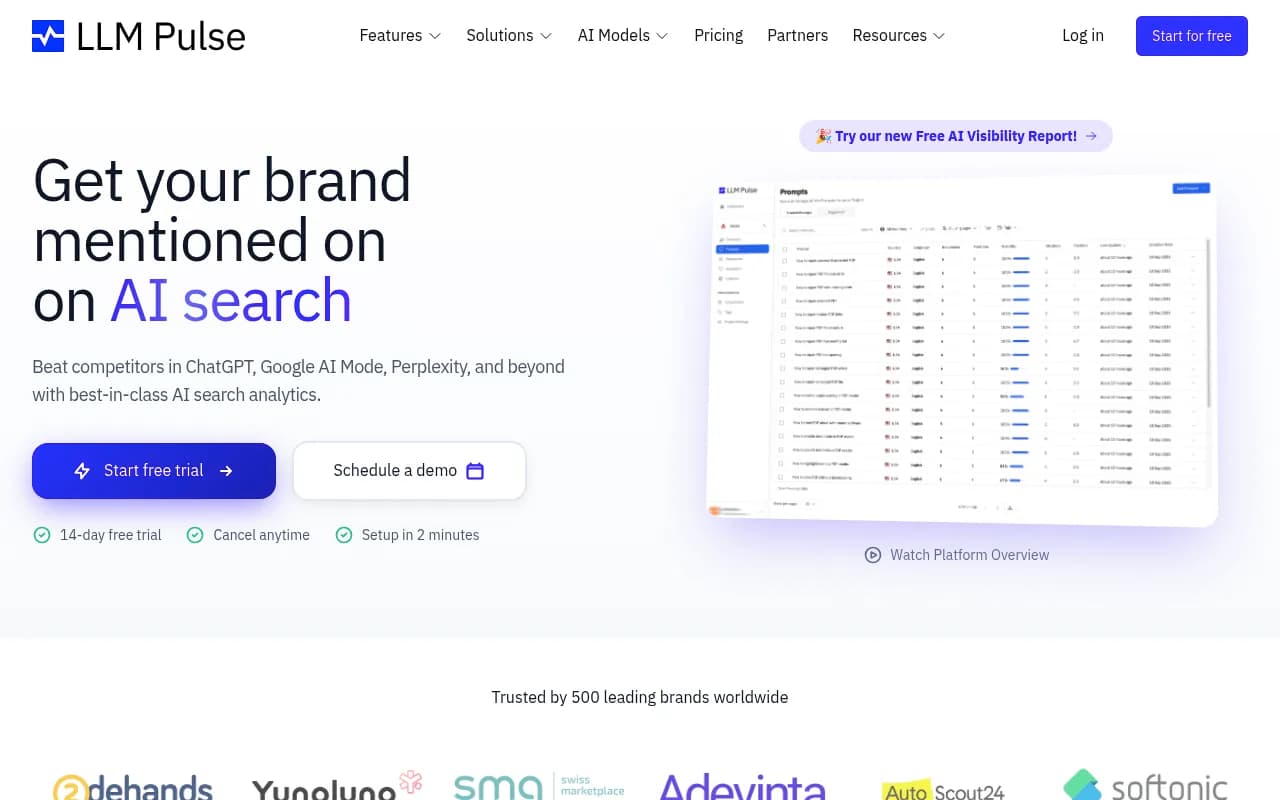
LLM Pulse runs from €49/month (Starter, 50 prompts, 5 models, unlimited seats) up through €1,199/month tiers, with a 14-day trial. Unlimited team members with no per-seat fees is rare in this category, and Brand Sentiment plus Looker Studio integration give it reporting depth that punches above its price. If you're in Europe and want per-prompt cost clarity, it's a strong pick.
Searchable: monitoring plus content production
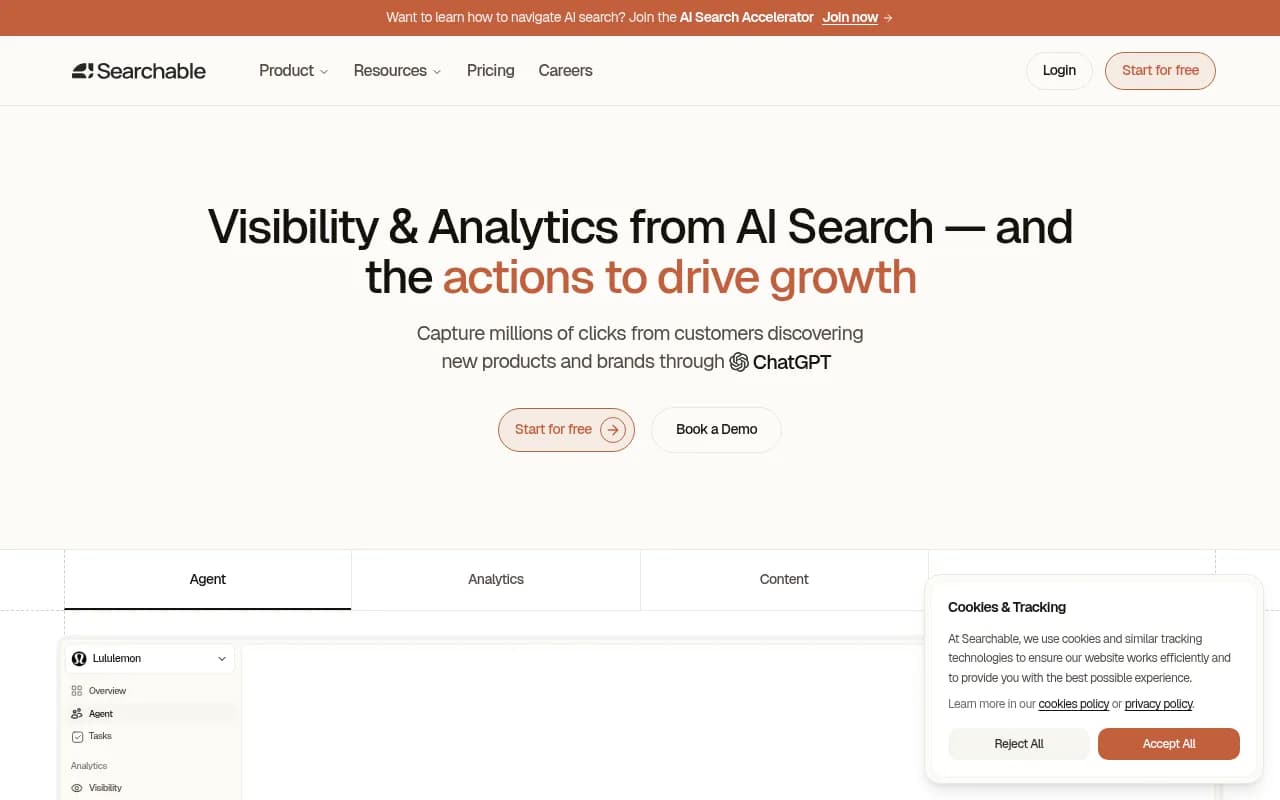
Searchable pairs visibility tracking with an AI content agent: Pro at $125/month includes 100 prompts, 9,000 analyzed answers, and 20 articles per month; Scale at $400/month scales that to 500 prompts and 80 articles. If your bottleneck is producing the content that fixes visibility gaps rather than measuring them, this bundling is efficient.
AthenaHQ, Peec, and the specialists
AthenaHQ starts at $95/month with Shopify integration, which makes it the practical choice for e-commerce brands that can't justify Bluefish's AI Commerce pillar. Peec starts at €89/month with 115+ language support and a per-platform add-on model, suited to international brands. Scrunch (from $250/month) maps customer journeys and detects hallucinations about your brand, a lighter-weight take on Bluefish's AI Accuracy pitch. And at the top end, Evertune ($3,000/month, 1M+ custom prompts) is the one alternative that matches Bluefish's statistical- rigor positioning with published pricing.


Side-by-side comparison
| Platform | Starting price | Free tier or trial | Engines | What it does that Bluefish doesn't |
|---|---|---|---|---|
| Bluefish | Quote-only (est. $100K–$500K+/yr) | No | ChatGPT, Claude, Gemini, Perplexity, Copilot, Rufus | Rufus and Alexa commerce tracking, Brand Vault |
| Promptwatch | $95/mo (free tier) | Yes | 11+ including AI Mode, Grok, DeepSeek | Crawler logs, CMS publishing, visitor analytics, Reddit/YouTube tracking |
| Profound | $99/mo | No | 1 at Starter, up to 10 at Enterprise | Public pricing, HIPAA, FactCheck |
| Otterly.AI | $29/mo | Trial | 4 core, add-ons extra | Self-serve at a genuinely low price |
| LLM Pulse | €49/mo | 14-day trial | 5 core + add-ons | Unlimited seats, transparent per-prompt pricing |
| Searchable | $125/mo | 14-day trial | 5+ | Content production bundled with monitoring |
| AthenaHQ | $95/mo | No | 8+ | Shopify integration |
| Evertune | $3,000/mo | No | 9 | Published enterprise pricing, 1M+ prompts |
How to choose without wasting a sales cycle
My honest decision framework, having looked at what all of these cost:
Stay with Bluefish if you're a Fortune 500 brand with a six-figure budget, a dedicated brand and PR team, and a concrete need for agentic commerce tracking (Rufus, Alexa) or verified brand-safety infrastructure at scale. For that buyer, Bluefish is purpose-built, and the price of being misrepresented in AI answers can genuinely exceed the platform fee.
Choose Promptwatch if you want to connect visibility data to actual traffic and conversions, and you want the platform to help produce the fixes rather than just report the gaps. It's the strongest end-to-end option for mid-market brands and agencies.
Choose Profound if compliance requirements rule your procurement and you still want a real enterprise feature set with public entry pricing.
Choose Otterly, LLM Pulse, or AthenaHQ if you're budget-constrained, self-serve, or e-commerce-specific respectively. Any of them will tell you the price before you book a call, which Bluefish will not.
One practical tip before you commit to anything: run a free visibility audit first. Promptwatch's free AI Brand Visibility Report, and similar free tiers across the category, will show you whether you have a visibility problem worth spending five figures on at all. Too many teams buy enterprise tooling for a problem a $95/month plan would have fully covered.
If you want to browse the full category rather than take my word for it, the directories at bestgeosoftware.com and ai-rank-tools.com catalog GEO platforms and AI rank trackers with current pricing.
FAQ
Does Bluefish AI have a free trial?
No. There's no trial, no free tier, and no self-serve signup. Evaluation happens through a sales-led demo and a custom Order Form.
What's the cheapest Bluefish AI plan?
There is no published plan. Third-party estimates range from ~$99/month (likely stale or small-deal figures) to $100,000–$500,000+ in annual contract value. Only a Bluefish sales quote will tell you what you'd pay.
Is Bluefish worth it for a mid-market company?
Almost certainly not. The features that justify its pricing, Custom AI Audiences, Brand Vault, agentic commerce tracking, are built for organizations where brand misrepresentation in AI answers carries seven-figure consequences. Mid-market teams get more from transparent platforms like Promptwatch, Profound, or LLM Pulse at 1–5% of the cost.
Do any Bluefish alternatives track Amazon Rufus?
Very few. Bluefish's agentic commerce coverage (Rufus, Alexa for Shopping) is its clearest differentiator. If retail AI assistants are central to your strategy, that's the one case where Bluefish has no direct substitute at any price.