Key takeaways
- Userpilot's $299/mo Starter plan excludes funnels, session replay, A/B testing, the resource center and surveys beyond NPS. Those sit in the Growth tier, listed from $849/mo. Budget with that number if you need analytics depth.
- Appcues and Chameleon are the closest like-for-like no-code flow builders. Pendo is the pick when analytics and guidance need to live in one contract.
- WalkMe and Whatfix are built for enterprise employee rollouts of software you don't own. They are heavy for in-product onboarding in your own SaaS.
- UserGuiding and ProductFruits are the budget options, with simpler editors and lower usage ceilings.
- Most price comparisons online are written by vendors. Treat every figure as a starting point and confirm on the pricing page.
Why teams look for Userpilot alternatives
Userpilot is a solid no-code product adoption platform. You get flows, checklists, tooltips, NPS surveys and segmentation, and most teams can ship a first flow in days. The reasons people leave are fairly consistent.
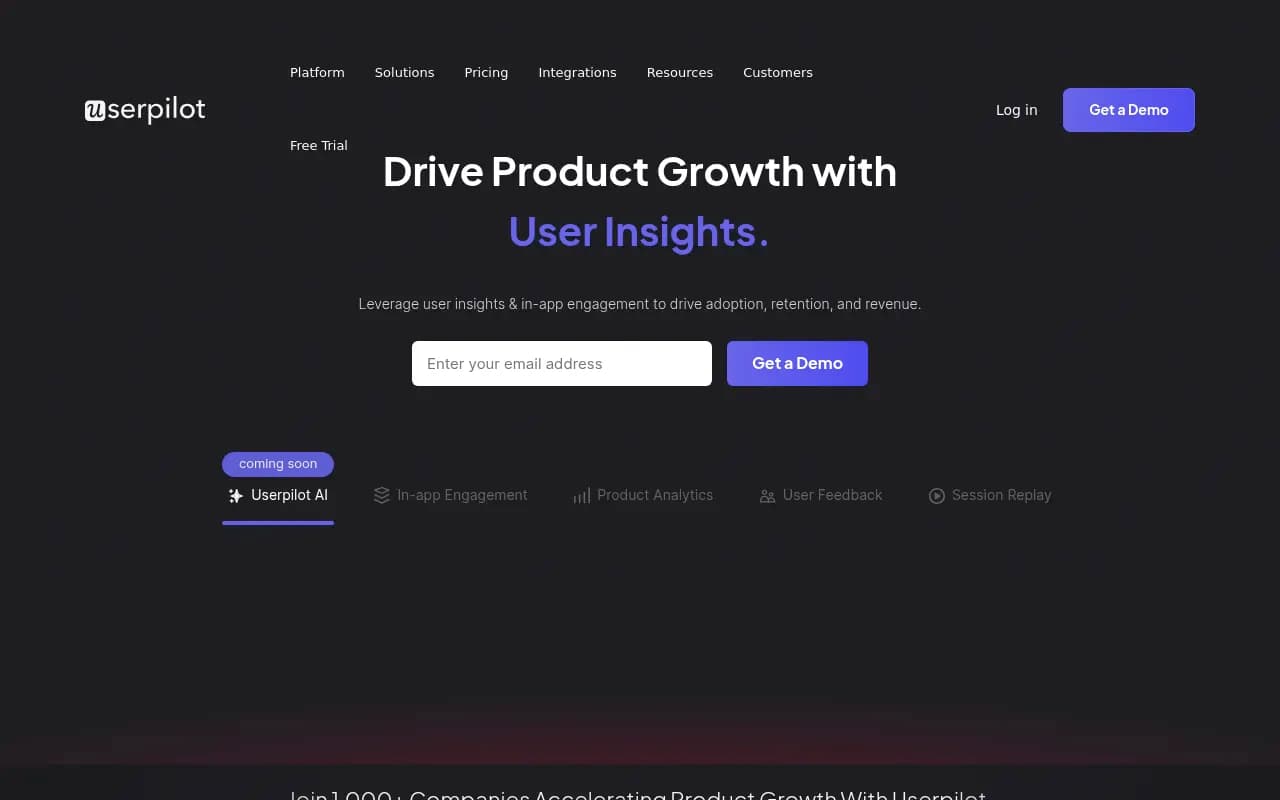
The first is pricing structure. The $299/mo Starter plan covers up to 2,000 MAU and 3 seats, but it caps segmentation at 10 segments and leaves out custom events, funnels, retention analysis, session replay, custom CSS, A/B testing and a staging environment. The Growth plan, listed from $849/mo, adds the AI guides builder, the resource center, advanced surveys, 5k free session replays a month and unlimited localization. Plenty of comparison articles quote only the $299 figure, which understates what a team that needs those features will actually pay.
The second is mobile. Native iOS and Android support, mobile analytics and push show up as add-ons in the Enterprise feature table, so mobile is not part of Starter or Growth. If mobile onboarding is central to your product, check that before you sign.
The third is a mismatch of problem and tool. Some teams want deeper analytics, some want to explain why users stall rather than just measure drop-off, and some actually need employee training rather than customer onboarding. One tool rarely covers all of that.
Userpilot's own guide makes a point I agree with: the biggest evaluation mistake happens before the evaluation starts, when a buyer hasn't decided whether they are solving customer adoption or employee onboarding. Those are different purchases with different criteria. Keep that distinction in mind as you read the list below.
Userpilot alternatives at a glance
Prices below come from vendor pages where we could verify them and from third-party comparisons otherwise. Several of those comparisons are written by competing vendors, so confirm before budgeting.
| Tool | Type | Starting price | Best for |
|---|---|---|---|
| Appcues | No-code flow builder | Annual contract, quote-based (MAU, installs, published experiences) | Teams that want hands-on control and implementation help |
| Chameleon | Self-serve in-app engagement | About $279/mo (Startup) | Branded, highly customized tours |
| Pendo | Analytics suite with guides | Quote-based, free tier reported up to 500 MAU | Mid-size and large orgs wanting analytics and guidance together |
| UserGuiding | SMB no-code builder | About $174-249/mo | Early-stage teams on a budget |
| ProductFruits | AI-assisted onboarding | About $149-159/mo | Startups and SMBs wanting simple tooling |
| Userflow | No-code web onboarding | About $240/mo | Mid-market web onboarding without deep analytics |
| WalkMe | Enterprise DAP | Six-figure annual | Overlaying enterprise software at scale |
| Whatfix | Enterprise DAP | About $23K/yr (estimate) | Employee training across app portfolios |
| Frigade | AI-native adoption platform | About $1K/mo, usage-based; Engage free under 250 monthly users | Teams that don't want to author every flow |
| Perspective AI | AI interviews | Not verified | Understanding why users stall |
Appcues
Appcues is the original product-led no-code onboarding tool, and the most direct Userpilot competitor. Its pricing is built on MAU, number of installations and number of published experiences. The Start tier covers up to 3,000 MAU with 10 published experiences and 12 months of reporting history. Grow begins at 3,000 MAU with 25 experiences and 24 months of history. Enterprise goes to 100 published experiences and 36 months.
A few things stand out. Appcues says every plan includes every experience type, feature and integration, so you are not unlocking capabilities as you climb. Every customer also gets implementation services, onboarding support and a dedicated experience manager, which is unusual at this price level. And it is one of the few tools in this category with native iOS and Android support as a core selling point, which is the main reason to pick it over Userpilot for mobile-heavy products.
The catches: there is no public pricing, no self-serve trial (you book a call first, then get a no-credit-card trial), and the contract is annual. Appcues also counts only users who sign in during the month, and it does not charge for dormant users. If you exceed limits, experiences keep running and the team contacts you about upgrading at the next cycle, which is a friendlier policy than a hard cutoff. Teams under 25 people can ask about the Spark plan, though no price is published.
Choose it if you want a vendor who will help build the first flows and you need mobile. Skip it if you want to start on a credit card this afternoon.
Chameleon
Chameleon is the one to look at when design fidelity matters. It is known for tours, tooltips and microsurveys that look like part of your product rather than a bolt-on, and for deep styling control. Reported pricing starts around $279/mo on the Startup plan for 2,000 MTUs.
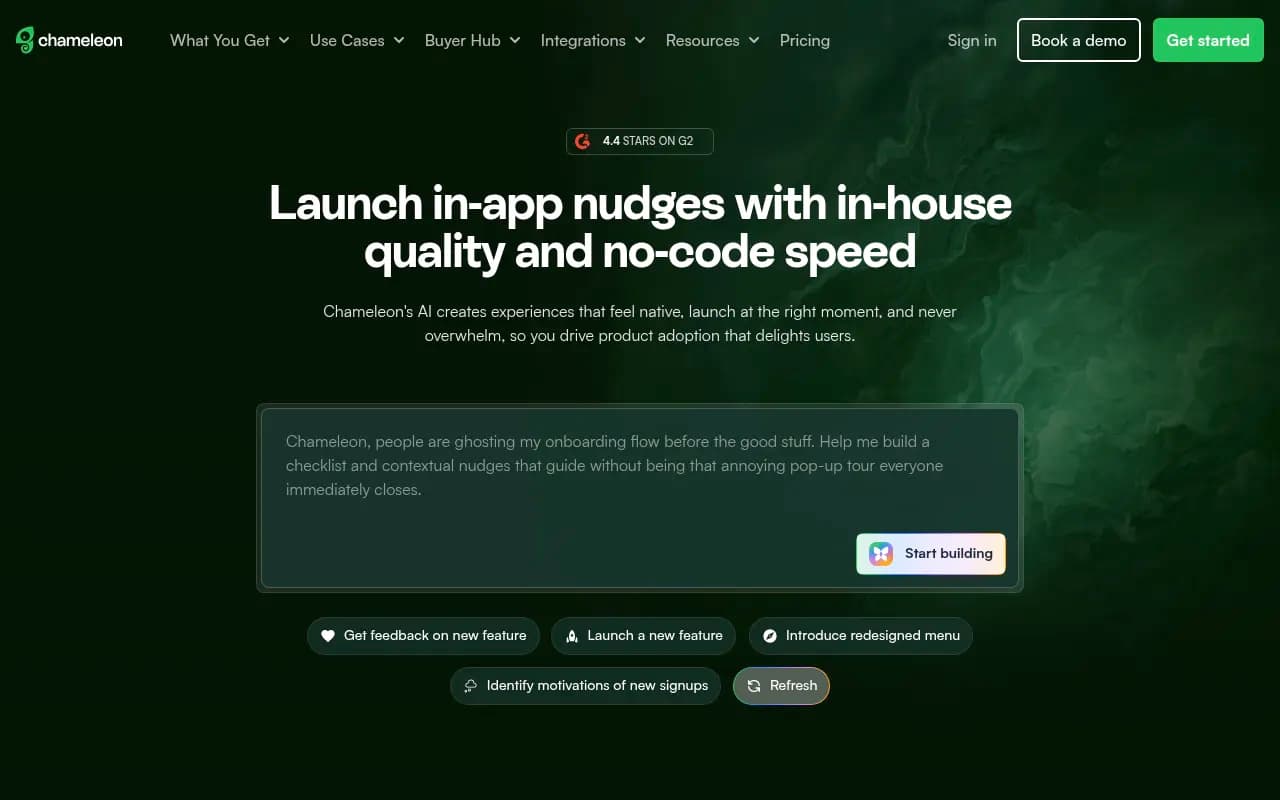
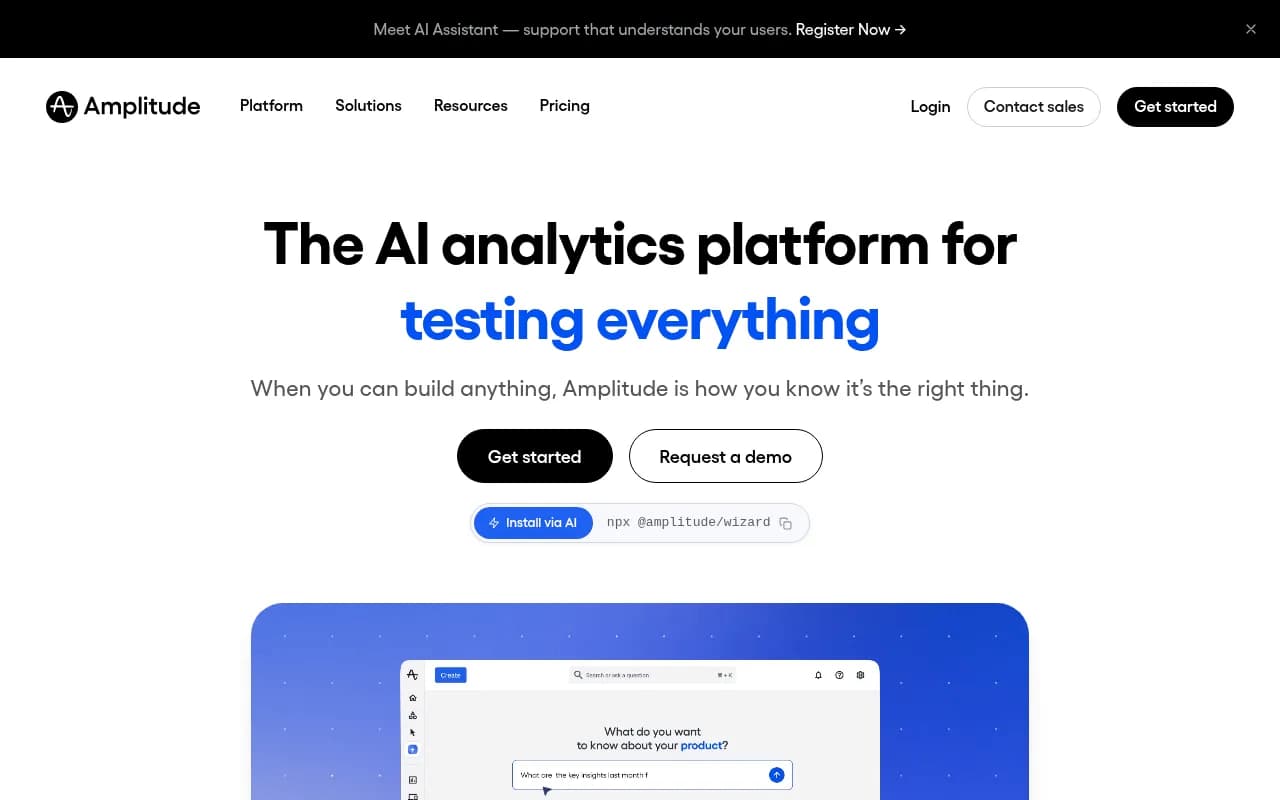
The trade-off, per the comparison write-ups, is lighter analytics than Userpilot or Pendo. Chameleon is an engagement layer, not an analytics platform. If your team already runs Mixpanel or Amplitude and just wants a beautiful delivery layer on top, that is fine. If you were hoping for one tool that replaces your analytics, it isn't.
Pendo
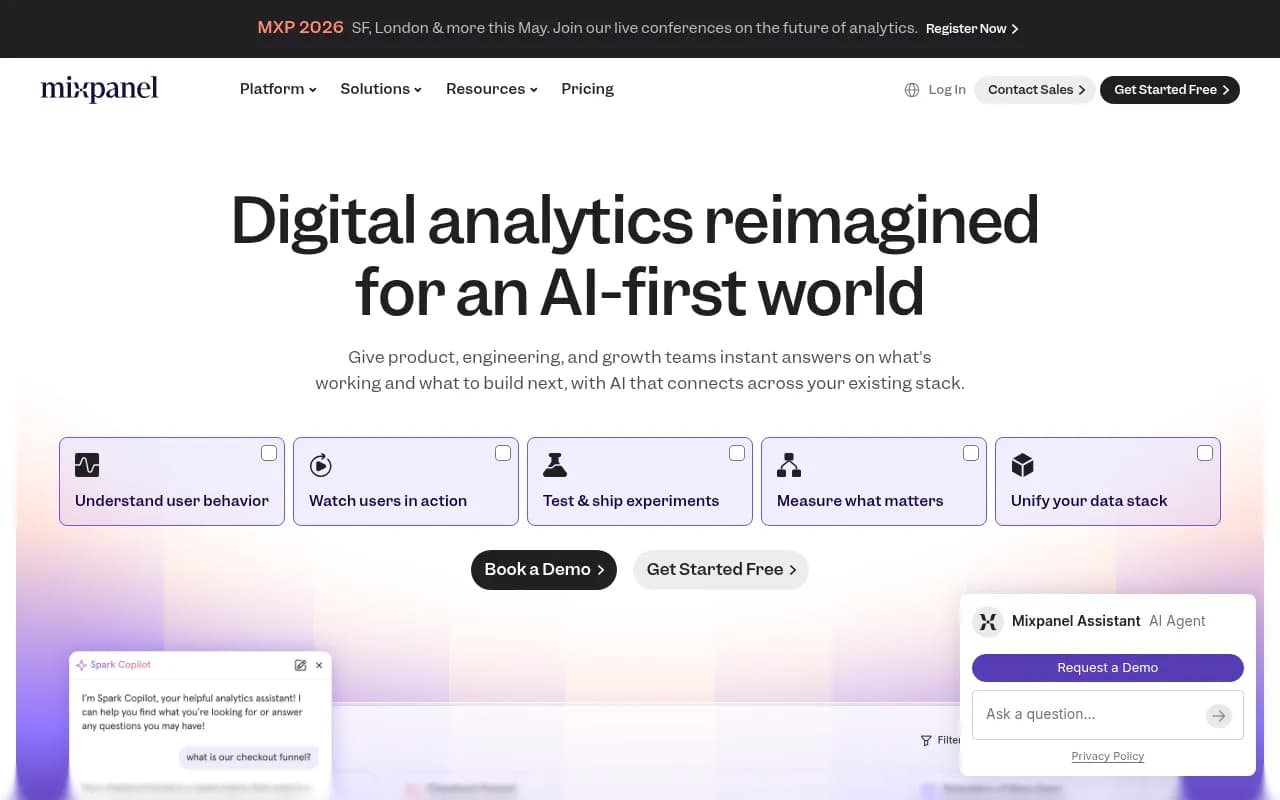
Pendo is the suite option. It bundles product analytics, guides, session replay and feedback, and it is sold on quotes, with a free tier reported up to 500 MAU. For mid-size to large organizations that want adoption analytics and in-app guidance under one contract, it is the usual shortlist leader.
It is more than most early-stage teams need, and the price reflects that. The honest summary: Pendo is stronger than Userpilot on analytics depth, and weaker on the "I just want to ship a checklist this week" front.
UserGuiding
UserGuiding targets early-stage teams on a budget, with reported pricing between $174 and $249/mo depending on the source. It bundles onboarding flows with a knowledge base, which is the main reason to pick it over a pure flow builder. The analytics are lighter, and the product is less suited to complex branching journeys. For a first onboarding project at a seed-stage SaaS, it is hard to argue with the price.
ProductFruits
ProductFruits pairs onboarding flows with AI-powered support elements, aimed at startups and SMBs. All plans reportedly ship the full feature set, so the Starter tier at about $149/month differs from higher plans mainly in usage limits. Its Life Ring widget centralizes knowledge base search, feedback, live chat and tour replays in one place.
Two cautions. First, ProductFruits publishes its own Userpilot comparison claiming it wins for 90% of SaaS teams, which is marketing, not a benchmark. Second, a G2 reviewer criticized how hard it is to position tours so they work on both desktop and mobile, and ProductFruits itself concedes Userpilot is the better fit for mobile-specific patterns and journeys with 10+ branching paths. It suits browser-based onboarding with simple paths.
Userflow
Userflow is a mid-market no-code option for web onboarding, reported at roughly $240/mo on the Startup plan. It is focused and does not try to be an analytics platform. If the brief is "web checklists and tours, no deep analytics", it is a reasonable fit.
WalkMe and Whatfix
These two belong in a different category, and Userpilot's own article is right about that. WalkMe's real use case is overlaying software you don't own, such as Salesforce, Workday or NetSuite, for rollouts to thousands of employees, usually with services attached. Reported pricing is six-figure annual contracts. Whatfix is positioned similarly for enterprise employee training across app portfolios, with estimates around $23,000-25,000 a year.
For onboarding customers into your own SaaS product, both are heavy: long implementations, dedicated admins, large contracts. If your actual problem is internal change management, they are the right shortlist. If it isn't, don't let a sales demo talk you into one.
Lemon Learning and Stonly also appear on these lists. Lemon Learning leans on internal employee adoption and EU data sovereignty, and Stonly on guided help and knowledge content. Both fit the employee and support side more than PLG onboarding.
AI-native options: Frigade and Perspective AI
Two newer approaches deserve a mention, with a caveat: both rankings that put them first were written by the vendors or by close relatives of them.
Frigade's cofounder wrote the productonboarding.com ranking that puts Frigade Assistant at #1, and he says so openly. The pitch is an agent that learns your product, answers questions in the live UI and generates tours from a prompt, instead of asking your team to author and maintain every flow. Reported pricing is around $1K/mo usage-based for Assistant, with Frigade Engage free under 250 monthly users and about $300/mo on its Growth plan. It is a genuine alternative if flow maintenance is your pain, but weigh the source of the ranking.
Perspective AI takes a different angle. Its pitch is that Userpilot-style microsurveys capture a rating, not an explanation, and that AI-led interviews can ask why a user stalled. That is a research tool rather than a flow builder, so it complements an onboarding platform more than it replaces one.
When a DAP isn't enough: LMS and hybrid tools
MeltingSpot's comparison makes a fair point. Digital adoption platforms guide users in the moment, but they rarely support multi-step skill building, certification or compliance tracking. Classic learning management systems go deeper but pull people out of the software. If your problem is formal training rather than activation, look at LMS or hybrid tools instead of another flow builder.
How to choose
Decide which problem you have
- Customer activation inside your own SaaS: Userpilot, Appcues, Chameleon, Userflow, UserGuiding, ProductFruits, Pendo.
- Employee adoption of third-party enterprise software: WalkMe, Whatfix, Lemon Learning.
- Explaining drop-off rather than measuring it: a research layer such as Perspective AI alongside your flow tool.
- Not wanting to maintain flows manually: an AI-native option such as Frigade.
Price the tier you need, not the headline
Write down the features you can't live without: funnels, session replay, A/B testing, localization, mobile. Then price that tier. For Userpilot, that usually means Growth from $849/mo, not $299. For Appcues, it means a quote. A cheaper tool with a simpler editor can win outright if you only need tours and checklists.
Check the mobile and analytics gaps
If you need native mobile, start with Appcues, or Userpilot's Enterprise tier with the mobile add-ons. If you need deep analytics, either choose Pendo or pair a lighter flow tool with a dedicated analytics product.
Run a two-week pilot on one real flow
Build the same onboarding checklist in two tools and measure setup time, how it renders on your real UI, and what happens when you change a page. Editor friction only shows up on your own product. Also ask each vendor what happens when you exceed MAU limits.
A note on measuring AI-driven acquisition
Onboarding tools only help once people arrive. If you are also tracking how your product shows up in ChatGPT or Google AI Overviews, a platform like Promptwatch can show which prompts mention you and what traffic they send. You can browse more options in the GEO software directory at bestgeosoftware.com.

Final recommendation
For most PLG SaaS teams, the shortlist is Userpilot, Appcues and Chameleon, with Pendo added if analytics is the deciding factor. Pick UserGuiding or ProductFruits if budget is tight and your flows are simple. Pick WalkMe or Whatfix only if you are rolling software out to employees. Before any of them, get a written quote for the exact tier and MAU volume you need, because the gap between headline and real price is where most of these evaluations go wrong.