Key takeaways
- Profound is a solid AI visibility tracker, but it stops at the data -- it won't help you create the content that actually improves your citations
- Content teams in 2026 need platforms that move from "you're invisible here" to "here's the article that fixes it"
- The 7 tools below all offer some form of content generation or optimization on top of visibility tracking
- Pricing ranges from ~$49/month to enterprise contracts, so there's a realistic option for most team sizes
- Promptwatch is the only platform in this comparison rated as a "Leader" across both monitoring and content generation categories
Profound does one thing really well: it shows you where your brand appears (or doesn't) inside AI-generated answers from ChatGPT, Perplexity, Claude, and Google AI Overviews. For a pure visibility dashboard, it's genuinely good.
But here's the problem most content teams run into after a few weeks. You've got a beautiful report showing that your competitor ranks for 40 prompts you don't. Now what? Profound doesn't write the articles. It doesn't tell you what angle to take, what questions to answer, or how to structure content so that an LLM will actually cite it. You're left staring at a gap analysis with no clear path forward.
That's the gap this guide addresses. The 7 platforms below all go further than monitoring -- they help you act on what you find.
Why "monitoring only" isn't enough anymore
The GEO tools market exploded in 2025-2026. There are now dozens of platforms that will track your brand mentions across AI engines. Most of them are essentially dashboards: they show you a score, a trend line, and a list of prompts where you're missing.
That's useful context. But content teams aren't paid to watch dashboards. They're paid to create content that drives traffic, leads, and revenue. The disconnect between "visibility data" and "content output" is where most monitoring-only tools fall short.
What you actually need is a platform that:
- Identifies the specific prompts and topics where you're invisible
- Tells you what content would close those gaps
- Helps you create that content (or at least gives you a strong brief)
- Tracks whether the new content actually improved your citations
Very few tools do all four. The ones below come closest.
The 7 best Profound alternatives for content teams
1. Promptwatch -- best overall for the full content loop
Promptwatch is the most complete option here if your goal is to go from "gap identified" to "article published" to "visibility improved" without switching tools.

The core workflow is built around what the platform calls the Action Loop. Answer Gap Analysis surfaces the exact prompts where competitors appear but you don't -- not just a count, but the specific questions and topics. From there, a built-in AI writing agent generates articles, listicles, and comparisons grounded in real citation data. The platform has processed over 880 million citations, so when it suggests a content angle, it's based on what AI models actually cite, not generic SEO advice.
What separates Promptwatch from most alternatives is the traffic attribution layer. You can connect a code snippet, Google Search Console, or server log analysis to see which AI-generated content is actually sending visitors to your site. That closes the loop in a way that pure visibility trackers can't.
A few other things worth knowing: Promptwatch tracks 10 AI models (ChatGPT, Perplexity, Claude, Gemini, Grok, DeepSeek, Copilot, Meta AI, Google AI Overviews, and Google AI Mode), has real-time AI crawler logs showing which pages bots are reading and which are throwing errors, and includes Reddit and YouTube tracking -- two channels that directly influence what LLMs recommend but that most competitors ignore entirely.
Pricing starts at $99/month for the Essential plan (1 site, 50 prompts, 5 articles/month). Professional is $249/month with crawler logs and city-level tracking. Business is $579/month for up to 5 sites. Free trial available.
2. Writesonic -- best for teams that want content generation baked in from day one
Writesonic started as an AI writing tool and has since built out a GEO layer on top of it. That origin story shows in how the product feels: content creation is the primary workflow, and visibility tracking is there to inform what you write.
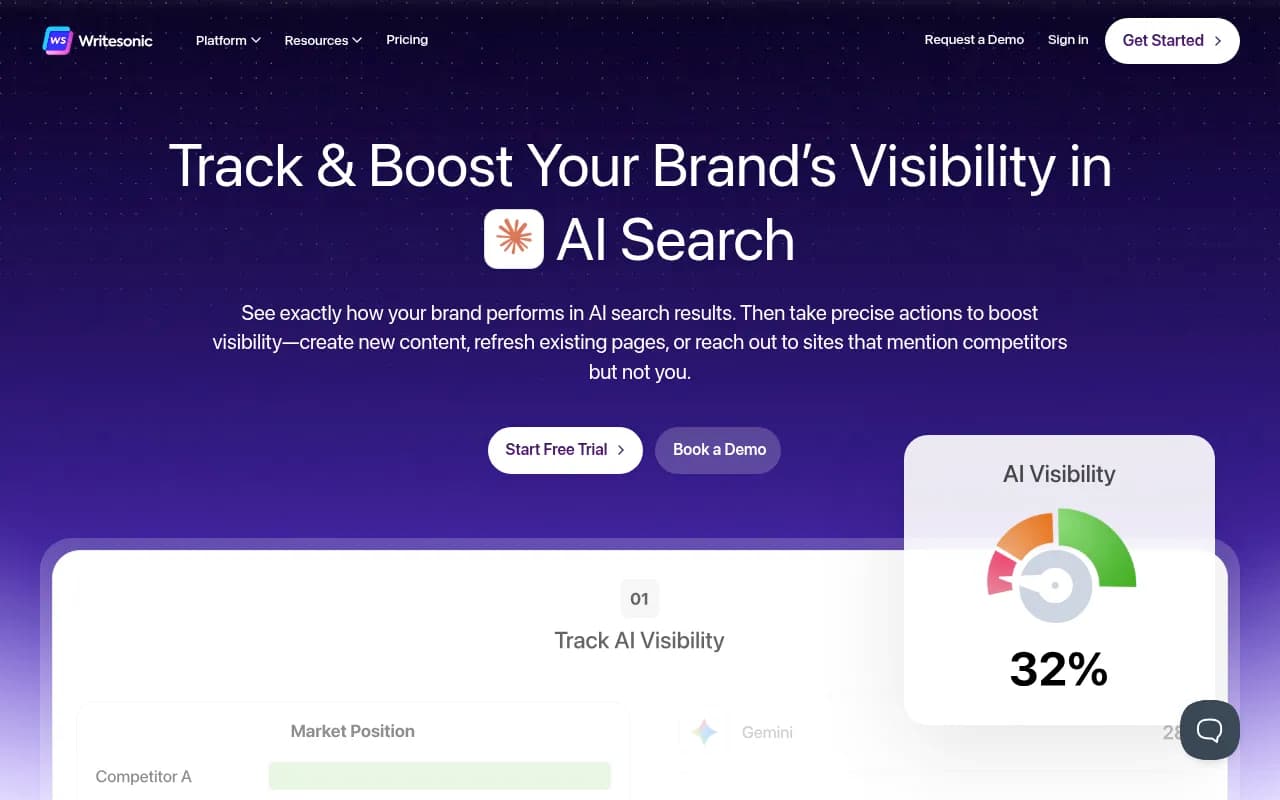
The platform tracks brand mentions across major AI engines and pairs that data with a content editor that can generate and optimize articles. If you're a content team that already uses Writesonic for blog production, the GEO features are a natural extension rather than a separate tool to learn.
The limitation is depth on the analytics side. Prompt-level difficulty scoring, query fan-outs, and AI crawler logs aren't really part of the offering. It's better suited to teams that want to produce more content faster and use AI visibility data as a directional signal rather than a precise measurement.
3. Scrunch AI -- best for technical teams who want to control what AI crawlers see
Scrunch takes a different angle. Instead of focusing primarily on content creation, it focuses on AI delivery control -- essentially, what information AI crawlers receive when they visit your site and how that shapes what gets cited.
This is genuinely useful for technical SEO teams and developers who want to understand and influence the crawl layer. Scrunch provides visibility into how AI engines index your content and gives you tools to adjust what they see.
The trade-off: it's more technical than most content marketers will want to deal with, and the content generation capabilities are limited compared to Promptwatch or Writesonic. Think of it as a strong complement to a content-focused tool rather than a standalone solution.
4. AthenaHQ -- best for enterprise teams with budget to match
AthenaHQ is a full GEO platform aimed at enterprise brands. It covers AI visibility tracking, automation, and some revenue attribution -- a broader scope than most tools in this space.

The platform is monitoring-focused at its core, but the enterprise tier includes workflow features that help teams act on what they find. It's genuinely capable, and if you're a large brand with a dedicated GEO team and an enterprise budget, it's worth evaluating.
The honest caveat: content generation capabilities are not AthenaHQ's strongest suit. You'll likely still need a separate writing tool or a platform like Promptwatch to handle the actual article production. Pricing is also on the higher end -- expect to be in enterprise contract territory.
5. SE Ranking -- best for SEO teams who want AI visibility inside a full SEO suite
SE Ranking has been building out its AI visibility toolkit steadily, and it now sits in a useful middle ground: you get solid AI search tracking alongside all the traditional SEO features (rank tracking, site audits, backlink analysis) in one platform.
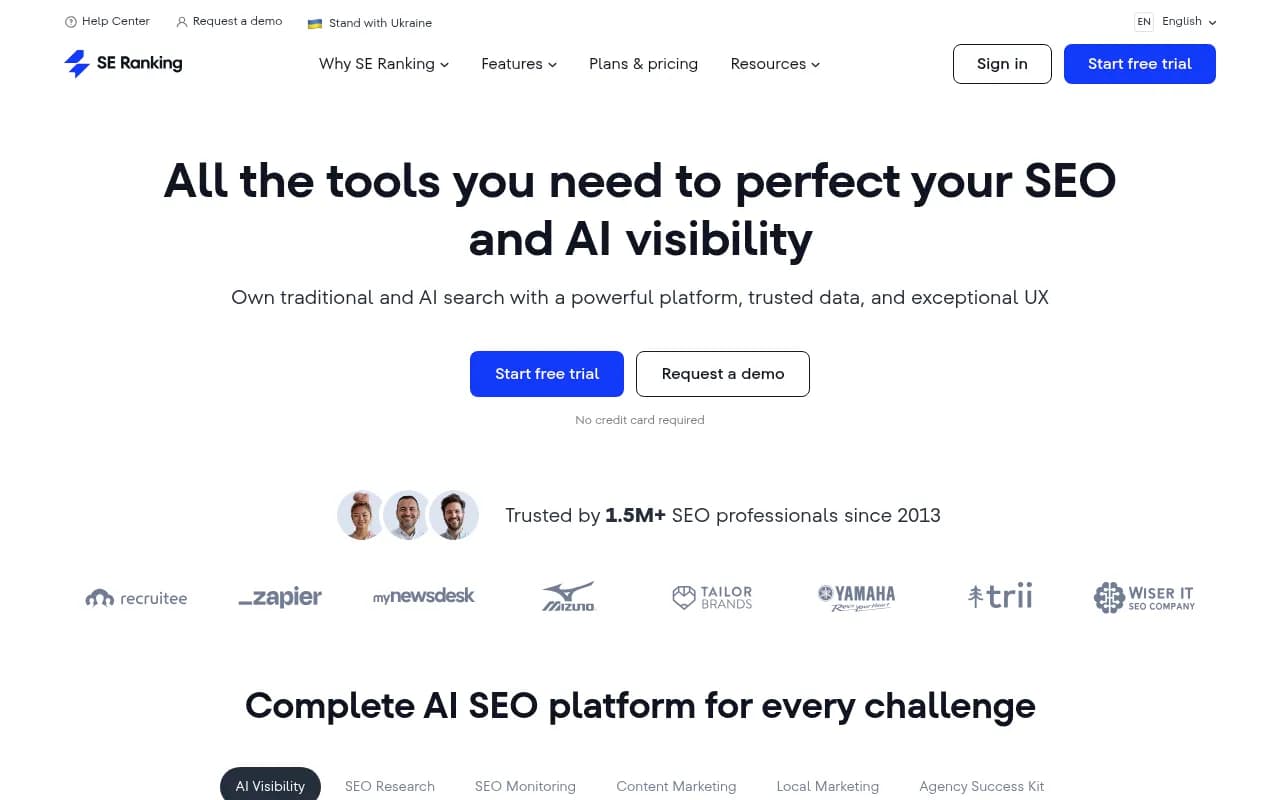
For teams that don't want to manage separate tools for traditional SEO and AI visibility, SE Ranking is a practical choice. The AI content tools are decent -- not as purpose-built for GEO as Promptwatch's citation-grounded writing agent, but functional for teams that need to produce content at scale.
The AI visibility tracking covers Google AI Overviews well, which makes sense given SE Ranking's Google-first heritage. Coverage of other AI engines is improving but still not as broad as dedicated GEO platforms.
6. Ranketta -- best for e-commerce brands tracking product-level AI visibility
Most GEO tools track brand mentions. Ranketta tracks individual products. If ChatGPT Shopping recommends your competitor's running shoes instead of yours, Ranketta shows you exactly which product is losing and what content changes might fix it.
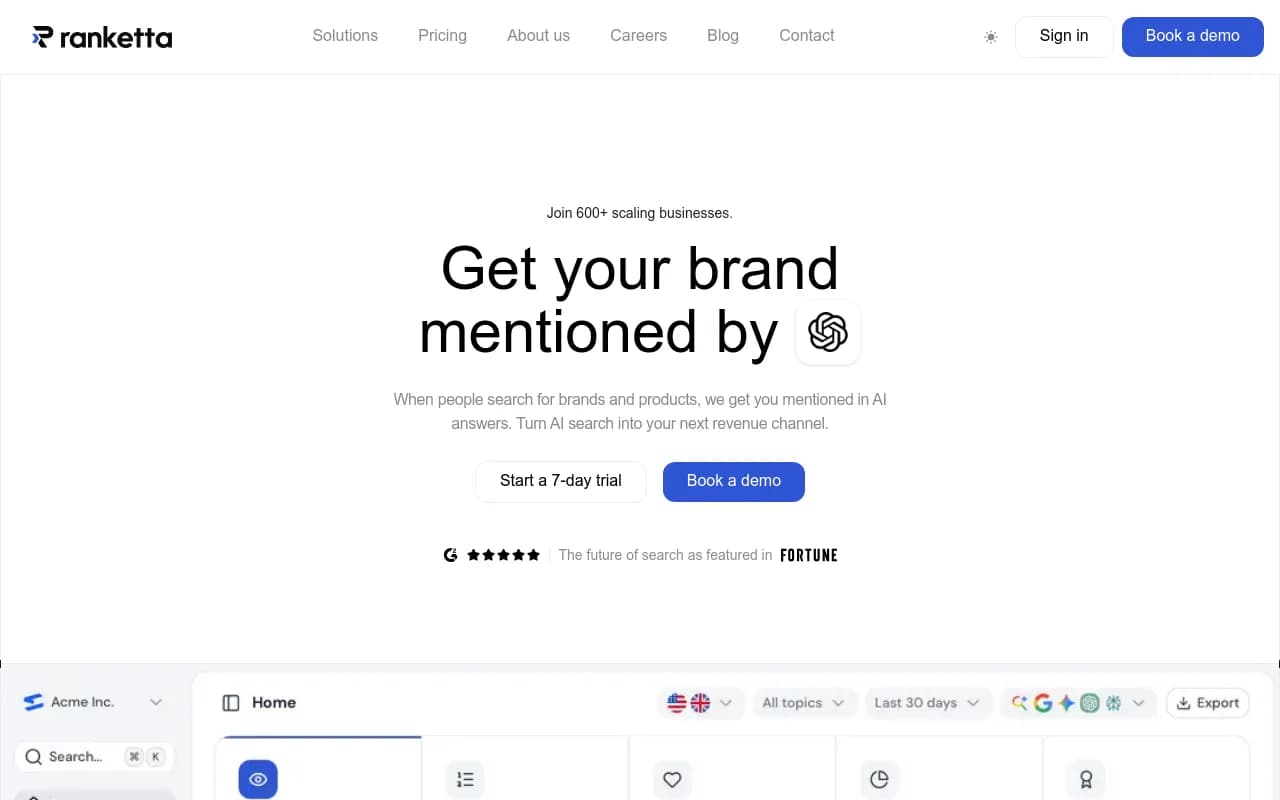
That product-level granularity is genuinely rare. For D2C and e-commerce brands where AI shopping recommendations are becoming a meaningful traffic channel, Ranketta fills a gap that broader platforms don't address.
The platform also includes article generation (2-6 articles/month depending on plan), so it's not purely a monitoring tool. Starter plans begin with a 7-day free trial, which makes it easy to test before committing.
The limitation is scope: if you're not in e-commerce, a lot of Ranketta's differentiation doesn't apply to you.
7. Otterly.AI -- best for small teams or agencies on a tight budget
Otterly.AI is the most affordable option in this comparison. It covers brand monitoring across AI engines, tracks mentions and sentiment, and sends alerts when something changes.

For small teams or agencies that need to show clients "here's where you appear in AI search" without a large monthly commitment, Otterly works. It's honest about what it is: a monitoring tool with a clean interface and accessible pricing.
What it doesn't do: content generation, AI crawler logs, prompt difficulty scoring, or traffic attribution. If you need any of those, you'll outgrow Otterly quickly. But as a starting point or a budget-conscious option for basic AI visibility reporting, it's solid.
Feature comparison table
| Platform | AI engines tracked | Content generation | Crawler logs | Traffic attribution | Starting price |
|---|---|---|---|---|---|
| Promptwatch | 10 (most complete) | Yes -- citation-grounded articles | Yes | Yes (GSC, snippet, logs) | $99/mo |
| Writesonic | 4-6 | Yes -- native writing tools | No | Limited | ~$49/mo |
| Scrunch AI | 4-5 | Limited | Yes | No | Custom |
| AthenaHQ | 8 | Limited | No | Some | Enterprise |
| SE Ranking | 3-4 (Google-focused) | Yes -- basic | No | No | ~$65/mo |
| Ranketta | 3-7 (plan-dependent) | Yes -- 2-6 articles/mo | No | Yes (visitor analytics) | Starter trial |
| Otterly.AI | 4-5 | No | No | No | ~$29/mo |
| Profound | 4-5 | No | No | No | $99-$399+/mo |
How to choose the right tool for your team
The honest answer is that the right tool depends on where your team is in the GEO maturity curve.
If you're just starting out and need to understand where you stand before investing in content, Otterly.AI or SE Ranking give you a low-risk entry point. You'll get enough data to make the case internally for a bigger investment.
If you're an e-commerce brand and AI shopping recommendations are already on your radar, Ranketta's product-level tracking is worth the focused scope.
If you're a technical team that wants to control the crawl layer and understand how AI engines index your site, Scrunch is worth exploring alongside a content-focused tool.
If you're a content team that needs to move fast -- identify gaps, write articles, track results, repeat -- Promptwatch is the most complete option. The combination of Answer Gap Analysis, citation-grounded content generation, AI crawler logs, and traffic attribution means you're not stitching together three separate tools to do what one platform handles end-to-end.
The one thing I'd push back on is the idea that any of these tools is a "set it and forget it" solution. AI search is changing fast. The prompts that matter today will shift. The models that dominate citations will evolve. Whatever platform you choose, plan to revisit your prompt list and content strategy every quarter.
What Profound does well (and when to stick with it)
To be fair: Profound is a genuinely capable platform for enterprise analytics. If your primary need is deep reporting, brand configuration across multiple business units, and a polished dashboard for stakeholder presentations, Profound delivers that well.
The Profound Growth plan at $399/month and enterprise tiers in the mid-four figures make sense for large brands with dedicated GEO analysts who need granular data and don't need the platform to generate content for them.
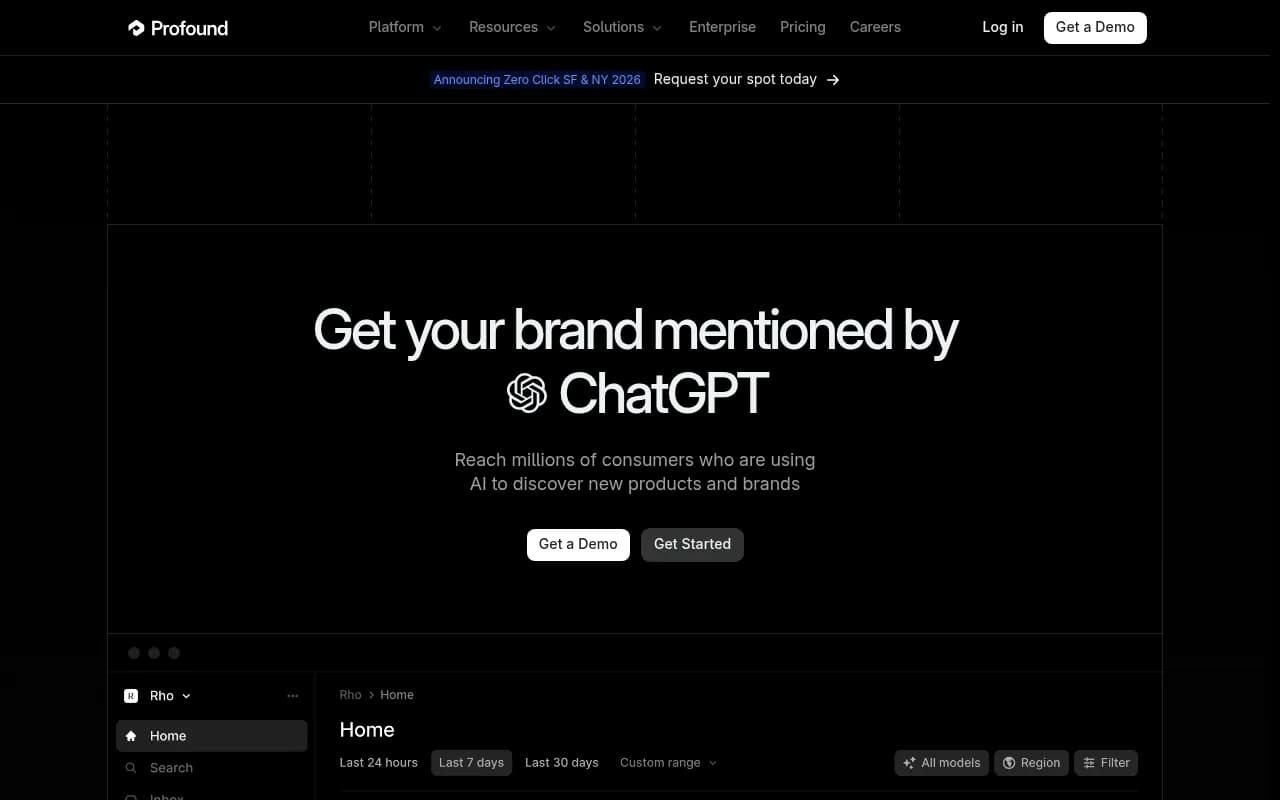
Where it falls short is exactly what this guide is about: if your team needs to act on the data, not just report on it, you'll find yourself exporting CSVs and handing them to a content team that has no idea what to do with them. That's the gap the alternatives above are built to close.
The bottom line
Visibility reports are a means to an end. The end is content that gets cited, traffic that converts, and a brand that shows up when someone asks an AI engine for a recommendation in your category.
Most Profound alternatives in 2026 are still monitoring-first tools. A handful -- Promptwatch most completely, Writesonic and Ranketta in more specific contexts -- have built the content generation layer that turns data into output.
If you're evaluating options, start with what your team actually needs to do next week. If the answer is "understand where we stand," almost any tool on this list will help. If the answer is "write content that improves our AI citations," the list gets shorter fast.