Key takeaways
- Omnia tracks AI share of voice and brand visibility, but stops short of telling you what content to actually create to close those gaps
- Answer gap analysis -- knowing which prompts your competitors get cited for that you don't -- is the missing piece most monitoring tools skip
- The best alternatives in 2026 combine visibility tracking with content gap diagnosis and, in some cases, content generation
- Tools range from lightweight trackers (Peec AI, Otterly.AI) to full optimization platforms (Promptwatch, Profound, AthenaHQ)
- If your goal is to fix your AI visibility, not just measure it, you need a tool that goes beyond dashboards
Omnia does a decent job of showing you where your brand stands in AI-generated answers. You get share of voice data, mention tracking, and a sense of how you compare to competitors across models like ChatGPT and Perplexity. That's useful. But at some point you'll hit the same wall every monitoring-only tool creates: you can see you're invisible, but the tool doesn't help you figure out why or what to do about it.
That's the answer gap problem. Your competitors are getting cited for questions you should own. The content those AI models want to reference exists on someone else's site, not yours. And unless a tool can show you which specific prompts, topics, and angles you're missing, you're left guessing.
This guide covers 8 alternatives to Omnia that actually address that gap -- some through deeper monitoring, some through content gap analysis, and some through end-to-end optimization workflows.
What Omnia does well (and where it falls short)
Omnia is positioned as an AI visibility and share of voice platform. It tracks how often your brand appears in AI responses, compares your presence against competitors, and gives you a visibility score across models.
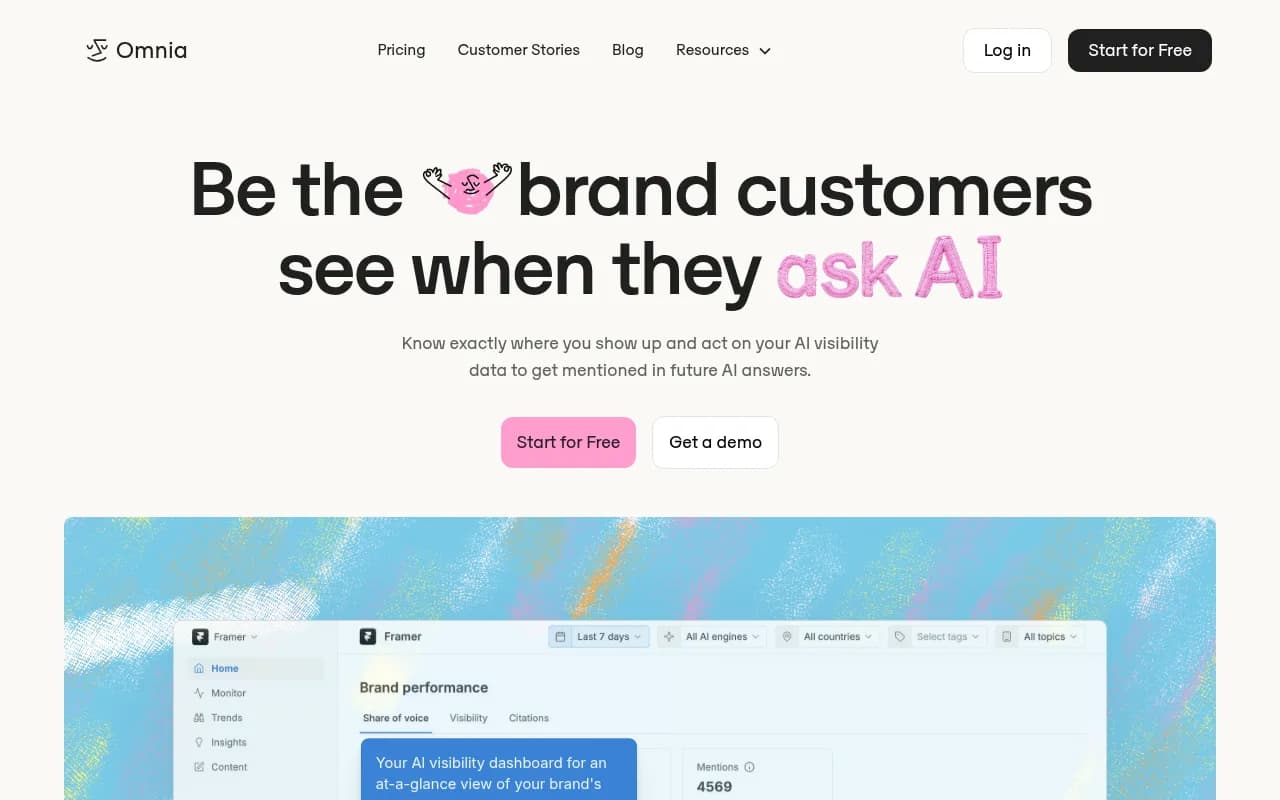
Where it works well: brand monitoring, competitive benchmarking, and getting a quick read on whether your AI presence is trending up or down. If you're a marketing leader who needs a simple answer to "how visible are we in AI search?", Omnia delivers that.
Where it falls short: it doesn't tell you why you're invisible for certain prompts. It doesn't show you which specific questions your competitors are answering that you're not. It doesn't generate content briefs or articles to close those gaps. And it doesn't track crawler behavior -- so you can't see whether AI agents are actually reading your pages or hitting errors before they get there.
In short: Omnia is a measurement tool. The alternatives below are optimization tools.
The 8 best Omnia alternatives in 2026
1. Promptwatch -- best for the full answer gap loop
Promptwatch is the most complete option on this list if your goal is to actually improve your AI visibility, not just track it. The core workflow is built around three steps: find the gaps, create content to fill them, and track the results.

The Answer Gap Analysis feature is what sets it apart. It shows you the specific prompts your competitors are getting cited for that you're not -- not just topic categories, but the actual questions, with prompt volume estimates and difficulty scores so you can prioritize. You can see exactly what information is missing from your site that causes AI models to reach for a competitor's page instead.
From there, Content Agents generate articles, listicles, comparisons, and briefs grounded in that prompt data. This isn't generic AI writing -- it's content engineered around the specific gaps the analysis surfaces. Once published, page-level tracking shows you when AI crawlers pick up the new content and when it starts generating citations.
Other capabilities worth knowing about: real-time AI crawler logs (so you can see which pages ChatGPT or Perplexity are actually reading), Reddit and YouTube insights that surface off-site content influencing AI recommendations, and ChatGPT Shopping tracking for brands in e-commerce. It monitors 10 AI models including Google AI Overviews, Claude, Gemini, DeepSeek, and Grok.
Pricing starts at $99/month for the Essential plan (1 site, 50 prompts, 5 articles). Professional is $249/month and adds crawler logs and multi-location tracking. Business is $579/month for teams managing multiple sites.
2. Profound -- best for enterprise-grade monitoring with strong data depth
Profound is one of the more serious platforms in this space. It tracks brand mentions across AI models with solid data depth, and it's built for teams that need reliable, structured visibility data at scale.

Where Profound pulls ahead of Omnia: the data quality and the breadth of AI models covered. Where it falls short relative to Promptwatch: it's still primarily a monitoring platform. You get good data on where you stand, but content gap analysis and content generation aren't the core workflow. Pricing is also on the higher end, which makes it a harder sell for mid-market teams.
Best for: enterprise marketing and SEO teams that need robust monitoring and competitive intelligence, and have separate content workflows to act on the data.
3. AthenaHQ -- best for teams that want clean, structured AI visibility data
AthenaHQ tracks your brand across 8+ AI search engines and presents the data in a clean, structured way. It's a solid monitoring tool that's easier to navigate than some of the more complex platforms.

The interface is genuinely good -- cleaner than most competitors in this space. But like Profound, AthenaHQ is monitoring-focused. It shows you visibility scores and competitor comparisons, but doesn't have content gap analysis or generation built in. If you're looking for a tool that tells you what to write, this isn't it. If you want clear, reliable visibility data to feed into your own content process, it works well.
4. Peec AI -- best for multi-language tracking on a budget
Peec AI is a lighter-weight option that covers AI visibility monitoring across multiple languages and regions. For international teams or agencies managing brands in non-English markets, it's one of the more practical options available.

It won't replace a full optimization platform, but it's affordable and covers the basics well. Prompt tracking, brand mention monitoring, and competitor comparisons are all there. Answer gap analysis isn't a core feature, so you'd need to layer in other tools to act on the data.
5. Otterly.AI -- best for simple, affordable monitoring
Otterly.AI is the most accessible entry point in this category. It's affordable, easy to set up, and gives you a clear picture of how your brand appears in AI responses without a steep learning curve.

The trade-off is depth. Otterly.AI is a monitoring dashboard -- it shows you what's happening but doesn't diagnose why or suggest fixes. For small teams or solo marketers who just want to know whether they're showing up in ChatGPT or Perplexity, it's a reasonable starting point. For teams that need to actually improve their visibility, it's a first step, not a solution.
6. SE Ranking -- best for teams that want AI visibility inside a broader SEO suite
SE Ranking is an all-in-one SEO platform that has added AI visibility tracking to its existing suite of keyword research, rank tracking, and site audit tools. If your team already uses SE Ranking for traditional SEO, the AI visibility module is a natural extension.
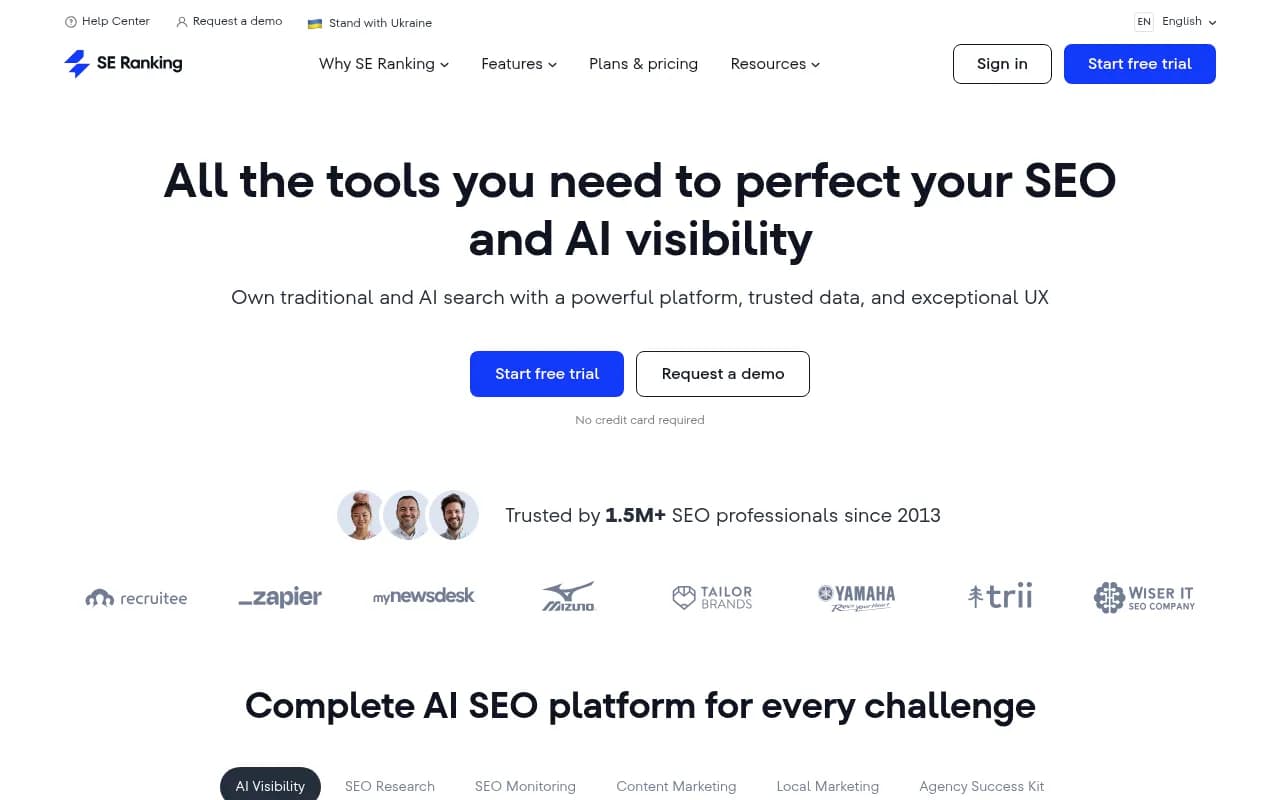
The advantage here is consolidation -- one platform for both traditional and AI search monitoring. The limitation is that the AI visibility features aren't as deep as dedicated platforms. Content gap analysis for AI search specifically isn't a core workflow. But for teams that want a single tool covering both channels without switching between platforms, SE Ranking is worth considering.
7. Scrunch AI -- best for brand-focused AI monitoring
Scrunch AI focuses on how AI models talk about your brand -- the sentiment, the framing, the context in which you get mentioned. It's more brand intelligence than SEO tool, which makes it useful for communications and brand teams alongside marketing.
If your primary concern is how your brand is being described in AI responses (not just whether you appear), Scrunch AI gives you that lens. It's less focused on prompt-level gap analysis and more on brand narrative. A different use case from most tools on this list, but a legitimate one.
8. Semrush -- best for teams that want AI visibility layered onto traditional SEO
Semrush has been adding AI search tracking capabilities to its existing platform, and for teams already invested in the Semrush ecosystem, it's a practical way to get some AI visibility data without adding another tool.
The honest limitation: Semrush's AI visibility features use fixed prompts rather than tracking the full range of real user queries. That means you're getting a partial picture. It also doesn't have the content gap analysis or content generation workflows that dedicated GEO platforms offer. But if you're a Semrush shop and want a basic read on AI visibility without a separate subscription, it covers the fundamentals.
How these tools compare
| Tool | Answer gap analysis | Content generation | Crawler logs | AI models tracked | Best for |
|---|---|---|---|---|---|
| Promptwatch | Yes | Yes (Content Agents) | Yes | 10+ | Full optimization loop |
| Profound | Partial | No | No | 8+ | Enterprise monitoring |
| AthenaHQ | No | No | No | 8+ | Clean monitoring data |
| Peec AI | No | No | No | 6+ | Multi-language tracking |
| Otterly.AI | No | No | No | 4+ | Simple, affordable monitoring |
| SE Ranking | No | No | No | 5+ | All-in-one SEO suite |
| Scrunch AI | No | No | No | 5+ | Brand narrative tracking |
| Semrush | No | No | No | Limited | Traditional SEO teams |
| Omnia | No | No | No | 5+ | Share of voice benchmarking |
What answer gap analysis actually looks like in practice
It's worth being specific about what "answer gap analysis" means, because the term gets used loosely.
The traditional version -- keyword gap analysis -- compares which keywords your competitors rank for that you don't. You export a list from Ahrefs or Semrush, sort by volume, and build content around the biggest opportunities. That process still works for traditional search.
For AI search, the gap is different. When ChatGPT answers a question about "best project management software for remote teams," it's not pulling from the page with the most backlinks. It's pulling from the source that most completely answers the question -- the one that covers the relevant entities, provides specific data points, and demonstrates genuine expertise on the topic. If your content is missing key comparisons, specific use cases, or structured context that a competitor's page includes, the AI cites them. You get nothing.
Real answer gap analysis for AI search means:
- Identifying which specific prompts your competitors are getting cited for that you're not
- Understanding what information those competitor pages contain that yours don't
- Prioritizing by prompt volume and difficulty so you work on the highest-value gaps first
- Generating content that addresses those gaps specifically, not just "more content"
Most monitoring tools -- including Omnia -- show you the outcome (you're not being cited) but not the cause (here's exactly what's missing). The distinction matters because knowing you're invisible doesn't help you fix it.
Which tool should you actually use?
It depends on what you're trying to accomplish.
If you want to measure your AI visibility and benchmark against competitors, Omnia, AthenaHQ, or Profound all do that reasonably well. Profound has the most data depth; AthenaHQ has the cleanest interface; Omnia is a solid middle ground.
If you're on a tight budget and just want basic monitoring, Otterly.AI or Peec AI are the most accessible options.
If you're managing an international brand or multiple markets, Peec AI's multi-language support is worth looking at.
If you want to actually improve your AI visibility -- not just measure it -- you need a tool with answer gap analysis and content generation built in. Promptwatch is the only platform on this list that covers the full loop: identify gaps, generate content to fill them, track the results. That's a meaningfully different product from the monitoring tools, and it's the difference between knowing you have a problem and being able to fix it.
The honest version: if you're evaluating Omnia alternatives because your AI visibility isn't where you want it, adding another monitoring tool won't solve the problem. Monitoring tells you the score. Optimization changes it.
A note on content quality for AI search
One data point worth keeping in mind: Forrester's 2026 research found that content providing unique "information gain" -- data, perspectives, or context that isn't already widely available -- ranks three times higher in AI responses than content that rehashes existing consensus. That finding has practical implications for how you approach content gaps.
It's not enough to write a page that covers the same ground as your competitors. AI models are increasingly good at identifying which source is most complete, most specific, and most authoritative on a topic. If your content gap analysis just tells you "write about topic X," you'll end up with content that competes on the same terms as what's already there. The better approach is to understand specifically what information is missing from your site that AI models are looking for -- and create content that genuinely fills that gap, not just checks the topic box.
That's why the gap analysis step matters as much as the content creation step. Getting both right is what actually moves your AI visibility numbers.