Key takeaways
- Furniture is a strong fit for AI shopping questions: long, specific, high-ticket, and full of facts about dimensions, fabric, delivery, and returns.
- Product and landing pages are the main citation surface. In Promptwatch Data for Sep 28 to Oct 4, 2026, they made up 22.4% and 16.8% of ChatGPT citations.
- Tool choice depends on what you need: monitoring only, monitoring plus content, or e-commerce product feed work.
- No tool fixes a product page that hides its dimensions. Clean facts come first, tools second.
- Most small retailers should start with a free visibility check, then pay for a platform that closes the loop from tracking to published content.
Why furniture is a special case for GEO
Nobody buys a sectional on impulse, though plenty of people have bought one that did not fit up the stairs. That anxiety is exactly why furniture shoppers lean on AI assistants. They ask long questions: "What is the best sofa for a small apartment with a dog?" "Will a 112-inch sectional fit through a 30-inch doorway?" Then they ask three more in a row and want a store named at the end.
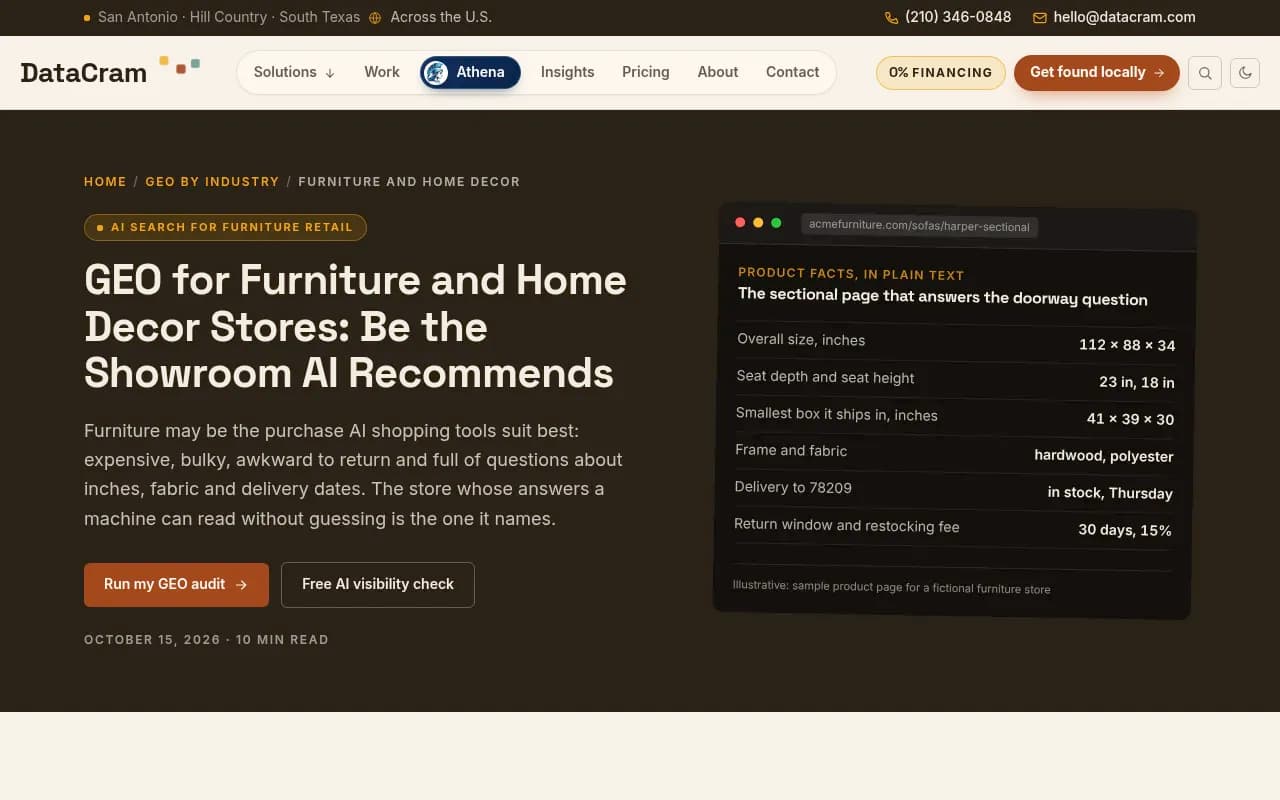
Generative engine optimization (GEO) is the practice of making your brand and pages the ones AI engines name and cite. For furniture and home decor, that mostly comes down to facts a machine can read without guessing: dimensions, materials, seat depth, box size, stock by location, delivery areas, and return terms. DataCram's furniture GEO guide makes the same argument with a sample product page, and I agree with the premise even though it is vendor content and should be read as such.
The tools below fall into three jobs: measuring where you appear, finding out why, and producing the pages that fix it. Some do one. A few do all three.
What the data says about what AI cites
There is no furniture-specific citation report yet, so I will not pretend otherwise. What we do have is general ChatGPT data that applies directly to a catalog-driven retailer.
According to Promptwatch's data on ChatGPT citation share by content type (Sep 28 to Oct 4, 2026):
- Product pages were 22.4% of classified citations, landing pages 16.8%, and listicles 13.6%.
- On commercial prompts, where people compare options before buying, product pages rose to 26.0% and landing pages to 20.6%. Those two plus listicles and comparisons covered almost 70% of citations.
- On branded prompts, reviews were 5.6% of citations, more than three times their share across all prompts.
The takeaway for a furniture store: your product pages are the battleground, and your reviews matter more than usual once someone already knows your name.
One more caution. In Promptwatch's automotive report for August 2026, marketplaces like Autotrader and Cars.com outranked every car brand in ChatGPT citations. That is a different industry, not furniture data, but it is a reasonable warning. Wayfair, Amazon, and review roundups may well be what AI cites instead of your site. A good tool shows you which domains are filling that slot for your prompts.
Shopping cards matter too. ChatGPT attaches shopping features to only a low single-digit percentage of web-search responses, and the rate moves in steps, which Promptwatch reads as OpenAI tuning when product cards appear. They concentrate on commercial and transactional prompts. So Product schema, accurate prices and availability, and a clean merchant feed are worth doing, but do not expect them to carry everything.
What to look for in a GEO tool as a furniture retailer
Before the list, here is the checklist I would use:
- Prompt coverage that matches how buyers talk: room size, style, pet-friendly, budget, delivery timing.
- Real interface tracking rather than only API calls, since user-facing answers and citations can differ.
- Location tracking, because showrooms are local and "near me" queries are common.
- Citation and source reports, so you see which marketplaces and review sites AI trusts in your category.
- Crawler visibility. If AI bots cannot read your product pages, nothing else matters.
- A path from insight to action: content gaps, briefs, publishing.
- Pricing that makes sense for a retailer without an enterprise budget.
The best GEO tools for furniture and home decor retailers
Promptwatch
Promptwatch is the one I would put at the top for a retailer who wants more than a dashboard. It tracks how ChatGPT, Gemini, Perplexity, Google AI Overviews, Google AI Mode, Copilot, and others mention and cite your brand, then helps you fix gaps instead of leaving that work to you.

The features that matter most for furniture:
- IP-verified AI crawler logs show whether bots actually read your product pages, and where they fail. For stores with big catalogs and JavaScript-heavy templates, this is often where the real problem is.
- Local GEO/SEO targeting pins a monitor to exact coordinates, so ChatGPT and Google's AI surfaces answer as if asked from near your showroom (Business plan and above).
- ChatGPT Shopping insights show which products AI recommends and which competitors it picks instead.
- Content gap analysis and the Content Agent plan, write, and publish pages for the prompts you are missing, with WordPress, Webflow, and Framer publishing. Think buying guides, material comparisons, and small-space FAQs.
- Reddit, YouTube, and other citation reports show which threads and videos AI leans on. Check the Promptwatch Data reports before assuming Reddit is still a lever, since ChatGPT's Reddit citations dropped sharply in August 2026.
Pricing, per promptwatch.com/pricing: Essential is $95/mo, Professional $245/mo, and Business $579/mo. Note that the Content Agent, local targeting, Shopping insights, and state/city tracking start on Business, so a single-location store that wants only monitoring can begin lower. Confirm current numbers on the pricing page. There is a 7-day free trial on monthly billing, and a free AI visibility report if you want a snapshot first.
Profound
Profound is a strong monitoring platform aimed at larger brands. It is well regarded for tracking breadth, but it sits at a higher price point and leans toward reporting rather than doing the work for you. If you are a national furniture chain with a team to act on the data, it is worth a demo. See Promptwatch vs Profound for a direct comparison.

Scrunch
Scrunch focuses on AI visibility tracking with some work on how AI reads your site. It suits mid-size brands that want monitoring plus technical guidance. As with Profound, the action layer is thinner than an end-to-end platform.
Otterly.AI and Peec AI
Both are lighter prompt trackers. Otterly.AI is affordable, and Peec AI handles multi-language tracking well. For a small furniture store that only wants to know whether it is mentioned for a few dozen prompts, they are reasonable. They will not tell you whether AI crawlers can read your pages, and they will not write content.


Semrush and Ahrefs Brand Radar
If you already live in a classic SEO suite, Semrush and Ahrefs Brand Radar add AI visibility to what you use today. That is convenient. The tradeoff is fixed prompt sets and shallower AI-specific data than dedicated platforms.

Frizerly
Frizerly is aimed at small local businesses, including furniture stores. It auto-publishes weekly blog posts meant to rank in Google and be cited by AI. The pitch is appealing if you have nobody to write content. I would treat the claims on its own page as vendor marketing, check the sample output on its demo blog, and be careful about auto-publishing anything that states product facts you have not verified.

Yotpo Discover, Azoma, and Goodie AI for product discovery
These target e-commerce product discovery specifically. Yotpo Discover is built around product discovery for ecommerce, Azoma focuses on AI shopping optimization for ChatGPT and Amazon Rufus, and Goodie AI covers agentic commerce. They make most sense for larger online catalogs where marketplace presence is a big part of sales.


Local and review tools
For showrooms, reviews and listings feed AI answers too. BrightLocal, Reputation.com, and Yext keep your Business Profile, listings, and reviews consistent. They are not GEO platforms, but they fix the inputs AI reads about a local store.



Comparison table
| Tool | Tracks AI answers | Crawler visibility | Writes and publishes content | Local / showroom targeting | Best for |
|---|---|---|---|---|---|
| Promptwatch | Yes, real interfaces | Yes, IP-verified logs | Yes, Content Agent (Business+) | Yes, exact coordinates (Business+) | Retailers who want to fix gaps, not just see them |
| Profound | Yes | Limited | No agentic execution | Limited | Large brands with analysts |
| Scrunch | Yes | Some site-readability work | Limited | Limited | Mid-size brands |
| Otterly.AI / Peec AI | Yes, basic | No | No | Limited | Small stores watching a few prompts |
| Semrush / Ahrefs | Yes, fixed prompt sets | No | Content tools separate | No | Teams already in an SEO suite |
| Frizerly | Basic | No | Yes, auto-published blogs | Local-business focus | Small stores with no writer |
| Yotpo Discover / Azoma / Goodie AI | Product-focused | Varies | Varies | No | Large ecommerce catalogs |
| BrightLocal / Yext | No | No | No | Yes, listings and reviews | Fixing local inputs |
Capabilities for competitors reflect what each vendor publicly positions; check current plans before buying.
Fix the pages first: a furniture-specific checklist
A tool can tell you that you are invisible. It cannot invent the facts that are missing. Before spending on software, get these onto your product and category pages in plain text:
- Overall dimensions, seat depth and height, and the smallest box size, so "will it fit" has an answer.
- Frame, fabric, and fill materials, spelled out rather than shown in an image.
- Delivery windows by ZIP code and stock by location.
- Return window and restocking fee.
- Product schema with accurate price and availability, plus a clean merchant feed.
- A FAQ page that covers the questions buyers ask: pet-friendly fabrics, assembly, white-glove delivery.
- Comparison and buying-guide pages for your own range, since listicles and comparisons are a meaningful slice of commercial citations in Promptwatch's data.
- Reviews gathered on the sites your buyers trust, not only your own.
Then check access. The free Agentic Readiness Check and AI Crawler URL Inspector tell you whether AI crawlers can reach your pages, and the robots.txt generator for AI helps if you have blocked them by accident.
How to choose
- Single store, tiny budget: start with the free AI visibility report, fix your product pages and Business Profile, and add a low-cost tracker only if you will check it weekly.
- Regional chain with several showrooms: you need location-aware tracking and crawler data, which points to Promptwatch's Business plan.
- Online-first retailer with a large catalog: combine a GEO platform for citation and crawler data with a product-discovery tool, and watch the marketplaces that outrank you.
- Agency serving furniture clients: look at agency plans rather than brand plans. Promptwatch's Kick-off, Growth, and Scale tiers ($199, $399, and $799/mo) give unlimited projects.
If you would rather hand the whole thing to a team, 1001 SEO Media is a full-service SEO and GEO agency that works with Promptwatch. Several agencies in this space, including furniture-specific ones, are launching AI search programs, so ask any of them for examples before signing.
For more options, browse the GEO software directory at bestgeosoftware.com.
A sensible first 30 days
- Week 1: run a free visibility report, and list 30 to 50 prompts your buyers really ask, including room-size, material, and budget questions.
- Week 2: audit your top 20 product pages for missing dimensions, materials, and delivery facts. Fix them.
- Week 3: check crawler access and schema. Note which marketplaces and roundups get cited for your prompts.
- Week 4: publish two or three comparison or buying-guide pages, then re-run your prompts and see what moved.
It is not glamorous. But the stores that AI names tend to be the ones that wrote down the numbers a machine would otherwise guess.