Key takeaways
- Ceyo AI is a solid entry-level monitor for tracking brand mentions across ChatGPT, Perplexity, Claude, and Gemini -- but it stops at showing you data
- Most Ceyo AI alternatives fall into the same trap: they're dashboards, not optimization tools
- The tools worth switching to are the ones that close the loop -- finding content gaps, generating AI-optimized content, and tracking whether it worked
- Promptwatch is the only platform in this space rated as a "Leader" across all GEO categories, largely because it moves beyond monitoring into actual content optimization
- If budget is the main concern, Otterly.AI and Peec AI are the most affordable entry points; if you need the full picture, Promptwatch is the clear step up
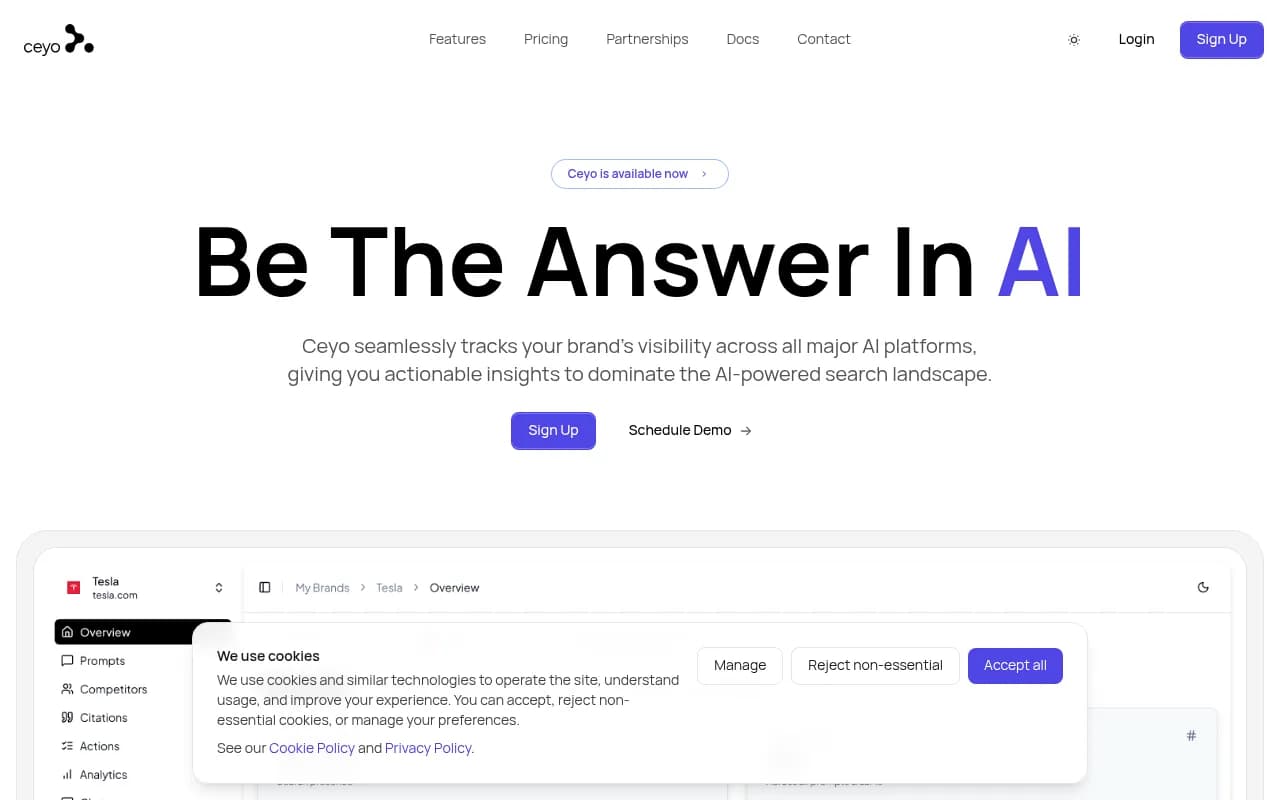
Ceyo AI does what it says on the tin. You connect your brand, set up some prompts, and it tells you when ChatGPT, Perplexity, Claude, or Gemini mention you -- and roughly how often. For a lot of teams just getting started with AI visibility, that's genuinely useful.
But here's the problem: knowing you're invisible doesn't make you visible. Knowing a competitor is getting cited more than you doesn't tell you why, or what to do about it. And that's where Ceyo AI, like most monitoring-only tools, runs out of road.
If you've hit that ceiling -- or you're evaluating tools before you even start -- this guide covers the best Ceyo AI alternatives in 2026, with a clear-eyed look at what each one actually does versus what it promises.
What to look for in a Ceyo AI alternative
Before diving into specific tools, it's worth being honest about what the market looks like. There are now dozens of "GEO platforms" and "AI visibility trackers." Most of them are monitoring dashboards with a slightly different UI. They track brand mentions, show you a share-of-voice chart, and send you a weekly report. That's fine as far as it goes.
The tools that are actually worth paying for do at least some of the following:
- Show you which prompts competitors rank for that you don't (answer gap analysis)
- Help you understand why AI models cite certain sources over others
- Generate or suggest content specifically engineered to get cited by LLMs
- Track AI crawler activity on your own site (which pages are being read, how often, what errors they hit)
- Connect AI visibility to actual traffic and revenue
If a tool can't do at least two of those things, you're essentially paying for a fancier version of what Ceyo AI already offers.
The best Ceyo AI alternatives in 2026
Promptwatch -- best for teams that want to actually improve their AI visibility
Promptwatch is the most complete platform in this space, and the one most worth switching to if you've outgrown monitoring-only tools. The core difference is the action loop: find gaps, create content, track results.
The Answer Gap Analysis is genuinely useful -- it shows you the specific prompts where competitors are getting cited and you're not. Not just "you're missing coverage in category X" but the actual questions and topics AI models are answering from competitor content. From there, the built-in AI writing agent generates articles and comparisons grounded in 880M+ citations analyzed, so the content it produces is calibrated to what LLMs actually want to cite, not just what ranks in Google.
On top of that, Promptwatch has AI crawler logs (real-time visibility into which pages ChatGPT, Claude, and Perplexity are crawling on your site), ChatGPT Shopping tracking, Reddit and YouTube citation insights, and traffic attribution via GSC integration or server log analysis. It monitors 10 AI models including Google AI Overviews, Grok, DeepSeek, and Mistral -- more than most competitors.
Pricing starts at $99/month for the Essential plan (1 site, 50 prompts, 5 articles). Professional is $249/month. A free trial is available.

Otterly.AI -- best budget option for getting started
Otterly.AI is consistently recommended as one of the most affordable ways to get into AI visibility tracking. It covers the main LLMs, tracks brand mentions, and gives you a reasonable starting point for understanding your share of voice.
It's a monitoring tool, full stop. There's no content generation, no crawler logs, no gap analysis. But if you're a small team or solo marketer who just needs to know whether you're showing up at all, it's hard to argue with the price.

Peec AI -- best for multi-language tracking
Peec AI has carved out a niche with multi-language AI visibility tracking, which matters more than people realize. AI models give different answers in different languages and regions -- a brand that's well-cited in English responses might be invisible in French or Spanish ones.
It offers smart suggestions for improving visibility, which puts it slightly ahead of pure monitoring tools. Still, it lacks the content generation and crawler log capabilities that would make it a full optimization platform.

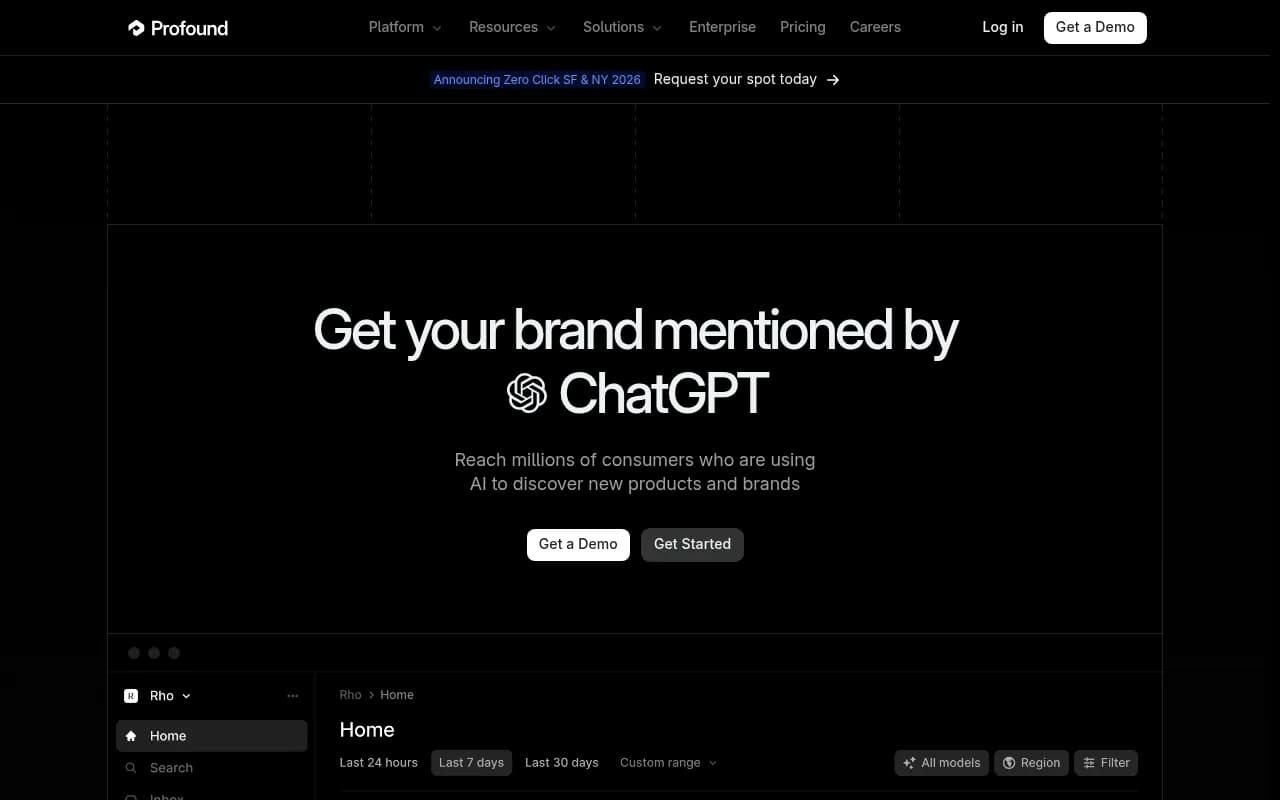
Profound -- best for enterprise teams with budget to match
Profound is one of the more feature-rich platforms in the space. It covers brand tracking across major AI models, has solid reporting, and is built for larger organizations with more complex needs. Zapier's roundup of AI visibility tools called it out specifically for all-in-one enterprise needs.
The trade-off is price -- Profound sits at a higher price point than most alternatives here, and it doesn't have Reddit tracking or ChatGPT Shopping monitoring. If you're at enterprise scale and need deep reporting, it's worth evaluating. If you're mid-market, the cost-to-value ratio may not work out.
AthenaHQ -- best for teams focused on brand tracking across multiple AI engines
AthenaHQ tracks brand visibility across 8+ AI search engines and has a clean interface for monitoring how your brand appears in AI responses. It's a step up from Ceyo AI in terms of breadth of coverage.
The limitation is that it's still primarily a monitoring tool. It doesn't have content optimization or generation capabilities, which means you'll still need a separate workflow to act on what you find.

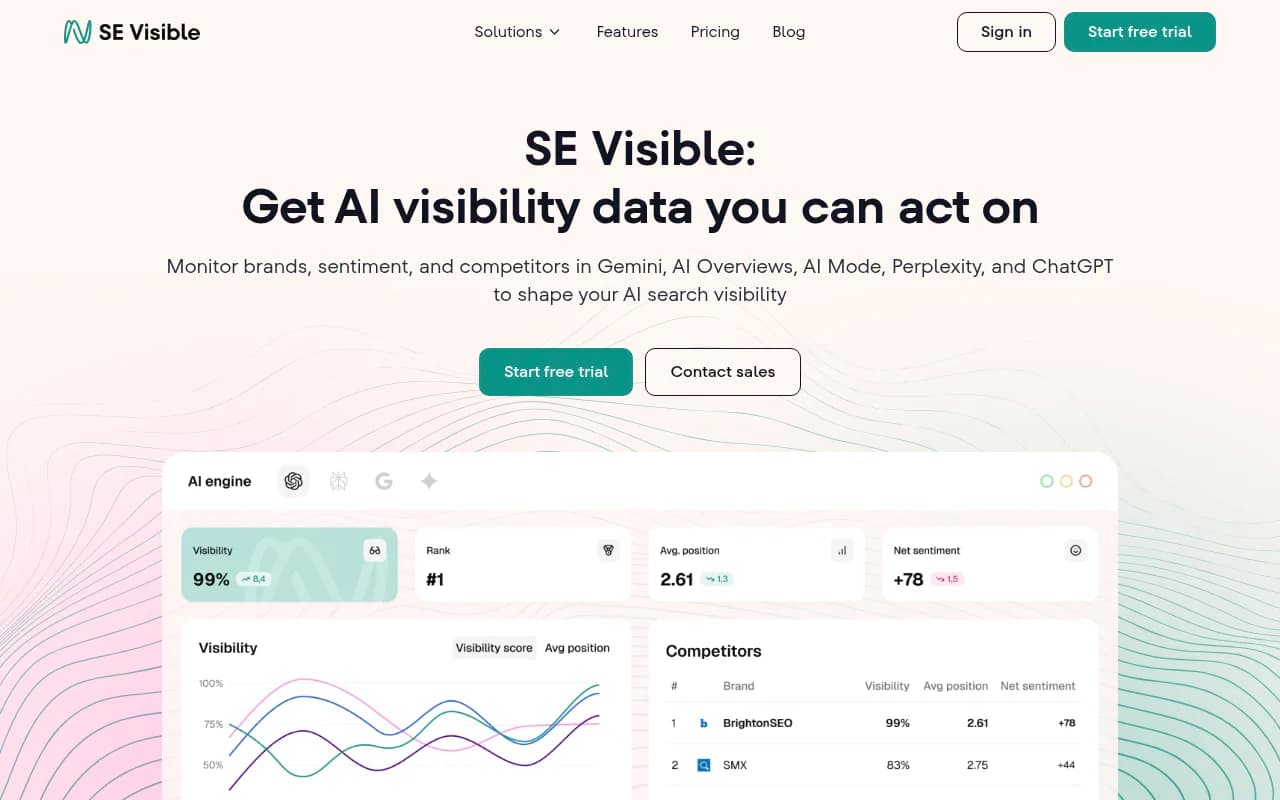
SE Visible -- best for teams already using SE Ranking
SE Visible is SE Ranking's AI visibility product. If you're already paying for SE Ranking for traditional SEO, adding SE Visible is a natural extension. It covers AI Mode tracking and brand visibility across major LLMs.
The advantage here is consolidation -- one platform for both traditional and AI search. The disadvantage is that it's not as deep on the GEO-specific features as dedicated platforms.
Ranksmith -- best for actionable insights without the complexity
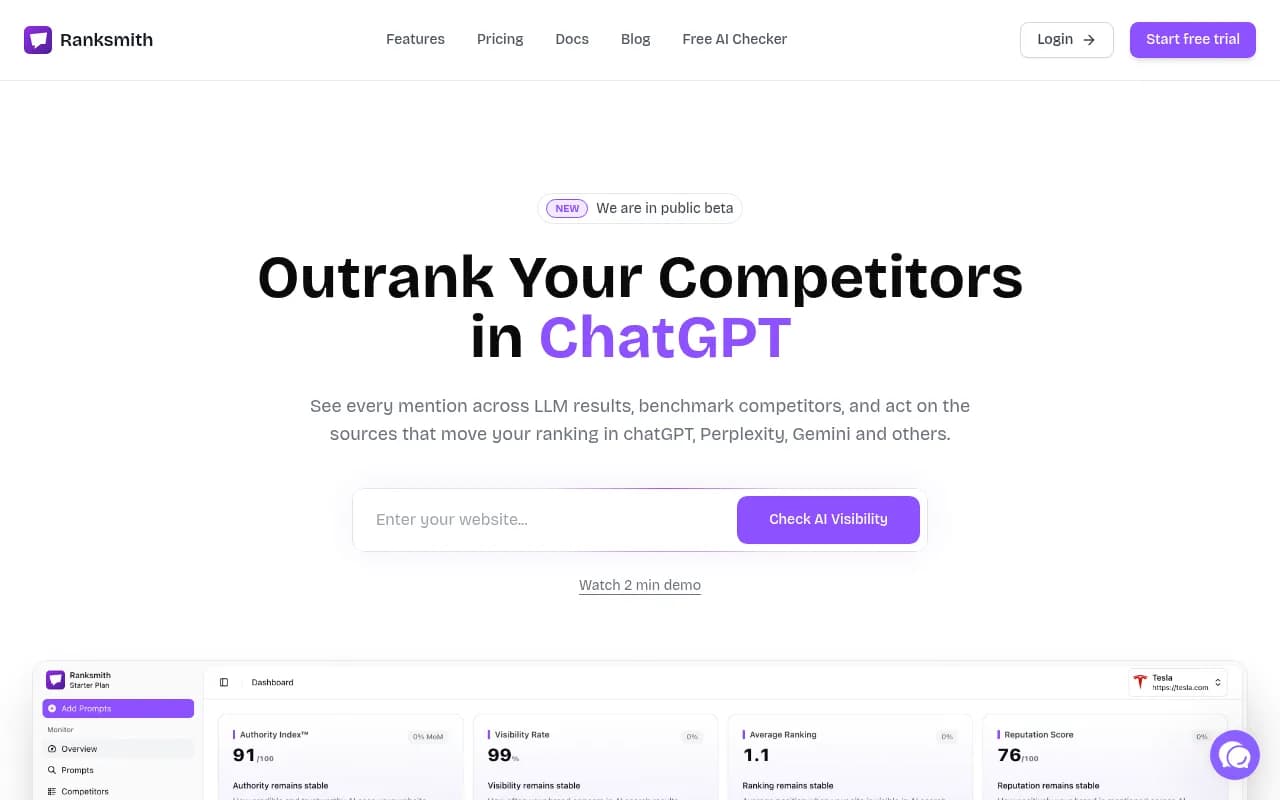
Ranksmith focuses on giving you actionable AI visibility insights rather than overwhelming you with data. It's a good fit for smaller teams that want clear recommendations without having to interpret raw visibility scores themselves.
Scrunch AI -- best for modern brands wanting clean monitoring
Scrunch AI is a clean, modern AI search visibility monitoring tool. It covers the main LLMs and gives you share-of-voice data in a well-designed interface. Like most tools in this tier, it's monitoring-focused, but the UX is notably better than some older platforms.
How these tools compare
Here's a side-by-side look at the key capabilities across the main Ceyo AI alternatives:
| Tool | Monitoring | Content gap analysis | AI content generation | Crawler logs | Reddit/YouTube tracking | ChatGPT Shopping | Starting price |
|---|---|---|---|---|---|---|---|
| Ceyo AI | Yes | No | No | No | No | No | -- |
| Promptwatch | Yes | Yes | Yes | Yes | Yes | Yes | $99/mo |
| Otterly.AI | Yes | No | No | No | No | No | Low |
| Peec AI | Yes | Partial | No | No | No | No | Low |
| Profound | Yes | Partial | No | No | No | No | High |
| AthenaHQ | Yes | No | No | No | No | No | Mid |
| SE Visible | Yes | No | No | No | No | No | Mid |
| Ranksmith | Yes | Yes | No | No | No | No | Mid |
| Scrunch AI | Yes | No | No | No | No | No | Mid |
The pattern is pretty clear. Most tools in this space are monitoring dashboards. Promptwatch is the outlier that actually helps you do something with what you find.
The monitoring trap -- why most GEO tools leave you stuck
This is worth saying plainly: a lot of teams buy an AI visibility tool, spend a few weeks looking at their share-of-voice charts, and then... don't know what to do next. The data tells them they're losing to a competitor on certain prompts, but it doesn't tell them why, and it definitely doesn't help them fix it.
That's the monitoring trap. You're paying for a dashboard that makes the problem visible but doesn't help you solve it.
The tools that break out of this pattern do one of two things. Either they show you the specific content gaps -- the prompts and topics where competitors have content and you don't -- or they help you create content that's actually likely to get cited by LLMs. Ideally both.
The research backs this up. In a 2026 comparison of 12 GEO platforms, Promptwatch was the only one rated as a "Leader" across all categories -- specifically because it's built around taking action, not just showing data. Most competitors (Otterly.AI, Peec.ai, AthenaHQ, Search Party) stop at step one.
Which tool should you actually choose?
It depends on where you are and what you need.
If you're just starting out and want to know whether you're showing up in AI responses at all, Otterly.AI or Peec AI will get you there without a big budget commitment. They're monitoring tools, but they're honest about it and priced accordingly.
If you're past that stage -- you know you have an AI visibility problem and you want to fix it -- Promptwatch is the right move. The combination of answer gap analysis, AI content generation grounded in real citation data, crawler logs, and traffic attribution is genuinely different from what anyone else offers. It's the only platform where you can go from "I'm not being cited for these prompts" to "here's the content I need to create" to "here's the traffic impact" without leaving the platform.
If you're at enterprise scale and need deep reporting with custom workflows, Profound is worth a look, though you'll pay for it.
The one thing I'd push back on: don't buy a monitoring tool and call it a GEO strategy. Knowing you're invisible is the starting point, not the destination.
Final thoughts
Ceyo AI is a reasonable entry point for AI visibility tracking. But the market has moved. The question in 2026 isn't "am I being mentioned in ChatGPT?" -- it's "what do I need to create to get cited more, and is it working?" Most tools in this space still can't answer that. The ones that can are worth paying attention to.
If you want to go beyond monitoring, Promptwatch is the most complete option available right now.