Key takeaways
- Most brands have no idea how they appear (or don't appear) in AI-generated answers — this is now a real business problem, not a future concern.
- The 10 major LLMs to track in 2026 are ChatGPT, Claude, Gemini, Perplexity, Grok, DeepSeek, Copilot, Mistral, Meta AI, and Google AI Overviews.
- There's a big difference between monitoring-only tools (which show you data) and optimization platforms (which help you act on it).
- Promptwatch is the only platform rated a "Leader" across all evaluation categories in a 2026 comparison of 12 GEO tools — the key differentiator is its built-in content generation and gap analysis, not just tracking.
- Free trials exist across most platforms; the right choice depends on whether you need monitoring, optimization, or both.
Something shifted in the last 18 months. Search behavior didn't just evolve — it fractured. A growing share of people now ask ChatGPT or Perplexity a question instead of typing it into Google. They get an answer. They trust it. They act on it. And your brand either shows up in that answer or it doesn't.
The problem is that most marketing teams are still measuring success the old way: keyword rankings, organic traffic, backlinks. Those metrics still matter, but they're increasingly incomplete. If ChatGPT recommends three project management tools and yours isn't one of them, you're losing deals you never even knew were in play.
That's what AI visibility tools are built to fix. But the market has exploded — there are now dozens of platforms claiming to solve this problem, and they're not all doing the same thing. Some just monitor. Some actually help you improve. This guide breaks down what's worth your attention in 2026.
What "AI visibility" actually means
When someone asks an AI model a question, the model generates an answer by drawing on its training data and, in some cases, real-time web retrieval. Your brand's "AI visibility" is how often, and how favorably, you appear in those answers.
This is different from traditional SEO in a few important ways:
- There's no single ranking position. You're either cited or you're not.
- The same prompt can produce different answers across different models.
- Sentiment matters as much as presence. Being mentioned negatively is arguably worse than not being mentioned.
- The content that gets cited isn't always your homepage — it might be a Reddit thread, a YouTube video, or a third-party review.
Tracking all of this across 10 different AI models, in multiple languages, for multiple competitors, is genuinely hard. That's why purpose-built tools exist.
The 10 LLMs worth tracking in 2026
Before picking a tool, it's worth being clear about what you're trying to monitor. The major AI models that matter for brand visibility right now are:
- ChatGPT (OpenAI)
- Claude (Anthropic)
- Gemini (Google)
- Perplexity
- Grok (xAI)
- DeepSeek
- Microsoft Copilot
- Mistral
- Meta AI (Llama)
- Google AI Overviews / Google AI Mode
Not every tool covers all ten. Some focus on the top three or four. That gap matters if your audience uses a mix of models — which, increasingly, they do.
The two types of tools in this market
This is the most important distinction to understand before evaluating anything.
Monitoring tools tell you where you stand. They run prompts, check whether your brand appears, score your visibility, and show you how competitors compare. That's genuinely useful data.
Optimization platforms do all of that, and then help you do something about it. They identify which prompts you're missing, explain why competitors are getting cited instead of you, and help you create the content that fills those gaps.
Most tools in this market are monitoring tools. A smaller number are true optimization platforms. The right choice depends on what you actually need — but if you're serious about improving your AI visibility, not just measuring it, you need the second type.
The best AI visibility tools in 2026
Promptwatch — best for end-to-end optimization
Promptwatch is the platform I'd recommend first for any brand that wants to actually move the needle, not just watch the dashboard.

The core workflow is what separates it from the field. First, the Answer Gap Analysis shows you exactly which prompts competitors are visible for that you're not — not vague topic suggestions, but specific questions and angles where AI models are citing your competitors and ignoring you. Second, a built-in AI writing agent generates content designed to get cited, grounded in 880M+ citations analyzed across real AI responses. Third, page-level tracking closes the loop by showing which of your pages are being cited, by which models, and how often.
It monitors all 10 major LLMs (ChatGPT, Claude, Gemini, Perplexity, Grok, DeepSeek, Copilot, Mistral, Meta AI, Google AI Overviews), includes AI crawler logs so you can see which pages AI bots are actually reading, and tracks Reddit and YouTube sources that influence AI recommendations — a channel most competitors ignore.
Pricing starts at $99/month for the Essential plan (1 site, 50 prompts, 5 articles). Professional is $249/month, Business $579/month. A free trial is available.
In a 2026 comparison of 12 GEO platforms, Promptwatch was the only tool rated a "Leader" across all evaluation categories. The gap is real.
Profound — best for enterprise teams
Profound is a strong all-in-one platform aimed at larger organizations. It covers prompt ideation, multi-LLM tracking, and competitive benchmarking with a clean interface that enterprise teams tend to appreciate.

The main limitation is that it skews toward monitoring and analysis rather than content creation. You'll get excellent data on where you stand; you'll need to do more of the "what to do about it" work yourself. Pricing is on the higher end, and it lacks Reddit tracking and ChatGPT Shopping monitoring.
Otterly.AI — best for budget-conscious teams
Otterly.AI is one of the more affordable options in the market and is genuinely easy to use. It tracks brand mentions across the major AI models and gives you a clear picture of your visibility score over time.

The trade-off is depth. Otterly is a monitoring tool — no crawler logs, no content generation, no gap analysis. If you're just starting to understand your AI visibility and want something lightweight to get the lay of the land, it works well. If you need to act on what you find, you'll hit its ceiling quickly.
Peec AI — best for multi-language tracking
Peec AI has built a solid reputation for multi-language and multi-region monitoring, which matters more than most people realize. AI models don't give the same answers in English and French, or in the US and Germany. If you operate internationally, that variability is a real risk.

Like Otterly, Peec is primarily a monitoring tool. It's good at what it does — tracking visibility across languages and regions — but doesn't offer content optimization or gap analysis.
AthenaHQ — best for tracking across 8+ AI engines
AthenaHQ covers a wide range of AI engines and has a clean competitive benchmarking interface. It's a solid choice for teams that want broad coverage and clear visualizations of how they compare to competitors.

The gap, again, is on the action side. AthenaHQ is monitoring-focused and doesn't have content generation or optimization capabilities built in.
Scrunch AI — best for mid-market brands
Scrunch AI offers a good balance of features for mid-market teams that need more than basic monitoring but aren't ready for enterprise pricing. It covers the major LLMs and includes some competitive analysis features.
Worth evaluating if Profound feels too expensive and Otterly feels too limited. The feature set sits comfortably in between.
SE Ranking — best for teams already using traditional SEO tools
SE Ranking has added AI visibility tracking to its existing SEO platform, which makes it a convenient option if you're already a customer. You get keyword tracking, site auditing, and AI visibility monitoring in one place.
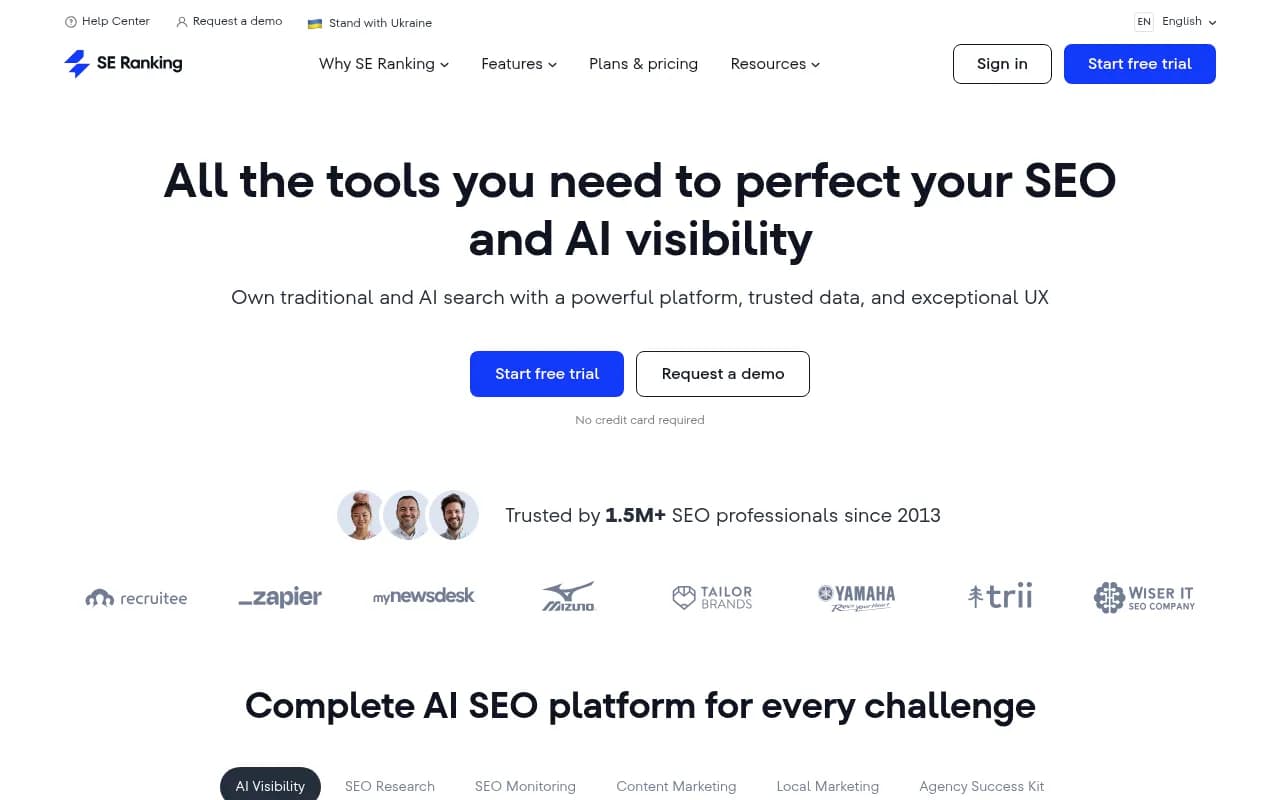
The AI visibility features are less deep than purpose-built GEO tools, but the integration with traditional SEO data is genuinely useful for teams that want a unified view.
Rankscale — best for AI search ranking focus
Rankscale focuses specifically on AI search ranking and visibility, with a clean interface for tracking how your brand positions across different models and prompt types.
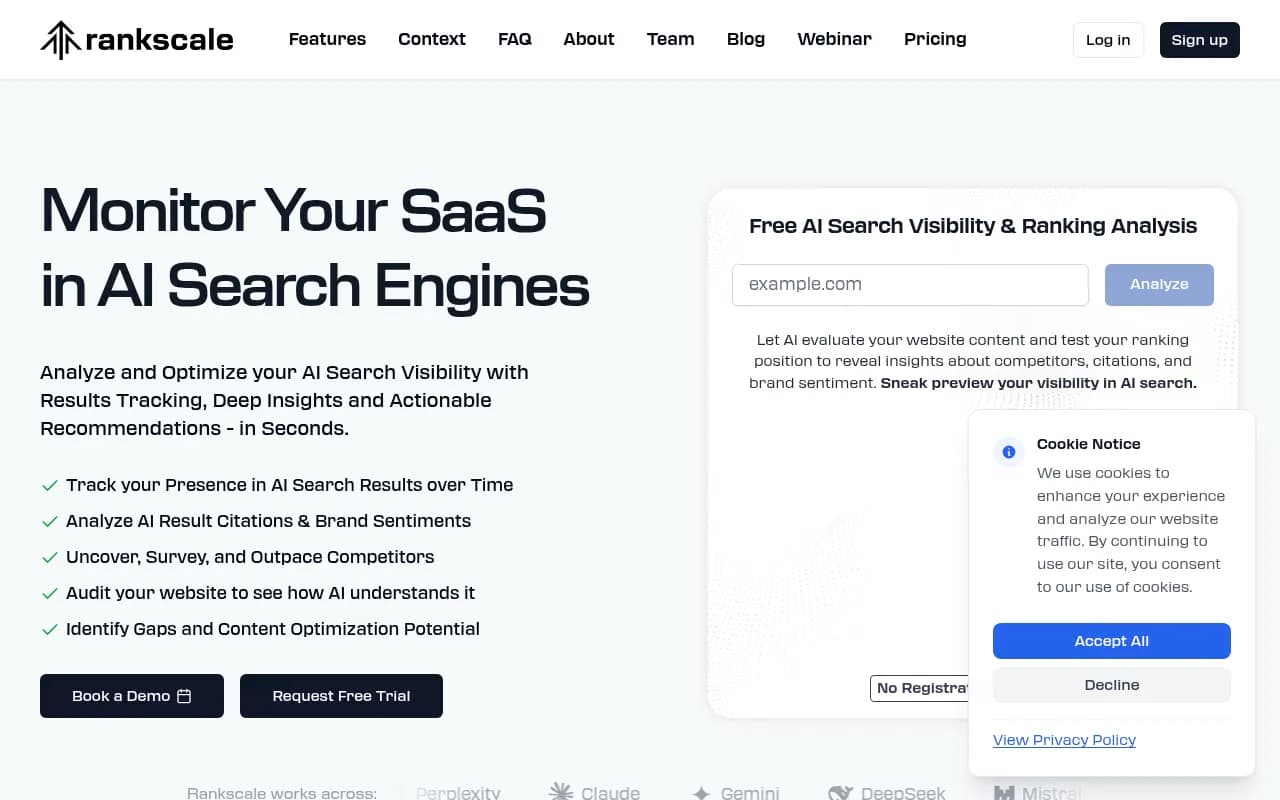
It's a focused tool that does its core job well. Less breadth than the enterprise platforms, but a reasonable option for smaller teams with specific tracking needs.
ZipTie — best for deep analysis and reporting
ZipTie is built for teams that want to go deep on analysis rather than just surface-level monitoring. It's particularly strong on reporting, which makes it useful for agencies or in-house teams that need to communicate AI visibility performance to stakeholders.
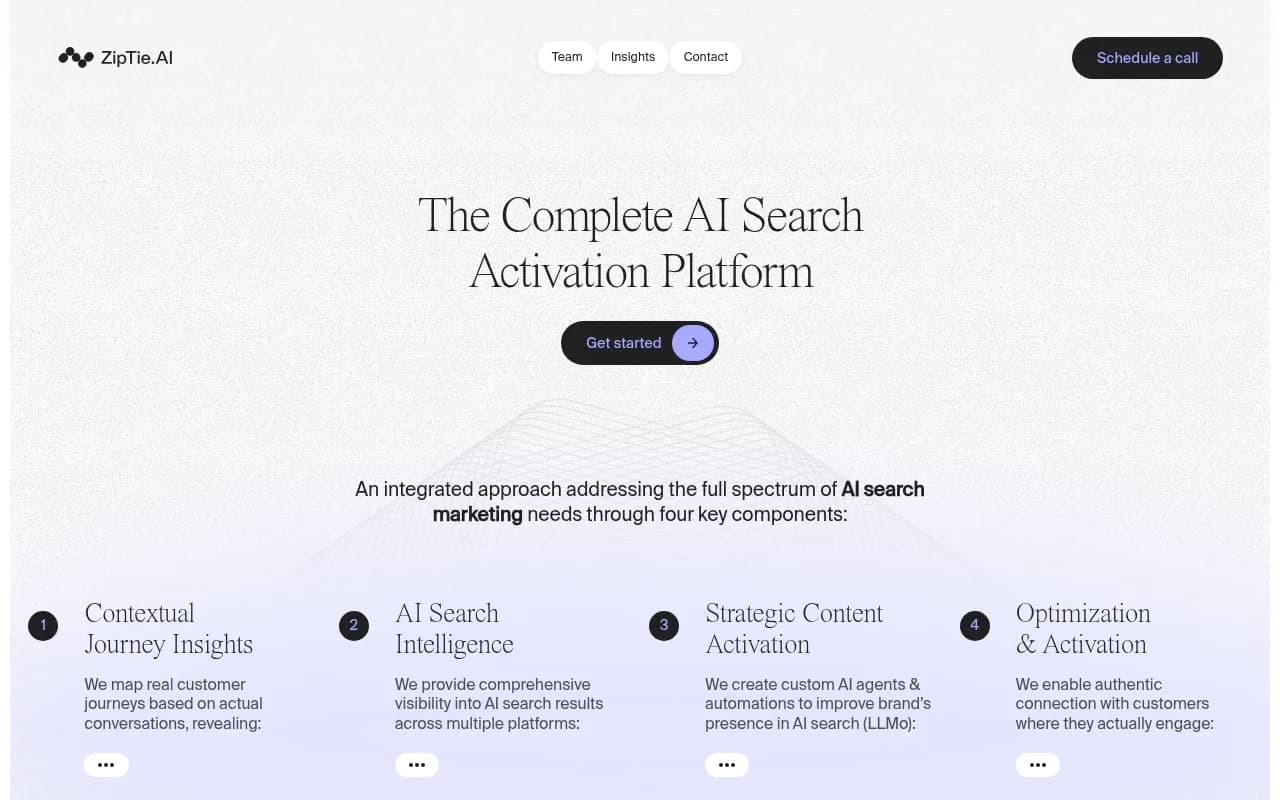
The depth of analysis is a genuine differentiator. The trade-off is that it's less focused on optimization and content creation.
Brandlight — best for brand reputation in AI
Brandlight focuses specifically on how your brand is portrayed in AI responses, not just whether you appear. Sentiment analysis and reputation monitoring are its core strengths.
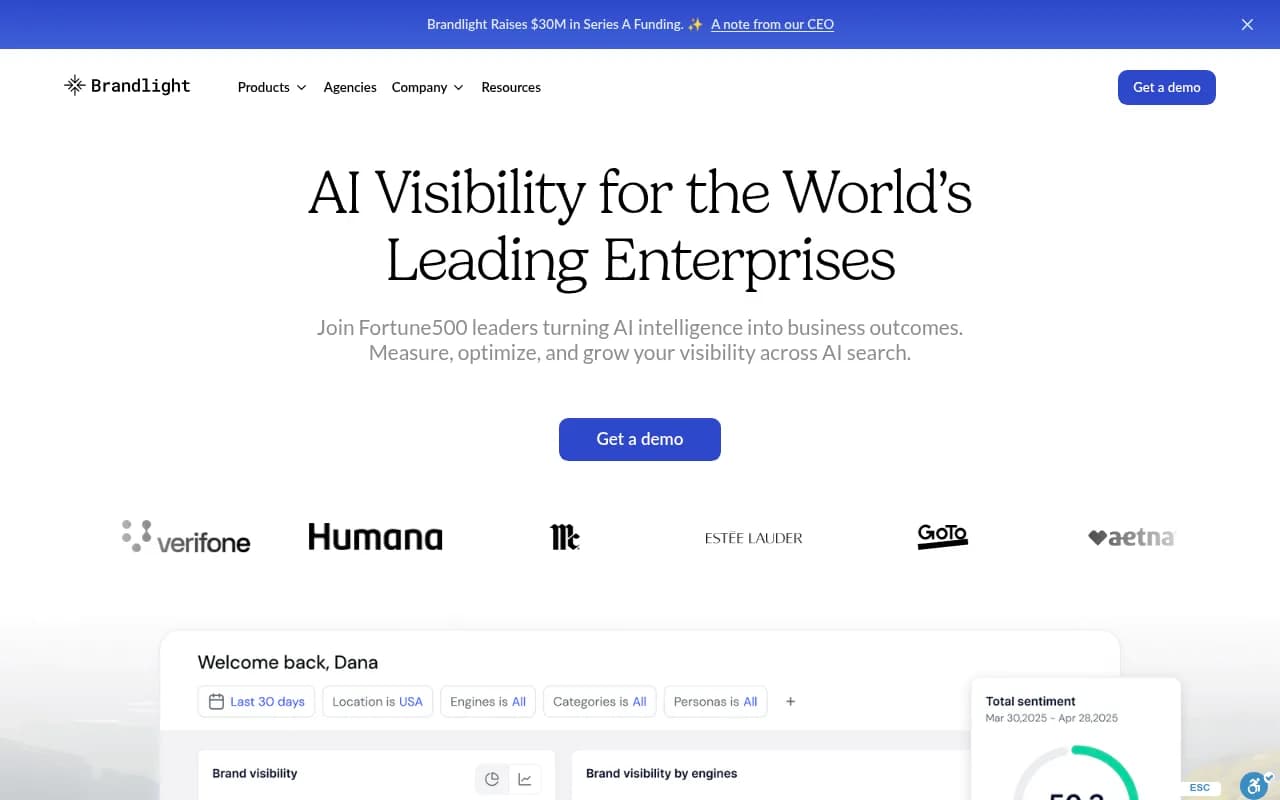
If your primary concern is brand safety — catching negative portrayals or hallucinated claims before they spread — Brandlight is worth a look. It's more specialized than the all-in-one platforms.
Feature comparison
| Tool | LLMs covered | Content generation | Gap analysis | Crawler logs | Reddit/YouTube tracking | Starting price |
|---|---|---|---|---|---|---|
| Promptwatch | 10 | Yes | Yes | Yes | Yes | $99/mo |
| Profound | 6+ | No | Limited | No | No | Higher |
| Otterly.AI | 5+ | No | No | No | No | Lower |
| Peec AI | 5+ | No | No | No | No | Mid |
| AthenaHQ | 8+ | No | No | No | No | Mid |
| Scrunch AI | 5+ | No | Limited | No | No | Mid |
| SE Ranking | 3+ | No | No | No | No | $44/mo |
| ZipTie | 5+ | No | No | No | No | Mid |
| Brandlight | 5+ | No | No | No | No | Mid |
| Rankscale | 5+ | No | No | No | No | Lower |
What to look for when evaluating a tool
The market is noisy. Here's a practical checklist for cutting through it.
LLM coverage: Does it monitor the models your audience actually uses? ChatGPT and Google AI Overviews are table stakes. Grok, DeepSeek, and Mistral matter more than most tools acknowledge.
Prompt flexibility: Can you define your own prompts, or are you stuck with fixed templates? Fixed prompts are a significant limitation — your customers don't ask AI models the same questions as everyone else's customers.
Competitor tracking: Can you see how your competitors are performing on the same prompts? Visibility data without competitive context is hard to act on.
Content gap analysis: Does the tool show you what you're missing, not just what you have? This is where most tools fall short.
Content creation: Can the tool help you produce content that's likely to get cited, or does it just tell you that you need to?
Traffic attribution: Can you connect AI visibility to actual website traffic and revenue? This is the hardest problem in the space and most tools haven't solved it.
Crawler logs: Can you see which AI bots are crawling your site, which pages they're reading, and whether they're encountering errors? This is surprisingly rare and surprisingly useful.
A practical framework for getting started
If you're new to AI visibility tracking, here's a reasonable sequence:
-
Start with a free trial of a monitoring tool to understand your baseline. Where do you appear? Where don't you? What are competitors doing that you're not?
-
Identify your highest-value prompts. These are the questions your ideal customers are most likely to ask AI models in your category. Don't guess — use prompt intelligence data if you can.
-
Audit your existing content against those prompts. Is the information AI models need to cite you actually on your website? Is it clear, structured, and authoritative?
-
Create content that fills the gaps. This is the actual work. Generic blog posts won't cut it — you need content that directly answers the questions AI models are fielding.
-
Track the results. Monitor your visibility scores over time and connect them to traffic and conversions where possible.
Tools like Promptwatch are built around exactly this cycle. The monitoring-only tools can help with step one and two. The optimization platforms help with all five.
The honest reality of this market
A few things worth saying plainly:
The GEO tool market is young and moving fast. Features that differentiate a platform today might be table stakes in six months. Pricing is still settling. Some tools that look impressive are essentially dashboards with a nice UI on top of a handful of API calls.
That said, the underlying problem is real and growing. AI search is not a niche behavior anymore. Google's own AI Overviews now appear in a significant share of searches. ChatGPT has hundreds of millions of users. Perplexity is growing fast. The brands that figure out how to be cited in AI answers will have a durable advantage over those that don't.
The tools in this guide are the best available right now for tracking and improving that visibility. Start with a free trial, run it against your actual prompts, and see what the data tells you. The gap between where you think you appear and where you actually appear is usually surprising.
Screenshots from the research
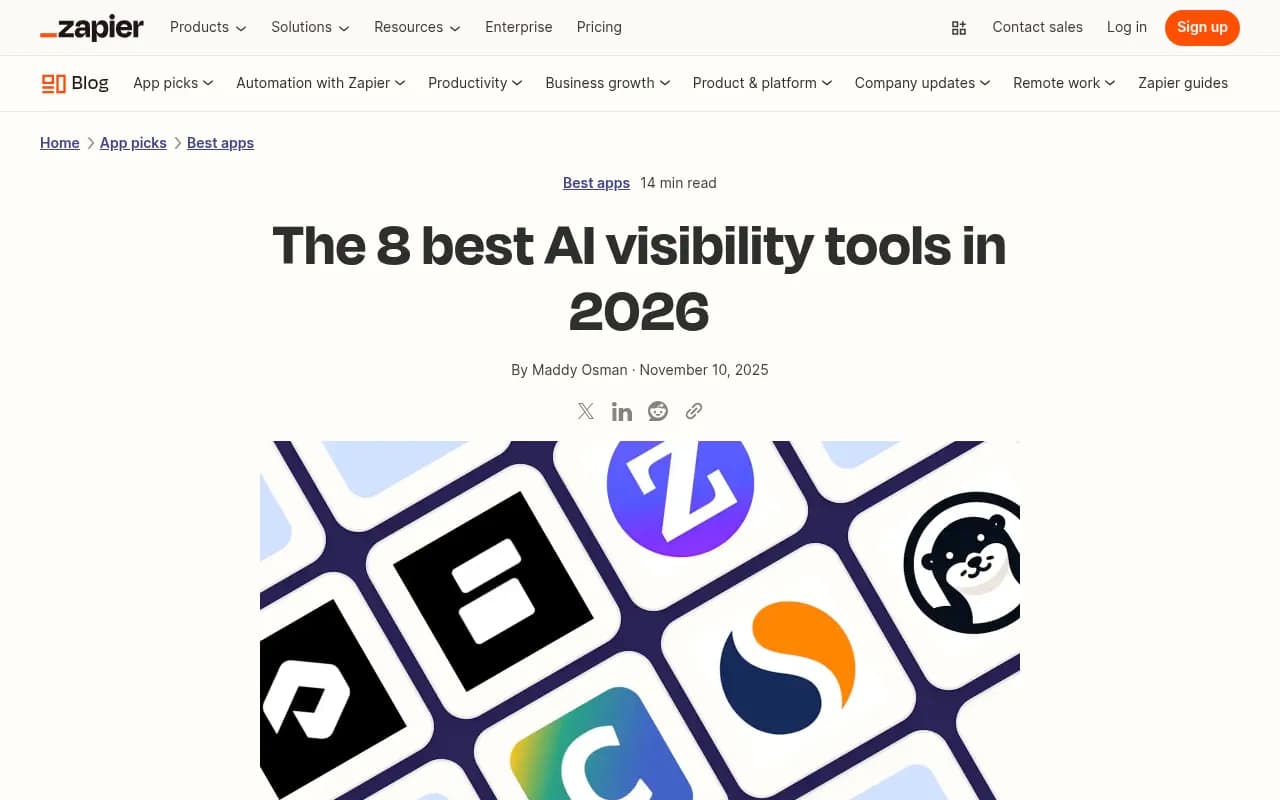
Zapier's 2026 roundup of AI visibility tools — useful for cross-referencing feature claims against independent evaluations.