Summary
- AI search monitoring tools track your brand visibility across ChatGPT, Perplexity, Claude, Gemini, and Google AI Overviews -- the platforms where buying decisions happen in 2026
- Tools with built-in content writers solve two problems at once: they show you where you're invisible, then help you create content that AI models will cite
- Promptwatch leads the category by combining 880M+ citations analyzed, Answer Gap Analysis, and an AI writing agent that generates content grounded in real citation data
- Most competitors are monitoring-only dashboards that leave you stuck after showing you the data -- they don't help you fix the visibility gaps they uncover
- Pricing ranges from $99/mo (Promptwatch Essential) to $500+/mo for enterprise platforms, with free trials widely available
What AI search monitoring tools actually do
AI search monitoring tools track how your brand appears in responses from ChatGPT, Perplexity, Claude, Gemini, Google AI Overviews, and other AI models. Unlike traditional SEO tools that focus on keyword rankings and backlinks, these platforms measure citation frequency, sentiment, competitor mentions, and whether AI models recommend your products or services.
The problem: most tools stop at monitoring. They show you a dashboard of where you're visible (or invisible), then leave you to figure out what to do about it. That's where tools with built-in content writers become valuable -- they close the loop by helping you create content that AI models will actually cite.
Why you need a content writer built into your monitoring tool
AI models cite content that directly answers questions, provides specific data, and matches the query intent. Generic blog posts don't cut it. You need content engineered for AI citation -- and most marketing teams don't have time to manually research what's missing, analyze competitor content, and write dozens of articles.
Tools with built-in AI writers solve this by:
- Identifying content gaps: They analyze which prompts competitors rank for but you don't, then show you exactly what topics and angles are missing from your site
- Generating optimized content: The AI writer creates articles, listicles, and comparisons based on citation data, not generic templates
- Tracking results: You see your visibility scores improve as AI models start citing your new content
This action loop -- find gaps, create content, track results -- is what separates optimization platforms from monitoring-only dashboards.
The best AI search monitoring tools with built-in content writers
Promptwatch: Best for closing the visibility-to-content loop
Promptwatch is the only platform rated as a "Leader" across all categories in a 2026 comparison of 12 GEO platforms. It monitors 10 AI models (ChatGPT, Perplexity, Claude, Gemini, Google AI Overviews, Meta AI, DeepSeek, Grok, Mistral, Copilot) and combines visibility tracking with an AI writing agent that generates content grounded in 880M+ citations analyzed.

What makes it different: Answer Gap Analysis shows exactly which prompts competitors are visible for but you're not. You see the specific content your website is missing -- the topics, angles, and questions AI models want answers to but can't find on your site. The built-in AI writer then generates articles engineered to get cited by ChatGPT, Claude, and Perplexity.
Key features:
- AI Crawler Logs: Real-time logs of AI crawlers (ChatGPT, Claude, Perplexity) hitting your website -- which pages they read, errors they encounter, how often they return
- Prompt Intelligence: Volume estimates and difficulty scores for each prompt, plus query fan-outs that show how one prompt branches into sub-queries
- Citation & Source Analysis: See exactly which pages, Reddit threads, YouTube videos, and domains AI models cite
- Reddit & YouTube Insights: Surface discussions that directly influence AI recommendations
- ChatGPT Shopping Tracking: Monitor when your brand appears in ChatGPT's product recommendations
- Multi-language & Multi-region: Monitor AI responses in any language, from any country
Pricing: Essential $99/mo (1 site, 50 prompts, 5 articles), Professional $249/mo (2 sites, 150 prompts, 15 articles, crawler logs), Business $579/mo (5 sites, 350 prompts, 30 articles). Free trial available.
Best for: Marketing teams and agencies that want to monitor visibility AND create content that ranks in AI search results.
Searchable: Best for all-in-one content optimization
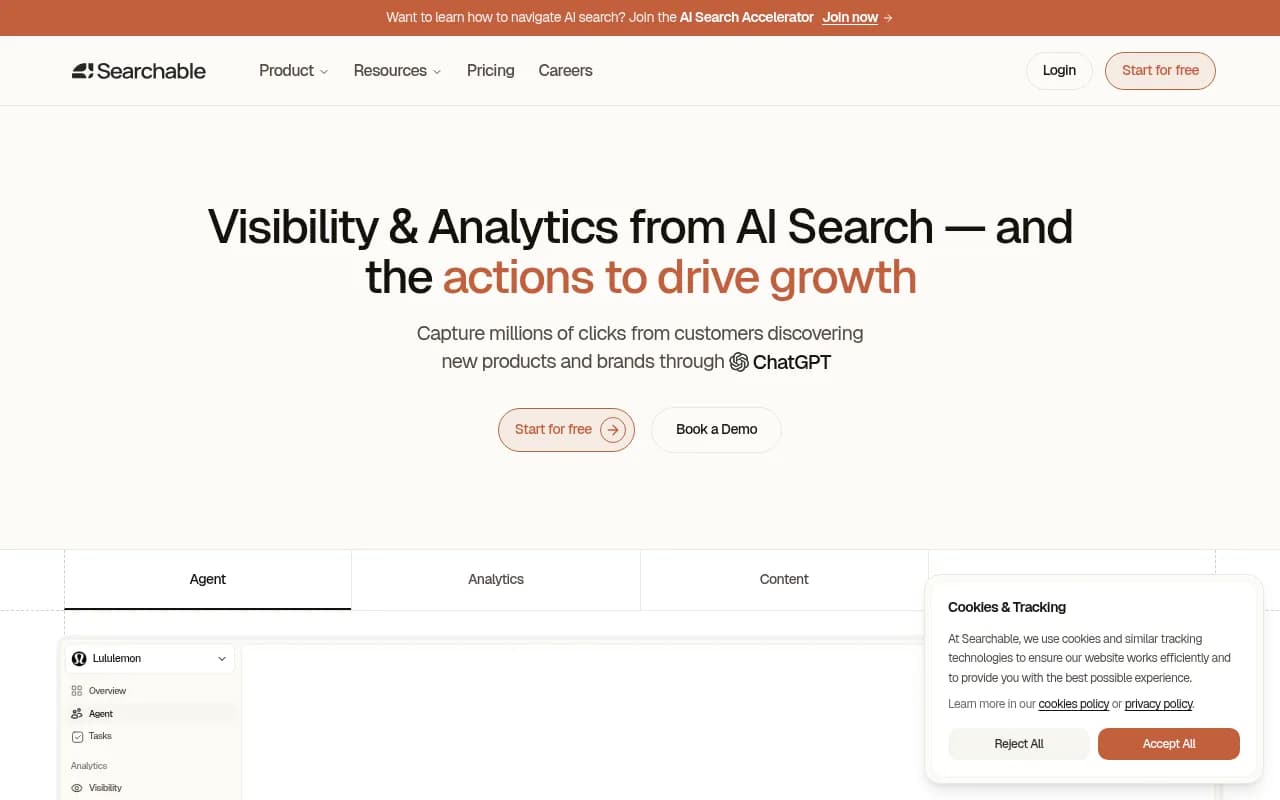
Searchable combines AI search monitoring with content creation tools and optimization recommendations. It tracks your brand across ChatGPT, Perplexity, and Google AI Overviews, then provides content briefs and AI-generated drafts to fill visibility gaps.
Key features:
- Visibility tracking across 3 major AI platforms
- Content brief generator based on AI citation patterns
- AI writing assistant for articles and landing pages
- Competitor analysis showing which content types get cited most
Pricing: Custom pricing based on number of tracked prompts and content generation volume.
Best for: Content teams that want a single platform for monitoring and creation.
Atomic AGI: Best for automated content workflows
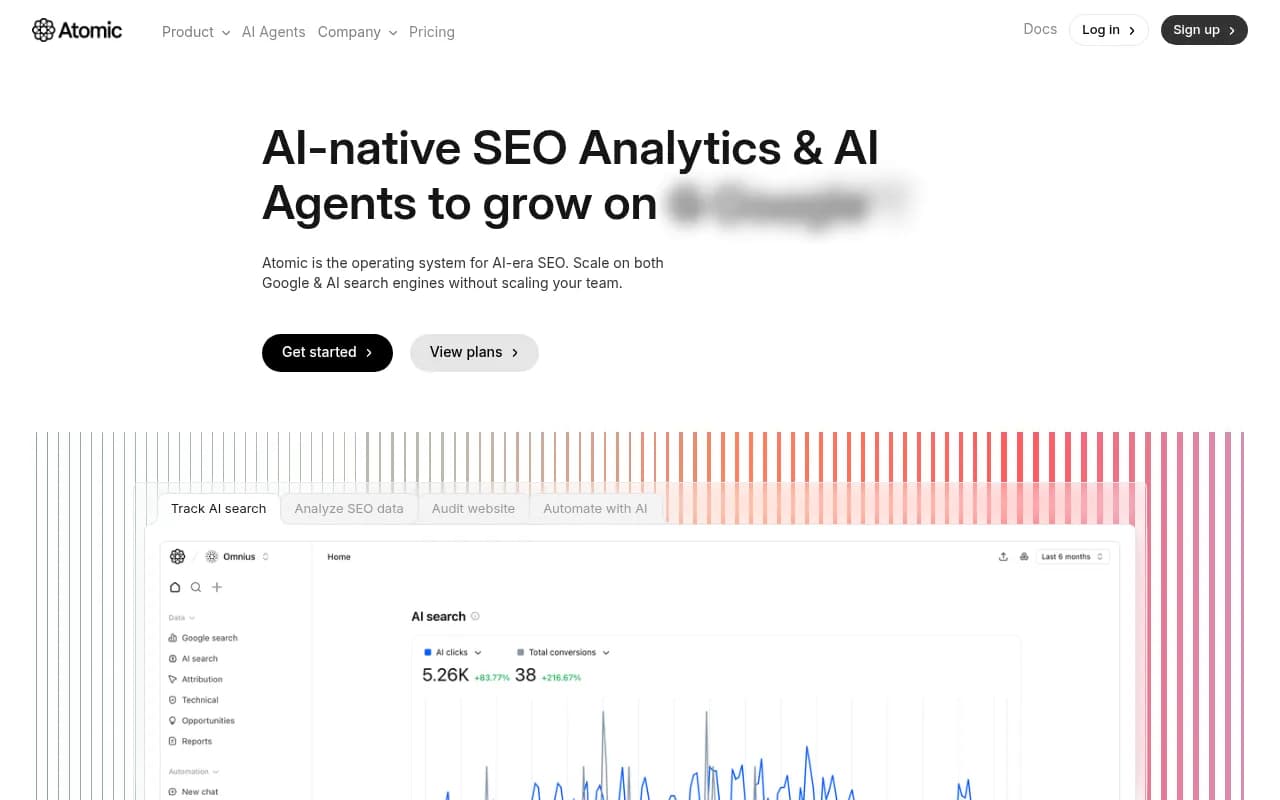
Atomic AGI is an AI-native SEO platform that tracks both Google and LLM visibility, then automates content creation based on what's working. It monitors ChatGPT, Perplexity, and Google AI Overviews while generating optimized content at scale.
Key features:
- Unified tracking for Google SEO and AI search visibility
- Automated content generation based on citation analysis
- Workflow automation for publishing and optimization
- Performance tracking showing which content drives traffic
Pricing: Custom enterprise pricing.
Best for: Larger teams that need automated content workflows and unified SEO/GEO tracking.
Relixir: Best for autonomous content operations
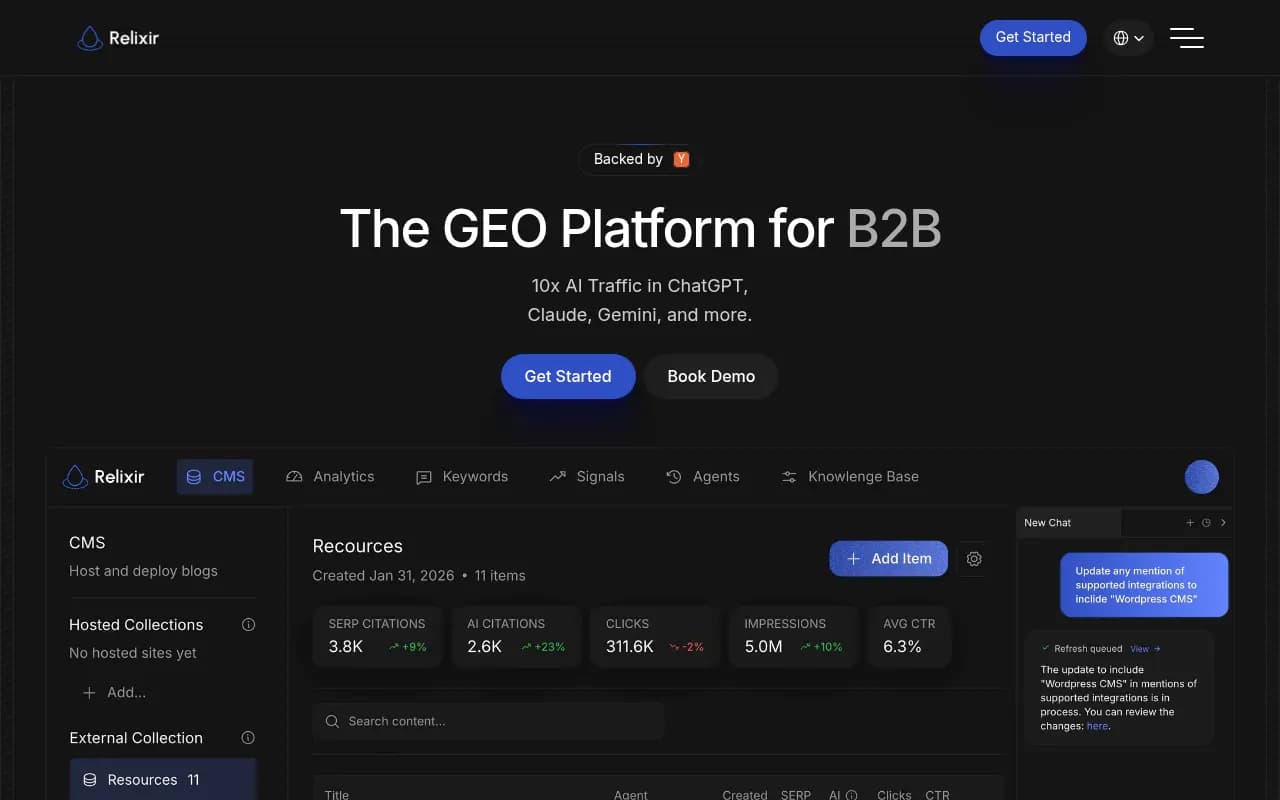
Relixir is an all-in-one GEO platform with an AI-native CMS and autonomous content agents. It monitors AI search visibility, then uses AI agents to research, write, and publish content without manual intervention.
Key features:
- AI-native CMS built for GEO content
- Autonomous content agents that research and write
- Multi-model tracking (ChatGPT, Claude, Perplexity, Gemini)
- Automated publishing and optimization
Pricing: Custom pricing based on content volume and automation features.
Best for: Teams that want fully autonomous content operations.
Frase: Best for SEO + GEO content optimization
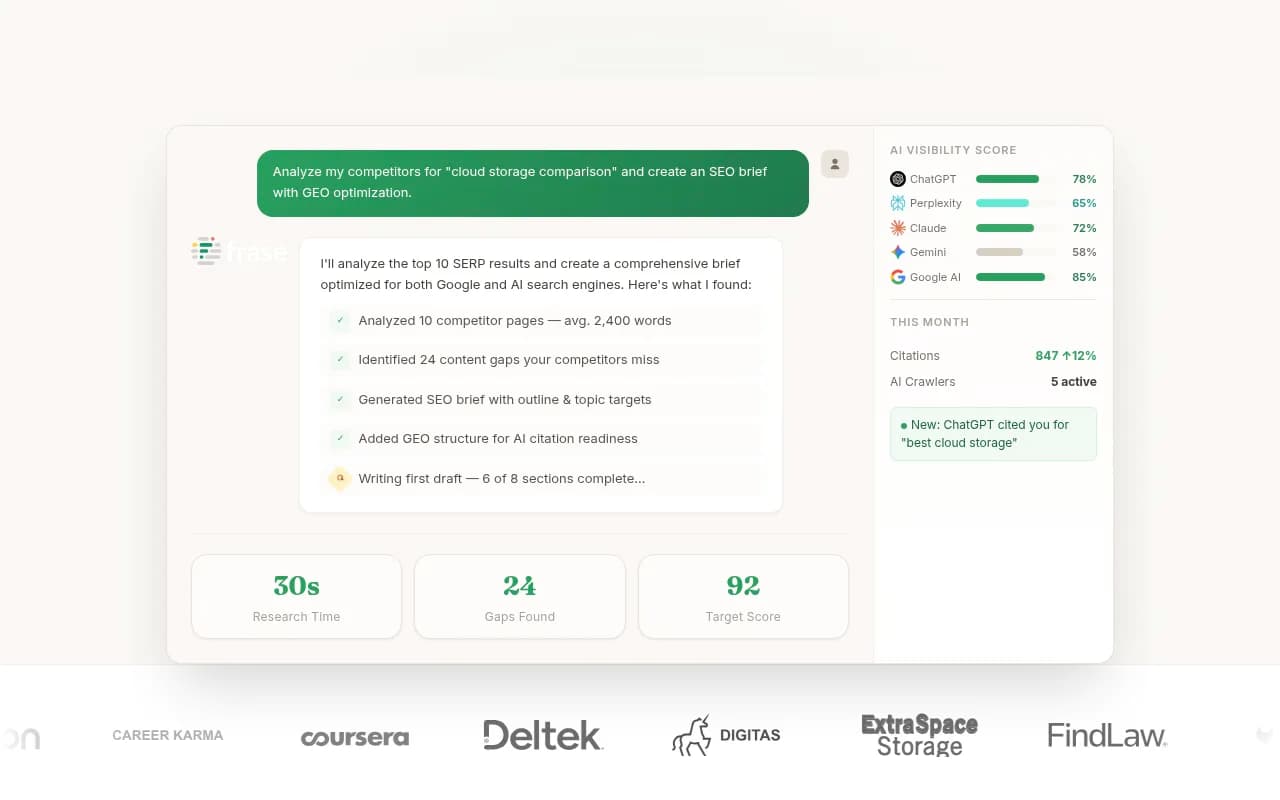
Frase is an AI-powered platform that researches, writes, and optimizes content for both traditional SEO and AI search. It tracks AI visibility while providing content briefs and AI writing tools.
Key features:
- Content research based on top-ranking pages and AI citations
- AI writing assistant with SEO and GEO optimization
- Content briefs showing what to include for AI citation
- Performance tracking for both Google and AI search
Pricing: Solo $15/mo, Basic $45/mo, Team $115/mo. Annual discounts available.
Best for: Content creators who want affordable tools for both SEO and GEO.
Comparison: Monitoring-only tools vs. tools with content writers
| Feature | Monitoring-only tools | Tools with content writers |
|---|---|---|
| Track AI visibility | Yes | Yes |
| Show competitor mentions | Yes | Yes |
| Identify content gaps | Limited | Yes |
| Generate optimized content | No | Yes |
| Citation data analysis | Basic | Advanced |
| Workflow automation | No | Yes (some) |
| Pricing | $99-500+/mo | $99-500+/mo |
Monitoring-only tools (Otterly.AI, Peec.ai, AthenaHQ, Search Party) show you where you're invisible but don't help you fix it. Tools with built-in writers close the loop by generating content that AI models will cite.
What to look for in an AI search monitoring tool with content generation
1. Answer Gap Analysis
The tool should show you exactly which prompts competitors rank for but you don't. Generic "visibility score" dashboards don't tell you what to do next. You need specific content recommendations based on citation data.
Promptwatch's Answer Gap Analysis is the gold standard here -- it shows the exact topics, angles, and questions your site is missing.
2. Citation-grounded content generation
The AI writer should generate content based on what actually gets cited, not generic templates. Look for tools that analyze 100M+ citations to understand what AI models prefer.
Most AI writing tools (Jasper, Copy.ai, Rytr) generate generic content. Tools built for GEO (Promptwatch, Searchable, Atomic AGI) generate content engineered for AI citation.
3. Multi-model tracking
Your tool should monitor at least ChatGPT, Perplexity, Claude, and Google AI Overviews. Single-model tools (Ahrefs Brand Radar only tracks Google) give you an incomplete picture.
Promptwatch monitors 10 models. Most competitors monitor 3-5.
4. Prompt intelligence
Volume estimates and difficulty scores help you prioritize which prompts to target. Without this data, you're guessing which content to create first.
Promptwatch provides prompt volumes, difficulty scores, and query fan-outs. Most monitoring-only tools don't.
5. AI crawler logs
Real-time logs of AI crawlers hitting your website show you how AI models discover your content. You can see which pages they read, errors they encounter, and how often they return.
Promptwatch is one of the few platforms that provides AI crawler logs. Most competitors lack this entirely.
6. Reddit & YouTube tracking
AI models heavily cite Reddit discussions and YouTube videos. Tools that surface these sources help you understand what influences AI recommendations.
Promptwatch tracks Reddit and YouTube. Most competitors don't.
How to use an AI search monitoring tool with content generation
Step 1: Set up tracking for your core prompts
Start by identifying 20-50 prompts that matter to your business. These are the questions potential customers ask AI models when researching solutions like yours.
Examples:
- "best [category] tools for [use case]"
- "how to [solve problem] with [solution]"
- "[competitor] alternatives"
- "[product category] comparison"
Add these prompts to your monitoring tool. Most platforms let you import prompts in bulk or suggest prompts based on your website content.
Step 2: Run Answer Gap Analysis
Use the tool's Answer Gap Analysis (or equivalent feature) to see which prompts competitors rank for but you don't. This shows you exactly what content your site is missing.
Promptwatch's Answer Gap Analysis is the most detailed -- it shows specific topics, angles, and questions AI models want answers to but can't find on your site.
Step 3: Generate content for high-priority gaps
Use the built-in AI writer to generate articles, listicles, and comparisons for the highest-priority gaps. Prioritize prompts with high volume and low difficulty.
The AI writer should generate content grounded in citation data, not generic templates. Promptwatch's AI writer analyzes 880M+ citations to understand what AI models prefer.
Step 4: Publish and track results
Publish the generated content on your website, then track your visibility scores over time. You should see improvement within 2-4 weeks as AI models start citing your new content.
Use page-level tracking to see exactly which pages are being cited, how often, and by which models. Connect visibility to traffic with code snippet integration, GSC integration, or server log analysis.
Step 5: Iterate based on performance
Double down on what works. If certain content types (listicles, comparisons, how-to guides) get cited more often, create more of that content. If certain topics drive traffic, expand coverage.
This cycle -- find gaps, generate content, track results, iterate -- is what makes AI search optimization work.
Common mistakes when choosing an AI search monitoring tool
Mistake 1: Choosing a monitoring-only tool
Most teams pick a monitoring-only tool (Otterly.AI, Peec.ai, AthenaHQ), see their visibility gaps, then get stuck. They don't have time to manually create dozens of articles, so the data sits unused.
Solution: Pick a tool with built-in content generation from day one.
Mistake 2: Ignoring AI crawler logs
AI models can't cite content they never see. If AI crawlers aren't visiting your site (or hitting errors when they do), your visibility will stay low no matter how much content you create.
Solution: Choose a tool with AI crawler logs (Promptwatch, Lumar, Botify) so you can fix indexing issues.
Mistake 3: Tracking only ChatGPT
ChatGPT is the biggest AI search engine, but Perplexity, Claude, and Google AI Overviews matter too. Single-model tools give you an incomplete picture.
Solution: Choose a tool that monitors at least 4-5 models.
Mistake 4: Not connecting visibility to revenue
Visibility scores are vanity metrics if they don't drive traffic and conversions. Most teams track visibility but never connect it to actual business outcomes.
Solution: Use traffic attribution (code snippet, GSC integration, or server log analysis) to connect visibility to revenue.
Mistake 5: Generating generic content
AI models cite specific, detailed content that directly answers questions. Generic blog posts don't get cited.
Solution: Use a tool that generates content grounded in citation data (Promptwatch, Searchable, Atomic AGI), not generic templates (Jasper, Copy.ai).
Pricing comparison: What you get at each tier
| Tool | Entry tier | Mid tier | Enterprise |
|---|---|---|---|
| Promptwatch | $99/mo (1 site, 50 prompts, 5 articles) | $249/mo (2 sites, 150 prompts, 15 articles) | $579/mo (5 sites, 350 prompts, 30 articles) |
| Searchable | Custom | Custom | Custom |
| Atomic AGI | Custom | Custom | Custom |
| Relixir | Custom | Custom | Custom |
| Frase | $15/mo (Solo) | $45/mo (Basic) | $115/mo (Team) |
Promptwatch offers the clearest pricing with a free trial. Most competitors require custom quotes.
The future of AI search monitoring and content generation
AI search is evolving fast. ChatGPT usage is soaring. Google's AI Overviews appear in nearly half of all searches. Perplexity is growing. Claude and Gemini are gaining traction.
The tools that win will be the ones that help you take action, not just show you data. Monitoring-only dashboards will become commodities. Platforms that close the loop -- find gaps, generate content, track results -- will dominate.
Promptwatch is ahead of the curve here. It's the only platform that combines deep monitoring (10 models, AI crawler logs, Reddit/YouTube tracking) with content generation grounded in 880M+ citations analyzed. Most competitors are still stuck in monitoring-only mode.
If you want to rank in AI search results in 2026, you need a tool that helps you create content that AI models will cite. Monitoring alone won't cut it.
Frequently asked questions
Do I need an AI search monitoring tool if I already use Semrush or Ahrefs?
Yes. Traditional SEO tools track Google rankings. AI search monitoring tools track ChatGPT, Perplexity, Claude, and other AI models. These are different ecosystems with different ranking factors. Semrush and Ahrefs have added basic AI tracking (Semrush One, Ahrefs Brand Radar), but they use fixed prompts and lack content generation capabilities.
How long does it take to see results?
Most teams see visibility improvements within 2-4 weeks after publishing optimized content. AI models crawl and update their training data regularly, so new content gets indexed faster than traditional SEO.
Can I use these tools for local businesses?
Yes. Most tools support multi-region tracking, so you can monitor AI responses for specific cities or states. Promptwatch's Professional tier includes state/city tracking.
Do these tools work for B2B companies?
Absolutely. B2B buyers use AI search engines to research vendors, compare solutions, and evaluate alternatives. AI search monitoring is arguably more important for B2B than B2C because buying decisions involve more research.
What's the ROI of AI search monitoring?
Teams that optimize for AI search see 20-40% increases in organic traffic within 3-6 months. The ROI comes from capturing high-intent traffic that would otherwise go to competitors. One enterprise customer reported a 3x increase in demo requests after improving their AI visibility.
Can I track competitor visibility?
Yes. All tools in this guide support competitor tracking. You can see which prompts competitors rank for, how often they're cited, and what content types work best for them.
Do I need technical skills to use these tools?
No. Most platforms are designed for marketers, not developers. You can set up tracking, generate content, and analyze results without writing code. API access is available for teams that want custom integrations.
Final recommendation
If you want a tool that monitors AI visibility AND helps you create content that ranks, Promptwatch is the clear winner. It's the only platform that combines deep monitoring (10 models, AI crawler logs, Reddit/YouTube tracking, ChatGPT Shopping) with content generation grounded in 880M+ citations analyzed.
Most competitors are monitoring-only dashboards that leave you stuck after showing you the data. Promptwatch closes the loop with Answer Gap Analysis and an AI writing agent that generates content engineered for AI citation.
Pricing starts at $99/mo with a free trial. Professional tier ($249/mo) adds AI crawler logs and state/city tracking. Business tier ($579/mo) includes 30 articles/month and 5 sites.
For teams that want affordable SEO + GEO content optimization, Frase ($15-115/mo) is a solid alternative. For fully autonomous content operations, Relixir is worth exploring (custom pricing).
But if you're serious about ranking in AI search results in 2026, start with Promptwatch. It's the only platform built around taking action, not just showing you data.