
Key Takeaways
- Most AEO tools still stop at a dashboard. A smaller group writes the content and pushes it to your CMS, which is the part that changes results.
- Four things matter when you evaluate: where the content ideas come from, which CMSs it publishes to, how much review control you get, and whether anything measures the published page afterwards.
- Promptwatch and AirOps are the two clearest examples of the "find the gap, fill the gap" approach, but they start from opposite ends (visibility data vs. content production).
- Pricing varies wildly. AirOps pricing is sales-led and third-party estimates conflict, so verify anything you read before budgeting.
- Plan content per intent and plan refreshes. Promptwatch Data shows product pages and landing pages draw about 39% of ChatGPT citations, and news pages lose half their citations within 36 days.
Why content agents matter for AEO
A year or two ago, buying an AEO platform meant buying a dashboard. You got a visibility score, a list of prompts where competitors beat you, and a pile of homework. Then your content team looked at the homework, shrugged, and went back to the editorial calendar they already had.
That gap is why content agents exist. An agent takes the citation gap, writes a draft, and ships it to WordPress or Webflow. The reasonable skeptic's question is whether AI-written pages deserve to be cited at all. Sometimes they don't. But the structure that AI engines quote (answer first, clear headings, FAQ at the end) is formulaic enough that software can produce it consistently, as long as it is grounded in your real facts and a human can review it.
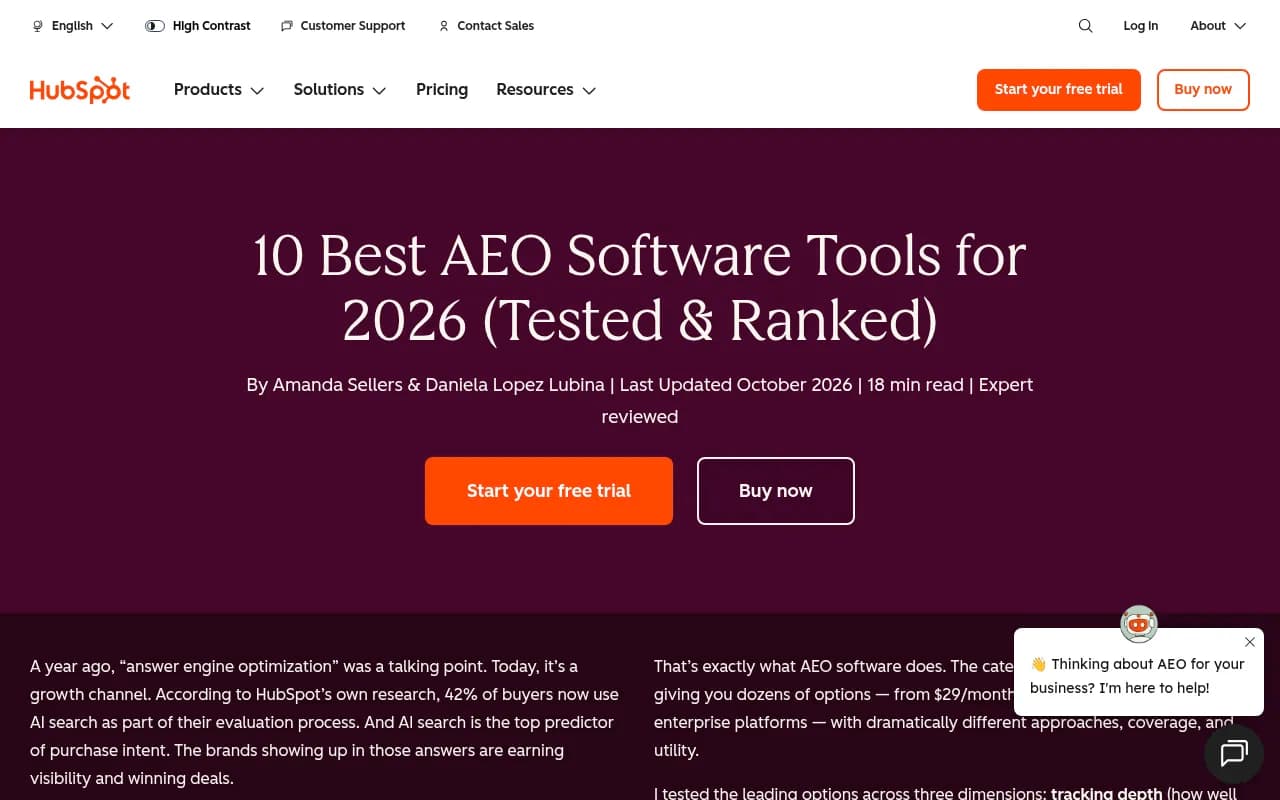
HubSpot's October 2026 guide to AEO software frames it the same way: tracking depth, actionability, and fit. Actionability is the column that separates the tools in this guide. HubSpot also cites its own research that 42% of buyers use AI search in evaluation. That is a vendor statistic and I haven't seen it independently verified, so treat it as directional.
What to look for in a content agent and CMS publisher
Before the tool list, here is the checklist I would use. Feature pages blur together, so these are the questions that expose the differences.
Where do the topics come from?
An agent that writes from a generic keyword list is just an AI writer. The useful ones write against your actual visibility gaps: prompts where AI answers without citing you, pages competitors get cited for, and the sub-queries AI runs behind the scenes (query fan-outs). Ask whether the writing step is connected to tracking data or sits next to it.
Which CMSs does it publish to, and how?
The common set is WordPress, Webflow, and Framer, with enterprise tools adding headless options like Contentful, Sanity and Strapi. Check the mechanics too. Does it push drafts or live pages? Does it map fields (title, body, featured image, date) once? Can it handle localized collections? Does it track the live URL afterwards?
How much control do you keep?
A review inbox with approve, edit and decline is the sane default. Fully hands-off mode is nice once you trust the output. You also want brand guidance: a knowledge base, tone rules, and a way to feed it your own style guide.
Does anything measure the result?
This is the one most tools skip. After publishing, you want to know whether AI crawlers fetched the page, whether any model cited it, and whether it sent visits. Without that, you are guessing, and you will not know which pages to refresh.
What does it decay like?
Content is not permanent in AI answers. Promptwatch Data's content half-life report tracked pages ChatGPT cited on July 6, 2026 for 90 days. After 30 days, 78% of landing pages and 76% of docs were still cited. Product pages, reviews and how-tos had a half-life of roughly 74 to 77 days. News was the outlier: half of news pages were gone after 36 days. So a good agent should come with refresh workflows, not just first drafts.
Comparison table
| Platform | Starts from | Writes content | CMS publishing | Measures published pages | Pricing visibility |
|---|---|---|---|---|---|
| Promptwatch | Visibility and citation data | Content Agent, on-demand creation, refresh | WordPress, Webflow, Framer | Crawler logs, citations, AI traffic | Published, from $95/mo |
| AirOps | Content production | Workflows, Grids, brand kits | WordPress, Webflow, Contentful, Sanity, Strapi | Visibility tracking, Search Console in Grids | Sales-led |
| Profound | Enterprise monitoring | Content creation module | Not verified here | Crawler analytics, attribution | Not published |
| Scrunch | Monitoring | Agent Experience Platform serves AI-optimized content | Not verified here | Monitoring and auditing | Not verified here |
| ChatFeatured | Agency tracking | Citation-gap drafting | Webflow, WordPress | Not verified here | Not verified here |
| HubSpot AEO | Tracking and CRM | Recommendations | Via HubSpot | CRM attribution | From $50/mo |
A note on the "not verified" cells. I did not scrape the official pages for Profound, Scrunch or ChatFeatured, so I am only repeating what their own published guides claim. Check each vendor before you shortlist.
The platforms
Promptwatch
Promptwatch is the one I would put first on a shortlist if the goal is a closed loop: monitor, write, publish, measure. It tracks how ChatGPT, Gemini, Claude, Perplexity, Google AI Overviews, AI Mode and Copilot mention and cite you, then routes the gaps into an Action Board and the Content Agent.

The agent plans, writes and publishes against your visibility gaps. You set a publishing calendar, a monthly budget and publish windows, then choose a review inbox (approve, edit, decline) or run it hands-off. Pieces open with key takeaways, answer each heading in its first lines, and end with a FAQ, which is the structure assistants tend to quote. A Knowledge Base and Brand Book keep facts and tone consistent, and custom skills let you load your own house style.
Publishing goes to WordPress through the official plugin, to Webflow through OAuth or the Webflow Marketplace app, and to Framer with a project URL and API key. You can push drafts or live pages, with AI field mapping so you set up title, description, body, image and date once. It also tracks each document's draft, staged, published and live URL, then follows the live page through crawls, citations and AI traffic.
That last part is where it separates from writing-first tools. IP-verified AI crawler logs show whether bots actually read the page, Page Tracker shows whether AI cites it, and visitor analytics show whether it sends traffic. Underperformers come back as refresh suggestions, which matters given the half-life numbers above. The case studies back the approach: Crisp reported 2x higher conversion rates from AI traffic and scaled to 5 to 10 articles per day (Crisp case study).
Plan note: the automated Content Agent starts on Business ($579/mo). Essential ($95/mo) and Professional ($245/mo) include AEO articles on Professional (5 per month) but not the full agent. Agency plans do not include the Content Agent or CMS-driven AEO articles; agencies that need that go to the custom Partner plan. Confirm current terms at promptwatch.com/pricing. There is a 7-day free trial on monthly billing, and a free AI visibility report if you just want a baseline first. For comparisons with competitors, see Promptwatch vs Profound and Promptwatch vs Scrunch.
AirOps
AirOps comes at the problem from the other side. It is a content engineering platform that added AI search visibility tracking, rather than the reverse. HubSpot's guide ranks it for teams that need to act on insights at scale.
The building blocks are a workflow builder, Grids for bulk operations, knowledge bases and brand kits. Third-party reviews say it publishes directly to WordPress, Webflow, Contentful, Strapi and Sanity, with one source also listing Shopify. AirOps's own blog says Grids import from and export to Webflow, WordPress, Contentful and Sanity, and Grids can pull Google Search Console data so a refresh cycle starts and ends in one place. If your stack is headless, that CMS list is wider than most competitors.
The trade-off is price transparency. Pricing is not published. ContentMonk estimates Pro at roughly $2,000 a month and lists 250 tracked prompts and pages, four answer engines, 75,000 tasks, 5 knowledge bases and unlimited seats. That is a third-party figure and I could not confirm it. Sources also disagree on whether CMS access depends on your plan, so ask this one before the demo, not after. The AirOps pricing page was not scraped for this guide; check airops.com/pricing.
It is a strong pick if you have content ops people who like building workflows. If you want something that tells you what to write and then tells you whether it worked, you will lean on its tracking more than you might expect.
Profound
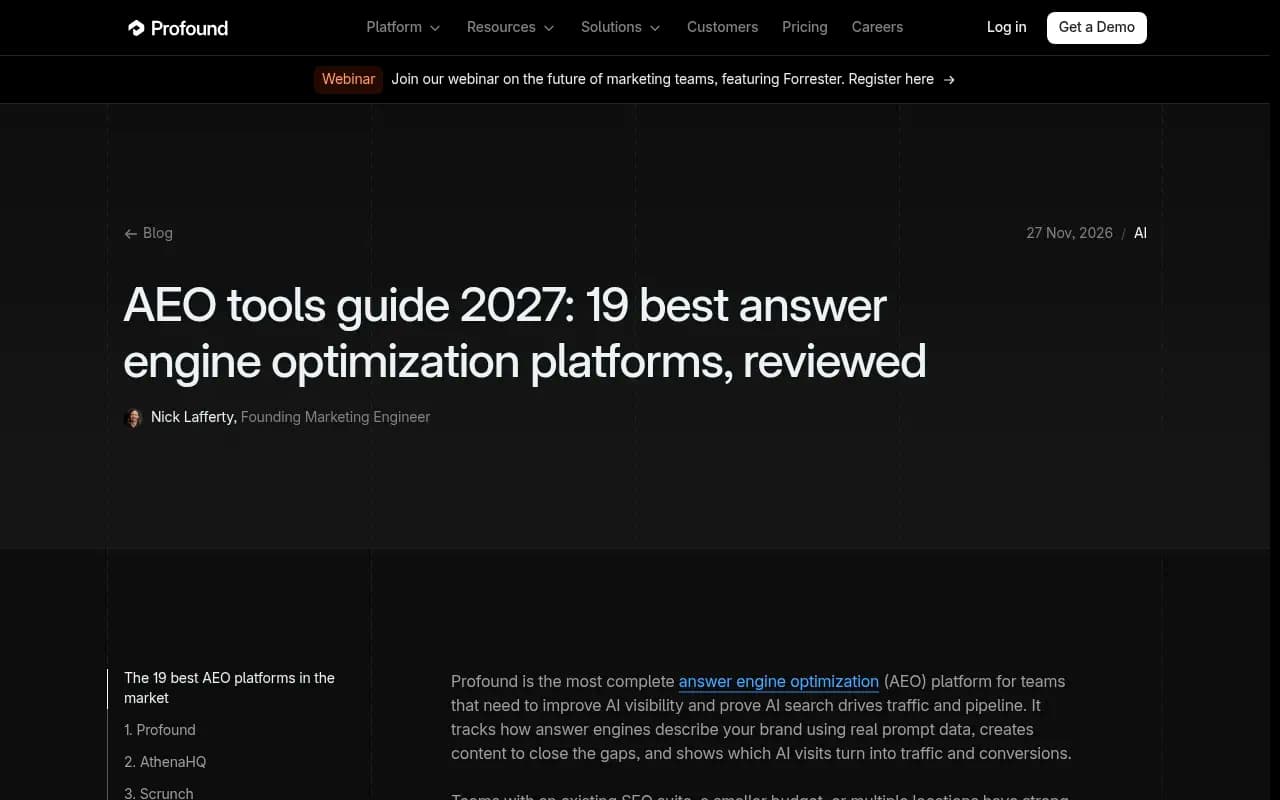
Profound is the enterprise monitoring heavyweight. Its own guide describes daily tracking of all major engines on 1.9B+ real prompts, with content creation, crawler analytics and attribution in one platform. It also admits it is overkill for teams that want a lightweight score.

I did not verify its CMS publishing list, so I won't claim one. If publishing integrations are a hard requirement, ask for the exact list in writing.
Scrunch
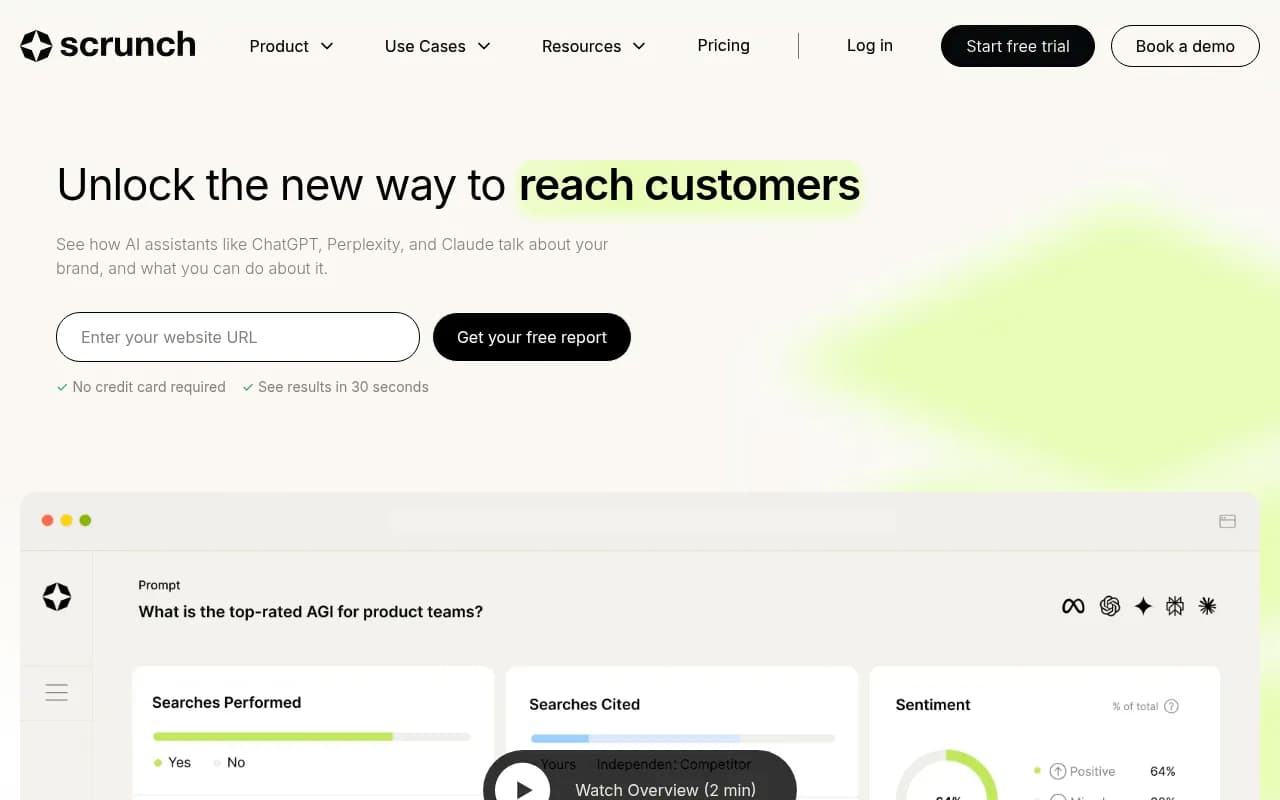
Scrunch pairs multi-LLM monitoring with auditing and an Agent Experience Platform that serves AI-optimized versions of content. That is a different idea from publishing new articles: it changes what AI crawlers see on existing pages. Useful, but not the same job as a content agent.
ChatFeatured
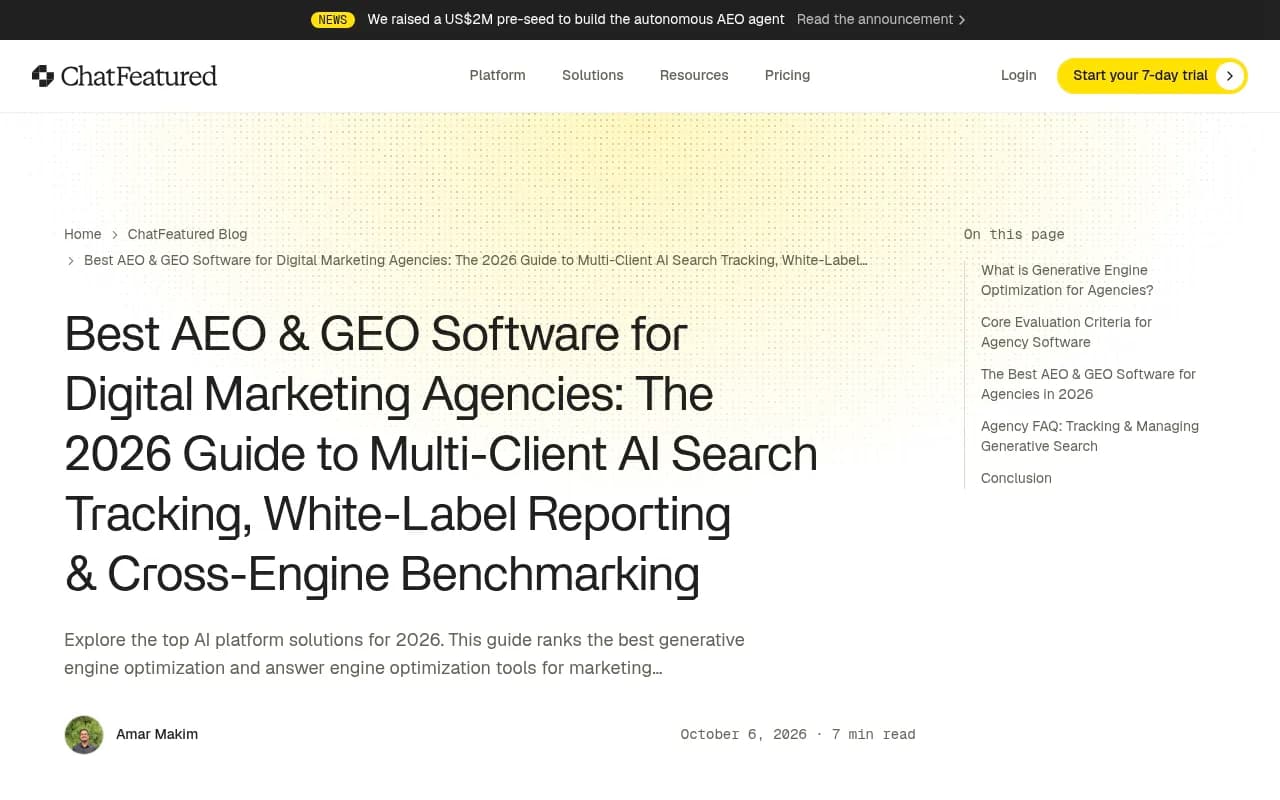
ChatFeatured targets agencies. Its guide describes a generation suite that researches citation gaps, drafts answer-first content, calculates an optimization score, and publishes to Webflow or WordPress with one click. The company raised a $2M pre-seed to build an autonomous AEO agent, so it is early. Fair to evaluate, worth asking about track record.
HubSpot AEO
HubSpot AEO starts at $50 per month with a 28-day free trial, according to HubSpot. Its strength is CRM attribution if you already live in HubSpot, and recommendations rather than heavy autonomous publishing.
Other tools worth a look
Several catalog tools combine tracking with writing or publishing: [tool:frizerly] Frizerly (affordable with auto-publishing), [tool:geoforge] GEOforge (closed-loop from monitoring to published content), [tool:relixir] Relixir (AI-native CMS), [tool:open-forge] Open Forge (finds gaps and publishes to your CMS), and [tool:bydefault] bydefault. I have not tested these, so evaluate them on the checklist above. For a broader sweep, the GEO software directory lists many more.
What to publish: use the citation data
A content agent is only as good as its brief. Promptwatch Data's content type report (Sep 28 to Oct 4, 2026) gives you a starting point:
| Content type | Share of ChatGPT citations |
|---|---|
| Product pages | 22.4% |
| Landing pages | 16.8% |
| Listicles | 13.6% |
| How-to guides | 8.7% |
| Documentation | 7.5% |
| General articles | 6.1% |
| Comparisons | 5.9% |
| News | 5.7% |
By intent, commercial prompts lean on product pages (26.0%), landing pages (20.6%) and listicles (15.0%). Informational prompts spread more toward how-tos and docs. Branded prompts favor FAQ pages and reviews more than other intents do. So the practical rule is to point your agent at comparisons and product-led pages for buying prompts, and at guides for informational ones. Do not let it default to blog posts for everything.
How to choose
- You want one loop from tracking to publishing to measuring: Promptwatch.
- You have a content ops team and a headless CMS: AirOps, once you have a firm price.
- You are an enterprise buying monitoring depth first: Profound.
- You live in HubSpot and need CRM attribution: HubSpot AEO.
- You run an agency: look at ChatFeatured and the agency tiers of Promptwatch (note the content-agent limits above).
Run a four-week pilot with one tool and one content type. Publish ten pages, check crawler logs after a week, check citations after three, and refresh whatever slipped. If you would rather hand the program to specialists, an agency like 1001 SEO Media runs AEO programs with Promptwatch as its platform.
FAQ
Do content agents replace writers?
No. They replace the first draft and the formatting grind. Someone still needs to check facts, add original data and decide what is worth publishing.
Is auto-publishing safe?
Start with drafts and a review inbox. Move to hands-off only after you have reviewed a few dozen pieces and trust the brand guidance.
How do I know if the content worked?
Look for three signals in order: AI crawlers fetching the page, models citing it, then AI-referred visits. Tools without crawler logs or page tracking can only guess at the first two.