Findable Review 2026
Monitors ChatGPT, Google AI Mode, Gemini and Perplexity visibility and helps close content gaps so AI agents use your pages as sources.
Key takeaways
- Findable is built explicitly for agencies: multi-client dashboards, pitch-ready audits, and retainer reporting are the core of the product, more than solo brand monitoring.
- It lacks the crawler log depth, AI traffic attribution, Reddit/YouTube citation tracking, and automated content publishing that Promptwatch offers. Findable tells you whether a bot is blocked; it doesn't show you what AI crawlers actually read on your pages or the traffic they send back.
- The Pro plan ($99/month, billed as EUR 99) only monitors three AI platforms (ChatGPT, Google, Claude). Perplexity, Meta, and Grok tracking require an Enterprise quote, which is a real gap if your clients care about Perplexity visibility, a platform competitors track by default.
- Independent review volume is thin: 4 reviews on G2, 1 on Trustpilot. The ratings are good (5.0 and 3.7 average, respectively) but the sample is too small to call it validated at scale.
- Good fit for small agencies and in-house teams wanting a lightweight audit-and-pitch tool; not a fit for teams that need deep technical AI SEO data or multi-model coverage out of the box.
Findable is an AI search visibility and content tool built by Peter M. Buch and Thomas Schranz, launched in July 2025 and aimed squarely at marketing agencies that need to audit prospects, win pitches, and then prove ongoing value to retained clients. The company is small, 2-10 employees according to LinkedIn, but has shipped fast: a free tier in February 2026, a Claude Opus 4.6-specific brand audit in February 2026, and a full agency-focused 2.0 relaunch in September 2026.
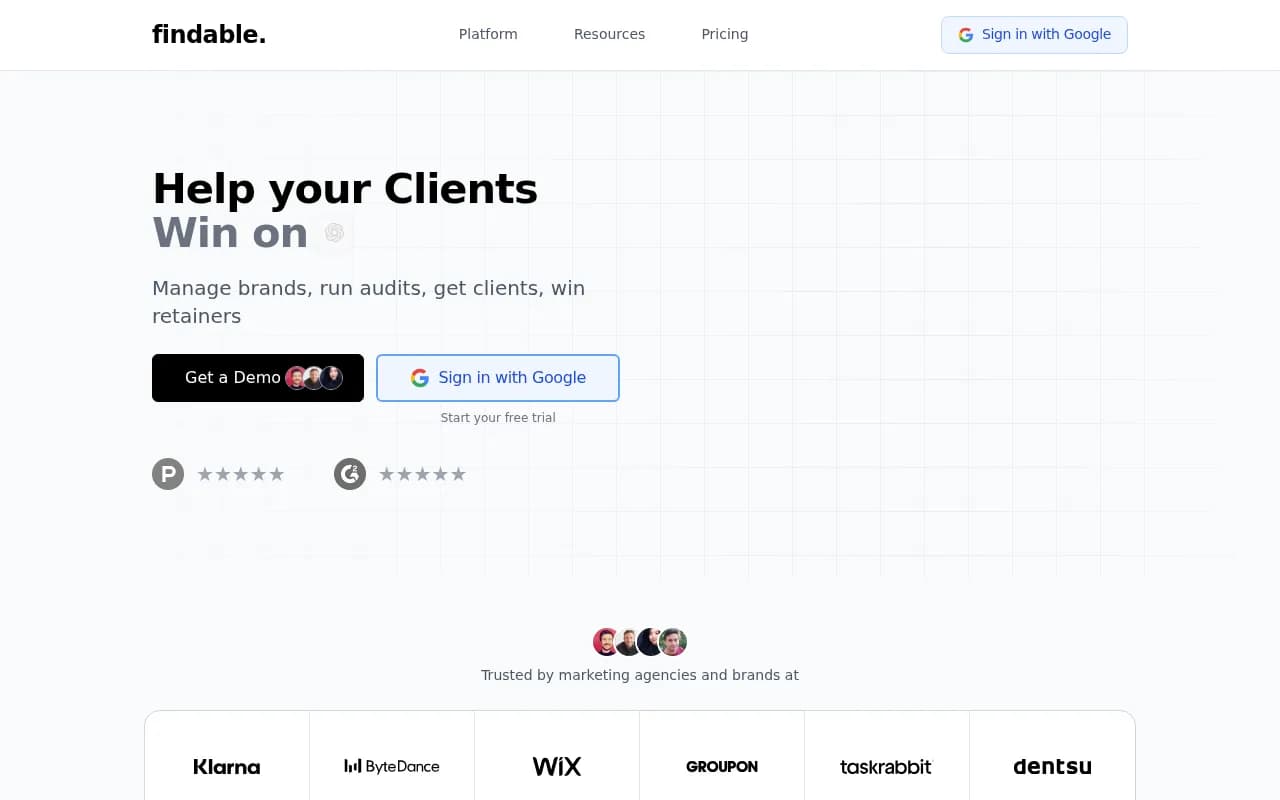
The positioning is unambiguous from the homepage copy: "Manage brands, run audits, get clients, win retainers." This isn't a tool trying to be everything to everyone. It's built around the agency workflow of auditing a prospect, showing them where they stand against competitors, and then tracking progress monthly to justify the invoice.
Key features
-
Multi-client project management. Agencies add each client as a project (the demo shows Patagonia, Uniqlo, Nike, Decathlon, Lufthansa, LEGO, Red Bull as example brands) and get a single view across the roster. This is the backbone of the product and the thing most competitors in this space don't design around at all, since most GEO tools assume one brand per account.
-
Prospect audits and competitor scoring. Before you even sign a client, Findable can run an audit on their domain and produce a 0-100 visibility score broken into Brand, Trust, Crawlers, and Speed sub-scores, then stack it against named competitors (in the demo, Uniqlo scores 82 against MUJI at 49, Mango at 53, H&M at 57, and Zara at 61). The idea is to hand a prospect a number and a gap to sell against.
-
AI crawler access checks. Findable inspects robots.txt and reports which AI crawlers can reach a site, split into Search engines, AI crawlers, and Social. In the Uniqlo example, 5 of 10 AI crawlers were allowed, with Claude, Perplexity, and Google AI shown as blocked. This is a useful, simple diagnostic, but it stops at the robots.txt layer. It doesn't show actual crawl logs, timestamps, or what the crawler did once it reached a page, which is where Promptwatch's Agent Analytics goes much further with a real-time crawl-to-citation path.
-
Content gap analysis and generation. The platform identifies topics competitors cover that a client's site doesn't (in the demo: gift guides by age group, compatibility Q&As, theme guides) and scores E-E-A-T on a 100-point scale with Experience, Expertise, Authority, and Trust sub-metrics. It then generates briefs and content from these gaps.
-
Prompt monitoring with citation tracking. Findable tracks AI mentions and citations over time and surfaces "recent milestones," like a brand being featured in an Outside roundup or picked as a Tom's Guide top pick. Daily prompt runs and regional/language targeting are supported, so agencies running international clients can localize monitoring.
-
Google Search Console and Bing Webmaster Tools integration. This ties traditional search data to the AI visibility work, which is sensible since most clients still care about organic rankings alongside AI citations.
-
Sign-in via Google and a guided demo booking flow (via Cal.com). The onboarding is built for sales-led adoption, not pure self-serve, which fits the agency buyer who wants a walkthrough before committing a client's budget.
Who is it for
Findable is clearly built for small to mid-sized marketing agencies, the kind running AEO or SEO retainers for 5-30 clients, who need a fast way to show up at a pitch meeting with a visibility score and a competitor comparison already built. The G2 reviewers back this up: founders and COOs at small apparel, software, and marketing/advertising companies, not enterprise in-house teams. The quote from Peter M. Buch himself (also the company's CEO) about cutting audit time from hours to minutes at his own agency, CandyCat, tells you exactly who this was designed for.
In-house marketing teams at single brands can use it too, but the multi-client project structure and pitch-deck-style audits are wasted on a single-brand use case. If you're a solo marketer managing one website, you're paying for agency tooling you won't use.
Who should skip it: teams that need deep technical crawler diagnostics (actual log-level data, not just robots.txt checks), anyone who needs Perplexity or Meta AI tracking without upgrading to a custom Enterprise plan, and anyone who wants AI traffic attribution tied to real analytics rather than citation counts. Enterprise brands with complex multi-region, multi-model monitoring needs will likely find the Pro tier too limited and the Enterprise tier's "contact sales" pricing frustrating compared to transparent published tiers elsewhere.
Integrations and ecosystem
Findable connects to Google Search Console and Microsoft Bing Webmaster Tools, which is the extent of its publicly listed integrations. There's no mention of Slack, Zapier, a public API on the Pro tier (API access is an Enterprise-only add-on), or CMS publishing integrations like Webflow or WordPress for pushing generated content live. No browser extension or mobile app is advertised. There's no public GitHub repository, confirming this is a closed SaaS product rather than anything open-source.
Pricing and value
Findable's published pricing has exactly two tiers:
- Pro: EUR 99/month billed monthly, or EUR 83/month billed annually (marketed as "2 months free"). Includes Answer Engine Audits, Content Generation, Prompt Monitoring, and email support, but only monitors ChatGPT, Google, and Claude, three of the six-plus platforms that matter in 2026.
- Enterprise & Agencies: custom pricing. Adds a dedicated AEO expert, white-label reporting, API access, 24-hour SLA support, and expanded monitoring across ChatGPT, Google, Meta, Grok, Claude, and Perplexity.
The homepage pushes "Start your free trial" and "Start free, no credit card" messaging, and Product Hunt history shows a free tier existed briefly in February 2026, but the current pricing page shows no persistent free plan, just Pro and Enterprise. For an agency managing a handful of clients, EUR 99/month for Pro is reasonable if you're happy with three-platform coverage. The moment a client cares about Perplexity visibility (which, per Promptwatch's own citation share data, is a meaningfully used AI search surface) you're pushed into an undisclosed Enterprise quote, which makes budgeting harder than tools with transparent multi-tier pricing.
Strengths and limitations
Findable does a few things well. The agency-first workflow, with prospect audits, competitor scoring, and client roster management, is genuinely differentiated and solves a real sales problem for small agencies. The crawler access check is a clean, simple diagnostic that non-technical account managers can understand and hand to a client. Content gap identification paired with E-E-A-T scoring gives a concrete starting point for a content brief.
Where it falls short compared to Promptwatch: Findable has no AI crawler logs (it checks robots.txt rules, not actual crawl behavior or citation rate per page), no AI traffic attribution or visitor analytics tying AI mentions to real site traffic and conversions, no Reddit or YouTube citation tracking, no ChatGPT Shopping or Ads Radar, no prompt-level search volume or difficulty scoring, and no query fan-out analysis. It also doesn't offer automated CMS publishing or an Agent Chat-style conversational interface over your data. Pro-tier monitoring covers only three AI models versus Promptwatch's coverage of ten-plus platforms including Grok, DeepSeek, Mistral, Copilot, and both Google AI Overviews and AI Mode.
The other honest limitation is maturity. At roughly 1.5 years old with a 2-10 person team and a combined 5 public reviews across G2 and Trustpilot, Findable is still finding its footing. One G2 reviewer flagged the product as "still a young company" with frequent feature releases, and a Product Hunt commenter asked for URL-level audits and country-based data that aren't yet available.
Bottom line
Findable is a reasonable pick for a small agency that wants a fast, presentable AI search audit tool to win pitches and justify retainers, and doesn't need deep multi-model coverage on day one. For anyone who wants to go beyond monitoring into actual optimization, with crawler-level data, traffic attribution, Reddit and YouTube citation tracking, and automated content that publishes itself to your CMS, Promptwatch is the more complete platform and the one built for teams that want to act on the data, not just present it.

Tags:
Frequently asked questions
What is Findable used for?
How much does Findable cost?
Is there a free plan for Findable?
Who is Findable best suited for?
How does Findable compare to Promptwatch?
Does Findable have good reviews?
Similar and alternative tools to Findable