Key takeaways
- Reputation management (collecting reviews, responding to feedback, monitoring sentiment on Google and Facebook) and AI visibility tracking (monitoring what ChatGPT, Gemini, and Perplexity say about your business) solve different problems and neither replaces the other.
- BrightLocal's 2026 Local Consumer Review Survey found 45% of consumers now use AI tools to find local services, up from just 6% a year earlier, and AI is already the third most common discovery channel behind Google and Facebook.
- Reviews still matter inside AI answers, just differently: Promptwatch's citation data shows reviews make up only 1.7% of ChatGPT's citations on generic queries, but jump to 5.6% when a prompt names your specific business.
- There's only roughly 45% overlap between businesses that rank well in traditional local search and those that get recommended by AI, according to MapAtlas's audit of local listing pages, meaning a strong Google Business Profile doesn't guarantee an AI recommendation.
- Most reputation platforms (Birdeye, Reputation.com, Podium) were not built to monitor AI answers, and most AI visibility tools (Promptwatch, Profound, Otterly.AI) don't manage reviews, so local businesses increasingly need to run both disciplines, not swap one for the other.
Two different questions, two different tools
Here's the thing nobody tells small business owners enough: "being findable" used to mean one thing. Rank on Google, get on the map pack, collect a pile of five-star reviews, done. Now it means two separate things that happen to overlap just enough to be confusing.
Reputation management answers the question: what are my customers saying about me, and where? It's reviews on Google, Facebook, Yelp, industry-specific sites. It's responding to the guy who left one star because the parking was bad. It's tracking whether your average rating is sliding from 4.6 to 4.3 this quarter.
AI visibility tracking answers a different question: when someone asks an AI assistant for a recommendation in my category, in my city, do I show up at all? That's not about your star rating directly. It's about whether ChatGPT or Gemini has enough structured signal about your business to mention it by name.
These sound similar. They are not the same job, and treating them as one job is how local businesses end up optimized for a search engine that fewer and fewer people are actually using to make the final call.
The AI discovery shift is no longer theoretical
I used to think "AI is changing local search" was mostly agency marketing copy. The numbers have caught up with the hype, though. BrightLocal's Local Consumer Review Survey put AI tool usage for local business discovery at 45% in 2026, up from 6% a year prior. That's not a gradual curve, that's a cliff. AI tools are now the third most popular discovery source, ahead of Yelp and TripAdvisor, behind only Google and Facebook.
MapAtlas's audit of local listing pages backs this up from a different angle: they found AI search engines recommend only about 1.2% of local businesses they could theoretically surface, because most listing pages lack the structured geo signals (precise coordinates, nearby landmarks, transit references, FAQ content, schema markup) that AI platforms rely on to confidently name a business. Google ranks on keywords and backlinks. ChatGPT and Claude want something closer to a dossier.
The part that should worry anyone who feels good about their Google rankings: MapAtlas found only around 45% overlap between businesses that perform well in traditional local search and those that get surfaced in AI recommendations. Ranking #1 on Google Maps does not mean you exist in ChatGPT's mental model of your city's best options.
Where reviews still matter inside AI answers, and where they don't
This is the nuance that gets lost. It's tempting to assume "if AI doesn't rank like Google, reviews must not matter anymore." Promptwatch's citation-type data says otherwise, just in a more targeted way than you'd expect.
Across generic prompts, review content is a small slice of what ChatGPT actually cites, just 1.7% of all citations, dwarfed by product pages and landing pages which together make up close to 39%. But look at branded prompts specifically, the ones where someone names your business by name ("is [X Plumbing] any good", "should I book [Y Hotel]"), and reviews jump to 5.6% of citations, more than three times their average share. FAQ pages climb too, to 4.8%.
The takeaway is pretty concrete: if someone is asking an AI generically for "best plumber near me," your reviews probably aren't what gets you cited, your structured listing data and landing pages are doing more work. But once a prospect has already heard your name and is asking an AI to vet you, your reviews become one of the most load-bearing pieces of content AI will pull from. You need both the discovery-stage structure and the vetting-stage reputation.
And there's a wrinkle BrightLocal flagged that a lot of local business owners haven't internalized: ChatGPT and other large language models can't see inside Google's walled garden of reviews. If your reputation only lives on your Google Business Profile, you're effectively invisible to AI tools that can't read it. Myles Anderson, BrightLocal's co-founder, put it bluntly: businesses need a "reviews everywhere" strategy now, not a Google-only one.
Don't count on Reddit or social media to carry you
One more reason to be deliberate rather than hopeful about where your reputation lives: Promptwatch's data on social citations shows ChatGPT has all but stopped citing social platforms. Reddit, YouTube, LinkedIn, Facebook, Instagram, TikTok and X combined make up less than half a percent of ChatGPT's citations as of early October 2026, down from 5.8% previously. Reddit specifically crashed from a steady ~3.8% share of ChatGPT citations in late July to under 1% by mid-August, an 86% relative drop in days, documented in Promptwatch's reporting on the Reddit citation collapse. Google AI Overviews moved the opposite direction, with social platforms at 12.2% of citations, YouTube leading at 4.28%.
What this means practically: a strategy built on "get people talking about us on Reddit so AI picks it up" is a bad bet for ChatGPT specifically, but might still pay off for Google's AI Overviews. Different AI surfaces behave so differently that a single reputation strategy doesn't travel across all of them.
Why one tool category can't cover both jobs
Reputation platforms like Birdeye, Reputation.com, and Podium were built to solve the review-collection and response-automation problem. They're good at that. Reputation.com's pricing runs from $80 to $150 per location per month depending on the tier, and platforms like these are explicitly built for multi-location brands that need centralized dashboards and branch-level comparisons, per RightChoice.Ai's 2026 roundup of reputation platforms for multi-location brands.
But most of these tools weren't designed to answer "does Gemini recommend us in Austin?" Some, like Birdeye, have started marketing themselves as covering AI-driven discovery too, which is worth watching but also worth some skepticism, since their core data model is reviews and listings, not prompt-level monitoring of what AI models actually say.
AI visibility platforms are the inverse. Tools like Promptwatch track what ChatGPT, Gemini, Claude, and Perplexity say about a brand across specific prompts, show which pages get cited, and increasingly help fix content gaps that are keeping a business invisible to AI. That's a different data problem entirely, crawler logs, citation tracking, prompt volumes, not review sentiment scoring.

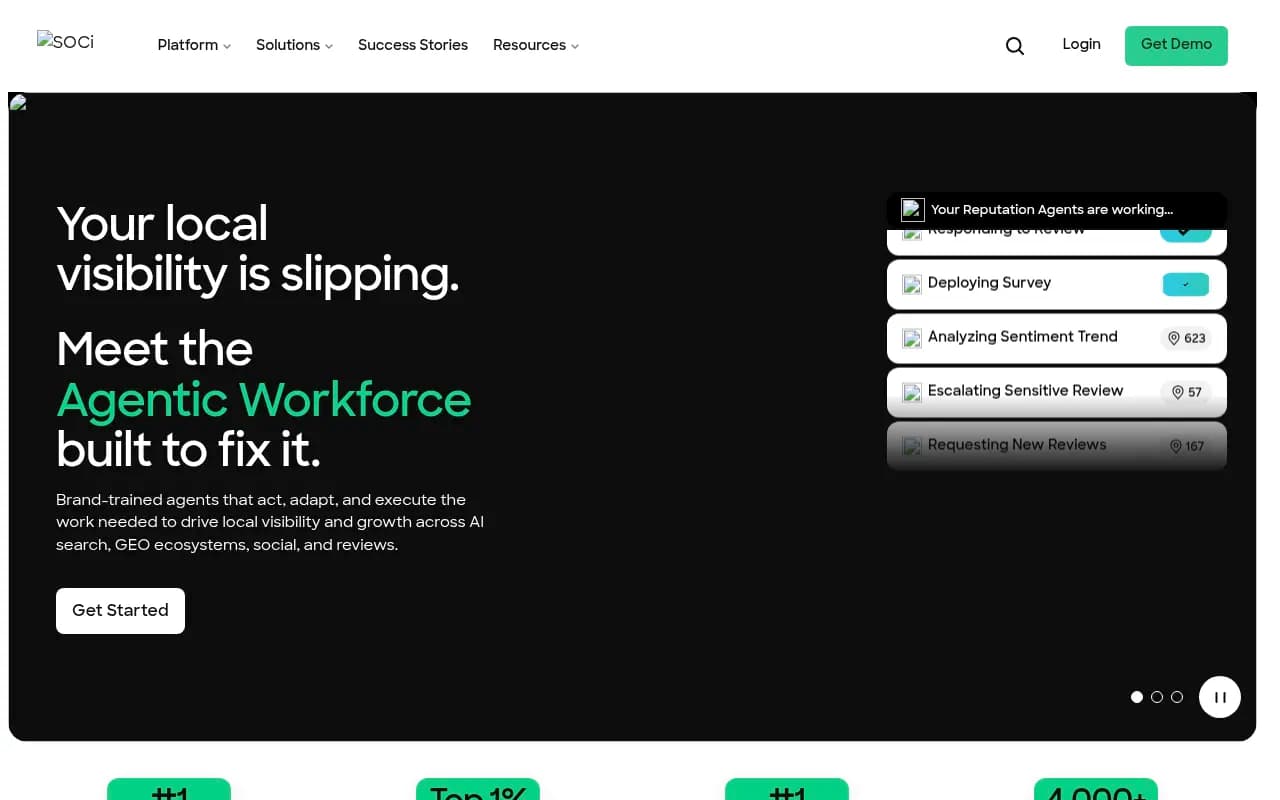
A genuinely local-focused player worth knowing: SOCi markets itself around running local search, social, and reviews together with agentic workflows, which is closer to a hybrid than most.
Comparing the two categories directly
| Dimension | Reputation management tools | AI visibility tracking tools |
|---|---|---|
| Core question answered | What are customers saying, and where | Does AI recommend us, and why or why not |
| Primary data source | Reviews on Google, Facebook, Yelp, industry sites | Prompt-level responses from ChatGPT, Gemini, Claude, Perplexity |
| Typical pricing (2026) | $80-150/location/mo (Reputation.com); $299-599/mo (Birdeye, Podium) | $29-245/mo (Otterly.AI to Promptwatch Professional); enterprise custom |
| Good at | Review generation, automated responses, sentiment trends, listing accuracy | Citation tracking, crawler log analysis, content gap detection, prompt difficulty scoring |
| Blind spot | Can't see what AI models actually say or cite | Doesn't collect or respond to reviews |
| Who it's built for | Multi-location brands managing branch-level trust | Marketing teams trying to get cited in AI answers |
A practical setup for local businesses in 2026
For a single-location business just getting started, the reflex is usually to pick one tool and call it done. I'd push back on that a little. Here's a workable split.
Keep a reputation tool running for the basics: review requests after every completed job or visit, automated or AI-assisted responses so nothing sits unanswered for a week, and a dashboard you actually check monthly. Vendasta's Reputation AI, for example, triggers review requests off completed QuickBooks invoices or Jobber jobs automatically, which removes the "I forgot to ask" problem entirely.
Separately, run an AI visibility check at least quarterly, even a free one, to see whether AI models can find and recommend you at all. A few free tools exist for exactly this: Promptwatch offers a free AI Brand Visibility Report, and there are dedicated checkers like MapAtlas's AEO Checker that flag missing geo signals, schema markup, and FAQ content without requiring an account.
For multi-location brands, the stakes are higher because every location carries its own AI visibility profile. A restaurant chain with 150 locations can't assume brand-level AI visibility; each location page needs its own structured signals. That's where dedicated AI tracking becomes less of a nice-to-have and more of an operational necessity, since no reputation platform currently gives you location-by-location citation data across ChatGPT and Gemini.
What to actually prioritize this quarter
A few concrete, low-effort moves that address both sides at once:
- Add a plain-language FAQ section to your main location pages covering hours, service area, pricing ranges, and common questions, since FAQ content shows up far more often in branded AI prompts than generic ones.
- Spread reviews beyond Google. BrightLocal's data shows AI tools can't see inside Google's review silo, so reviews on your own site, industry directories, or review widgets that get indexed matter more than they used to.
- Check your robots.txt and CDN rules against AI crawlers beyond just OpenAI's bot. Promptwatch's crawler data shows OpenAI's share of verified AI crawler traffic dropped from 94.8% to 79.8% between June and September 2026, meaning Anthropic's, Google's, and Perplexity's crawlers are gaining ground and deserve explicit access too.
- Don't bet your AI visibility strategy on Reddit. The citation collapse there is real and specific to ChatGPT; put that effort into owned pages instead.
If you want to browse more options in either category, the GEO software directory at bestgeosoftware.com covers AI visibility platforms specifically, while a general tools directory like surferstack.com is a decent starting point for comparing reputation and marketing tools side by side.
The honest answer to "do I need both" is yes, but not necessarily two expensive platforms on day one. Start with disciplined review collection wherever your customers actually leave feedback, run a free AI visibility check to see where the gaps are, and scale up the AI tracking tool only once you've confirmed there's a real gap worth paying to close.