Key takeaways
- ChatGPT now searches your own domain directly. Since August 8, 2026, about 1 in 6 fanout queries use the site: operator, so a thin or unindexed store page costs you answers.
- Product and landing pages make up about 39% of ChatGPT citations. A real page for each location beats a line in a store locator.
- Press coverage fades fast. News pages lose half their citations within 36 days, which is roughly a pop-up's whole life. Landing pages last for months.
- Consistent listings, current hours and recent reviews do most of the work for "near me" answers. Boring, and it works.
- Test with real prompts from the actual neighborhood before and after launch, then fix whatever is missing.
Why new locations are hard for ChatGPT to see
A store that opened last week has almost no footprint. No reviews, no backlinks, no history of being mentioned anywhere. Established competitors in the same mall have years of it. That gap is the whole problem.
Pop-ups are worse. They exist for a few weeks, and retail pop-ups are common enough that NewStore, citing Storefront and AMA research, says 80% of retailers have opened one and the category is a $50 billion business. Those numbers come from a July 2024 article, so treat them as directional. The point is that you are one of many temporary locations, and nobody has time to wait for organic authority to build.
The good news: local answers lean on a small set of sources. If you get the basics right in the first week, you can show up before older competitors bother to update anything.
What ChatGPT actually pulls from
When someone asks "where can I buy X near me" or "is there a good [category] store at the mall," ChatGPT runs web searches behind the scenes (query fanouts) and builds an answer from the pages it finds. It does not keep a secret store database. It reads what is on the web.
That means your visibility is a function of three things: whether your location data is findable and consistent, whether your own pages say clearly what the location is, and whether third-party pages mention you.
Promptwatch Data tracked what ChatGPT cites. In the week of Sep 28 to Oct 4, 2026, product pages were 22.4% of citations and landing pages 16.8%. Listicles added 13.6%. Reviews were only 1.7% overall, but for branded prompts (someone asking about you by name) reviews rose to 5.6%, more than three times their overall share.
So for a store, the practical read is: have a proper page for the location, get into roundup lists, and collect reviews on sites people trust.
Step 1: Fix your listings before anything else
This is the unglamorous part and I would do it first. A research thread from a local-search agency on Instagram put it as a checklist: is your location information consistent across all platforms, are reviews current and answered, do your locations show up where people look.
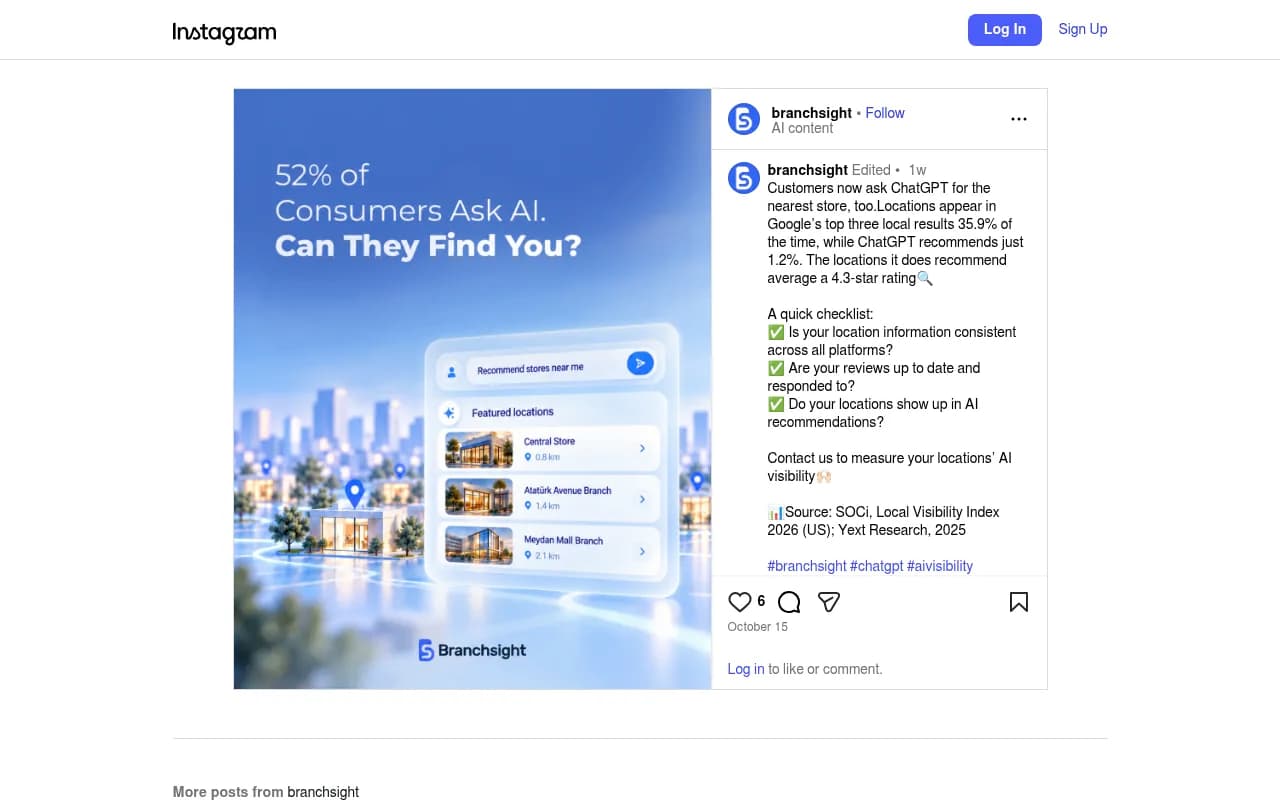
For a new opening, make a list and do each one in the first few days:
- Google Business Profile, with the exact mall name, unit or level, and a category that matches what you sell
- Bing Places, which is often skipped and which ChatGPT-style search can lean on
- Apple Maps, Yelp and any industry directory relevant to your category
- The mall's own tenant directory and website. These are local publisher-style pages AI tends to read, and mall operators usually let new tenants submit details.
- Name, address, phone, and hours written identically everywhere. "Unit 214" in one place and "Suite 214" in another is exactly the kind of mismatch that makes a model hedge.
For multi-location brands, a listings platform can push all of this at once. Yext is built for exactly that kind of distribution, and SOCi covers local search, social and reviews for chains.
Birdeye is another option if reviews are your weak spot, since new locations start at zero.
Step 2: Give each location a real page on your site
Here is where August 2026 changed things. Promptwatch Data shows that on August 8, 2026, ChatGPT started using the site: operator at scale. Site-scoped fanouts jumped from 0.37% to 16.8% of all fanout queries overnight, and average queries per response rose from about 1.08 to about 1.83.
In plain terms, ChatGPT is now much more likely to search your domain for the answer. If your "store page" is a dropdown in a locator with no crawlable URL, there is nothing to find.
A good location or pop-up page includes:
- The full address, including the mall name, level and nearest entrance or anchor store
- Opening hours, with holiday changes
- What you sell there. If the pop-up carries a limited range, say so.
- Start and end dates for a pop-up. Be explicit. "Open through December 28" is useful, "limited time only" is not.
- Parking, transit and accessibility details, because people ask about those in conversational prompts
- A short FAQ answering what people really ask: do you take returns, is there a try-on area, are products the same as online
- LocalBusiness schema markup with address, hours and geo coordinates
Then confirm the page is crawlable and indexed. Check robots.txt, make sure it is in your sitemap, and link to it from your homepage and navigation. If you run on a CDN or have bot protection, check that AI crawlers are not being blocked. A crawler such as Screaming Frog or Sitebulb will show you orphaned or noindexed pages quickly.
An FAQ section on the page is worth the effort. FAQ content is a smaller slice of citations (3.3% overall, 4.8% for branded prompts), but it directly matches the way people phrase local questions.
Step 3: Keep it current, because freshness decays differently by page type
Promptwatch's content half-life study tracked pages ChatGPT cited on July 6, 2026 for 90 days. The spread by type matters a lot for a short-lived store:
| Page type | Still cited after 30 days | Still cited after 60 days |
|---|---|---|
| Landing pages | 78% | 69% |
| Docs | 76% | 67% |
| Comparisons | 72% | 63% |
| Listicles | n/a | 60% |
| Product pages | n/a | 55% |
| News | about half gone by day 36 | 41% |
Product pages, reviews and how-tos reach their half-life around 74 to 77 days. News is the fast burner: almost a quarter of news pages are never cited again after day 0.
What I take from this for openings: a grand-opening press release gives you a burst, about five weeks of it. That is genuinely useful for a pop-up that runs a month. But do not rely on it. Your own landing page for the location is the thing that sticks around, so put effort there and update it whenever hours, stock or dates change. A pop-up page that still says "opens Saturday" three weeks later is worse than no page.
Step 4: Get named on pages ChatGPT already trusts
Own pages are half of it. Commercial prompts like "best [category] stores in [city]" lean heavily on third-party formats. In Promptwatch's data, commercial prompts cite product pages (26.0%), landing pages (20.6%), listicles (15.0%) and comparisons (7.9%), almost 70% together.
That suggests a short outreach list for a new location:
- Local "best of" and "things to do at [mall]" roundups. Pitch the editors with your opening date and what is unique.
- Local news and city blogs for the opening, which also gives the short-term burst described above
- Mall and shopping-district event pages and newsletters
- Local creators and community accounts, mainly for reviews and mentions that people search for later
- Industry directories and marketplaces if you sell through them
A caution on social posts. ChatGPT got only 0.46% of its citations from social platforms from Sep 28 to Oct 4, 2026, while Google AI Overviews got 12.2%. Instagram and TikTok are fine for driving foot traffic, but do not count on them to carry your ChatGPT visibility. If anything, a Google AI Overview answer is more likely to pull from a post.
Also keep in mind that in verticals like travel and automotive, Promptwatch Data shows booking sites and marketplaces outranking brand sites. Retail may behave similarly, with marketplaces and aggregators beating individual store pages for generic prompts. If you sell through one, make sure your listing there names the physical location too.
Step 5: Reviews, and what a restaurant guide gets right
A restaurant-focused guide from Malou makes the same point I keep running into with local queries: the basics are listing accuracy and reviews, and models read both.
For a brand-new location, you start at zero reviews. Plan for it:
- Put a QR code at the till and on bags that goes straight to your Google review link
- Ask in the first week, when the opening buzz is highest
- Reply to every review, including the short ones. Recent, responded-to reviews signal an active location.
- Do not fake them. It is against platform rules, and a sudden spike of identical five-star reviews on a brand-new profile is easy to spot.
Step 6: Test the way a shopper would
Open ChatGPT and ask it the way someone standing in the mall would. Vary it:
- "Where can I buy [product] near [mall name]?"
- "Pop-up shops open in [city] this month"
- "Best [category] stores in [neighborhood]"
- "Is [your brand] open on Sundays?"
- "Does [your brand] have a store in [city]?"
Note what comes back: is the location mentioned, is the address correct, are the hours right, which sources are cited. Wrong hours usually trace back to one stale listing. A missing mention usually means a missing or uncrawlable page. Repeat the same prompts weekly, since answers vary run to run and a single check proves little.
Doing this by hand for ten locations gets old. Tools like Promptwatch can run your prompts daily across ChatGPT and Google's AI surfaces, and its local targeting can pin a monitor to exact coordinates so answers are generated as if asked from that mall. It also logs which AI crawlers hit your location pages and which pages get cited, which helps when you need to know whether the page is being read at all.

Other trackers are worth a look if you want a cheaper entry point, such as Otterly.AI or Peec AI, though they focus on monitoring rather than crawler data or content fixes. Check the directories at bestgeosoftware.com and ai-rank-tools.com for more options.


A fast timeline for a new opening or pop-up
| When | What to do |
|---|---|
| 3 to 4 weeks before | Create the location page with dates and address, add schema, confirm it is indexed |
| 2 weeks before | Claim Google, Bing, Apple and Yelp listings with identical details; submit to the mall directory |
| 1 to 2 weeks before | Pitch local roundups and news; line up creators |
| Opening week | Publish the press release, set up the review QR code, run baseline test prompts |
| Weeks 2 to 4 | Reply to reviews, update hours and stock, re-run prompts, fix wrong or missing answers |
| Last week of a pop-up | Update the page with the closing date and point to your permanent store or site |
On that last row: when the pop-up ends, do not delete the page. Redirect or edit it to point to the nearest permanent location. Otherwise ChatGPT keeps sending people to a closed unit, which is a bad experience and bad for your brand.
What about ChatGPT ads and shopping features?
ChatGPT has added shopping research and, in some markets, sponsored placements. A few vendors, such as Smalk, already sell local AI ad placements aimed at driving store visits. I would treat paid placement as a supplement once your organic basics are solid, not a shortcut around them, and I would check what is actually available in your market before budgeting for it. Promptwatch's ChatGPT ads data shows how often ads appear in responses if you want a sense of scale.
Common mistakes
- Putting the pop-up only on Instagram. Great for foot traffic, barely cited by ChatGPT.
- Hours that differ between Google, your site and the mall directory
- A store locator that loads results with JavaScript and gives crawlers nothing
- Relying on one launch press release and then going quiet
- Never retesting. Answers change, and the August 8 shift to site: searches is a reminder that behavior can flip overnight.
- Leaving a closed pop-up page live with no end date
Where this leaves you
I could not find public data on how ChatGPT handles local or pop-up prompts specifically, so the advice above combines what Promptwatch has measured about citations and freshness with standard local-listing practice. Treat it as a strong working plan, then test your own prompts and let the results tell you what to fix first. Start with one location page that is crawlable, accurate and dated, get your listings to match, and check ChatGPT again in a week.