Key takeaways
- AI answers for "grocery store near me" or "pharmacy open now" are built from location data, product and landing pages, reviews and a handful of trusted third-party sources. Market share alone doesn't win them.
- Promptwatch Data shows product pages (22.4%) and landing pages (16.8%) make up 39% of ChatGPT citations. Store-level pages are your highest-leverage asset.
- Social is uneven. ChatGPT drew just 0.46% of its citations from social platforms in the week of Sep 28 to Oct 4, 2026, while Google AI Overviews drew 12.2%.
- Chains with 1,000+ locations need monitoring by region and store cluster, not one national prompt list.
- Start with data accuracy and crawlability, then content, then reviews and social, then measurement.
Why chains need a different playbook
A single-location bakery can get away with a good Google Business Profile and a few reviews. A grocery chain with 800 stores, a pharmacy brand with in-store clinics, or a convenience operator with fuel, food service and lottery has a harder problem. AI engines have to decide which of your locations to name, which attributes to quote (hours, pharmacy counter, curbside pickup, fuel prices) and whether your brand even belongs in the shortlist.
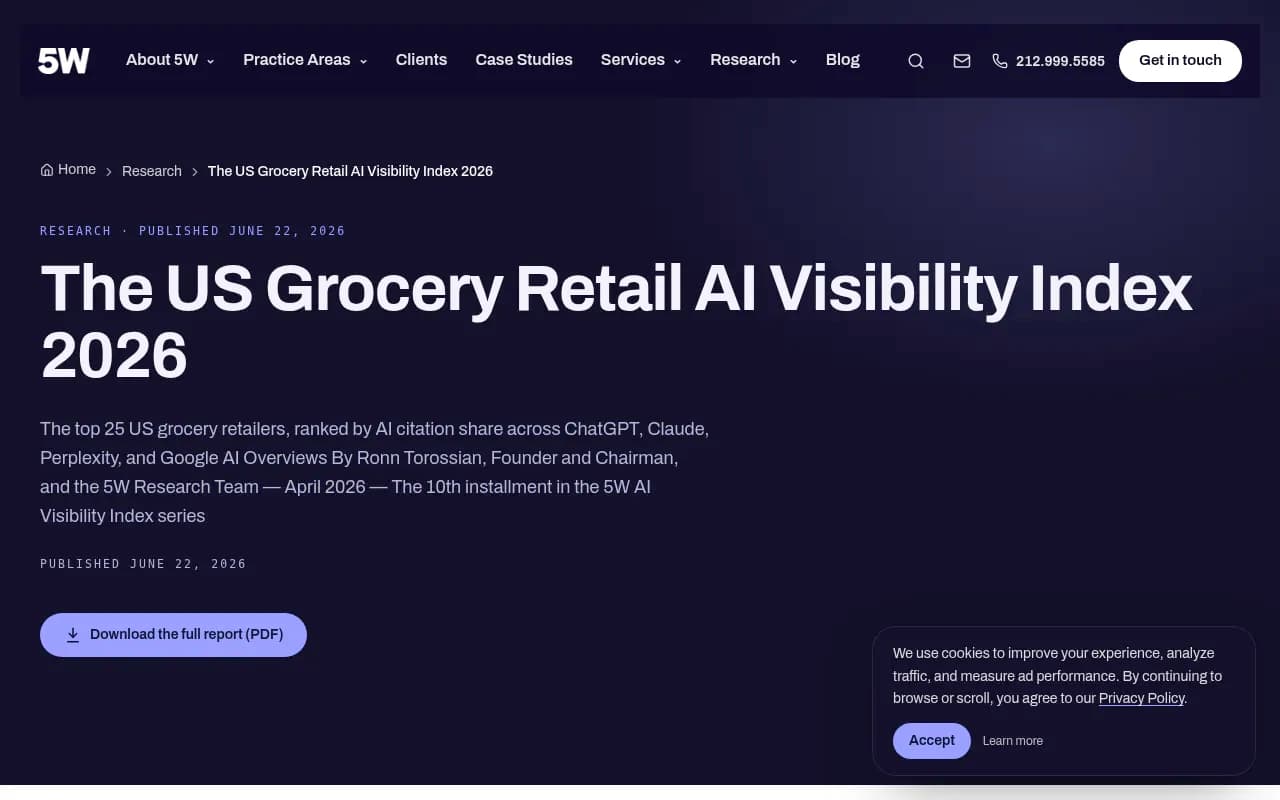
The 5W Research "US Grocery Retail AI Visibility Index 2026" opens with a pointed observation: one retailer holds 23.6% of the US grocery market and still isn't winning the AI answer. Costco, Trader Joe's, Whole Foods and Aldi are. I could only verify that headline from the truncated page, so I won't pretend to quote the rest of their findings. But the point stands on its own. Size doesn't translate into AI recommendations. Clear, consistent, well-cited information does.
How AI engines decide which store to recommend
Three things get blended in most local answers.
- Structured location facts. Addresses, hours, categories, services, phone numbers. These come from your Google Business Profile, Apple and Bing listings, and aggregator feeds.
- Pages the model can read and cite. Store pages, department pages (pharmacy, deli, bakery), product pages, and FAQs.
- Third-party validation. Reviews, editorial roundups, local news, and in Google's case, YouTube, Facebook and Instagram.
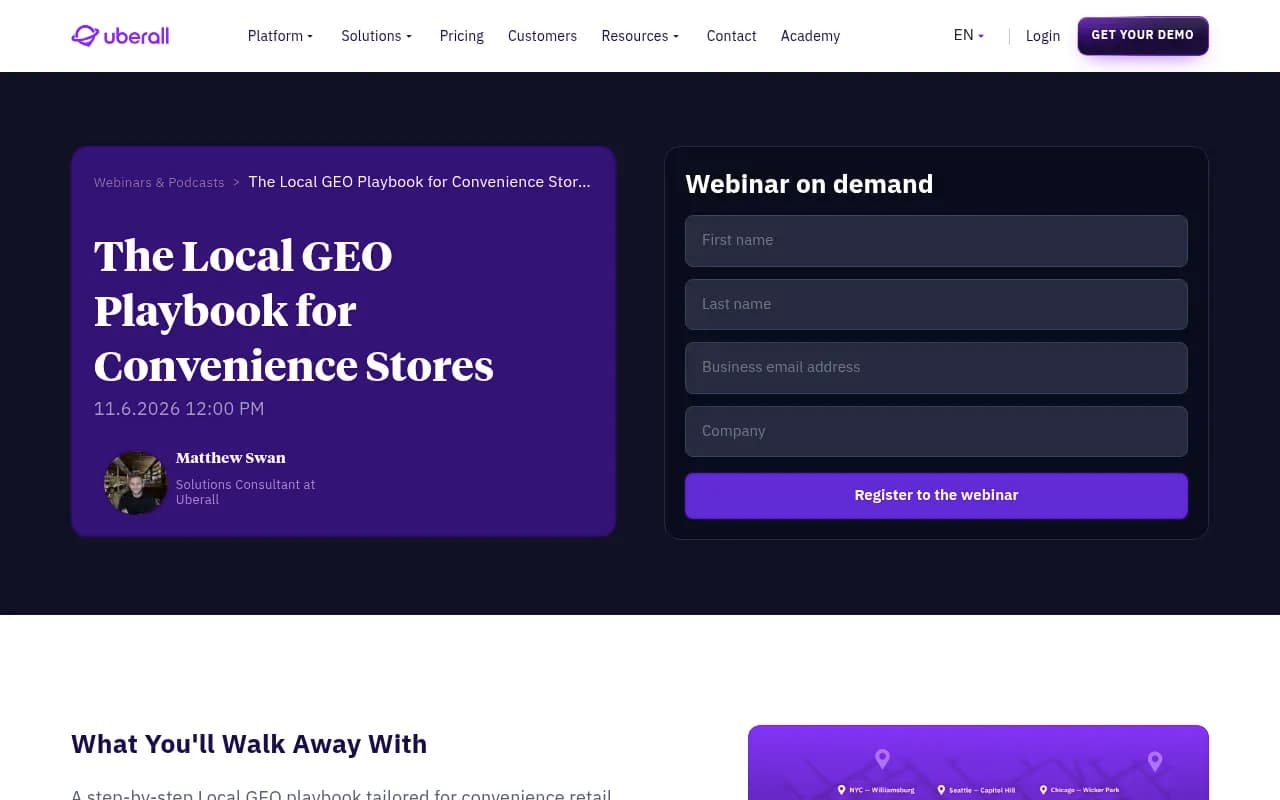
Uberall's webinar "The Local GEO Playbook for Convenience Stores" (dated 11.6.2026, presented by Matthew Swan) covers the same territory: which signals AI agents trust for c-store recommendations and how to monitor visibility across thousands of locations. Those two topics are the right frame for the rest of this guide.
Step 1: Fix the location data foundation
This part is boring and it matters most. If a model sees three different sets of hours for the same store, it will either hedge or pick a competitor.
- Audit every location across Google Business Profile, Apple Business Connect, Bing Places, Facebook and your own site. Hours, holiday hours, phone and category should match everywhere.
- Use specific categories and attributes. A store with a pharmacy counter should say so, along with drive-thru, vaccinations, 24-hour service, curbside pickup and delivery partners.
- Treat temporary closures, remodels and holiday hours as a process, not a one-off. Stale hours are the most common local failure.
- Keep a single source of truth. Listings platforms like [tool:yext] and [tool:soci] exist to push consistent data and manage reviews and social at multi-location scale, and [tool:birdeye] covers reputation management.
A chain I would worry about is one where franchisees or store managers edit listings by hand. Lock down who can change what.
Step 2: Build store pages AI can actually cite
Promptwatch Data on which content types ChatGPT cites (Sep 28 to Oct 4, 2026) is the clearest guide to where to spend effort. Shares of classified citations:
| Content type | Share of ChatGPT citations |
|---|---|
| Product pages | 22.4% |
| Landing pages | 16.8% |
| Listicles | 13.6% |
| How-to guides | 8.7% |
| Documentation | 7.5% |
| General articles | 6.1% |
| Comparisons | 5.9% |
| News | 5.7% |
| FAQ pages | 3.3% |
| Reviews | 1.7% |
For commercial prompts like "best grocery store near me", product pages hit 26.0% and landing pages 20.6%. Those two plus listicles and comparisons make up almost 70% of commercial citations. For branded prompts, landing pages rise to 22.8% and reviews reach 5.6%, more than three times their share across all prompts.
Translate that for a chain:
- Store landing pages should be real pages, not a map pin with a phone number. Include services, department hours, parking, accessibility, local brands, a few lines about the neighborhood, and links to the pharmacy or deli subpages.
- Department and service pages (pharmacy, flu shots, prescription transfer, catering, fuel rewards) deserve their own URLs. These answer the specific questions people ask.
- Product pages matter more than grocers usually assume. Private-label items, specialty products and seasonal lines are what AI engines pull when someone asks about a product category. Keep specs, size, price range and dietary attributes complete and factual.
- FAQ pages are only 3.3% of citations overall but 4.8% for branded prompts. Write one for the questions customers actually ask: "Does the pharmacy accept my insurance?", "Can I order groceries for same-day pickup?"
One caveat from Promptwatch's content half-life report: news pages lose half their citations in about five weeks, while landing pages and docs keep most of theirs for months. Evergreen store and service pages are the durable investment. Weekly promo blog posts are not.
Pharmacy pages need extra care
Pharmacy queries sit close to health. Promptwatch's healthcare citation report (Sep 9 to Oct 8, 2026) found ChatGPT cites NIH, the FDA and the NHS most, and government and public health sites earn almost half of citations. That doesn't mean a pharmacy chain is locked out. It means medical claims on your pages should be conservative and sourced, and your pharmacy pages should win on what government sites can't answer: which location, what hours, which services, what it costs, how to transfer a prescription.
Step 3: Make the site readable by AI crawlers
A store locator built entirely in client-side JavaScript, with no crawlable URLs per store, is invisible to most AI bots. Check the basics:
- Every store has a unique, indexable URL linked from a crawlable directory (state, city, store).
- Schema markup for LocalBusiness, Pharmacy, GroceryStore or ConvenienceStore, with opening hours and geo coordinates.
- robots.txt and your CDN or bot protection aren't blocking GPTBot, OAI-SearchBot, PerplexityBot, ClaudeBot or Google's agents by accident.
- Fast, server-rendered pages. A crawler that times out doesn't cite you.
To see which bots hit your site and which pages they read, you need crawler logs. Promptwatch provides IP-verified AI crawler logs with a crawl-to-citation path per page, and tools like [tool:darkvisitors] focus on bot and agent traffic specifically. Technical crawlers like [tool:screaming-frog], [tool:lumar] and [tool:botify] are better suited to auditing 800-page store directories.

Step 4: Reviews and third-party signals
Reviews are only 1.7% of ChatGPT citations overall, but they jump on branded prompts, and for local queries they feed the ratings and sentiment models quote. Practical moves:
- Reply to reviews at the store level, in plain language. A reply that mentions the specific department ("our pharmacy team can transfer that today") adds usable facts.
- Look for recurring complaints by location. If one store has a pattern of "always out of stock" reviews, that's an operations problem that will surface in AI summaries. The inventory side is its own topic. Vendors such as LEAFIO AI pitch continuous replenishment forecasting for exactly this gap between system stock and shelf, though I'd treat their claimed gains (up to 50% fewer overstocks) as vendor numbers.
- Get included in local and category roundups. Listicles are 13.6% of ChatGPT citations, and "best grocery stores in [city]" or "best 24-hour pharmacies" pages are the ones being cited.
Step 5: Pick your social channels by engine
Social citations vary a lot by AI engine, so one social strategy for everything wastes effort. Promptwatch's social media citations report (Sep 28 to Oct 4, 2026) shows:
| Engine | Share of citations from social | Notes |
|---|---|---|
| ChatGPT | 0.46% | Reddit fell from 5.19% to 0.09%; LinkedIn is top at 0.3% |
| Perplexity | 2.7% | LinkedIn and Reddit tie at 0.86%; YouTube 0.79% |
| Google AI Overviews | 12.2% | YouTube 4.28%, Facebook 2.38%, Reddit 2.15%, Instagram 1.61% |
The averages across the three engines: YouTube 1.70%, Reddit 1.03%, LinkedIn 0.90%, Facebook 0.81%, Instagram 0.56%, TikTok 0.07%, X 0.04%.
For a local chain, the implication is straightforward. Google-driven discovery is where social pays off, so prioritize YouTube (recipe and how-to videos, store tours, pharmacy service explainers), then keep public Facebook pages and Instagram profiles complete and active per region. Don't count on Reddit to reach ChatGPT, since its share there collapsed in August (Promptwatch Data on the Reddit drop). Skip X.
That's a notable reversal from advice that was common a year ago. Uberall still runs webinars about Reddit plays for multi-location brands, which tells you how recently the ground moved.
Step 6: Monitor visibility across hundreds or thousands of stores
This is where chains differ most from small businesses. You can't check prompts by hand, and a national average hides the story. A chain can look fine overall while being absent in an entire metro.
Build your prompt set in layers:
- Category prompts: "best grocery store for organic produce in Columbus", "pharmacy open late near me", "convenience store with hot food near [highway exit]".
- Branded prompts: "Is [chain] pharmacy good?", "[chain] vs [competitor] prices".
- Service prompts: flu shot, prescription transfer, curbside pickup, EBT/SNAP acceptance, fuel rewards.
- Product prompts: private-label items, dietary categories, seasonal items.
Then track by geography. Promptwatch supports pinning a monitor to exact coordinates so ChatGPT, AI Overviews and AI Mode answer as if asked from that spot, and state/city tracking on its Business plan and above. That's useful for "near me" queries where results change block by block. Check promptwatch.com/pricing for current tiers.
Other options in the catalog worth a look depending on your stack:
| Tool | Angle for multi-location chains |
|---|---|
| Promptwatch | Prompt tracking with location targeting, crawler logs, content gap analysis and publishing |
| Yext | Listings and knowledge graph for search and AI answers |
| SOCi | Local search, social and reviews across locations |
| Profound | Enterprise AI visibility monitoring |
| Semrush | Broad SEO suite with AI tracking added |
| BrightEdge | Enterprise SEO with AI search visibility |
| Azoma | AI shopping optimization (ChatGPT, Rufus) for product catalogs |

For a wider survey of options, the directories at bestgeosoftware.com and ai-rank-tools.com list far more trackers than I can cover here.
Step 7: Close the content gaps with a repeatable process
Monitoring alone just tells you what's broken. For a chain, the useful loop is:
- Find prompts where competitors are cited and you aren't.
- Check which of your pages should have answered them. Often it's a missing department page, a thin store page, or an old FAQ.
- Fix or create the page, with accurate facts and local specifics.
- Track whether it gets crawled, cited and clicked.
Promptwatch's content gap analysis, Content Agent and Action Board are built for that loop, publishing to WordPress, Webflow or Framer. Whatever tool you use, put a person in the review step. A pharmacy page published without a compliance check is a bigger risk than an invisible one.
Step 8: Measure what matters
Visibility score and share of voice are useful, but a grocery CMO will ask about traffic and store visits. Track:
- AI-referred sessions and conversions on your site (pickup orders, prescription transfers, app installs).
- Direction requests and calls from Google Business Profile, as best you can attribute them.
- Share of voice by region, not just nationally.
- Citation sources: which of your pages, and which third-party pages, are doing the work.
A realistic note: I found no public benchmark linking AI answer position to in-store foot traffic for grocery or pharmacy, and Promptwatch has no grocery-specific report yet. Treat early numbers as directional and compare against your own baseline.
A 90-day plan
| Weeks | Focus | Output |
|---|---|---|
| 1-2 | Baseline | Prompt set by region, listings audit, crawler access check |
| 3-4 | Data fixes | Consistent hours, categories, services across all listings |
| 5-8 | Page build | Store landing templates, pharmacy and department pages, FAQs |
| 9-10 | Off-site | Review response process, roundup outreach, YouTube and Facebook cleanup |
| 11-12 | Measure and iterate | Region-level share of voice, gap list, next sprint |
Common mistakes
- Publishing one generic national page and expecting it to answer local prompts.
- Chasing Reddit for ChatGPT visibility after the August drop.
- Letting store pages go stale. Seasonal hours and temporary closures are the first things a model gets wrong.
- Treating pharmacy content like retail content. Health claims need sourcing.
- Measuring only the brand-name prompts. Customers mostly ask category questions without naming you.
Where to go from here
If you run a chain, start with the unglamorous work: clean location data, real store pages, crawlable site, and a regional prompt set. Then use the citation data above to decide where to put your content and social effort. For more tools in this space, the GEO software directory is a good next stop, and Promptwatch's data hub is worth bookmarking because the numbers shift month to month.