Key takeaways
- Birdeye AI Search and BrightLocal both anchor AI tracking to individual business locations. Promptwatch tracks by market (country, language, state, city) rather than by individual listing.
- Birdeye is built for multi-location brands that want diagnosis and fixes (listings, reviews, local pages), and it appears to be quote-based. BrightLocal is the cheapest entry point, with its tracker included on Track, Manage and Grow plans.
- BrightLocal covers ChatGPT, Google AI Mode and AI Overviews, and works in the USA, UK, Canada and Australia. Birdeye lists a wider set of models, including Gemini, Claude, Perplexity and Grok.
- Promptwatch is the pick when you care about many AI platforms, crawler logs, traffic attribution and content execution across markets, not per-store diagnostics.
- Many brands will end up using a local tool and a broader AI visibility platform together.
Why location-level tracking is a separate problem
Most AI visibility tools answer one question: does the brand get mentioned? That works for a SaaS company. It falls apart for a dental group with 40 clinics or a retailer with 300 stores, because AI answers to "best dentist near me" are about a specific place, not a brand.
Birdeye makes this argument forcefully. Its vendor research, the "Location Blind Spot in AI Search 2026" report, analyzed 1,762 multi-location brands across 16,240 location-level scans. It found that 1 in 5 locations is invisible in AI search, with up to a 50-point visibility gap between a brand's best and worst location. Those are vendor numbers, so treat them as directional, but the logic holds up: a single brand score can hide a lot of weak locations.
BrightLocal makes a similar point from a different angle. Its pitch is that competitors track AI mentions at the brand level, even when they let you set a local area, while its tracker anchors every query to a specific location.
So "location-level" can mean three different things:
- Brand tracked inside a geography (a city or state).
- Each business location tracked as its own entity, with its own score.
- Each location tracked and then fixed, with actions on listings, reviews and local pages.
The three tools in this guide sit at different points on that scale.
Quick comparison
| Birdeye AI Search | BrightLocal Local AI Visibility | Promptwatch | |
|---|---|---|---|
| Tracking unit | Each business location | Each business location | Market: country, language, state or city |
| AI platforms | ChatGPT, Gemini, Claude, Perplexity, Google AI Overviews and AI Mode, Grok | ChatGPT, Google AI Mode, Google AI Overviews | ChatGPT, Google AI Overviews and AI Mode, Gemini, Perplexity, Copilot, Alexa, Meta AI, Claude and more |
| Fixes | Listings, reviews, citations, local pages, business info, via AI agents | Competitor comparison and what to fix | Content gap analysis, Content Agent, Action Board |
| Crawler logs and AI traffic | Not found in sources | Not found in sources | Yes (Professional and up for logs) |
| Pricing | No public pricing found | From $31/mo per location (annual) | From $95/mo; free Explore plan |
| Best for | Enterprise multi-location brands | Local businesses and agencies | Brands competing across markets and AI platforms |
Birdeye AI Search
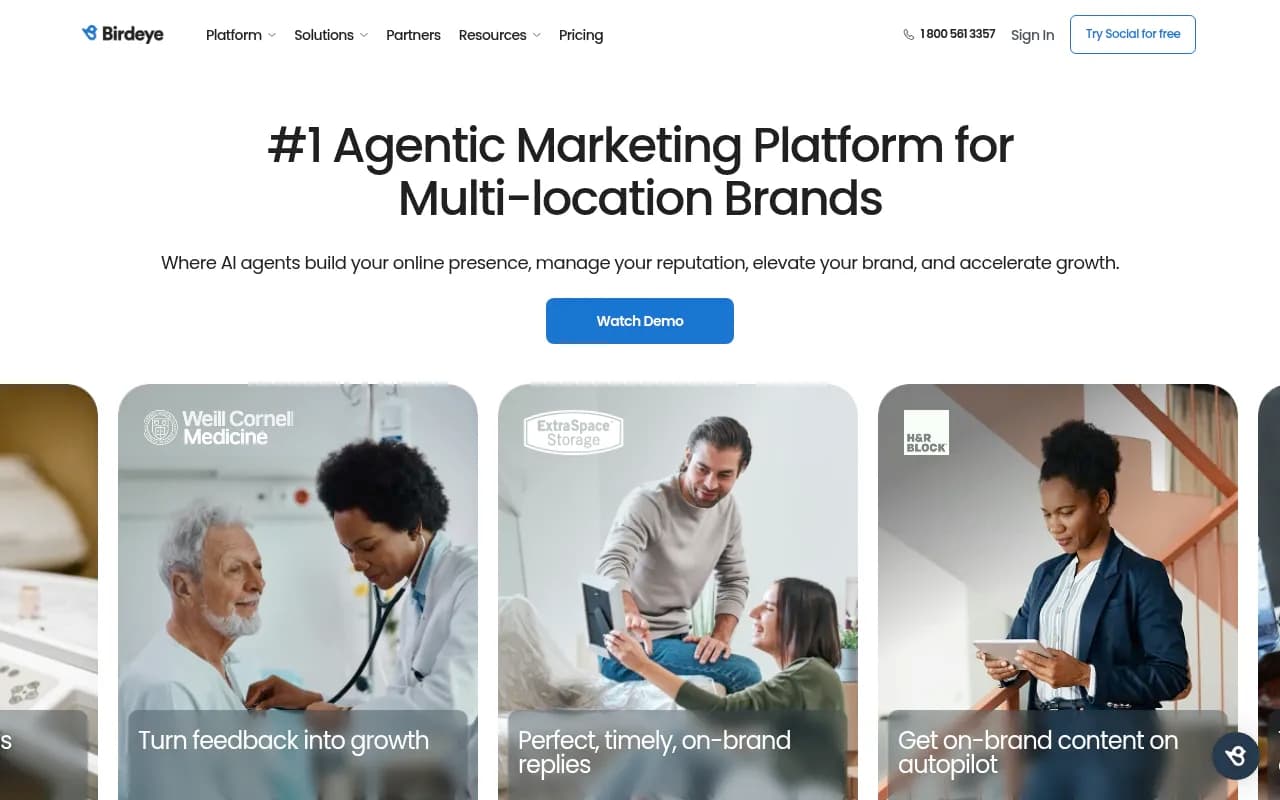
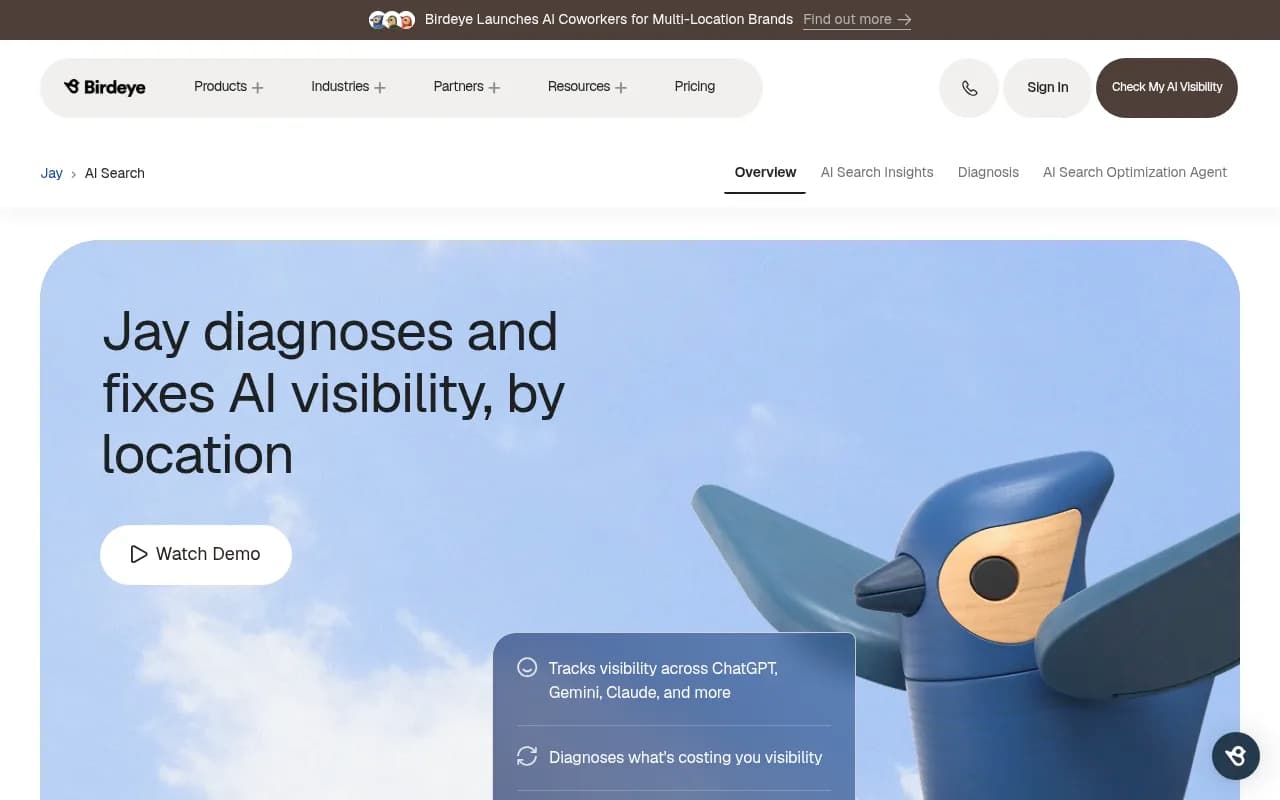
Birdeye is best known for reputation management and reviews, and AI Search extends that into AI visibility. It started life as a private beta called "Search AI" and is now pitched around an agent named Jay, part of what Birdeye calls AI Coworkers for Multi-Location Brands.
How the location tracking works
Birdeye says AI Search offers location-level coverage across ChatGPT, Claude, Perplexity, Gemini, Google AI Overviews and AI Mode, and Grok. You get a visibility score and Share of Voice per location, not just per brand. The product then tries to explain the score: citations, accuracy and website signals are listed as the causes behind each number.
That diagnosis step is the real differentiator. The tool's pitch is that tracking is table stakes and the value is in fixing. Birdeye says it generates and applies updates to listings, blogs, FAQs and reviews, ranked by impact. Its own marketing cites customer results of a 30% AI visibility increase, a 53% increase in lead volume and 74% of recommendations accepted. Those are vendor claims from its product page, so ask for references that match your vertical.
Where it fits
Birdeye already sits on top of reviews, listings and messaging for many multi-location companies. If you use it for that, adding AI Search keeps the fix workflow in one place. If you do not, you are buying into a much bigger platform than a tracker.
What I could not verify
I found no public pricing, and it is probably quote-based. I also could not confirm prompts per location or scan frequency. Ask both questions in the demo, because they decide whether the data is statistically useful for a location with little AI exposure.
BrightLocal Local AI Visibility Tracker
BrightLocal has been a local SEO tool for years, with a Local Rank Tracker and Local Search Grid. The Local AI Visibility Tracker borrows that location-first approach.
How the location tracking works
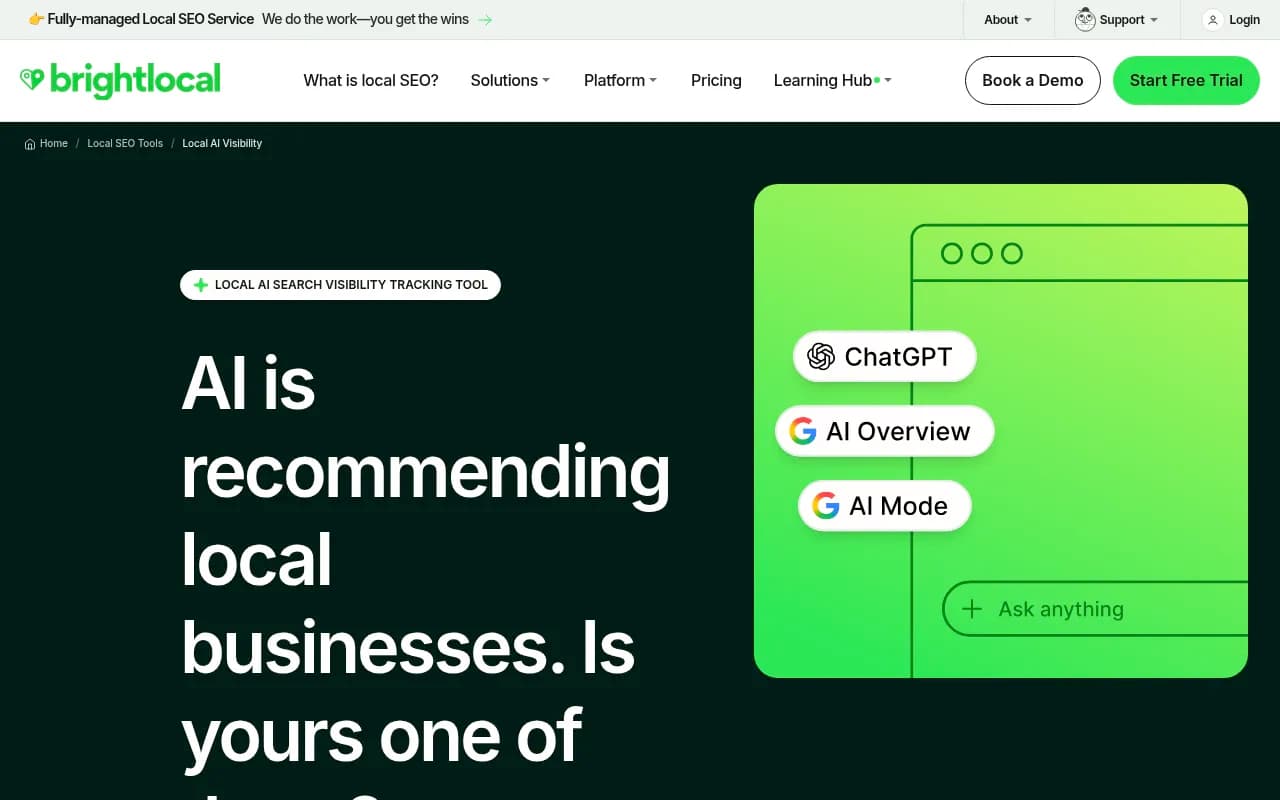
Every query is anchored to a specific location, which BrightLocal says makes results the closest you can currently get to what someone searching in that area would see. Setup starts with a single location configured under "Your locations". Beyond the score, the tool surfaces the localized sources LLMs draw on, such as directories, local publications and regional sites. That list is practical: it tells you which citation sites to fix or claim for a given area.
Coverage is narrower than Birdeye's. The sources list ChatGPT, Google AI Mode and Google AI Overviews. I could not confirm Perplexity or Gemini.
Pricing
The tracker is included at no extra cost on Track, Manage and Grow plans, for locations set to active. Annual billing, per the BrightLocal pricing page:
| Locations | Track | Manage | Grow |
|---|---|---|---|
| 1 | $31/mo | $40/mo | $49/mo |
| 2-5 | $47/mo | $57/mo | $65/mo |
| 11-20 | $78/mo | $115/mo | $148/mo |
| 91-100 | $393/mo | $577/mo | $742/mo |
Monthly billing costs more, and 100+ locations are priced on request. Note the platform works in the USA, UK, Canada and Australia, so a franchise with sites in Germany or the Netherlands is out of luck. Check the pricing page before you commit, since plan details change.
Evidence base
BrightLocal published a study built on 200,000 non-branded prompts and 1.9 million AI citations from its tracker. It also reports that 23% of searchers used AI platforms in their most recent search for a local business. That is more transparent than most vendors manage, and it is a decent reason to read the study before you buy.
Promptwatch
Promptwatch takes a different route, and I want to be clear about that rather than stretch the term. It does not track individual business listings. Each monitor is scoped to one country and one language, with optional state or city targeting, which is available on every plan, Essential included. A brand operating in the UK and Germany sets up "UK, English" and "DE, German" monitors. On Business and above you can also pin a monitor to exact coordinates, with an accuracy radius from 20 m to 5 km, so ChatGPT, Google AI Overviews and Google AI Mode answer as if asked from that spot.

What "location" means here
The coordinate pinning is the closest Promptwatch gets to per-store tracking. You can put a monitor at a store, an office or a franchise address and run "near me" prompts from there. What you do not get is a per-listing workflow: no review responses, no directory syncing, no business-profile fixes of the kind Birdeye and BrightLocal point toward. The tracking unit is the monitor, not the Google Business Profile.
The data collection is real UI monitoring rather than API calls, so results reflect localization, citation order and sources as a real user would see them. Promptwatch tracks ChatGPT, Google AI Overviews, Google AI Mode, Gemini, Perplexity, Copilot, Alexa and Meta AI this way, with API models like Claude and Mistral alongside.
What you get beyond tracking
The reason to consider it for location work is everything around the monitor. IP-verified AI crawler logs show whether bots can even read your location pages. Visitor analytics attribute actual traffic and conversions from AI platforms. Content gap analysis maps your pages against the prompts AI answers, and the Content Agent can write and publish to WordPress, Webflow or Framer. On the Action Board you get prioritized to-dos, including untapped pages.
Pricing starts free (Explore: 1 project, 10 prompts, ChatGPT only). Essential is $95/mo with 50 prompts, 6,000 responses a month, and country, state and city tracking. Crawler logs start on Professional at $245/mo, and local GEO/SEO targeting at exact coordinates is on Business ($579/mo), Agency Scale and Enterprise. Agency plans start at $199/mo. Confirm current numbers at promptwatch.com/pricing, since third-party reviews list slightly different figures.
How the three differ in practice
Granularity
Birdeye and BrightLocal treat the location as the object. You open a dashboard and see one row per site. Promptwatch treats the market as the object, with optional pinning to a point. If your question is "why does our Leeds branch never appear?" the first two answer it directly. If your question is "how do we show up across the UK versus Germany, in French and Dutch, on eight AI platforms?" Promptwatch is built for that.
Coverage of AI platforms
Birdeye lists the widest set of AI engines among the two local-first tools. BrightLocal covers the three that matter most for local discovery today (ChatGPT, AI Mode, AI Overviews) and leaves the rest. Promptwatch covers the most platforms, including Copilot, Alexa and Meta AI.
Fixing versus measuring
Birdeye leans hardest toward execution on local assets: listings, reviews, citations, local pages. BrightLocal gives you competitor comparison and a fix list, and sits next to its existing citation and listing tools. Promptwatch executes on content and technical access, not on local listings.
Cost
BrightLocal is the clear low-cost option. Ten locations on Track would run you well under $100 a month based on the published tiers, though I only have prices for the bands above. Birdeye has no public pricing. Promptwatch costs more per month but is not priced per location, which is attractive if you have many sites in one market and mostly care about market-level visibility.
A note on what AI actually cites
Whatever tool you use, remember that sources matter more than your own site. Promptwatch's data on ChatGPT shows that almost half of responses cite 10 or more unique domains, in Promptwatch Data on unique domains per response for Sep 28 to Oct 4, 2026. For local queries, that means directories, review platforms and local publications compete with you for the slot. It also helps explain why BrightLocal's source list is useful. Likewise, Promptwatch's report on social media citations by AI model found ChatGPT drew only 0.46% of its citations from social platforms that week, while Google AI Overviews drew 12.2%. A location that relies on social presence will fare differently across engines.
Promptwatch has no report specifically on location-level tracking, so the numbers above are background, not proof that one tool is better.
Which should you choose?
- You run 50+ locations in the US and want AI agents to push listing and review fixes: start with a Birdeye demo.
- You are a local business or agency with a handful of locations and a tight budget: BrightLocal's tracker is the lowest-friction test, and you may already pay for the plan.
- You operate across several countries and languages, or you need crawler logs, AI traffic data and content production: Promptwatch.
- You are a hybrid (many locations plus a strong content site): use a local tool for per-site diagnostics and Promptwatch for the market view.
If you want to compare other options, the GEO software directory lists more platforms, and the AI rank tracker directory covers tools that focus on tracking alone.
Questions to ask before you buy
- How many prompts run per location, and how often?
- Which AI platforms are covered, and are results from the real interface or an API?
- Is a location a business profile, a geo-coordinate, or a city?
- How are non-US locations handled?
- Can the tool tell me which sources the AI cited, and which of those I can influence?
- What does a fix actually look like, and who approves it?
Those six questions will sort the vendors faster than any feature table. Vendor claims on visibility lifts, in particular, deserve a reference call before you sign anything.