Key takeaways
- Yes. For location-dependent questions, ChatGPT gives different answers by country. In an October 10, 2026 test, one prompt sent from the US, Brazil and Japan returned three different emergency numbers.
- OpenAI says ChatGPT may use an approximate location based on your IP address when it searches the web. Sharing device location is optional and off by default.
- Location matters for local search, prices, stock, ads and regional availability. It matters much less for stable facts like a country's capital.
- Location is only one source of variation. Memory, model routing, prompt wording and platform updates also change answers, so one run per country proves the effect exists but not how big it is.
- If you track brand visibility in AI search, track by country and repeat runs, rather than trusting a single screenshot.
The short answer
Yes, but only when the question has a local answer. Ask ChatGPT for the capital of Australia and everyone gets Canberra. Ask it what number to call in an emergency and the answer depends on where the request appears to come from.
That second kind of question is more common than it sounds. Prices, nearby businesses, legal availability, shipping, "best X" lists and shopping recommendations all have a geographic component, and a lot of brand-related prompts fall into that bucket.
We asked ChatGPT the same question from three countries
The clearest evidence I found comes from a test by Massive, run on October 10, 2026 with their public AI geo playground. It sends one prompt to ChatGPT from several countries at once, without needing an account. The prompt was deliberately simple: "What number should I call in an emergency?"
| Asked from | What ChatGPT answered |
|---|---|
| United States | 911 for medical, fire and police |
| Brazil | 190 for police, 192 for an ambulance, 193 for the fire department |
| Japan | 119 for an ambulance or fire, 110 for police |

Each answer was correct for its own country, and none of them would help a user in the other two. The prompt never mentioned a country. The request's location supplied it.
A second, looser prompt showed the same pattern. Asked for a typical price for a cup of coffee at a cafe, the US answer quoted dollars, the Brazil answer added reais and the Japan answer added yen.
One caveat, and the test authors say it themselves: answers can change from run to run, and one run per country shows the effect exists, not how often it happens. It is a demonstration, not a measurement.
Does ChatGPT actually use your location?
OpenAI's help center says it does, in two ways. First, ChatGPT may use your IP address to estimate your general location, such as country, state or city. The help center's own example: if it determines you are in the San Francisco area, it may rewrite your prompt into a search query like "top restaurants San Francisco." It also notes that a VPN or network location may change the inferred location. You can read the details in OpenAI's help article on searching the web with ChatGPT.
Second, users can share their device location. OpenAI describes that as optional and off by default.
If you are testing with a script, an agent or a monitoring tool, there is no phone and no settings page. The IP address is the location. Whatever exit your request leaves from is the place ChatGPT thinks you are.
The question comes up a lot. In a 2024 OpenAI community thread, a user asked about different results in Japan and Australia. The first reply said "as far as I know, there are no differences." Later posters described regional differences they couldn't explain. The emergency-number test is a clean counterexample to that first reply, at least for questions with one right answer per country.
What changes by location
Not everything. Here is how I would sort it.
| Type of question | Location sensitivity | Example |
|---|---|---|
| Stable facts | Low | Capital of Australia |
| Emergency, legal, regulatory | High | Emergency numbers, tax rules |
| Local recommendations | High | Best pizza in London vs New York |
| Prices and currency | High | Cup of coffee, product pricing |
| Product availability and shopping | High | Which retailers ship to you |
| Brand and software comparisons | Medium | Which tools get recommended, which regional sites get cited |
The last row is the one marketers should care about. If a prompt has regional intent, the sources ChatGPT pulls in can shift toward local publishers, local marketplaces and local-language pages. I haven't seen solid first-party data on how large that shift is for brand mentions, and I'd be wary of anyone claiming a precise number.
Pricing is where the money is
Location-based variation isn't new to AI. Researchers logging prices from different vantage points (Mikians et al., 2013) found several retailers whose prices for the same product differed by 10% to 30%, with isolated cases up to 2x. Google also says it always estimates the general area you are searching from. AI answers are built on top of the same web, so they inherit those differences. If a model reads a retailer page from a German IP, it may well quote euro prices and German availability.
Location is not the only thing changing answers
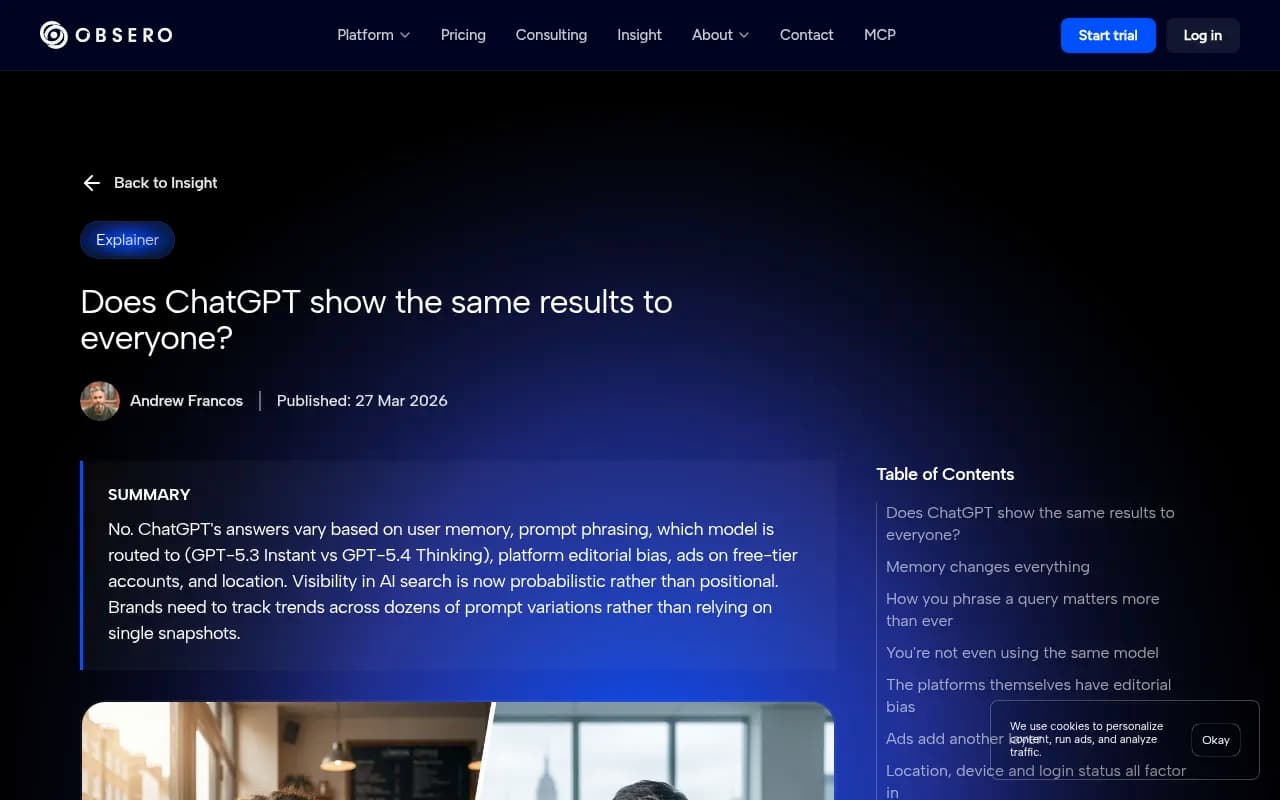
This is where a lot of location tests go wrong. Before you attribute a difference to geography, rule out everything else. A March 2026 explainer from Obsero lists the usual suspects:
- Memory. ChatGPT stores preferences and insights from earlier conversations, so two users asking the same restaurant question can get different filters applied.
- Model routing. Two people can end up on different models, for example a fast Instant model versus a Thinking model.
- Prompt phrasing. "What are the benefits of coffee?" and "is coffee bad for you?" pull different sources.
- Platform differences. ChatGPT, Gemini and Perplexity don't use the same index or weigh the same signals.
- Ads on free-tier accounts, and login status.
There is also noise from ChatGPT itself. Promptwatch's query fanout data shows ChatGPT ran about 2.15 distinct web searches per response in early December 2025, easing to about 1.84 by early March, with average fanout query length dropping from roughly 117 characters to the high 80s and later about 53 from April. And on August 8, 2026, ChatGPT started using the site: operator at scale: site:-scoped fanout queries jumped from 0.37% to 16.8% of all fanout queries in a day, and average fanout queries per response went from about 1.08 to 1.83.
Neither report measures location directly. The point is that search behavior shifted several times in 2026. A per-country comparison from a single run can mix a real location effect with run-to-run randomness and a platform update that landed in between.
How to test location effects properly
If you want evidence for your own brand or category, a rigorous version of the Massive test looks like this.
- Pick prompts with real regional intent. "Best project management software" may barely move. "Where to buy running shoes online" probably will.
- Run each prompt from each target country at the same time, using the real ChatGPT interface where you can, since API outputs can differ from what users see.
- Repeat every run several times. Five to ten repeats per country per prompt is a sensible floor, and more is better for prompts that matter.
- Record mentions, cited domains, position in the answer and any prices or availability claims, not just a yes or no on whether your brand appeared.
- Control for the other variables: logged-out sessions or clean accounts, the same model, the same prompt wording.
- Re-test after major ChatGPT changes. The August site: shift is a good example of why one audit goes stale.
For a quick sanity check, the free playground above is fine. For anything you will make decisions on, you need repeated, scheduled tracking.
Tools that track AI answers by country
Doing this by hand across ten countries and fifty prompts gets old fast. Several AI visibility platforms let you set a country (and sometimes a state or city) per prompt and re-run on a schedule.
Promptwatch tracks the real user interfaces of ChatGPT, Google AI Overviews, AI Mode, Gemini, Perplexity and others by country and language, with state and city tracking on higher plans. It also shows query fan-outs and cited sources, which helps explain why an answer changed, not only that it did.

Other options worth a look if you are comparing:

Peec AI is built around multi-language tracking.

Profound is an enterprise-oriented monitoring platform.

Otterly.AI is a lower-cost way to start monitoring.
Semrush adds AI tracking to an existing SEO suite, which is handy if your team already lives there.
| Tool | Good for | Location angle |
|---|---|---|
| Promptwatch | Tracking plus fixing visibility gaps | Country tracking on every paid plan, state and city from Business |
| Peec AI | Multi-language monitoring | Strong language and market coverage |
| Profound | Enterprise monitoring | Multi-region reporting |
| Otterly.AI | Budget monitoring | Basic country settings |
| Semrush | Teams already using Semrush | AI tracking inside the SEO suite |
Check each vendor's current pricing and limits before committing, since they change often. For wider lists, the GEO software directory and the AI rank tracking directory cover far more options.
What to do with this
A few practical moves follow from all of this.
- Track by market. If you sell in the UK, Germany and the US, a US-only view of your AI visibility is a partial view at best.
- Localize the pages AI is likely to read. Currency, shipping, availability and local terminology all give a model something regional to quote.
- Watch which domains get cited per country. Local marketplaces and publishers often replace the global ones you are used to.
- Treat any one-off screenshot as an anecdote. This includes the emergency-number test. It is a great demo and a poor benchmark.
- If you are building agents that browse for users, choose the request location on purpose. An agent that ignores location is not neutral. It sees whatever version of the web matches the IP it happens to use.
For broader context on how citations behave across ChatGPT and other engines, Promptwatch Data publishes regularly updated research.
The bottom line
- Every request has a location. If you don't choose it, it gets inferred from the IP the request arrives from.
- For location-dependent questions, ChatGPT gives different answers by country. The same-prompt test returned three different emergency numbers from three countries.
- For everything else, expect smaller differences, and expect run-to-run and model-to-model noise to be as large as any location effect until you have repeated measurements.
Frequently asked questions
Does ChatGPT use my location?
OpenAI says ChatGPT may use an approximate location based on your IP address to provide relevant local results, and a VPN or network location may change that estimate. Device location sharing is optional and off by default.
Does ChatGPT show the same results to everyone?
No. Answers vary with memory, prompt wording, the model you are routed to, platform differences, ads on free accounts and location.
When does location matter?
Only for tasks where the answer depends on place: local search, prices, stock, ads, legal and regional availability.
Can a VPN change ChatGPT's answers?
It can, since OpenAI says VPN or network location may affect the location inferred from your IP. Expect the effect on local questions, and run repeated tests to confirm.
How many times should I run a location test?
More than once. Answers differ between runs, and ChatGPT's search behavior changed several times in 2026, so repeat each prompt per country and re-test after major updates.