Key takeaways
- SOCi's 2026 Local Visibility Index puts the average retailer at 49.5% in Google's local 3-Pack, but only 10.2% in ChatGPT recommendations (Gemini 18.3%, Perplexity 16.2%).
- Only 45% of the top 20 retail brands in local search also land in the top 20 most recommended by AI. Winning Google does not mean winning ChatGPT.
- A realistic baseline for an average retail brand in ChatGPT is roughly 10%. Leaders can run several times higher, but you should set targets by store tier, not one blended number.
- Single-prompt results are noisy. Almost half of ChatGPT responses cite 10 or more domains, so measure across many prompts and many locations.
- No public benchmark exists for store-level ChatGPT share of voice yet. Treat every figure below as a directional reference and build your own baseline.
The short answer: what is realistic?
If you want one number, here it is. The average retailer is recommended by ChatGPT about 10.2% of the time in local queries, according to SOCi's 2026 Local Visibility Index. That is the floor you have to clear to beat a typical competitor.
The same index shows Gemini at 18.3% and Perplexity at 16.2%, and Google's local 3-Pack at 49.5%. So ChatGPT is the hardest of the four surfaces for a typical retailer to show up on.
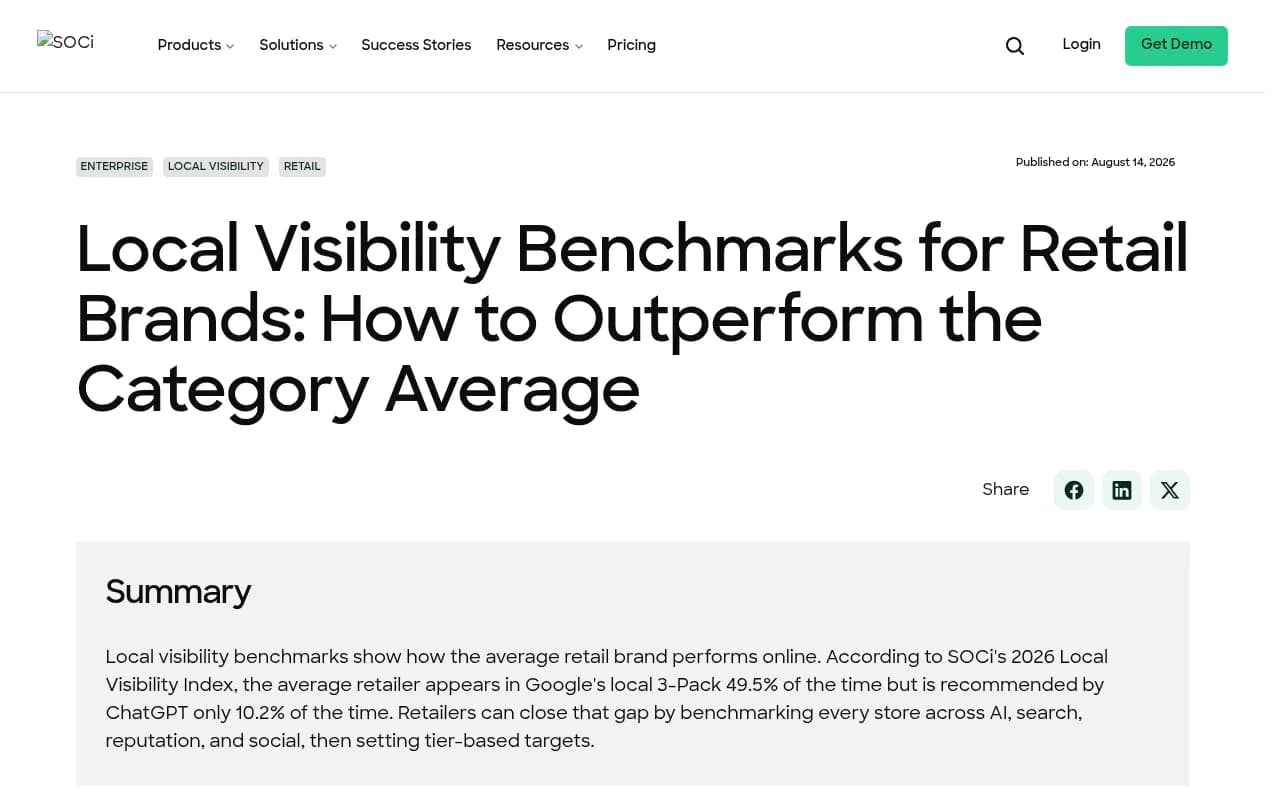
I would be careful about reading too much into a single average, though. Averages across a whole category hide a huge spread. SOCi's own example makes the point: Batteries Plus Bulbs appears in the Google 3-Pack 92.3% of the time, replies to 98.3% of its Google reviews in about 0.6 days, and reaches a 38.4% Gemini recommendation rate, more than double the retail benchmark. That is a brand with strong fundamentals across every store, not a lucky prompt.
So a sensible way to think about targets:
| Tier | ChatGPT local recommendation rate | What it means |
|---|---|---|
| Below benchmark | Under 10% | You are behind a typical retailer. Fix listings, reviews and basic data first |
| At benchmark | Around 10% | Average. Shoppers see you about one time in ten |
| Above benchmark | 15-25% | Reasonable stretch goal for a brand with consistent store-level execution |
| Category leader | 30%+ | Rare. Expect it only where Google 3-Pack presence and review response are already excellent |
The top two bands come straight from SOCi's 10.2% figure. The stretch and leader bands are my own planning heuristics, loosely anchored to the Gemini leader example above, not published ChatGPT benchmarks. Treat them as working targets you should replace with your own data after a quarter of tracking.
Why ChatGPT lags Google so badly for local
The 49.5% versus 10.2% gap is not mysterious once you look at how each surface works.
Google's 3-Pack is a map-based, structured result. It pulls from Business Profiles, proximity, reviews and categories. Every store competes in a small, well-understood auction.
ChatGPT builds an answer from many sources. Promptwatch Data from Sep 28 to Oct 4, 2026 found that 47.6% of ChatGPT responses with citations cite 10 or more unique domains, and for organic non-branded prompts that rises to 52.5%. Your store is one name in a crowd, and the answer is often built from aggregators and roundups instead of brand sites.
The content mix matters too. In the same period, product pages were the most cited content type at 22.4% of ChatGPT citations, with landing pages at 16.8%. Listicles added another 13.6%. For commercial prompts like "best running shoe store near me" the top four types (product pages, landing pages, listicles, comparisons) make up almost 70% of citations.
Translated for a retailer: ChatGPT cites pages that describe what you sell and third-party "best of" lists. A thin store locator page does not do much for you.
One more pattern from adjacent industries. In Promptwatch's automotive citation data for August 2026, marketplaces like Autotrader and Cars.com outranked every car brand. Retail is likely to behave similarly in some categories, with aggregators and directories pulling share from the brands themselves. That is an inference, not a measured retail result.
Google rank does not carry over
The most useful stat in the SOCi data is this one: only 45% of the top 20 retail brands by local search visibility are also in the top 20 most recommended by AI.
That means more than half of your Google winners are missing from the AI shortlist. If your reporting stack only tracks Google rankings, you could be celebrating a lead that does not exist in ChatGPT.
There are a few reasons this happens, and I would hold them loosely until more data arrives:
- AI answers weigh reviews, brand mentions and content on third-party sites, not only map proximity.
- ChatGPT tends to recommend brands rather than individual store locations, so brand-level reputation can matter more than store-level rankings.
- Domain authority behaves differently. Promptwatch Data for August 2026 showed that sites with domain rank 46-75 earned almost half of ChatGPT citations, while DR 91-100 fell to about 3%. Mid-sized specialists can beat giants.
What share of voice actually means here
Share of voice sounds simple. It is not. One LLM Pulse guide puts it bluntly: every AI visibility tool reports a "share of voice," and they produce wildly different numbers for the same brand. Before you compare your figure to any benchmark, you need to know how it was calculated.
Two definitions get mixed up constantly:
- Recommendation rate: the percentage of prompts in which your brand is recommended at all. This is the style of metric SOCi reports (10.2% for ChatGPT).
- Share of voice: your mentions as a percentage of all brand mentions across the same prompt set, competitors included.
A brand can have a 10% recommendation rate and a very different share of voice depending on how many competitors the answers name. If you compare your share of voice to SOCi's recommendation rate, you are comparing two different things.
A second issue is reliability. Rand Fishkin's January 2026 SparkToro study, discussed in Ellevate's guide to Share of Model, found that AI recommendations are highly inconsistent from run to run, which means a lot of tracking sold today is statistically weak. A single prompt told you very little before and tells you even less now.
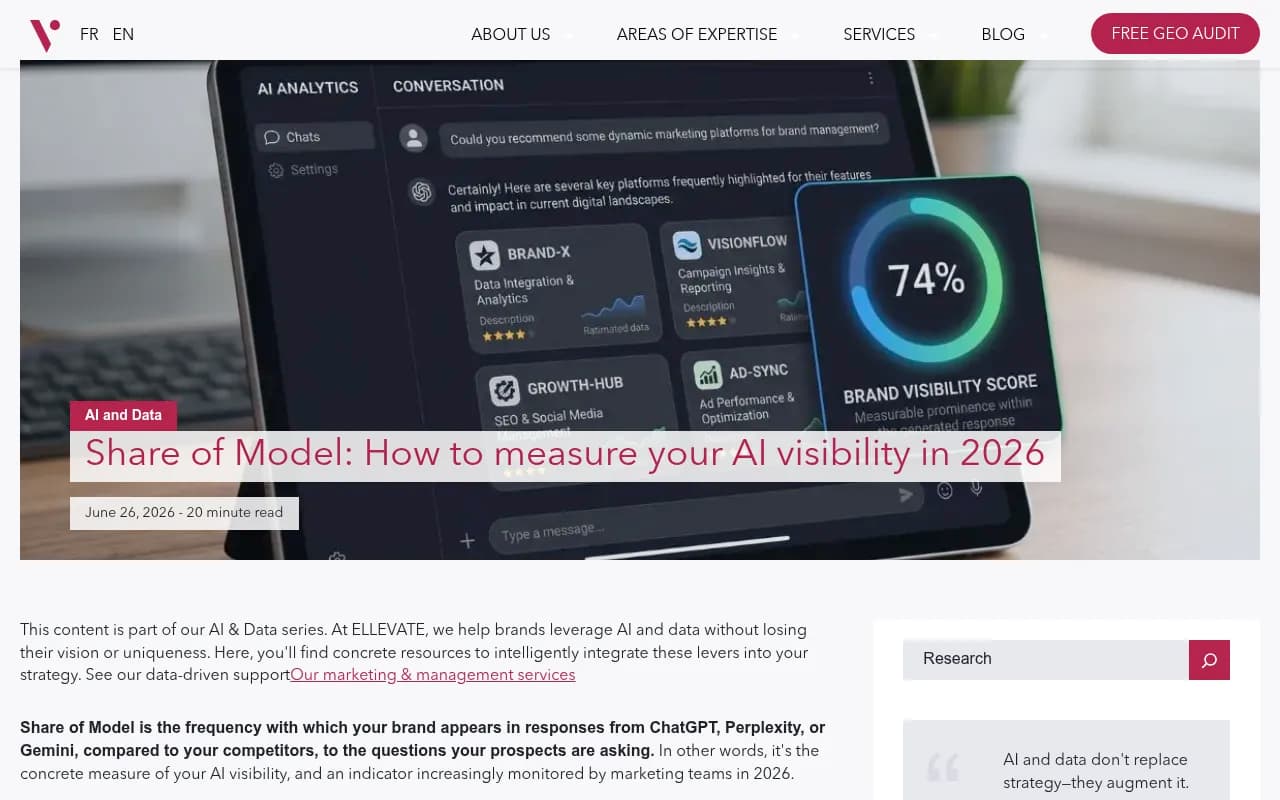
The practical fix is volume. Promptwatch Data recommends measuring across many prompts, tracking where you appear in a response and how ChatGPT describes you, and checking which competitors are cited next to you.
How to build your own local baseline
Since no public store-level ChatGPT benchmark exists, your own baseline is worth more than any industry average. Here is a process that works without a huge budget.
1. Build a prompt set by intent
Group prompts into three buckets. Promptwatch Data shows they behave differently: brand-specific prompts cite fewer domains (21.3% cite 10 or more) than organic ones (52.5%).
- Organic local: "best furniture store in Austin", "where to buy hiking boots near me"
- Competitor comparison: "Store A vs Store B for mattresses"
- Branded: "is [your brand] good for returns"
Report each bucket separately. Blending them will make your number meaningless.
2. Pick representative locations
Do not track all 800 stores on day one. Sample by tier: flagship urban stores, mid-market suburban stores, and low-traffic rural ones. Run the same prompts with each city or ZIP swapped in.
3. Run enough repetitions
Because answers vary, run each prompt multiple times over several days and report an average. Think dozens of prompts per tier, not a handful.
4. Record more than a yes or no
Capture position in the answer, sentiment, the competitors named alongside you, and the sources cited. The sources are where your fixes come from.
5. Set targets by tier
SOCi's own recommendation is to benchmark every store across AI, search, reputation and social and set tier-based targets. A flagship in a dense market should have a higher target than a small-town location. One blended goal punishes the wrong stores.
Tools for tracking local AI visibility
You can start with a spreadsheet and manual prompts. It gets old fast. Most teams move to a tracker once they have more than a few dozen prompts.
For retail specifically, look for country, state and city targeting, repeat runs, citation extraction and competitor comparison. Promptwatch is the one I would look at first for local work: it can pin a monitor to exact coordinates so ChatGPT and Google's AI surfaces answer as if asked from that spot, and it tracks citations, crawler activity and AI-referred traffic alongside visibility. Local targeting at exact coordinates is on its Business plan and above, so check promptwatch.com/pricing for current limits.

For a Google-centric enterprise suite that is adding AI tracking, BrightEdge is another option, and its share of voice write-up is a useful read on how organic and AI visibility fit together.
If your main problem is the underlying local data (listings, reviews, social), SOCi and Yext sit in that layer rather than pure AI tracking.
On the lighter side, tools like Omnia monitor prompts daily, compare visibility by country and track share of voice over time. Peec AI and Otterly.AI are common entry-level trackers, though they focus on monitoring and are not built for store-level local work.


| Tool | Strength for local retail | Watch out for |
|---|---|---|
| Promptwatch | Exact-coordinate local targeting, citation and crawler data, content actions | Local targeting needs Business plan or above |
| SOCi | Store-level listings, reviews, social and its own Local Visibility Index | Aimed at multi-location brands, not a pure AI tracker |
| Yext | Listings and structured data feeding search and AI answers | Data layer more than measurement |
| BrightEdge | Enterprise organic plus AI share of voice | Enterprise pricing and scope |
| Omnia | Daily prompts, country comparison, citation extraction | Verify depth of city-level targeting |
| Peec AI / Otterly.AI | Affordable monitoring | Mostly tracking, little store-level depth |
For more options, the GEO software directory at bestgeosoftware.com lists a wide range of trackers.
How to move from 10% to something better
Benchmarks are only useful if they change what you do. Here is where I would put effort, in order.
Fix the fundamentals at every store
SOCi's leader example is not a story about clever prompts. It is about showing up in the 3-Pack and answering reviews quickly. Accurate hours, categories, inventory attributes and fast review replies are boring and they work. If your Google presence is shaky, AI will not rescue you.
Make product and landing pages complete
Given that product pages and landing pages together account for about 39% of ChatGPT citations, give each category and each key store landing page full specs, prices, availability and positioning. Promptwatch Data explicitly advises keeping these complete and current.
Get into third-party lists
Listicles are 13.6% of citations overall and 15.0% for commercial prompts. Local "best of" roundups, regional publications and retail comparison sites are worth pursuing. Collect reviews on trusted sites too, since review content rises to 5.6% of citations on branded prompts.
Do not count on Reddit or social
This one surprised me. Reddit's share of ChatGPT citations fell from about 4% to 0.5% on August 14, 2026, and across all social platforms ChatGPT drew just 0.46% of its citations from Sep 28 to Oct 4, 2026. Google AI Overviews, by contrast, got 12.2% of its citations from social. Social still matters for Google surfaces, but it is a weak lever for ChatGPT right now.
Check that AI crawlers can read your site
Store pages that are blocked, slow or rendered entirely in JavaScript will not get cited. Crawler logs and a technical audit tell you quickly. Promptwatch and tools like DarkVisitors can show which AI bots visit.
Watch for query changes
ChatGPT started using the site: operator at scale on August 8, 2026, jumping from roughly 0.4% to 17% of fanout queries, per Promptwatch Data. That can matter for store-level queries, because ChatGPT may now search specific retailer domains directly. I have not seen a local-specific breakdown, so test it in your own prompt set.
Common mistakes when comparing to benchmarks
- Comparing brand-level and location-level numbers. SOCi's 10.2% is an average across retail brands and locations. Your single-store figure will be noisier.
- Using one prompt as evidence. Variance is large. Aggregate.
- Mixing tools. Two trackers will give you different shares for the same brand. Pick one and compare against yourself over time.
- Chasing parity with Google. A 49.5% 3-Pack rate does not imply you should hit 49.5% in ChatGPT. AI answers are shared among many domains by design.
- Ignoring sentiment and position. Being named last, with a lukewarm description, is not the same as being the first recommendation.
A realistic plan for the next two quarters
Quarter one: build your prompt set, sample stores across tiers, and establish a baseline per intent bucket. Expect to land somewhere near 10% if you are an average retailer, lower if your Google presence is weak.
Quarter two: fix the gaps your citation data reveals, add complete product and landing pages, pursue a small number of third-party list placements, and re-measure. A move from 10% to the mid-teens is a believable result for a brand that executes consistently. Moving to 30% or more means you are competing with the best-run retailers in the category, and that usually takes sustained work across reviews, listings and content.
If you are mapping out the wider AI search tool market first, ai-rank-tools.com keeps a directory of AI rank trackers worth comparing.
Bottom line
Ten percent is the number to beat. It comes from one index, SOCi's 2026 Local Visibility Index, and it describes an average across retail, not your category or your stores. Use it as a sanity check, then build your own baseline, measure across many prompts and locations, and set targets by store tier. The brands pulling ahead are not gaming ChatGPT. They are doing the unglamorous local work consistently, and the AI recommendations follow.